Accelerated Death Benefit: What Policyholders Should Do Now


An accelerated death benefit (ADB) lets a life insurance policyholder access part of their death benefit while still alive when they meet specific medical criteria. You may also see it called a living benefit, terminal illness rider, or accelerated benefit rider. One thing to understand immediately: any amount you receive reduces the death benefit your beneficiaries will eventually collect, and it is not repaid.
If you think you or a family member may qualify, here are three steps to take right now:
Pull out your policy documents and find the rider language or endorsement section labeled “accelerated death benefit” or “living benefit.”
Start the physician certification conversation with your doctor. You will need written documentation of your diagnosis and a life-expectancy estimate.
Call your insurer or agent and ask for the ADB claim forms. Do not wait for the paperwork to come to you.
Key Takeaways
An accelerated death benefit provides tax-free liquidity for terminal illness under IRC Section 101(g), but every dollar received reduces the death benefit your beneficiaries will collect.
Point | Details |
What an ADB is | A living benefit that lets policyholders access part of their death benefit early when they meet medical criteria. |
Tax treatment | Terminal illness accelerations are generally fully tax-free under IRC Section 101(g); chronic illness payments follow annual per-diem limits. |
Payout range | Typical payouts run from 25% to 100% of face amount, reduced by actuarial discounts and administrative fees. |
Immediate next steps | Find your rider language, get physician certification, and request claim forms from your insurer before anything else. |
East Two West | East Two West helps policyholders review ADB terms, estimate net payouts, and compare living benefit policies across multiple carriers. |
Table of Contents
How does an accelerated death benefit actually work?
The trigger for an ADB is a qualifying medical event, and insurers generally recognize three categories. Terminal illness is the most common: a physician certifies that the insured has a life expectancy within a defined window. Under model standards used across many states, that window runs from a minimum of 6 months to a maximum of 24 months. Chronic illness is a second trigger, typically requiring that the insured cannot perform two or more activities of daily living (ADLs) such as bathing, dressing, or eating, or that they have a severe cognitive impairment. Critical illness triggers, where offered, pay on diagnosis of a specific listed condition such as a heart attack, stroke, or organ failure, regardless of life expectancy.
Once you submit a claim, the insurer orders a review of your medical records and may have its own physician evaluate the file. In some cases, a second opinion is requested. Group term life certificates issued through an employer follow the same basic process, but the employer’s HR department typically routes the paperwork and holds the group certificate. Individual policyholders file directly with the carrier.
Physician certification is not optional. The letter must state the diagnosis, the prognosis, and a life-expectancy estimate that falls within the insurer’s qualifying window. A letter that says only “serious illness” without a specific prognosis will stall the claim.
Which policies include ADBs, and how are riders added?
Not every policy comes with an ADB built in, and the answer depends heavily on when the policy was issued and what type it is.
Policy Type | ADB Availability | Notes |
Term life (modern, post-1990s) | Commonly included at no extra premium | Check the endorsement page; some carriers add it automatically |
Whole life / permanent (modern) | Commonly included or available as a rider | Confirm whether it covers terminal only or also chronic/critical |
Indexed universal life (IUL) | Often included; may cover multiple triggers | Rider terms vary significantly by carrier |
Group term life (employer plan) | Varies; many large-group plans include it | Coverage limits and qualifying windows differ from individual policies |
Older policies (pre-1990s) | Often absent or requires a paid rider | You generally cannot add an ADB rider after a diagnosis |
The last row matters most. ADB riders for terminal illness are commonly included at no additional premium in modern policies, but policies issued before the mid-1990s often predate the widespread adoption of living benefit endorsements. If your policy is older, call your carrier to confirm whether a rider exists and whether you can add one. Adding a rider after a diagnosis is almost never permitted.
Group certificates also carry important differences. The qualifying-event definitions and life-expectancy windows in a group plan may be narrower than what an individually underwritten policy offers, and the maximum payout is often capped at a lower dollar amount. If you have both a group plan through work and an individual policy, check both.
How much can you receive, and what happens to the death benefit?
Payout amounts typically range from a quarter to the full amount of the policy’s face value, subject to insurer caps and the specific policy terms. Some carriers cap the dollar amount regardless of face value.
Here is what those two deductions mean in practice:
Actuarial discount: The insurer calculates the present value of the death benefit based on your life expectancy and expected future premiums. A shorter life expectancy generally produces a smaller discount and a higher net payout. Some insurers base the discount on expected future premiums and lost investment income.
Administrative fee: A flat or percentage-based processing charge, typically deducted from the gross acceleration amount before you receive funds.
Effect on remaining death benefit: Whatever you receive reduces the face amount dollar for dollar (or by a proportional formula, depending on the policy). If you accelerate $100,000 from a $300,000 policy, your beneficiaries receive $200,000 at death, minus any ongoing premium adjustments.
Lump sum vs. periodic payments: A lump sum gives you immediate liquidity and is simpler for tax purposes under a terminal illness claim. Periodic installments can help manage spending but introduce per-diem rules for chronic illness payments that affect how much of each payment is tax-free.
The remaining death benefit would be $50,000.
How fees and acceleration affect your beneficiaries
The financial impact on beneficiaries is straightforward but often underestimated. Every dollar you receive now is a dollar they will not receive later.
Premium treatment after acceleration: Some policies waive premiums after a terminal illness acceleration. Others recalculate the premium based on the reduced face amount. Ask your carrier explicitly which applies to your policy before accepting any offer.
No-extra-cost riders: Modern policies frequently include the terminal illness ADB at no added premium, as explained in Main Residence Exemption Disputes | Elamine Lawyers. Older policies may require a separate paid rider, and if that rider was never added, the benefit simply does not exist.
Administrative fees: These vary by carrier. Some charge a flat fee; others take a percentage of the accelerated amount. Request the exact fee schedule in writing before signing an acceptance form.
Beneficiary notification: Many states require the insurer to notify named beneficiaries when an acceleration is requested or approved. Check your state’s rules, because this can affect family planning conversations.
Pro Tip: Before you accept any acceleration offer, ask your insurer for an in-force reproposal. This document shows exactly what your policy looks like after the acceleration: the remaining death benefit, the revised premium (if any), and any changes to other riders. Reviewing it takes 10 minutes and can prevent surprises.
IRS rules, taxability, and the forms you may receive
Tax treatment is where many policyholders get confused, so the rules deserve a direct read.
Under IRC Section 101(g), accelerated death benefit payments made to a terminally ill individual are generally excluded from gross income in full. For chronic illness payments, the exclusion is limited to the greater of a per-diem amount set annually by the IRS or actual long-term care expenses incurred. Payments above those limits may be taxable. IRS Publication 907 covers the eligible exclusions in detail.
A few practical points on reporting:
Form 1099-LTC: Your insurer may issue this form if you receive ADB payments. Box 2 of Form 1099-LTC reports accelerated death benefits, and the form distinguishes between per-diem and reimbursed payment types, which affects how you calculate any taxable portion.
Terminal illness payments: If your physician certifies a life expectancy within the 24-month window, the full payment is generally tax-free under Section 101(g). Keep the physician certification letter as part of your tax records.
Chronic illness payments: The per-diem limit is adjusted annually. Payments above the limit that are not tied to actual LTC expenses may be reportable as income.
State taxes: Most states follow federal treatment, but not all. A handful of states have their own rules on life insurance proceeds and living benefits.
Documents to bring to your tax preparer:
The insurer’s benefit statement showing the amount paid and the payment type
Form 1099-LTC (if issued by the insurer)
Your physician certification letter with the life-expectancy statement
Actual expense receipts if you are claiming the expense method for a chronic illness payment
If your payments run above the per-diem limit, consult a tax professional before filing. The math on the taxable portion is not complicated, but getting it wrong triggers IRS notices.
How to file an ADB claim, step by step
Filing is more straightforward than most people expect, but the sequence matters.
Gather your policy documents. You need the policy number, the rider or endorsement language, and your beneficiary designations.
Obtain physician certification. The letter must include the diagnosis, the prognosis, and a life-expectancy statement within the insurer’s qualifying window. Get it dated at the time of the claim, not weeks earlier.
Request and complete the insurer’s ADB claim form. Call the carrier’s claims department directly. Do not rely on a general customer service line.
Submit your medical records. The insurer will specify which records it needs. Comprehensive records from the treating physician speed the review.
Review the insurer’s calculation and accept or decline. The insurer will present a written offer showing the gross acceleration, the actuarial discount, any fees, and the net payment. You are not obligated to accept. If the offer seems low, ask for the calculation methodology in writing.
Approved payments are typically issued as a lump sum or periodic installments and commonly arrive within four to six weeks after approval, though timelines vary by insurer and the complexity of the medical review. Complex cases with incomplete records can run longer.
For group/employer plans, route the initial request through your HR department. HR will coordinate with the group carrier and may handle some of the paperwork submission. The underlying process is the same, but the administrative path is different.
After approval, the insurer adjusts your policy records to reflect the reduced death benefit. If premiums are not waived, you will receive a revised billing statement. Keep all approval documents in a secure location alongside your original policy.
How does an ADB compare with other living benefit riders?
These products are related but not interchangeable, and choosing the wrong one for your situation has real financial consequences.
Accelerated death benefit (terminal illness): Pays when a physician certifies a life expectancy within the qualifying window (typically 6–24 months). Best for one-time liquidity when a terminal diagnosis is confirmed. Tax-free under Section 101(g) for terminal cases.
Chronic illness rider: Triggers when the insured cannot perform two or more ADLs or has a severe cognitive impairment. Designed for ongoing conditions like advanced Parkinson’s or ALS. Payments may be periodic and subject to per-diem limits. Not the same as an ADB, and confusing the two can lead to unexpected tax consequences.
Critical illness rider: Pays a lump sum on diagnosis of a listed condition (heart attack, stroke, cancer, kidney failure). No life-expectancy requirement. Tax treatment differs from Section 101(g) ADB rules and depends on how the rider is structured.
Long-term care (LTC) or hybrid LTC policy: Covers ongoing custodial care costs over months or years. Industry experts consistently note that ADB riders are not substitutes for standalone LTC insurance when the need is extended custodial care rather than a one-time terminal payout. See the East Two West long-term care insurance guide for a full comparison.
Practical scenarios: a terminal cancer diagnosis with a 12-month prognosis is a clear ADB case. Progressive Alzheimer’s with years of expected care needs is better served by a chronic illness rider or a standalone LTC policy. A major heart attack with full recovery prospects fits a critical illness rider, not an ADB. Matching the product to the scenario is the difference between getting paid and getting denied.
Is an ADB worth it, and what should you ask your insurer?
For most policyholders, the answer is yes, particularly when the rider is included at no extra cost. The liquidity it provides during a terminal illness can cover medical bills, home modifications, or simply allow a person to stop working without financial panic. The trade-off is real: beneficiaries receive less.
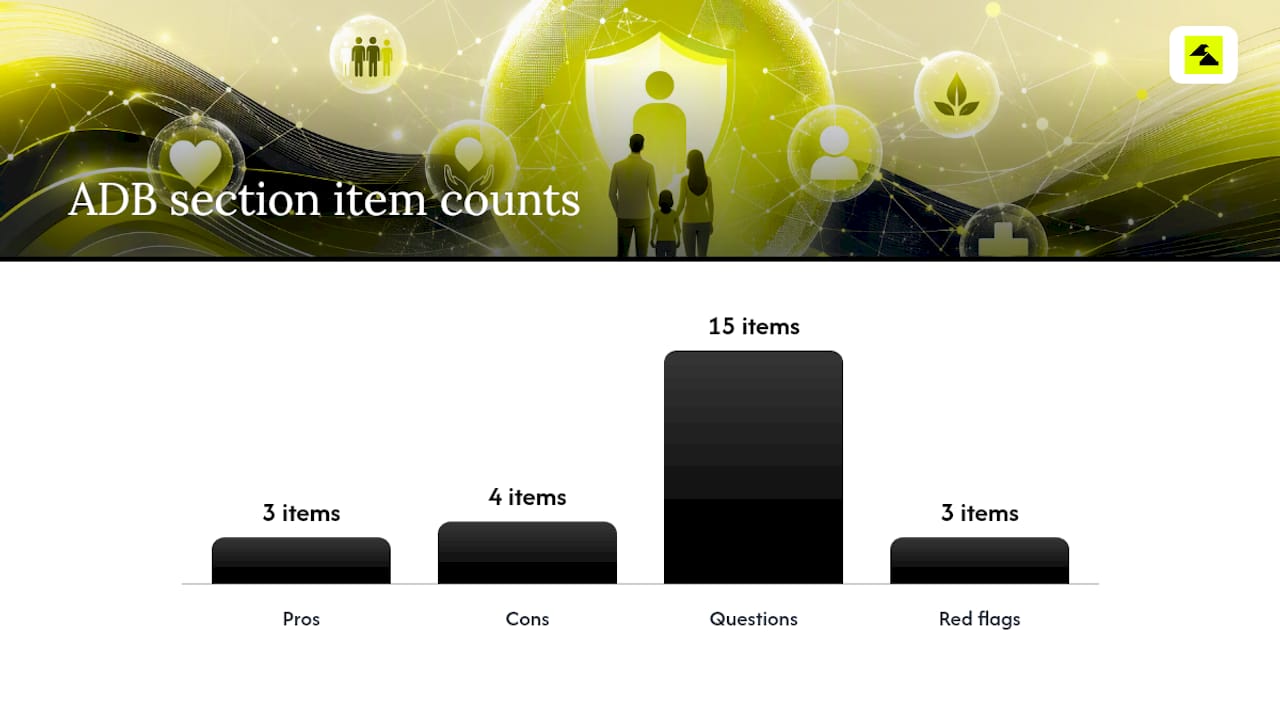
Pros:
Immediate liquidity during a medical crisis, often tax-free for terminal cases
Frequently included at no additional premium in modern policies
Reduces financial stress without requiring a policy loan or surrender
Cons:
Reduces the death benefit your beneficiaries will receive
Actuarial discounts and fees mean you receive less than the face amount accelerated
Chronic illness per-diem limits can cap how much of each payment is tax-free
Accepting acceleration may affect policy loan availability on permanent policies
15 questions to ask your insurer or agent before filing:
What qualifying events does my policy cover (terminal, chronic, critical)?
What is the life-expectancy window required for terminal illness certification?
What physician documentation is required, and in what format?
Is the payout a lump sum, periodic, or my choice?
What actuarial discount method does the insurer use?
Are there administrative fees, and what is the exact amount or formula?
What is the maximum percentage or dollar amount I can accelerate?
How does acceleration affect my remaining premium obligation?
Are premiums waived after a terminal illness acceleration?
How does acceleration affect other riders on my policy (waiver of premium, disability, etc.)?
Will the insurer notify my beneficiaries when I file?
For chronic illness: is recertification required, and how often?
Will I receive a Form 1099-LTC, and what will it report?
How is the remaining death benefit calculated after acceleration?
Can I see a written in-force reproposal before I accept the offer?
Red flags: vague qualifying-event language that does not specify ADL counts or life-expectancy windows; refusal to provide the actuarial discount calculation in writing; inability to produce an in-force reproposal. Walk away from any agent who cannot answer questions 5, 6, and 14 clearly.
Common mistakes brokers see, and how to avoid them
The most frequent error is conflating a critical illness rider with an ADB. They are different products with different triggers, different tax rules, and different claim processes. Filing under the wrong rider wastes weeks and may result in a denial.
A close second: waiting to get physician certification until after you have already submitted the claim form. Insurers will not process the claim without it, and tracking down a dated, properly worded physician letter after the fact adds unnecessary delay. Get the letter first, then file.

Practitioners also consistently advise requesting the insurer’s example calculation before submitting. This shows you the actuarial discount rate, the administrative fee, and the net payout for your specific policy, so there are no surprises when the formal offer arrives.
For chronic illness claims, keep physician-signed recertification documentation current. Benefits can stop if a recertification fails, and a lapse in documentation is the most common reason periodic payments are interrupted.
On timeline: approved ADB payments commonly issue within four to six weeks after approval. Complete, well-organized documentation submitted at the time of the initial claim is the single biggest factor in hitting that window rather than exceeding it. Missing records are the primary cause of extended review periods.
Pro Tip: Ask your insurer for the exact list of required medical records before you submit anything. Submitting a complete packet on the first attempt is far faster than responding to multiple requests for additional documents.
East Two West’s perspective on living benefits
Navigating an ADB claim while managing a serious illness is genuinely hard. At East Two West, we work with policyholders and their families to review existing policy language, identify which riders are active, and estimate the net payout after actuarial discounts and fees. We also help clients who do not yet have coverage compare policies across multiple carriers to find one that includes living benefits suited to their situation, whether that is a terminal illness rider, a chronic illness rider, or a more comprehensive accelerated underwriting path to get coverage in place quickly.
Ready to review your policy or get a quote?
If your current policy’s ADB terms are unclear, or you want to compare policies that include living benefits from multiple carriers, East Two West makes that process direct and pressure-free.
[

You can run a quote online in minutes or schedule a short consultation to walk through your existing policy, estimate your net payout under current terms, and understand exactly how an acceleration would affect your beneficiaries. No sales pitch, no obligation. East Two West works with multiple carriers, so the comparison is honest.
Get a life insurance quote or visit East Two West to compare your options today.
Sources
The sources below support the tax rules, reporting requirements, and model standards covered in this article.
This article is general information, not a substitute for advice from a qualified financial advisor. Consult a qualified financial professional about your own circumstances before acting on anything here.
Recommended
Comments