Accelerated Underwriting Life Insurance: Fast Approval Guide


Accelerated underwriting is a life insurance process that uses your application answers, third-party records, and predictive models to speed approvals and often skip the medical exam entirely. If you are a healthy adult in your 20s through 50s with a straightforward medical history and a coverage need that falls within a carrier’s face-amount threshold, this is almost certainly the faster, simpler path to getting covered. The catch: not everyone qualifies, and some applications still get routed to a human underwriter regardless.
Best for: healthy adults, typical face amounts, no complex medical history
Often delivers decisions in hours to days, with most carriers issuing approvals within hours to two weeks for eligible applicants, compared to four to six weeks for traditional underwriting.
A small percentage of applications still require full underwriting after automated review
Table of Contents
How do insurers evaluate an accelerated underwriting application?
Who typically qualifies, and what triggers full underwriting?
How does accelerated underwriting compare to traditional underwriting?
What do U.S. applicants need to know about regulation and privacy?
What the accelerated underwriting process taught me about applicant mistakes
What does accelerated underwriting actually mean?
Accelerated underwriting (AU) replaces the traditional paramedical exam and weeks-long review with an automated process that pulls external data and scores your risk profile in real time. Instead of scheduling a nurse visit and waiting four to six weeks for lab results to come back, the insurer queries several databases the moment you submit your application.
The data sources typically queried include:
Prescription drug history (confirms current medications and any undisclosed conditions)
MIB Group records (flags prior insurance applications and any noted health conditions)
Motor vehicle records (driving history, DUIs, reckless driving)
Electronic medical records or EHR data (where available and consented)
Credit and public financial records (used in some programs as a proxy for lifestyle risk)
Two flavors of AU exist in practice. “Instant issue” programs return a same-day decision for very simple cases, often with lower face-amount caps. “Accelerated” programs take a few days to two weeks but can approve higher coverage amounts and sometimes qualify applicants for Preferred premium classes that historically required a full exam. Most carriers set AU eligibility by age (commonly 18–60) and face amount (often up to $1 million or $3 million depending on the program), though these thresholds vary by carrier.
How do insurers evaluate an accelerated underwriting application?
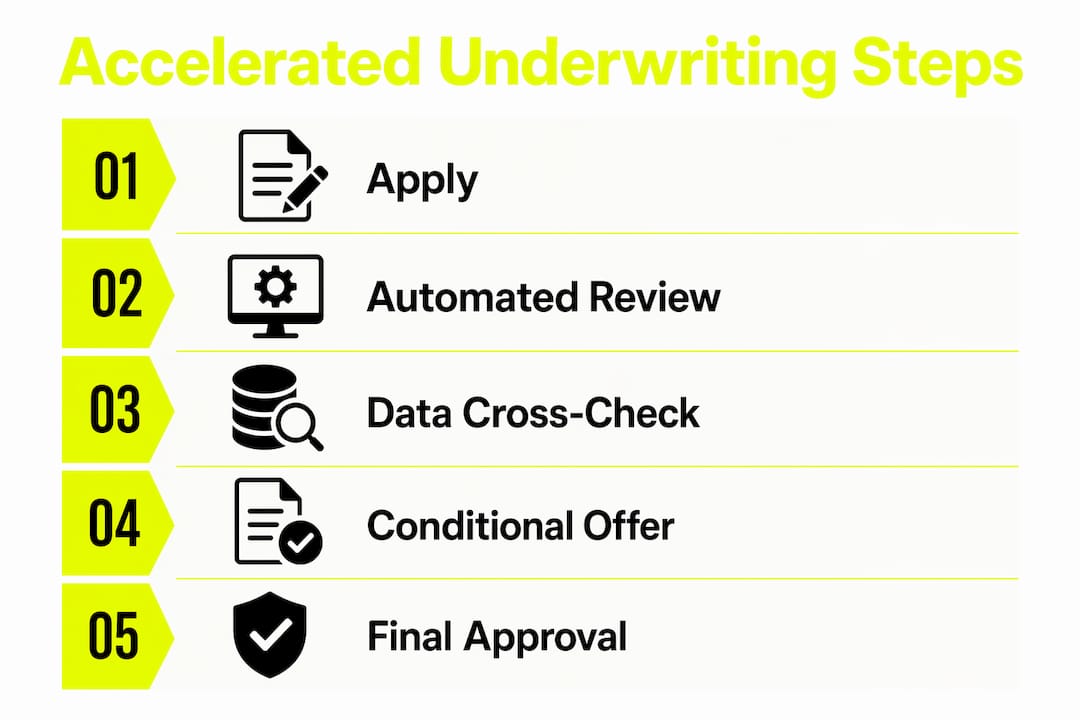
The process moves fast, but there are distinct steps behind the scenes. Here is the typical flow from submission to policy issuance.
Application submission. You complete a digital application covering health history, lifestyle, finances, and beneficiary details. Your answers seed the automated review.
Automated data retrieval. The insurer simultaneously queries prescription databases, MIB, motor vehicle records, and any other sources in its program. This happens within seconds to minutes of submission.
Predictive scoring. A model blends your application answers with the retrieved data to produce a risk score. Modern AU blends predictive scoring with deterministic rules, so an applicant whose external data profile aligns with the insurer’s model can still receive Preferred pricing without ever seeing a nurse.
Automated decision. The system returns one of three outcomes:
Instant or accelerated approval: policy issued, often within hours or a few days
Counteroffer: approved at a different rate class than applied for
Referral to manual underwriting: a human underwriter takes over
Manual review (if triggered). A licensed underwriter reviews the full file. This stage looks and feels like traditional underwriting and can add weeks to the timeline.
Policy issuance. Once approved, the policy is issued digitally or by mail and coverage begins upon first premium payment.
What triggers a referral? Common causes include:
A prescription record that conflicts with your application answers
An MIB flag from a prior application or declined policy
A driving record showing recent serious violations
A requested face amount above the program’s AU threshold
Age outside the program’s eligible range
Gaps or inconsistencies in medical records
Automated systems cross-check your answers against retrieved records, so even a small discrepancy, like a medication you forgot to list, can push the case to a human reviewer.

What are the pros and cons of accelerated underwriting?
Pros
Speed. Decisions in hours to days versus the traditional four-to-six-week window. For most healthy applicants, this is the single biggest win.
No paramedical exam. No nurse visit, no blood draw, no urine sample. The main practical advantage is removing the physical exam and the long waiting windows that discouraged applicants from finishing the process.
Competitive rates. Some AU programs now qualify healthy applicants for high premium classes that historically required full exams.
Digital experience. Apply from your phone or laptop; no scheduling, no in-person appointments.
Lower administrative friction. Fewer touchpoints between you and a live policy.
Cons
Not everyone qualifies. Eligibility depends on policy type, face amount, age, and medical history complexity. A referral to full underwriting is always possible.
Face-amount caps. AU programs typically have coverage ceilings. If you need $5 million in coverage, you will almost certainly need traditional underwriting.
Third-party data errors. Prescription histories and public records can contain inaccuracies that trigger an automated rejection or manual review even when your health is fine.
Less room to explain nuance. A full underwriting interview lets you contextualize a health condition. An algorithm does not ask follow-up questions.
Potential rate tradeoff. If you have minor but complex health nuances, a full exam with lab results might actually earn you a better rate class than AU’s data-driven estimate.
Pro Tip: If you are in excellent health and your coverage need falls within a carrier’s AU threshold, go accelerated. If you have a health condition that looks worse on paper than it is in reality, a fully underwritten policy with a paramedical exam may get you a better rate. A licensed broker can tell you which path fits before you apply.
Who typically qualifies, and what triggers full underwriting?
Most AU programs share a recognizable eligibility profile. You are a strong candidate if you check most of these boxes:
Age 18–60 (some programs extend to 65; thresholds vary by carrier)
Requested face amount within the program’s cap (commonly $1 million to $3 million)
No recent diagnosis of a serious chronic condition (cancer, heart disease, diabetes requiring insulin)
No tobacco use, or tobacco use clearly disclosed
No hazardous occupation or high-risk hobbies (commercial diving, private aviation, motorsports)
No recent DUI or serious driving violations
Clean MIB record (no prior declined applications or flagged conditions)
Common triggers that move a case to traditional underwriting:
A prescription record showing medications for a condition not disclosed on the application
An MIB flag from a prior life insurance application
A requested face amount above the AU program’s ceiling
Age outside the program’s eligible range
Recent foreign travel to high-risk regions (some programs flag this)
Unusual financial records relative to the requested coverage amount
Borderline cases often resolve one of two ways. If the data conflict is minor, a human underwriter may approve the policy at a standard or slightly adjusted rate. If the conflict is material, the applicant may be asked to complete a paramedical exam or provide additional medical records, which adds time but does not automatically mean a denial.
How do you apply, and what should you expect?
Application checklist
Gather these before you start:
Government-issued photo ID
Social Security number
Current medications (name, dose, prescribing physician)
Primary care physician’s name and contact information
Dates of any recent lab work or medical tests
Beneficiary names and Social Security numbers
Financial information if applying for a large face amount
Timeline expectations
Scenario | Typical decision time | What drives the wait |
Instant issue (simple case, lower face amount) | Within hours to same day | Fully automated; no data conflicts |
Accelerated (standard AU program) | Hours to two weeks | Data retrieval, minor clarifications |
Manual referral from AU | 2–6 additional weeks | Human underwriter review, possible exam |
Traditional underwriting (no AU) | 4–6 weeks | Paramedical exam, lab results, full review |
Tips to avoid delays
Be completely accurate. Automated checks compare your answers to external records. A discrepancy, even an innocent one, triggers a manual review.
Check your prescription history. Request your records from your pharmacy or a prescription data aggregator before applying. Outdated or incorrect entries are common.
Review your MIB file. You can request a free copy of your MIB consumer file at mib.com. Correct any errors before submitting an application.
Correct public record errors. Address discrepancies in your motor vehicle record or public financial records ahead of time.
Disclose everything. Omissions do not help you. They create data conflicts that slow the process or, worse, result in a rescission after the policy is issued.
Pro Tip: If you suspect you will be referred to manual underwriting, gather your medical records and a letter from your physician explaining any flagged condition before you apply. Carriers and brokers who prepare documentation in advance move cases through manual review significantly faster.

How does accelerated underwriting compare to traditional underwriting?
Factor | Accelerated underwriting | Traditional underwriting |
Decision speed | Hours to two weeks | 4–6 weeks |
Medical exam required | Usually no | Yes (paramedical exam) |
Typical face-amount cap | Varies; often up to $1M–$3M | No cap |
Data sources | External databases, algorithms | Exam, labs, APS, databases |
Premium class potential | Preferred available in some programs | Full range, including best classes |
Best for | Healthy applicants, standard needs | Complex health, high face amounts |
When traditional underwriting may actually serve you better:
You need more than $3 million in coverage
You have a health condition that lab results would show favorably (e.g., well-controlled cholesterol)
Your prescription record looks more concerning than your actual health status
You have a complex medical history that benefits from a physician’s narrative
Rules of thumb: choose AU when you want speed and your health profile is clean. Choose traditional underwriting when you want to optimize your rate class and your health story is better told with data than inferred from databases.
What do U.S. applicants need to know about regulation and privacy?
The NAIC has published guidance specifically on accelerated underwriting, emphasizing that insurers using external data and predictive models must follow sound actuarial practices, maintain transparency, and build in anti-discrimination safeguards. The core regulatory expectation: AU models must be explainable, auditable, and not produce outcomes that violate state insurance laws or federal anti-discrimination rules.
What consumer consent looks like in practice:
Insurers disclose data pulls in the application itself, typically in an authorization section you sign before submission
You consent to queries of prescription databases, MIB, motor vehicle records, and in some cases credit data
You have the right to know which data sources were used and to request a reason for an adverse decision
Practical privacy steps every applicant should take:
Request your MIB file. Visit mib.com to get your free consumer disclosure report. Errors in this file can cause automatic referrals or denials.
Check your prescription profile. Services like Milliman IntelliScript allow you to request your prescription history report. Incorrect entries are more common than most applicants expect.
Correct errors before applying. Dispute inaccuracies with the data source directly. This takes time, so do it weeks before you plan to apply.
Know your rights. If an insurer takes an adverse action based on external data, federal and state laws generally require them to tell you which data source was used.
Useful contacts:
NAIC Consumer Help: naic.org/consumer.htm for complaints and state insurance department referrals
MIB Group: mib.com for your consumer file request and dispute process
Your state insurance department: the primary regulator for any complaint about how a carrier used your data
How E2wusa helps with accelerated underwriting applications
E2wusa works with multiple carriers, which means the team can quickly identify which carriers offer AU programs that fit your age, coverage amount, and health profile. Instead of applying to one carrier and hoping for the best, you get a side-by-side look at which programs are most likely to approve you quickly and at a competitive rate.
Specific ways E2wusa supports faster approvals:
Online self-service quoting: get multi-carrier quotes in minutes without a sales call
Licensed agent consultations: for applicants with any health complexity, a licensed agent can walk through your profile before you apply and steer you toward the right program
Documentation prep: if your case is likely to be referred to manual underwriting, the team helps you gather and organize records to move that review faster
Transparent comparisons: no pressure, no upselling, just a clear look at which carriers and programs match your situation
E2wusa’s approach is built around the same principle that makes AU appealing in the first place: less friction, faster decisions, and no unnecessary steps. Whether you prefer to handle everything online or want a licensed agent to walk you through the process, the option is yours. You can request a fast quote online or schedule a consultation call.
Key Takeaways
Accelerated underwriting is the fastest path to life insurance coverage for healthy U.S. adults, delivering decisions in hours to days by replacing the medical exam with automated data checks and predictive scoring.
Point | Details |
Speed advantage | Accelerated underwriting decisions usually take hours to two weeks for eligible applicants, while traditional underwriting takes four to six weeks. |
Who it fits best | Healthy adults aged 18–60 with straightforward medical history and coverage needs within carrier thresholds. |
Data accuracy matters | Check your MIB file and prescription history before applying; errors in these records trigger manual reviews. |
Full underwriting still wins sometimes | Complex health profiles or high face amounts often get better rates through traditional underwriting with a paramedical exam. |
E2wusa next step | Compare AU-eligible carriers and get a fast, no-pressure quote at e2wusa.com/quote. |
What the accelerated underwriting process taught me about applicant mistakes
The most common mistake applicants make is treating the AU application like a formality. Because there is no nurse visit and no lab draw, it is easy to assume the process is casual. It is not. The automated system is cross-referencing your answers against prescription databases, MIB records, and motor vehicle data in real time. A medication you forgot to list, a driving violation you assumed was too old to matter, or a prescription that was filled under a slightly different name can all create a conflict that sends your case to a human reviewer and adds weeks to your timeline.
The second mistake is omission. Some applicants leave out health details hoping the system will not catch them. It usually does, and when it does, the outcome is worse than if they had disclosed upfront. Honesty on the application is not just an ethical requirement; it is the single most reliable way to keep your case on the accelerated track.
If you are unsure whether a detail is worth disclosing, disclose it. A licensed agent can help you frame it correctly and choose a carrier whose underwriting guidelines treat that detail most favorably.
Get a fast, transparent life insurance quote from E2wusa
Comparing AU-eligible carriers on your own takes time you probably do not have. E2wusa gives you accurate quotes from multiple carriers in one place, with no sales pressure and no obligation to buy.

Whether you want to handle everything online or talk through your options with a licensed agent, E2wusa makes both paths easy. The online quote tool surfaces carriers most likely to approve you quickly, and a consultation call takes the guesswork out of which program fits your health profile. Skip the back-and-forth and get your quote now, or visit e2wusa.com to compare coverage options across carriers.
Useful sources and official guidance
Source | What it covers | Why it is useful |
NAIC: Accelerated Underwriting | Regulatory guidance on AU data use, model transparency, and consumer protections | Primary U.S. regulatory source; defines what insurers must do to use AU lawfully |
MoneyGeek: Life Insurance Underwriting | How underwriting works, timelines, and rate classes | Clear consumer explainer with timeline benchmarks |
Algorithms, same-day approvals, and how AU decisions are made | Practical breakdown of how automated decisions work | |
Consumer file requests and dispute process | Where to check and correct your MIB record before applying | |
State insurance department referrals and complaint filing | First stop for any complaint about how a carrier used your data |
This article is general information, not professional insurance or financial advice. Coverage eligibility, rates, and program availability vary by carrier and state. Confirm current program details with a licensed agent or your state insurance department before applying.
Recommended
Comments