1% Fee vs Bigger Check: Annuitization vs Income Rider for Retirees


Annuitization typically works best if you want the largest possible guaranteed monthly check and don’t need access to your principal or a death benefit for heirs. An income rider (also called a GLWB, or guaranteed lifetime withdrawal benefit) suits you better if you want lifetime income but also want to keep control of your account value, leave something behind, and stay flexible if your plans change. The rider costs you an ongoing fee, usually 0.75% to 1.25% a year, while annuitization is a one-time irreversible trade of principal for a slightly higher paycheck.
TL;DR:
Annuitization often provides larger initial guaranteed payments since there are no ongoing rider fees and the insurer calculates payouts based on your life expectancy.
Income riders allow continued access to your account value and flexibility to withdraw more than the guaranteed amount, but they typically cost 0.75% to 1.25% annually, which reduces overall returns.
Annuitization is usually irreversible once elected, while riders offer flexibility to start, pause, or avoid activation, making them suitable for uncertain spending needs.
Fees and taxes significantly influence net income; rider fees compound annually if unused, and tax treatment differs depending on whether the annuity is qualified or nonqualified.
Leaving a legacy favors riders, which pass remaining account value to beneficiaries, whereas annuitization generally ends payments at death unless specific options are chosen.
Table of Contents
Annuitization vs Income Rider: Key Differences at a Glance
The two paths get you to the same destination, a paycheck you can’t outlive, but they get you there in very different ways. Annuitization hands your contract value to the insurer in exchange for a payment stream. An income rider lets you keep the account, add a guarantee on top, and pay for that privilege every year.
Here’s how the two stack up across the factors that actually matter when you’re deciding:
Guaranteed lifetime income: Both provide it. Annuitization guarantees payments through a contractual conversion of your balance; a rider guarantees withdrawals from an account you still technically own.
Access to principal after activation: Annuitization, none. An income rider, yes, you can still withdraw more than the guaranteed amount (though doing so typically reduces future guarantees).
Reversibility: Annuitization is typically irreversible once elected. Riders are flexible. You can turn on withdrawals, pause them, or never activate the benefit at all.
Death benefit / legacy: Annuitization usually ends payments at death (unless you chose a joint or period-certain option). A rider preserves the underlying account value for beneficiaries, minus any withdrawals taken.
Fees: Annuitization has no separate rider fee, the cost is baked into the lower relative payout. Riders charge an annual fee, commonly in the 0.75% to 1.25% range of the benefit base or account value.
Tax treatment: Nonqualified annuitized payments use an exclusion ratio; rider withdrawals typically follow last-in-first-out (LIFO) rules.
Payout size: Annuitization generally produces the larger initial monthly number because you’re not paying for optionality.
Typical rider fees run 0.75% to 1.25% annually, a cost that compounds against your account value every year the rider sits unused, not just the years you draw income.
Pro Tip: Never compare these products on payout alone. Ask each carrier for a side-by-side illustration: the annuitized monthly amount versus the guaranteed rider withdrawal on an identical premium. The gap tells you exactly what you’re paying for flexibility.
Before signing anything, check the issuing insurer’s claims-paying ability through AM Best or S&P Global Ratings. A guarantee is only as good as the company standing behind it decades from now.
How Does Annuitization Actually Work?
Annuitization is the process of converting your annuity’s accumulated value into a stream of periodic payments, calculated by the insurer and, in most contracts, locked in permanently once you elect it. You’re not withdrawing from an account anymore. You’ve exchanged that account for a promise.
Two starting points exist. An immediate annuity annuitizes right away, usually within 30 days of funding, and starts paying out almost immediately. A deferred annuity accumulates for years first, then converts to income later, often at retirement.
You also choose how the payments behave:
Life-only: The highest monthly payout, but payments stop entirely at death, even if that’s one month into the contract.
Joint life: Payments continue for as long as either spouse lives, at a somewhat lower monthly amount.
Period-certain: Guarantees payments for a set number of years (10, 20) even if you die early, with the balance going to a beneficiary.
Life with period-certain: Combines lifetime income with a minimum guaranteed payout period, a common middle-ground choice.
Inflation-adjusted: Starts lower but increases annually, protecting purchasing power over a 20 or 30-year retirement.
Insurers calculate your payout using your age, your life expectancy based on mortality tables, current interest rate assumptions, and the payout option you select. A 65-year-old electing life-only income will always see a bigger number than a 65-year-old electing joint life with a 20-year certain period, because the insurer is taking on less risk in the first scenario.
Taxes work differently depending on where the money sits. Inside a nonqualified annuity (funded with after-tax dollars), each payment is split by an exclusion ratio, part principal (tax-free) and part interest (taxable), until your original basis is fully recovered. After that, the entire payment becomes taxable. Inside a qualified account like an IRA or 401(k), there’s no exclusion ratio. Every dollar you receive is taxable as ordinary income, because you never paid tax on the contributions or growth. If you want the fuller mechanics on that distinction, our guide to qualified versus nonqualified annuity tax rules breaks it down further.
How Do Income Riders (GLWBs) Work?
An income rider is an optional benefit you attach to a deferred annuity, most often a fixed indexed annuity, that guarantees lifetime withdrawals while you keep ownership of the underlying contract. You never surrender the account. You’re paying an insurer to guarantee a withdrawal rate against it for life, regardless of what the market does or how long you live.
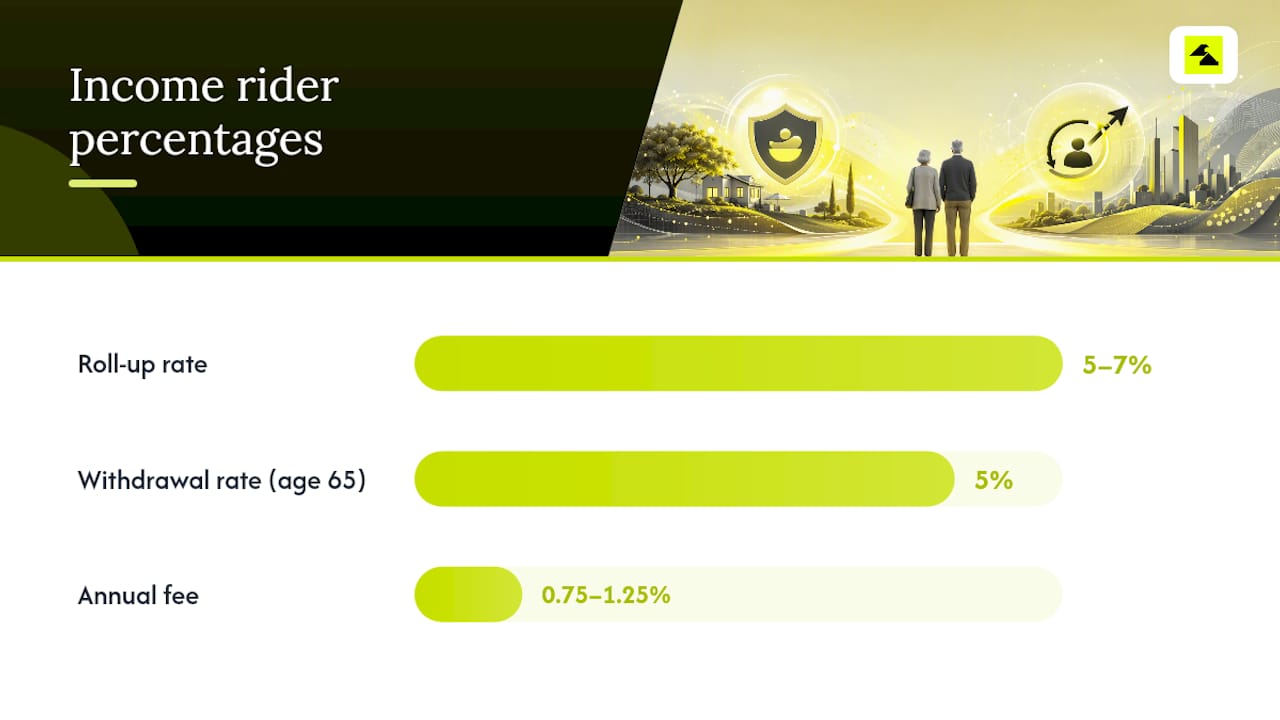
Everything centers on the benefit base, a separate value the insurer tracks purely for calculating your guaranteed withdrawal, and which usually differs from your actual account value. Many riders apply a roll-up rate, a guaranteed annual growth rate on the benefit base (often 5% to 7%) during years you don’t take withdrawals, or a ratchet feature that locks in market gains to the benefit base each year, whichever is higher. Once you activate withdrawals, the insurer applies an age-based percentage (say, 5% at age 65, higher at older activation ages) to the benefit base to set your guaranteed annual payment.
Rider mechanics come with real strings attached:
Annual fees typically run 0.75% to 1.25% of the benefit base or account value, charged whether or not you’ve started withdrawals, and deducted directly from your contract.
Withdrawal caps matter. Take more than the guaranteed amount in a given year and you can permanently reduce, or void, the guarantee.
Surrender schedules still apply to the underlying contract in most cases, typically declining over 7 to 10 years.
Account performance affects the actual cash value, but the benefit base and its guarantee are protected from market downside, that’s the entire point of the rider.
Tax treatment on rider withdrawals is different from annuitized payments. Withdrawals typically follow LIFO, last-in-first-out, meaning gains come out first and get taxed as ordinary income before you touch your original principal, which comes out tax-free. That front-loads your tax bill in the early withdrawal years compared to the more even exclusion-ratio treatment under annuitization.
Pro Tip: If legacy planning matters to you, riders usually beat annuitization by default; the account value (minus withdrawals) passes to beneficiaries, whereas most annuitized contracts extinguish the balance at death unless you specifically elected a period-certain or joint option.
Riders tend to fit people who want longevity insurance without giving up flexibility, especially anyone still uncertain about spending needs, health outlook, or whether they’ll want to leave money to children.
What Do Fees and Taxes Actually Cost You?
The sticker payout number rarely survives contact with fees and taxes. Here’s what typically eats into both paths:
Rider fee (income rider only): 0.75% to 1.25% annually against the benefit base, charged every year the rider is active.
Subaccount or index-crediting costs: built into variable and indexed products regardless of rider election.
Mortality and expense (M&E) charges: common in variable annuities, layered on top of any rider fee.
Surrender charges: apply if you exit the underlying contract early, typically during the first 7 to 10 years, and can apply to riders too if you cancel before the schedule ends.
A simplified example makes the trade-off concrete. Take two identical $200,000 nonqualified deferred annuities, purchased at age 65.
Annuitize the full $200,000 under a life-only option, and a typical insurer illustration might guarantee somewhere in the range of $1,100 to $1,300 a month for life. Because it’s nonqualified, part of each payment is excluded from tax under the exclusion ratio until your principal is recovered, so your after-tax income in the early years is close to the gross amount.
Add a GLWB rider instead, and the guaranteed withdrawal on the same $200,000 might land closer to $900 to $1,050 a month, lower than annuitizing, but you still hold the account. You’re paying roughly 1% annually against the benefit base for that flexibility. Withdrawals hit gains first under LIFO, so more of your early income is taxable than under the annuitized version, until basis is exhausted.

Neither example should be read as a quote. Actual figures vary by carrier, age, interest rates, and product design, always request an illustration for your specific numbers.
That penalty applies with equal force to both paths, so age matters as much as product choice.
How Do You Decide Between Annuitization and an Income Rider?
Run through a short checklist before you sign anything:
Liquidity needs: Will you need a lump sum for medical costs, a home repair, or an emergency? If yes, annuitization is the wrong tool.
Legacy goals: Do you want to leave money to children or a charity? Riders preserve that possibility; annuitization usually doesn’t.
Other guaranteed income: If Social Security and a pension already cover your basic expenses, you may not need the maximum possible annuitized payout.
Life expectancy and health: Longer expected lifespans favor annuitization’s mortality-pooled math; shorter horizons favor keeping flexibility.
Fee tolerance: Are you comfortable paying 0.75% to 1.25% a year indefinitely for the option to change your mind?
Bring these exact questions to any advisor or carrier before committing:
What is the current rider fee, and can it increase over the life of the contract?
How is the benefit base calculated, and what triggers a roll-up or ratchet?
What happens if I withdraw more than the guaranteed amount in a given year?
What is the surrender schedule, and does it apply separately to the rider?
What is the insurer’s current AM Best and S&P Global Ratings rating?
Once I annuitize, is there any way to reverse or modify the decision?
Pro Tip: Ask for the surrender schedule and the rider fee in writing, not verbally. Fee disclosures that are vague, or illustrations that show only the “best case” roll-up scenario, are the two biggest red flags in this entire category.
Walk away from any pitch that leads with the payout number and never mentions the insurer’s rating or the fee structure behind it.
Some advisors begin the evaluation process by prioritizing cash flow needs and long-term goals before comparing products. They may model both annuitization and rider options using carrier quotes, consider tax scenarios side by side, and review insurer ratings.
Clients often fall into patterns: some prioritize maximizing guaranteed monthly cash flow and lean toward annuitization; others who value preserving assets for heirs or maintaining control lean toward income riders despite ongoing fees.
Our Take: Don’t Treat This as an Either/Or Decision
The framing of “annuitization vs income rider” as a binary choice is where most people go wrong. A practitioner note worth taking seriously: plenty of retirees split the difference, annuitizing a portion of savings to lock in an income floor while keeping a rider or straightforward portfolio withdrawals on the remainder. That approach captures the higher guaranteed payout on part of the money without giving up all flexibility on the rest.
Get comparative quotes from more than one carrier before deciding anything. Check AM Best and S&P Global Ratings on any insurer you’re considering. Run the tax math with a CPA, the exclusion ratio and LIFO treatment can shift your net income by a meaningful margin depending on your bracket. If you’re unsure where you land, a no-obligation review with an advisor beats guessing.
— Jib Hunt
How East Two West Helps You Compare These Options
You can get an independent look across multiple insurers’ annuitization and rider illustrations side by side, so you can see the real gap between guaranteed payout and preserved flexibility before you commit to either.
[

A consultation starts with your cash flow and goals, not a product pitch. From there, an advisor pulls quotes from multiple carriers, runs the tax comparison between exclusion-ratio and LIFO treatment for your specific numbers, and checks claims-paying ratings on every insurer under consideration. If a split strategy, part annuitized, part rider, fits your situation better than an all-or-nothing choice, that gets modeled too. East Two West also works with long term care annuity strategies if you’re weighing income guarantees against future care costs at the same time.
If you’re planning a retirement income strategy right now, consider how long distance retirement moves might affect your transition and income choices; then request a no-obligation quote comparison and see the actual numbers side by side before you sign anything with a single carrier.
Sources
This article is general information, not a substitute for advice from a qualified financial advisor. Consult a qualified financial professional about your own circumstances before acting on anything here.
FAQ
What Does an Income Rider Mean on an Annuity?
An income rider is an optional add-on to a deferred annuity that guarantees lifetime withdrawal income while letting you keep ownership and access to your underlying account value. It usually charges an annual fee of 0.75% to 1.25% and calculates your guaranteed payment from a separate benefit base, not your actual cash value.
Why Should You Not Annuitize an Annuity?
Annuitization is typically irreversible, meaning you permanently give up access to your principal in exchange for guaranteed payments. If you have no need for a lump sum, no legacy goals, and want the largest possible guaranteed monthly income, that trade-off can make sense; if flexibility or a death benefit matters more, a rider or other strategy usually fits better.
What Is a Guaranteed Income Rider on an Annuity?
It’s a contract feature, often called a GLWB, that guarantees you can withdraw a set percentage of a benefit base for life, even if the underlying account value drops to zero from market losses. You keep the account, and any remaining value passes to beneficiaries at death, unlike a standard annuitized contract.
Is Annuitization a Good Idea?
Annuitization can be a strong choice if you want the highest guaranteed monthly income, have other assets set aside for emergencies or heirs, and are comfortable giving up access to principal permanently. It’s a poor fit if you might need liquidity later or want to preserve a legacy for beneficiaries, since most annuitized contracts stop paying at death unless you chose a joint or period-certain option.
Which Option Gives You a Higher Monthly Payout?
Annuitization generally produces a higher initial monthly payout than a comparable income rider on the same premium, because you’re not paying an ongoing rider fee. East Two West can pull illustrations from multiple carriers so you can see the exact dollar gap between the two on your specific numbers before deciding.
Recommended
Comments