Indexed Universal Life Insurance: What You Need to Know


An indexed universal life (IUL) policy is permanent life insurance that ties cash-value interest crediting to a market index while protecting against negative index returns through a floor, typically set at 0%. The policy also pays a death benefit for as long as you keep it in force. If you need lifelong coverage and have the discipline to fund a policy consistently over 15 to 30 years, IUL deserves a serious look, especially if you’ve already maxed out your 401(k) and Roth IRA and want another tax-advantaged accumulation vehicle. If your need is temporary or your budget is tight, term life is almost certainly the better answer.
East Two West is an independent practice that compares IUL quotes and illustrations from multiple carriers, so you can evaluate options without a sales pitch attached.
Table of Contents
Key takeaways on indexed universal life
IUL credits interest based on an index’s performance (commonly the S&P 500) subject to a floor (often 0%) and a cap or participation rate that limits upside.
Caps and participation rates are non-guaranteed elements; carriers can lower them after issue, which is why guaranteed minimums matter more than current rates.
IUL works best as a complement to qualified retirement plans, not a replacement. Max your 401(k) and IRA first.
A 0% floor does not guarantee your cash value won’t drop. Policy charges (cost of insurance, admin fees, rider costs) still come out every year, even in a 0% crediting year.
Underfunding is the single biggest reason IUL policies lapse. Proper funding, close to the maximum non-MEC level, is what makes the math work.
East Two West provides multi-carrier illustrations and funding scenario comparisons, online or by phone, so you can stress-test an IUL design before you commit.
How does an indexed universal life policy actually work?
Every IUL policy has two moving parts: a death benefit and a cash-value account. Your premium payment covers three things in sequence: the cost of insurance (COI), policy fees and administrative charges, and whatever is left over goes into the cash-value account. That cash value is what earns index-linked interest.

The death benefit options
You choose between a level death benefit (Option A) and an increasing death benefit (Option B). Option A keeps the face amount flat, which means more of your cash value is working as accumulation. Option B adds the cash value on top of the face amount, giving beneficiaries a larger payout but also raising the COI because the net amount at risk stays higher.
How interest gets credited
The insurer does not put your cash value into the stock market. Instead, it uses index options to replicate the price performance of an index like the S&P 500, then credits interest to your account based on that performance. Because the insurer buys options on price return only, dividends from the underlying index stocks are excluded. Historically, dividends have made up a meaningful share of the S&P 500’s total return, so IUL crediting consistently lags the index’s actual total return.
Three inputs determine what interest rate gets credited each year:
Floor: The minimum credited rate, most commonly 0%. If the index drops 20%, you get 0% credited, not a negative number.
Cap: The maximum credited rate. Caps on S&P 500 annual point-to-point strategies have typically been set within a range that is limited by carriers within contract limits.
Participation rate: The percentage of the index’s positive move that counts toward your credit. A 90% participation rate on a 10% index gain produces a 9% credited rate before the cap applies.
Crediting element | Typical current range | Guaranteed? |
Floor | 0% | Yes (contract minimum) |
Cap (annual point-to-point) | 8–12% | No — subject to carrier adjustment |
Participation rate | 50–100% | No — subject to carrier adjustment |
Minimum guaranteed cap | 1–3% | Yes (contract minimum) |
Common crediting methods include annual point-to-point (most widely used), monthly average, and monthly point-to-point. Annual point-to-point compares the index value at the start and end of a 12-month segment; monthly average averages 12 monthly snapshots. Monthly point-to-point applies the cap monthly, which can significantly limit upside in a strong year.
The crediting rate you see on an illustration today is not the rate you’ll earn for the life of the policy. Carriers reserve the right to lower caps and participation rates on in-force policies, down to the guaranteed minimums written into the contract. Always ask for the guaranteed minimum cap before you sign anything.
What does cash-value growth look like in a good year vs. a bad year?
The examples below use a simplified design to show how the mechanics play out. Assumptions: $100,000 starting cash value, 10% cap, 100% participation rate, 0% floor, and $3,000 in annual policy charges (COI plus admin fees).
Scenario | Index return | Credited rate | Interest earned | Policy charges | Net cash-value change | End-of-year cash value |
Good year | +18% | 10% (capped) | $10,000 | -$3,000 | +$7,000 | $107,000 |
Bad year | -14% | 0% (floored) | $0 | -$3,000 | -$3,000 | $97,000 |
A few things stand out here. In the good year, the index gained 18% but you captured only 10% because of the cap, resulting in a $7,000 net increase after policy charges. In the bad year, with a -14% index drop, the floor kept your credited rate at 0%, but the $3,000 in policy charges still came out, so your cash value dropped by $3,000 anyway.
Assumptions behind these numbers:
Policy charges are simplified to a flat $3,000 for illustration clarity; actual COI charges increase with age and with the net amount at risk.
The cap and participation rate shown are current, not guaranteed.
No loans are outstanding in either year.
The index return used is price return only, excluding dividends.
This is exactly why a 0% floor does not equal zero risk to your cash value. In a prolonged flat or down market, policy charges can erode cash value year after year even when the credited rate never goes negative.
Statistic to know: Over a 50-year period of S&P 500 price returns, a hypothetical IUL with a 10% cap and 0% floor would have been capped in 29 of those years, giving up over 333% in cumulative gains, while the floor provided protection in 11 years, shielding roughly 140% in cumulative losses. The cap cost more than the floor saved, which is the honest math behind every IUL illustration.
Pro Tip: Always ask your agent to run the illustration at a conservative credited rate of 5–6% in addition to the current cap assumption. If the policy still performs acceptably at that lower rate, the design is probably sound. If it collapses, the funding level is too low.
What are the real pros and cons of an IUL?
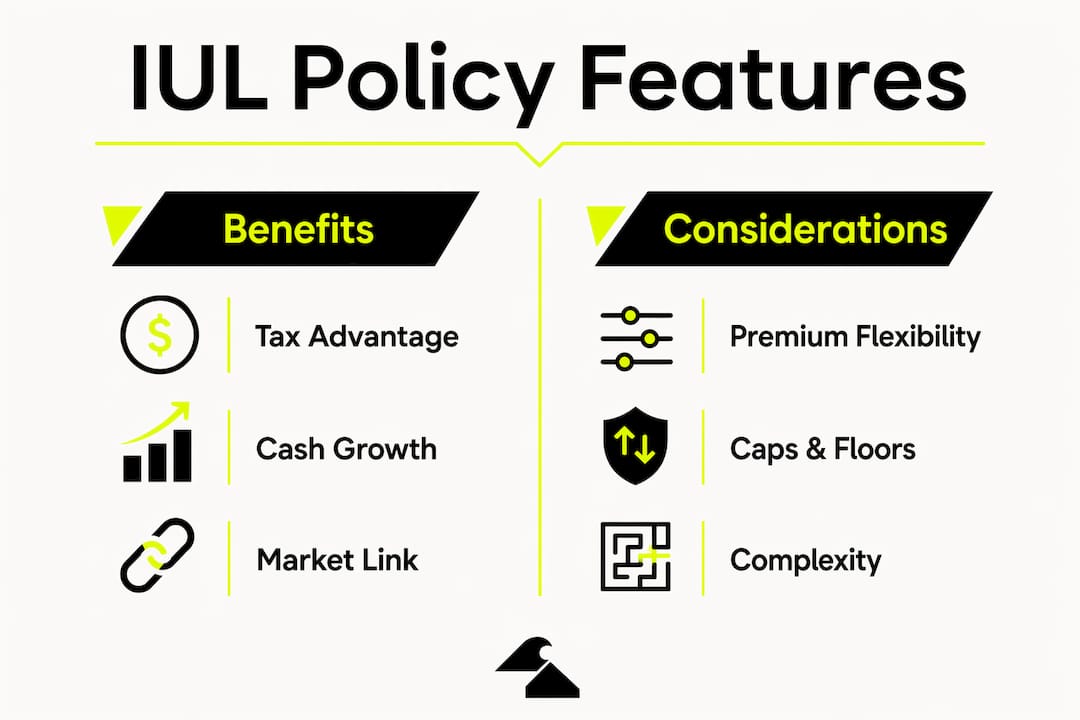
Pros
Lifelong death benefit as long as the policy stays funded, unlike term life which expires.
Tax-deferred cash-value growth with no annual contribution limits tied to IRS qualified-plan rules.
Downside floor protection compared to direct equity investing or variable universal life, where cash value can drop with the market.
Premium flexibility: you can pay more in high-income years and less in lean years, within limits.
Tax-advantaged retirement income via policy loans, which are generally not taxable as long as the policy stays in force.
Riders for chronic illness, terminal illness, and no-lapse guarantees can add meaningful protection.
Cons
Higher long-term costs than term life. COI charges grow with age, which is why underfunded policies become expensive to maintain later.
Caps and participation rates limit upside. In a strong bull market, a capped IUL will significantly underperform direct equity exposure.
Non-guaranteed crediting elements. Carriers can and do reduce caps and participation rates after issue, sometimes materially.
Surrender charges in early years (commonly years 1–10) make early exit expensive.
Lapse risk if premiums are skipped or reduced too aggressively; underpayment can trigger a lapse as charges eat through cash value.
Complexity. IUL illustrations involve many non-guaranteed assumptions, making it easy to be misled by an optimistic projection.
Pro Tip: The single most important determinant of IUL success is proper funding. A policy funded near the maximum non-MEC level from the start has the cash value to absorb charges, weather flat crediting years, and compound meaningfully over decades. Underfunding is how most IUL disappointments happen.
How does IUL compare to term, whole life, universal life, and variable UL?
Each permanent and temporary life product solves a different problem. Here is a quick structural comparison before the deeper breakdown.

Product | Cash value? | Growth type | Premiums | Complexity | Best use case |
Term life | No | None | Fixed, low | Low | Temporary income replacement |
Whole life (guaranteed) | Yes | Fixed/dividend | Fixed, high | Low | Guaranteed growth, estate planning |
Universal life (fixed) | Yes | Fixed declared rate | Flexible | Moderate | Flexible permanent coverage |
Indexed universal life | Yes | Index-linked, floored/capped | Flexible | High | Tax-advantaged accumulation + coverage |
Variable universal life | Yes | Direct sub-account investment | Flexible | Very high | Maximum growth potential, high risk tolerance |
Term life is the right answer when the need is temporary: a mortgage, income replacement during working years, or a business loan. It is cheap, simple, and expires. There is no cash value and no accumulation story. If you are comparing term to IUL purely on cost, term wins every time for the same death benefit. The question is whether you need coverage to last your entire life.
Guaranteed whole life offers fixed premiums, guaranteed cash-value growth, and potential dividends from mutual carriers. It is predictable and hands-off. The tradeoff is that premiums are higher than IUL for the same death benefit, and growth potential is lower. For someone who wants certainty above all else, or whose primary goal is estate liquidity, whole life is often the cleaner choice.
Fixed universal life uses a declared interest rate rather than an index. It offers premium flexibility like IUL but without the index upside or the complexity of crediting mechanics. It suits buyers who want permanent coverage with some flexibility but are not interested in accumulation as a primary goal.
Variable universal life (VUL) puts cash value directly into investment sub-accounts, meaning it can grow faster than IUL in a sustained bull market but can also lose value when markets fall. There is no floor. VUL makes sense for buyers with a high risk tolerance who want maximum growth potential and are comfortable with market-level volatility inside a life insurance wrapper.
IUL sits between whole life’s guarantees and VUL’s market exposure. It is the right fit when you want index-linked upside potential with a floor against catastrophic loss, combined with premium flexibility and a permanent death benefit.
What are the tax and estate implications of owning an IUL?
The tax treatment of IUL is one of its most cited advantages, but it comes with conditions worth understanding clearly.
Death benefit: Proceeds paid to beneficiaries are generally income-tax-free under current IRS rules. The main exception is the transfer-for-value rule, which can make proceeds taxable if the policy was sold or transferred for consideration.
Cash-value growth: Accumulates tax-deferred. You owe no income tax on credited interest each year.
Policy loans: Generally not treated as taxable income while the policy remains in force. This is the mechanism behind the “tax-free retirement income” strategy.
Withdrawals (partial surrenders): Taxed on a last-in, first-out basis up to the policy’s cost basis; amounts above basis are taxable as ordinary income.
Lapse with outstanding loans: If a policy lapses or is surrendered with loans outstanding, the loan balance can become taxable income in the year of lapse. This is a real risk in underfunded policies.
Tax warning: Using IUL policy loans as a substitute for qualified retirement plans is a strategy that only works if the policy stays in force for life. A lapse with large outstanding loans can produce a significant, unexpected tax bill. Coordinate any loan strategy with a qualified tax advisor, not just your insurance agent.
For estate planning, the death benefit is generally included in the insured’s taxable estate if they own the policy. For large estates, an Irrevocable Life Insurance Trust (ILIT) can remove the proceeds from the taxable estate. Beneficiary designations also matter: a named beneficiary receives proceeds outside of probate, while proceeds payable to the estate go through it.
This article is general information, not tax or legal advice. Confirm your specific situation with a qualified tax advisor or estate planning attorney.
What does an IUL actually cost, and how should you fund it?
The cost components
Every dollar of premium you pay gets reduced by several charges before it works as accumulation:
Cost of insurance (COI): The pure mortality charge, based on your age, health class, and the net amount at risk. COI increases every year as you age.
Administrative fees: Flat monthly or annual charges that cover policy maintenance.
Rider costs: Each optional rider (chronic illness, no-lapse guarantee, etc.) adds its own charge.
Premium load: Some carriers take a percentage off the top of each premium before it hits the cash-value account.
Index options cost: The insurer’s cost of purchasing options to replicate the index. This is embedded in the cap and participation rate mechanics rather than charged separately, but it directly determines how generous those parameters can be.
Surrender charges: Applied if you surrender the policy in early years, commonly years 1–10, on a declining schedule.
Surrender charges, loan mechanics, and rider costs are the primary early-year cash-value drains. A policy that looks impressive at year 20 on an illustration can look very different at year 5 if you need to exit.
Funding patterns
Funding level | Description | Risk |
Minimum premium | Keeps policy in force; little to no accumulation | High lapse risk if charges rise or crediting falls |
Target premium | Carrier’s suggested level; moderate accumulation | Moderate; sensitive to crediting changes |
Max non-MEC funding | Maximum IRS-allowed without triggering MEC status | Lowest lapse risk; best accumulation potential |
The Modified Endowment Contract (MEC) threshold is the IRS limit on how much premium you can put into a life insurance policy before it loses its favorable loan and withdrawal tax treatment. Funding up to but not exceeding the MEC limit is the standard approach for accumulation-focused IUL designs.
Properly structured IUL policies are typically front-loaded, meaning higher premiums in the early years. The logic is straightforward: getting cash value into the account early gives it more time to compound and creates a larger buffer against future COI increases. A policy funded at the minimum level in early years often struggles to sustain itself in later years when COI charges accelerate.
IUL is most effective for higher earners who have already maximized their 401(k), IRA, and Roth contributions and are looking for an additional tax-advantaged vehicle. As a rough frame, a sensible accumulation-focused IUL design typically requires a meaningful annual commitment sustained over many years, not a minimal premium that just keeps the policy alive.
Who actually benefits from an IUL, and how long does it take?
IUL is not a product for everyone. The buyer profile that makes the most sense looks like this:
Higher earners who have maxed their 401(k), IRA, and Roth IRA contributions and want additional tax-advantaged accumulation.
People who need permanent coverage, not just temporary income replacement. If your need disappears in 20 years, term life is cheaper.
Consistent funders. IUL rewards discipline. Skipping premiums or reducing them significantly in early years can permanently impair the policy’s performance.
Long time horizons. A 15-year minimum is often cited; 20–30 years is where the compounding and tax advantages become genuinely meaningful.
Business owners using IUL for key-person coverage, buy-sell funding, or executive benefit plans where permanent coverage and accumulation both matter.
The use cases break down into four main categories:
Retirement income supplement: Policy loans in retirement provide tax-advantaged income that does not count toward Social Security taxation thresholds or Medicare premium calculations.
Estate liquidity: A permanent death benefit provides heirs with immediate liquidity to pay estate taxes or equalize inheritances.
Business succession: Permanent coverage funds buy-sell agreements and key-person replacement costs.
Lifetime protection with accumulation: For buyers who want both a death benefit and a growing cash reserve, IUL combines them in one contract.
Avoiding catastrophic losses via a 0% floor over 20–30 years can be as meaningful to long-term accumulation as capturing bull-market gains. The compounding effect of never having a deeply negative year is real, but it only materializes if the policy is funded properly and held for the full horizon. Short-term liquidity needs and IUL are a poor combination.
How do you buy an IUL, and what should you ask the agent?
The buying checklist
Define your primary objective: death benefit, accumulation, or both.
Confirm your current retirement funding status: are 401(k)/IRA/Roth contributions maxed?
Decide on a desired death benefit amount and whether you prefer level or increasing.
Choose a funding level: minimum, target, or max non-MEC.
Establish your time horizon and confirm you can fund consistently for at least 15 years.
Request illustrations from at least two carriers at the same funding level.
Essential questions to ask any agent
What is the current cap and participation rate on the strategy I’m being shown?
What is the guaranteed minimum cap written into the contract?
What are the guaranteed minimum interest rates on the fixed account?
How does the cost of insurance change at age 65, 70, and 75?
What happens to the death benefit and the policy if I take a loan equal to 50% of cash value?
At what loan balance does the policy risk lapsing under the conservative illustration?
What riders are included, what do they cost, and can I remove them later?
Show me the illustration at a 5–6% credited rate, not just the current cap assumption.
Red flags
An agent who only shows the illustration at the current cap rate and refuses to run a conservative scenario.
No discussion of guaranteed minimums or MEC risk.
An illustration that shows the policy performing well at minimum premium levels over 30 years.
Pressure to decide before you’ve reviewed the guaranteed elements page of the contract.
When you request illustrations through East Two West, the process includes a multi-carrier comparison at the same funding level, a conservative stress-test run, and a plain-language review of the guaranteed contract elements. Underwriting typically involves a medical exam for larger face amounts, a review of your health history, and a 4–8 week timeline from application to policy issue.
Pro Tip: Ask for the policy’s “guaranteed column” illustration, not just the “current assumption” column. The guaranteed column shows what happens if the carrier drops every non-guaranteed element to its contractual minimum. If that scenario is catastrophic, the funding level is wrong.
How East Two West helps you compare IUL quotes
East Two West operates as an independent practice, which means it places policies with multiple carriers rather than representing one. That independence matters when you’re evaluating IUL, because the crediting parameters, COI schedules, and rider costs vary significantly from one carrier to the next.
The process works like this:
Step 1 — Quote request: You submit your age, health class estimate, desired death benefit, and funding level online or by phone.
Step 2 — Illustration review: East Two West pulls illustrations from multiple carriers at the same funding level and runs both current-assumption and conservative scenarios.
Step 3 — Funding adjustment: If the conservative scenario shows lapse risk, the funding level gets adjusted before you apply.
Step 4 — Application: Once you select a carrier and design, the application goes in.
Step 5 — Underwriting: Medical exam (if required), health history review, and carrier underwriting, typically 4–8 weeks.
Step 6 — Policy issue and annual review: East Two West supports annual illustration re-runs to confirm the policy is tracking as designed.
What to have ready before you request a quote: your date of birth, current health status and any major diagnoses, desired death benefit, annual premium budget, and a clear answer to whether you’ve maxed your qualified retirement accounts. The more specific your inputs, the more useful the illustration comparison.
East Two West is compensated by the issuing carrier once a policy is placed, not by direct client fees. That compensation structure is standard in the industry. The value of working with an independent practice is that no single carrier’s product is being pushed; the comparison is across the market.
Compare IUL quotes and illustrations across multiple carriers through East Two West’s online platform or schedule a consultation to walk through the numbers together.
Authoritative sources and further reading
Investopedia: What Is Indexed Universal Life (IUL)? — Clear explanation of IUL mechanics, crediting formulas, and how IUL compares to other permanent life products.
MassMutual: What Is Indexed Universal Life Insurance? — Includes a historical S&P 500 cap/floor example and explains why IUL crediting excludes dividends.
Ogletree Financial: IUL Cap Rates and Participation Rates Explained — Detailed breakdown of how caps, participation rates, and floors interact, including typical current ranges.
Eligry: IUL Explained — Practical explainer on who IUL is for, time horizons, and the importance of conservative illustration assumptions.
NAIC Consumer Information — The National Association of Insurance Commissioners’ consumer tools for verifying carrier licensing and complaint history.
IRS Publication 525 and IRC Section 7702 — Govern the tax treatment of life insurance cash value, loans, and MEC classification. Consult a qualified tax advisor for your specific situation.
For personalized advice on whether IUL fits your financial plan, consult a licensed life insurance agent and a qualified tax advisor. General articles, including this one, cannot account for your specific health, income, estate situation, or state-specific regulations.
Final steps: what to do next
Confirm the fit first. IUL is appropriate when you need permanent insurance and have the long-term funding capacity to sustain it after maxing qualified retirement accounts. If either condition is missing, revisit the product choice.
Run a conservative illustration. Request the policy illustration at a 5–6% credited rate, not just the current cap. Confirm the policy stays in force under that scenario.
Check the guaranteed minimums. Ask for the guaranteed column of the illustration and the guaranteed minimum cap written into the contract before you apply.
Compare across carriers. COI schedules, caps, participation rates, and rider costs differ enough between carriers that a single-carrier quote is not sufficient due diligence.
Request IUL quotes and illustrations through East Two West to compare multiple carriers side by side with conservative and current-assumption scenarios.
Schedule an annual review. Once a policy is in force, review the illustration annually to confirm the policy is tracking as designed and adjust funding if needed.
The part most IUL articles skip
The honest tension in IUL is not between IUL and whole life, or IUL and term. It is between what an illustration shows and what a policy actually delivers over 30 years.
Most buyers see a current-assumption illustration and mentally anchor to those numbers. The current cap looks reasonable. The projected cash value at age 65 looks attractive. What the illustration cannot show is what happens when a carrier quietly lowers the cap from 11% to 8% five years into the policy, which is entirely within their contractual rights. That single change, compounded over decades, can produce a materially different outcome than the one that sold the policy.
This is not an argument against IUL. It is an argument for buying it with your eyes open. The floor is real. The tax treatment is real. The flexibility is real. But the projected returns are not guaranteed, and the cost of insurance is not fixed. A well-funded policy reviewed annually by someone who will tell you the truth is a genuinely useful financial tool. A minimally funded policy sold on an optimistic illustration and never reviewed again is how people end up with a lapsed policy and a tax bill at age 72.
The buyers who get the most out of IUL are not the ones who found the highest cap. They are the ones who funded it properly, ran conservative scenarios before they bought, and treated it as a long-term commitment rather than a product to be set and forgotten.
Get personalized IUL quotes through East Two West
Shopping for an IUL without comparing carriers is like buying a house after seeing one listing. The crediting parameters, COI schedules, and rider costs vary enough between carriers that the difference in long-term cash-value outcomes can be substantial.
[

East Two West gives you multi-carrier IUL illustrations side by side, with both current-assumption and conservative stress-test scenarios included. You choose how you want to work: online self-service for buyers who know what they want, or a consultative review for anyone who wants to walk through the numbers with an independent agent. There are no carrier quotas and no pressure to decide before you’re ready. East Two West is compensated by the carrier once a policy is placed, so the comparison is genuinely across the market.
Before you request quotes, have your date of birth, health status, desired death benefit, and annual premium budget ready. The more specific your inputs, the more useful the comparison.
Get your IUL illustration comparison from East Two West and see how different funding levels and carriers stack up for your situation.
Key Takeaways
IUL is a long-term, tax-advantaged permanent policy that links cash-value growth to a market index with a floor for downside protection, but its real-world performance depends entirely on proper funding, conservative illustration assumptions, and annual monitoring.
Point | Details |
Floor ≠ guaranteed growth | A 0% floor stops negative crediting, but policy charges still reduce cash value in flat or down years. |
Caps and participation rates change | Carriers can lower non-guaranteed crediting elements after issue; always check the guaranteed minimum cap in the contract. |
Fund it properly | Max non-MEC funding from the start gives the policy the cash-value buffer it needs to survive charge increases and flat crediting years. |
IUL fits a specific buyer | Best for higher earners who have maxed 401(k)/IRA/Roth accounts, need permanent coverage, and can commit to a 15–30+ year horizon. |
East Two West | Provides multi-carrier IUL illustrations with conservative and current-assumption scenarios, online or by consultation, at no direct client fee. |
Recommended
Comments