Life Insurance for Non Citizens: What Foreign Nationals Need to Know


Yes, most non-U.S. citizens can buy life insurance in the United States. What changes is the documentation you need, how carriers evaluate your application, and in some cases, how much coverage you can get. Green card holders are typically treated the same as U.S. citizens. Visa holders face more scrutiny but can still qualify. Even undocumented applicants have options, though usually with lower face amounts and higher premiums.
Your three immediate next steps:
Gather your documents: passport with U.S. entry stamps, valid visa or I-94, Social Security Number (SSN) or Individual Taxpayer Identification Number (ITIN), and proof of a U.S. bank account or U.S. address.
Get quotes from multiple carriers: rates and eligibility rules vary significantly by carrier, so comparing is not optional.
Consult a broker or tax advisor if you have a large policy need, a complex immigration history, or foreign beneficiaries.
East Two West can pull quotes from multiple carriers in minutes so you can compare without pressure.
Table of Contents
How your immigration status shapes eligibility and coverage limits
Which documents insurers actually ask for from foreign-national applicants
Which life insurance products are available to foreign nationals
How carriers underwrite foreign nationals, and how long it takes
What a $1,000,000 policy costs for non-citizens: key drivers and illustrative ranges
How to apply for life insurance in the U.S. as a non-citizen, step by step
Special cases: undocumented applicants, students, visitors, and high-net-worth nonresidents
Should you buy a U.S. policy or get coverage in your home country?
Why an independent broker changes the outcome for non-citizen applicants
East Two West makes life insurance accessible for foreign nationals
How your immigration status shapes eligibility and coverage limits
Eligibility for non-citizen life insurance depends primarily on your immigration status and your financial ties to the U.S. Carriers sort applicants into rough tiers, and knowing which tier you fall into tells you a lot about what to expect.

Lawful permanent residents (green card holders) sit at the top of the access ladder. Most carriers treat them identically to U.S. citizens: full product range, standard underwriting, and no automatic premium loading for residency alone.
Long-term residents and dual citizens generally qualify for the same broad product set. Dual citizens with a U.S. passport face no additional hurdles; those with only a foreign passport but strong U.S. ties (property, employment, tax filings) can still access most products.
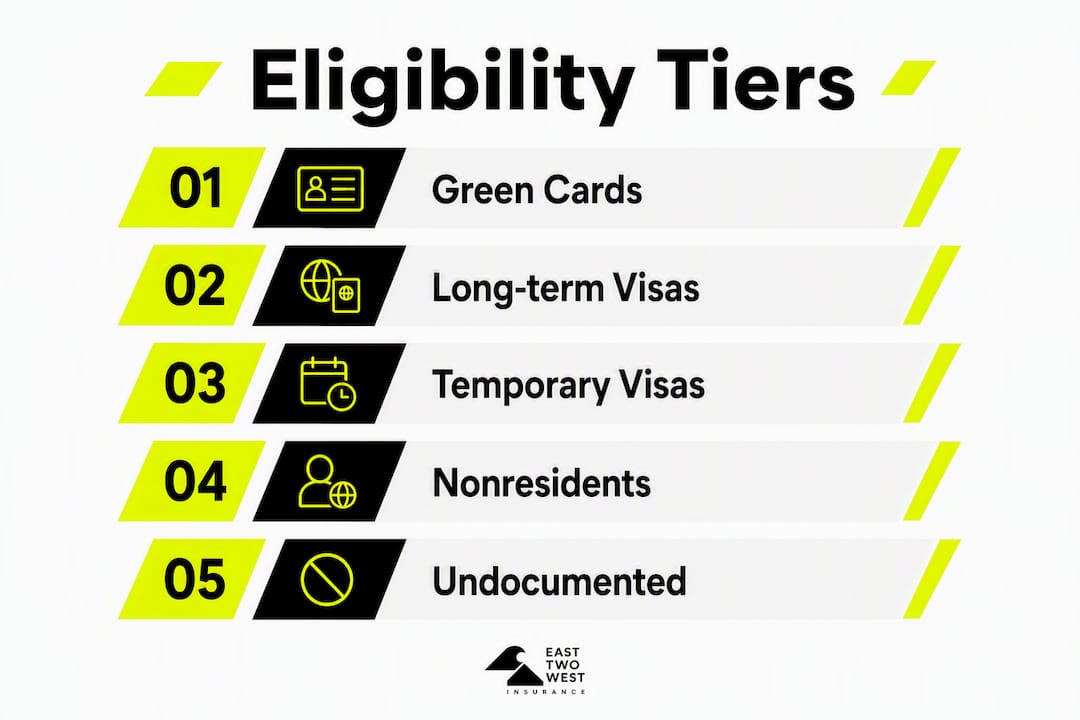
Temporary visa holders (H-1B, L-1, O-1, F-1 students, and similar) are eligible at most major carriers, but expect more documentation requests and a longer underwriting review. Some carriers cap face amounts for certain visa categories or require evidence that the visa is renewable.
Nonresident foreigners applying from abroad face the most restrictions. Carriers typically require that underwriting and policy delivery be completed inside the U.S., and country-code risk tiers limit available rate classes or trigger facultative reinsurance for large face amounts.
Undocumented applicants have the narrowest path. Some carriers will offer coverage to undocumented individuals who have an ITIN and demonstrable U.S. financial ties, but face amounts are often capped and premiums are higher. There are over 11 million undocumented immigrants in the U.S., and a meaningful subset do qualify for at least some coverage.
Quick self-triage: three questions to ask yourself
Do you have a green card, valid visa, or SSN/ITIN?
Can you show a U.S. financial tie (bank account, property, employer, or tax return)?
Will you be physically present in the U.S. during underwriting and policy delivery?
If you answered yes to all three, you have solid access to the standard market. Two out of three still opens most doors. One or fewer means you need a broker who specializes in nonresident underwriting.
Which documents insurers actually ask for from foreign-national applicants
Getting your paperwork right before you apply cuts weeks off the process. Here is the standard checklist:
Passport with U.S. entry stamps (current and valid)
Visa or I-94 arrival/departure record (showing current status and expiration)
Green card (Form I-551), if applicable
SSN or ITIN (see note below)
Proof of U.S. bank account (a voided check or bank statement)
U.S. mailing address (a P.O. box alone is rarely sufficient)
Proof of U.S. nexus if required: property deed, employment letter, or U.S. tax return
Carriers commonly require an SSN or ITIN; applying without an SSN slows underwriting considerably because automated credit and MIB checks cannot run. If you do not have an SSN, apply for an ITIN through the IRS using Form W-7 before you start the insurance application. The process takes roughly 7–11 weeks, so plan ahead.
Foreign medical records from the past five years must typically be submitted as certified English translations. Translation costs vary by language and document complexity, but budget at least $100–$300 per set of records as a rough planning figure. Carriers also commonly request HIPAA authorizations for any U.S. medical care.
Nationwide’s foreign-national guidelines specifically require evidence of “U.S. nexus”: real estate ownership, employment with a U.S. company, a U.S. bank account, or verifiable U.S. tax liability. The stronger your paper trail, the better your rate class.
Pro Tip: Order certified translations of your foreign medical records before submitting the application. Underwriters will ask for them anyway, and having them ready can shave three to four weeks off a typical review.
Which life insurance products are available to foreign nationals
The product range is broader than most applicants expect. What you can actually buy depends on your immigration tier.
Term life insurance is the most accessible product for non-citizens. It is straightforward, lower cost relative to face amount, and portable in the sense that a paid-up policy remains in force even if you leave the U.S. (subject to policy language). Most carriers offer term to green card holders and visa holders with U.S. nexus.
Whole life and permanent coverage are available to lawful permanent residents and long-term visa holders with strong U.S. ties. The cash value component makes underwriting more thorough, so expect a longer review. These policies work well for estate planning and wealth transfer.
Indexed universal life (IUL) is flexible and can serve both income-replacement and accumulation goals. It is available to most documented applicants but carries more complexity. East Two West offers IUL alongside term and whole life, so you can compare policy types side by side before committing.
Guaranteed-issue and final-expense policies require minimal underwriting and no medical exam. Face amounts are typically capped at $25,000–$50,000, making them suitable for final-expense coverage rather than income replacement. These are often the most realistic option for undocumented applicants or those with significant health issues.
Programs like Allianz’s Global Citizen are designed specifically for non-U.S. citizens and require passports, U.S. entry stamps, and financial documentation. Some citizenships or countries of residence carry additional restrictions under these programs.
A quick rule of thumb: if your goal is income replacement or mortgage protection, start with term. If you are thinking about estate planning or long-term wealth transfer, whole life or IUL deserves a closer look. Riders like waiver of premium or disability income are often restricted or unavailable for temporary visa holders, so confirm availability before you rely on them.
How carriers underwrite foreign nationals, and how long it takes
Underwriting for non-citizens follows the same general path as for U.S. citizens, with several additional checkpoints layered in.
The underwriting flow:
Application intake: You complete the application with full travel history, immigration status, and U.S. nexus documentation.
ID and visa verification: The carrier confirms your passport, visa type, and I-94 record.
Medical records and paramed exam: Standard health review; foreign records must arrive as certified translations.
MIB and credit checks: These run automatically with an SSN. Without one, the process becomes manual and slower.
Country risk review: The carrier checks your country of birth and residence against its country-code classification (typically A/B/C/D tiers), which determines available rate classes and maximum face amounts.
Reinsurance review (if applicable): Large face amounts or higher-risk country codes may require facultative reinsurance approval, adding weeks to the timeline.
Conditional approval and offer: The carrier issues an offer, possibly with a table rating or flat extra.
Policy issue and delivery: Policy must typically be delivered and signed in the U.S.
Realistic timelines:
Fast (days to 2 weeks): Accelerated or simplified-issue products for smaller face amounts; green card holders with SSN and clean health history.
Typical (4–8 weeks): Standard underwriting for visa holders with full documentation and a paramed exam.
Slow (3+ months): High face amounts requiring reinsurance, complex travel history, missing translations, or country-code complications.
The most common causes of delay are missing certified translations of foreign medical records, visa expiration windows that fall within the policy term, and reinsurance approvals for policies above $1 million. Disclose your full travel and residency history upfront. Omissions discovered later can trigger rescission.
Table ratings are a common outcome when residency or health raises perceived risk. Each table step adds roughly 25% to the standard premium. A Table 1 rating means approximately 125% of the standard rate; Table 4 puts you at roughly 200%. Flat extras are a fixed dollar charge per $1,000 of coverage added on top of the base rate, often used for specific country-of-residence concerns.
What a $1,000,000 policy costs for non-citizens: key drivers and illustrative ranges
Price is driven by age, sex, tobacco use, health class, face amount, term length, and your residency/visa status. The table below shows illustrative monthly ranges for a $1,000,000, 20-year term policy. These are planning estimates; your actual quote will vary.
Profile | Health Class | Illustrative Monthly Range |
Male, non-smoker, green card holder | Preferred Plus | — |
Female, non-smoker, green card holder | Preferred Plus | — |
Male, non-smoker, H-1B visa holder | Standard | — |
Female, non-smoker, H-1B visa holder | Standard | — |
Male, 50, non-smoker, Table 2 rating | Substandard | — |
Male, smoker, any immigration status | Standard Tobacco | — |
These ranges are illustrative only. Actual premiums depend on carrier, exact health history, visa type, country of residence, and underwriting outcome.
A Table 2 rating (roughly 150% of standard) on a policy that would otherwise cost $100/month pushes that to $150/month. Table 4 (roughly 200%) doubles it. Residency surcharges for certain country codes can layer on top of health-based ratings, so the combination matters.
The single biggest lever you control is your underwriting class. Proving strong U.S. nexus, submitting complete documentation upfront, and working with a broker who knows which carriers are most favorable for your specific visa type can move you from a standard offer to a preferred one. That difference on a $1 million policy over 20 years is substantial.
East Two West pulls quotes from multiple carriers simultaneously, so you see the spread rather than a single number. Get a personalized quote to find out where you actually land.
How to apply for life insurance in the U.S. as a non-citizen, step by step
Gather your documents before touching the application: passport, visa/I-94, SSN or ITIN, proof of U.S. bank account, and any foreign medical records you can obtain.
Complete the application accurately. Answer every question about travel history, country of birth, and immigration status truthfully. Carriers verify this; inconsistencies delay or void coverage.
Schedule your paramed exam at a U.S. location. Most carriers use third-party exam services that come to you. Confirm the exam must happen in the U.S. before booking.
Submit certified translations of any foreign medical records at the same time as your application, not after the underwriter asks. This alone can cut 3–4 weeks off the review.
Set up a U.S. bank account for premium payments. Many foreign-national programs require premiums paid in U.S. dollars from a U.S. bank. If you do not have one yet, open a basic checking account before applying.
Monitor underwriting and respond within 48 hours to any carrier request. Slow responses are the number-one applicant-controlled cause of delays.
Confirm policy delivery logistics. Policy must typically be delivered and accepted in the U.S. Arrange to be physically present or designate a U.S.-based representative.
Review the policy language for geographic limitation clauses before signing. Some policies restrict benefits if you relocate abroad permanently.
Pro Tip: When you submit your application, attach a one-page cover letter summarizing your U.S. nexus: your employer, your U.S. bank, your U.S. address, and any U.S. property. Underwriters are human. A clear summary reduces back-and-forth.
Accuracy on immigration history is not optional. Carriers check visa records and travel history. A misstatement, even an innocent one, can give a carrier grounds to rescind the policy at claim time, which is the worst possible outcome for your beneficiaries.
Special cases: undocumented applicants, students, visitors, and high-net-worth nonresidents
Not every applicant fits the standard mold. Here is how the most common edge cases play out.
Undocumented applicants
Coverage exists, but the path is narrower. Carriers that work with undocumented applicants typically require an ITIN (not an SSN), a U.S. bank account, and a U.S. mailing address. Face amounts are often capped, and premiums reflect the additional underwriting uncertainty. Final-expense and smaller term policies are the most realistic starting point. The priority is getting an ITIN first; without it, most carriers will not proceed.
International students (F-1 visa)
F-1 students can qualify for term life insurance at carriers that accept student visas. The practical constraint is duration: a policy that extends well beyond your expected graduation and visa expiration will face more scrutiny. Shorter terms (10-year) are easier to place. Riders like waiver of premium are often unavailable for F-1 holders. If you plan to adjust status after graduation, note that in your application.
Short-term visitors (B-2 tourist visa)
This is the hardest category. Most carriers decline long-term policies for B-2 visitors because the visa does not establish U.S. residency or financial nexus. If you are on a B-2 and need coverage, a final-expense or guaranteed-issue policy is the most realistic option. Any application for a longer-term policy will require strong evidence of pending status adjustment or U.S. financial ties.
High-net-worth nonresidents
Large face amounts (above $5 million) for nonresidents typically require premium financing arrangements, extensive U.S. nexus documentation, and facultative reinsurance approval. Expect a 3-month-plus timeline. These cases almost always need a broker with specific nonresident underwriting experience. The cross-border legal and tax complexity at this level, particularly for clients with assets in multiple jurisdictions, warrants coordinating with an international estate attorney alongside the insurance application.
Tax and beneficiary basics for non-citizen policyholders
Naming a foreign beneficiary
You can name a foreign national as your beneficiary. The carrier will pay the death benefit to them, but the process takes longer when the beneficiary lives outside the U.S. Carriers require government-issued ID, proof of relationship, and sometimes notarized documentation. One hard constraint: carriers cannot pay death benefits to beneficiaries in OFAC-sanctioned countries (currently including Cuba, Iran, North Korea, Syria, and others). Check the carrier’s restricted-country list before naming a beneficiary.
Tax treatment
Death benefits are generally income-tax-free to beneficiaries under U.S. federal rules, regardless of the beneficiary’s citizenship. However, nonresident alien policyholders and beneficiaries face different estate and withholding rules. For large policies, the U.S. estate tax can apply to assets held by nonresident aliens, and the exemption thresholds differ significantly from those available to U.S. citizens. This is not a DIY area.
Practical payout logistics
Beneficiaries outside the U.S. typically receive payment by international wire transfer. Expect documentation requirements, potential withholding review, and delays of several weeks beyond the standard claim processing time. Some countries impose their own taxes on received life insurance proceeds, so the beneficiary should check local rules.
Pro Tip: If your policy face amount exceeds $1 million and your beneficiary lives outside the U.S., consult a U.S. estate attorney before you finalize the application. The structure of ownership and beneficiary designation can have significant tax consequences that are much easier to fix before the policy is issued than after.
For Israeli citizens or those with cross-border obligations, reviewing your reporting obligations abroad alongside your insurance planning is worth the time.
This article is general information, not legal, tax, or financial advice. Confirm current rules with a qualified professional for your specific situation.
Should you buy a U.S. policy or get coverage in your home country?
Three questions settle this for most people:
Where will you live long-term? If you plan to stay in the U.S. or keep significant U.S. assets, a U.S. policy is the cleaner choice. If you are here temporarily and will return home, a home-country policy may be simpler to maintain.
Do you have U.S. estate or tax exposure? If you own U.S. real estate, have a U.S. employer, or file U.S. taxes, a U.S. policy integrates more naturally with your financial picture.
Can your beneficiaries access international payouts easily? A U.S. policy paying a beneficiary in a country with strong banking infrastructure is straightforward. A beneficiary in a country with currency controls or limited wire transfer access may face real friction.
Reasons to prefer a U.S. policy:
Larger, more competitive market with more carrier options
Dollar-denominated payouts are easier for beneficiaries with U.S. financial ties
Better portability if you remain in the U.S. or have U.S. assets
Stronger underwriting options for large face amounts
Reasons to prefer a home-country policy:
Simpler local claims process for beneficiaries who live there
Lower documentation friction if your medical records and ID are all domestic
Alignment with local tax and inheritance rules
Potentially lower premiums if your home country has favorable actuarial tables
The practical answer for most long-term U.S. residents: buy the U.S. policy. The documentation hurdle is a one-time cost; the benefits of a U.S.-based policy compound over time. For temporary residents who plan to return home within a few years, a shorter-term U.S. policy that covers the period of U.S. residency, combined with home-country coverage, is often the most practical structure.
Key Takeaways
Non-citizens can buy life insurance in the U.S., but eligibility, cost, and timeline depend on immigration status, U.S. financial ties, and how thoroughly you prepare your documentation before applying.
Point | Details |
Eligibility by status | Green card holders qualify like citizens; visa holders face more scrutiny; undocumented applicants have limited but real options with an ITIN. |
Documents matter most | Having your SSN or ITIN, certified medical translations, and proof of U.S. nexus ready before applying prevents the most common delays. |
Underwriting timeline | Expect days to 2 weeks for simplified issue, 4–8 weeks for standard underwriting, and 3+ months for large face amounts needing reinsurance. |
Cost drivers | Table ratings add roughly 25% per step above standard; a Table 4 rating roughly doubles your base premium. |
East Two West | East Two West provides multi-carrier quotes for non-citizen applicants online or by phone, with no sales pressure and options for both self-service and personalized consultation. |
Why an independent broker changes the outcome for non-citizen applicants
Most non-citizen applicants who struggle to get coverage are not ineligible. They applied to the wrong carrier. This is the part that rarely gets said plainly: carrier rules for foreign nationals vary enormously. One carrier may decline an H-1B holder outright; another treats the same applicant as standard. One carrier’s country-code list puts a specific nationality in a restricted tier; a competing carrier has no such restriction. Without access to multiple carriers simultaneously, you are essentially guessing.
Working with an independent broker means someone is reading the actual underwriting manuals, not just the marketing pages. East Two West operates across multiple carriers and offers both an online self-service quote tool and direct consultations for complex cases. The platform does not push a single carrier’s product; it shows you what the market actually offers for your specific profile. For applicants with complex immigration histories, foreign medical records, or large face-amount needs, that breadth is the difference between a placed policy and a declined application. Client information is handled with full compliance and confidentiality throughout.
East Two West makes life insurance accessible for foreign nationals
Getting life insurance as a non-citizen does not have to mean navigating carrier paperwork alone. East Two West works with multiple carriers that specifically accommodate foreign nationals, from green card holders to visa holders with complex documentation needs. The process is straightforward: run a quote online in minutes, or schedule a phone consultation if your situation involves nonresident underwriting, large face amounts, or foreign beneficiary questions.
[

The practical advantages are real. East Two West handles the carrier comparison work, knows which carriers are most favorable for specific visa types, and can guide you through the documentation requirements that trip up most applicants. No single-carrier bias, no pressure to buy more than you need.
Get your personalized quote today and see what multiple carriers will actually offer you.
Useful sources to read before you apply
Carrier rules change. Before submitting any application, check the issuing carrier’s current foreign-national guidelines directly. These are the most authoritative sources available:
Corebridge Financial (AGLC) Foreign Nationals Underwriting Guide: Detailed country-code classifications, acceptable visa lists, face-amount thresholds, and occupation exclusions. Essential reading for any applicant from a non-standard country of residence.
Nationwide Foreign National Guidelines (PDF): Covers U.S. nexus requirements, acceptable documentation, and program-specific rules for Nationwide’s foreign-national life products.
Allianz Global Citizen Program Underwriting Guide (PDF): Program-specific rules for non-U.S. citizens including passport requirements, financial documentation, and country restrictions.
Prudential: A Guide to Life Insurance for Non-U.S. Residents and Foreign Nationals (PDF): A clear overview of underwriting considerations, documentation, and program eligibility from a major carrier.
IRS Form W-7 and ITIN Application: Available at IRS.gov. If you do not have an SSN, this is your starting point. Processing takes approximately 7–11 weeks.
Carrier rules vary and update regularly. Always verify the current version of any underwriting guide directly with the carrier or your broker before relying on it for an application decision.
Recommended
Comments