Check These Two Numbers First: U.S. Life Insurance Policy Review


A life insurance policy review is a short annual check that confirms your beneficiaries are correct, your coverage still matches your needs, and your policy is on track instead of quietly heading toward a lapse. Do it every year, and again after any major life change. Your first move: find your most recent annual statement or in-force illustration before you do anything else.
TL;DR:
Regularly verify that your coverage matches your current financial needs using a simple DIME calculation, especially if your debt, income, or expenses have changed.
Always review your policy’s in-force illustration and annual statement for red flags such as declining nonguaranteed credits, rising insurance costs, or increasing loan balances.
Focus on key deadlines like term conversion windows and ensure outstanding loans do not approach the policy’s cash value, as these are common overlooked risks.
Consider that replacing a policy involves tradeoffs, such as losing guarantees and facing new underwriting, making side-by-side comparisons essential before making Changes.
Use an advisor for complex policies with cash value, loans, or riders to identify hidden issues like forgotten loans, declining dividends, or MEC risks that you might miss on your own.
Table of Contents
How to Do a Life Insurance Policy Review: A Step-by-Step Checklist
Most people buy a policy, file it in a drawer, and never look at it again until something goes wrong. That’s the entire problem. A policy is a contract that changes over time, especially if it has cash value, and the only way to catch a problem early is to check specific numbers against specific documents on a schedule.
Here’s the order that actually works, whether you’re doing this solo or walking into a meeting with an advisor.
1. Gather your documents first. Pull the original policy contract, the cover page and schedule of benefits, your most recent annual statement, an in-force illustration if you have one, and your current beneficiary designation form. If you can’t find some of these, your insurer’s customer service line can send replacements, and the NAIC offers guidance for tracking down a policy if the carrier merged or changed names.
2. Confirm ownership and beneficiaries. Check full legal names, Social Security numbers, and dates of birth against the beneficiary form, not your memory of what you filled out years ago. Decide whether you want per stirpes (a deceased beneficiary’s share passes to their children) or per capita (it’s redistributed among survivors) designations, and confirm any trust named for a minor beneficiary is still the one you intend.
3. Run a quick coverage check. A simple DIME calculation gets you close: add up Debt, Income replacement (typically several times annual income for many households), Mortgage balance, and Education costs for any children. If your policy amount is significantly lower than this estimate, you may have a coverage gap.
4. Check term specifics. Note how many years are left on a term policy, when the conversion window to permanent coverage closes, and the exact expiration date. Miss a conversion deadline and you lose the option permanently, regardless of your health at the time.
5. Dig into cash-value specifics. For whole life or indexed universal life policies, note the current cash value, any outstanding loan balance, the loan’s interest rate, and how projected nonguaranteed credits compare to the guaranteed minimum. This is where most people find surprises.
6. Review riders and special features. Look for accelerated or terminal illness riders, waiver of premium in case of disability, return of premium provisions, and any flexible premium features that let you adjust payments.
7. Handle administrative housekeeping. Confirm the servicing insurer (sometimes different from the company you originally bought from), your policy number, and current contact information on file.
Your checklist, condensed:
Policy contract, cover page, annual statement, in-force illustration, beneficiary form
Beneficiary names, IDs, and per stirpes/per capita elections
Death benefit versus a real DIME calculation
Term length, conversion window, expiration date
Cash value, loan balance, loan interest, guaranteed vs nonguaranteed projections
Riders: accelerated benefit, waiver of premium, return of premium
Servicing insurer and current contact details on file
Pro Tip: Photograph or scan every document the moment you find it. Carriers change names, merge, and get acquired more often than you’d think, and a paper policy in a drawer is a lot harder to track down five years from now than a PDF in your email.
When Should You Review Your Life Insurance Policy?
Once a year, at minimum. That’s the standard recommendation from the NAIC’s consumer guide, and it holds up because policies with cash value change every single year, whether you touch them or not. Dividends get credited, loan interest compounds, cost of insurance charges adjust. A policy that looked fine at your last checkup can look different twelve months later.
But annual reviews aren’t enough on their own. Certain events should trigger an immediate look, regardless of where you are in your yearly cycle:
Marriage or divorce
Birth or adoption of a child
Death of a named beneficiary
Job change or a significant shift in income
Buying a home or taking on major new debt
Receiving a large inheritance
Retirement
A serious health diagnosis, for you or a dependent
Policy-specific red flags matter just as much as life events. A term policy nearing its expiration date, a conversion window closing in the next few months, or a loan balance creeping close to the policy’s cash value are all reasons to stop and review right now, rather than at your next scheduled checkup.
How Do You Read an In-Force Illustration and Annual Statement?
Your annual statement and in-force illustration are the two documents that actually tell you what’s happening inside your policy, and most policyholders never open either one.
Requesting missing documents is straightforward: call your carrier’s customer service line and ask for a current in-force illustration and your latest annual statement. Most insurers turn these around within one to two weeks, though some can take longer if your policy is older or the carrier has changed hands.
On the cover page, check the policy number, issue date, and face amount against what you expect. The schedule of benefits lists riders and their costs, which is worth comparing against what you remember electing.
The in-force illustration is where things get interesting. It shows two sets of numbers: guaranteed values, which the insurer is contractually obligated to deliver, and nonguaranteed projections, which depend on dividends or index performance that can shift. Progressive’s guidance on policy reviews points out that these documents also reveal surrender charges and the interest rate assumptions baked into any outstanding loan.
Your annual statement, meanwhile, tracks actual cash value, dividends paid, and current loan balances year over year.
Watch for these red flags in the numbers:
Nonguaranteed credits that have dropped compared to last year’s illustration
Cost of insurance charges rising faster than your cash value is growing
A loan balance that’s grown faster than the cash value backing it
A projected lapse date that’s moved closer instead of further away
Financial writers have flagged a broader concern here too: cash-value growth assumptions shouldn’t be taken at face value, since nonguaranteed credits are not the same as guaranteed returns, and past performance in an illustration is not a promise about future performance.
What Are Your Options After a Policy Review?
A review usually ends in one of six outcomes: no change needed, an update to beneficiaries, an increase or decrease in death benefit, converting term to permanent coverage, replacing the policy entirely, or adjusting an outstanding loan. Occasionally, surrender is the right call, though it’s rarely the first option worth reaching for.
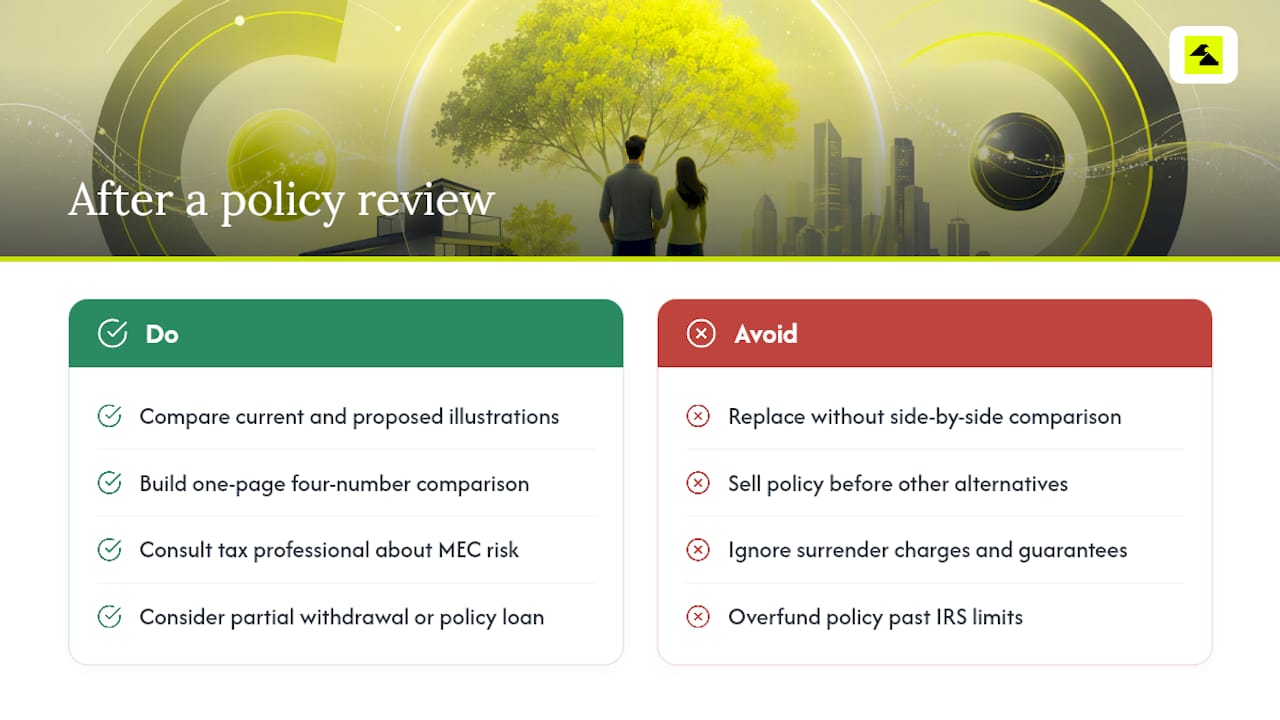
Replacing a policy carries real tradeoffs. You’ll face new underwriting, which means your current health determines your new premium, not the health you had when you bought the original policy. You may also owe surrender charges on the old policy, and you’ll lose any guarantees baked into the original contract. Before replacing anything, compare your current in-force illustration side by side with a proposed replacement illustration, because advisor guidance consistently emphasizes quantifying that gap before signing anything new. A detailed look at replacement tradeoffs is worth reading before you commit either way.
Life settlements, selling your policy to a third party for a lump sum, come up occasionally, usually when someone no longer wants or can afford a policy. Treat this as a last resort. Settlements involve transaction costs, loss of privacy around your medical information, and tax consequences that can be significant depending on your basis in the policy. The NAIC’s consumer guidance on life settlements and FINRA both recommend exhausting other options, like a partial withdrawal or a loan against cash value, before considering a sale.
The single most overlooked tax trap in a policy review is accidentally creating a Modified Endowment Contract. Overfund a policy beyond IRS limits, even with good intentions, and you change how every future distribution is taxed.
That’s the MEC issue in a nutshell. IRS Rev. Proc. 2007-19 lays out the 7-pay test that determines MEC status, and crossing that line means loans and withdrawals get taxed as income first, plus a potential 10% penalty if you’re under 59½. This is exactly the kind of detail a tax professional should confirm for your specific policy, since MEC status hinges on premium timing that’s easy to miss without running the actual numbers.
Pro Tip: Before any policy change, build a one-page comparison: current death benefit versus proposed, current premium versus proposed, surrender cost if you cancel, and your conversion deadline if one applies. Seeing all four numbers together makes bad trades obvious fast.
How Does an Advisor Spot Problems You’d Miss on Your Own?
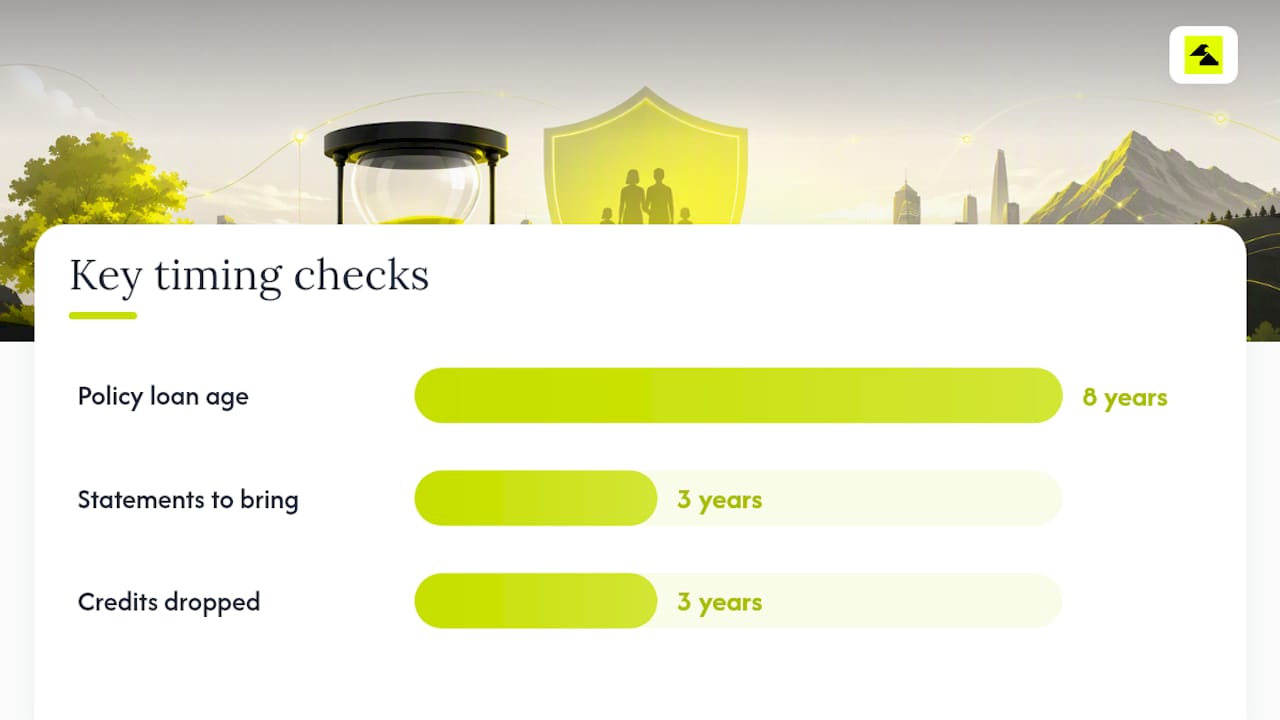
Advisors doing a life insurance evaluation for a living tend to zero in on the same handful of hidden issues, over and over. A policy loan taken out eight years ago and forgotten about. A conversion window that closed last spring without anyone noticing. Nonguaranteed dividend credits that have quietly dropped three years running while the policyholder kept assuming the original illustration was still accurate.
An East Two West advisor working through a client’s policy typically checks:
Loan-to-cash-value ratio, since a loan that’s crept close to 100% of cash value can trigger an unexpected taxable lapse
Whether current nonguaranteed credits still support the original lapse-free projection
Conversion deadlines on any term policy in the household
Whether the policy’s design still matches the client’s current liquidity, guarantee, and tax goals, not the goals they had when they bought it
What to bring to that kind of consultation: every document from the checklist above, a rough sense of your current financial goals, and any statements from the past three years if you have them. A real review usually ends with a short, specific list, not a sales pitch: keep this, fix that, watch this number next year.
The Checklist Matters More Than the Sales Pitch
Most life insurance content online is either a thinly disguised pitch to buy new coverage or a vague reminder to “check your policy sometime.” Neither helps you. What actually moves the needle is treating a review as a numbers exercise: pull the illustration, compare guaranteed to nonguaranteed, check the loan balance against cash value, confirm the conversion deadline hasn’t passed.
The conventional advice to “review annually” is correct but incomplete. Annual reviews catch slow drift. They miss the sudden stuff, a forgotten loan compounding for a decade, a conversion window that quietly closed. That’s why the life-event triggers matter as much as the calendar date.
If you take one thing from this, prioritize the loan-to-cash-value ratio and the conversion deadline before anything else. Those two numbers cause more accidental lapses and lost options than any other item on this checklist, and they’re the easiest to overlook because nothing about them changes dramatically from one year to the next, until suddenly it does.
— Jib Hunt
Get a Professional Review of Your Existing Policy
Running this checklist yourself catches a lot. But when a policy has cash value, outstanding loans, or riders you don’t fully understand, a second set of eyes trained on exactly those numbers is worth the conversation. Insurance advisors work through in-force illustrations line by line, check whether a term policy is worth converting, and design whole life and Infinite Banking structures for people who want their coverage to do more than sit in a drawer.
[

A consultation with East Two West starts with the same documents from the checklist above: your annual statement, in-force illustration, and beneficiary form. From there, an advisor walks through whether your current death benefit still fits your life, whether a loan balance is putting the policy at risk, and whether a different structure, term, whole life, or indexed universal life, would serve your goals better today than it did when you first bought coverage. If you’re ready to see what your policy actually looks like under the hood, visit East Two West to schedule a review.
Where to Learn More
For rules straight from the source rather than a summary: the NAIC buyer’s guide covers consumer basics, IRS Rev. Proc. 2007-19 details MEC tax rules, and FINRA’s guidance covers variable life and settlement suitability concerns.
NAIC consumer buyer’s guide and state insurance department contacts
IRS Rev. Proc. 2007-19 for MEC definitions and tax treatment
FINRA notices on variable life and life settlement suitability
This article is general information, not a substitute for advice from a qualified financial advisor. Consult a qualified financial professional about your own circumstances before acting on anything here.
Sources
FAQ
How Much Is a $100,000 Life Insurance Policy Worth If You Sell It?
Life settlement payouts vary widely based on your age, health, and the policy’s cash value, and they typically pay less than the face amount but more than the cash surrender value. Because settlements carry transaction costs and tax consequences, most guidance treats them as a last resort after exploring loans or partial withdrawals first.
Are Life Insurance Policies Really Worth It?
For most households with dependents or debt, yes, coverage that replaces lost income or pays off a mortgage protects people who’d otherwise face a financial gap. Whether a specific policy is still worth its premium depends on your current coverage amount, cash value performance, and whether your needs have changed since you bought it, which is exactly what an annual review is designed to answer.
How Much Does a $1,000,000 Life Insurance Policy Cost per Month?
Cost depends heavily on age, health, policy type, and term length, so there’s no single monthly figure that applies across the board. A term policy for a healthy younger adult typically costs far less per month than permanent coverage with the same face amount; getting an exact number requires a quote based on your own health profile.
Who Has the Best Reviews for Life Insurance?
Rather than chasing a single “best” ranking, compare carrier financial strength ratings, policy design flexibility, and whether an advisor works independently across multiple carriers or is captive to one company. East Two West works with multiple carriers rather than a single insurer, which lets an advisor match your health profile and goals to the company most likely to offer favorable terms.
How Often Should I Review My Life Insurance Policy?
Once a year at minimum, plus an immediate review after any major life event like marriage, divorce, a new child, or a significant income change. Term policyholders should add a review whenever their conversion window is approaching, since that deadline is one of the easiest things to miss.
Recommended
Comments