Life Insurance Reinstatement: Revive a Lapsed Policy with an Adviser


A lapsed life insurance policy can usually be reinstated, but the odds and paperwork depend heavily on how long it’s been lapsed. Short lapses often need just a signed health statement; longer ones trigger full underwriting or a new medical exam. Pull your policy’s reinstatement clause today, check the deadline it lists, and call your insurer or agent before that window closes.
TL;DR:
Reinstating a lapsed policy typically requires paying all overdue premiums, interest, and providing updated health evidence, with longer lapses demanding full medical exams.
The exact reinstatement window varies by policy type, generally offering several years for permanent policies but shorter for term coverage, depending on the contract clause.
Processing times can range from a few days with minimal proof needed to several weeks if a full medical exam and extensive documentation are required.
A decline in health since the original policy issue may lead to higher premiums or reclassification of risk, making a comparison with new policies advisable.
Acting quickly, honestly disclosing health facts, and consulting an adviser can prevent disputes and optimize reinstatement chances.
Table of Contents
What Is Life Insurance Reinstatement, and How Is It Different From a Grace Period?
The grace period and reinstatement are two different stages of the same problem, and mixing them up costs people money and coverage.
During the grace period, your policy is technically still in force even though you missed a payment. Miss the payment and die during that window, most policies still pay the death benefit minus what you owed. Once the grace period ends without payment, the policy lapses, meaning coverage stops entirely. Reinstatement is the process of asking the insurer to revive that lapsed contract, and it isn’t automatic.
Grace period: coverage active, payment overdue, typically 30 to 31 days.
Lapse: coverage ends, no death benefit if something happens now.
Reinstatement: a new approval process to bring the same policy back to life.
That distinction matters most at claim time. A death during the grace period is usually covered. A death after lapse, before reinstatement is approved, generally is not, even if you’d already mailed a check.
How Long Do You Have to Reinstate a Lapsed Policy?
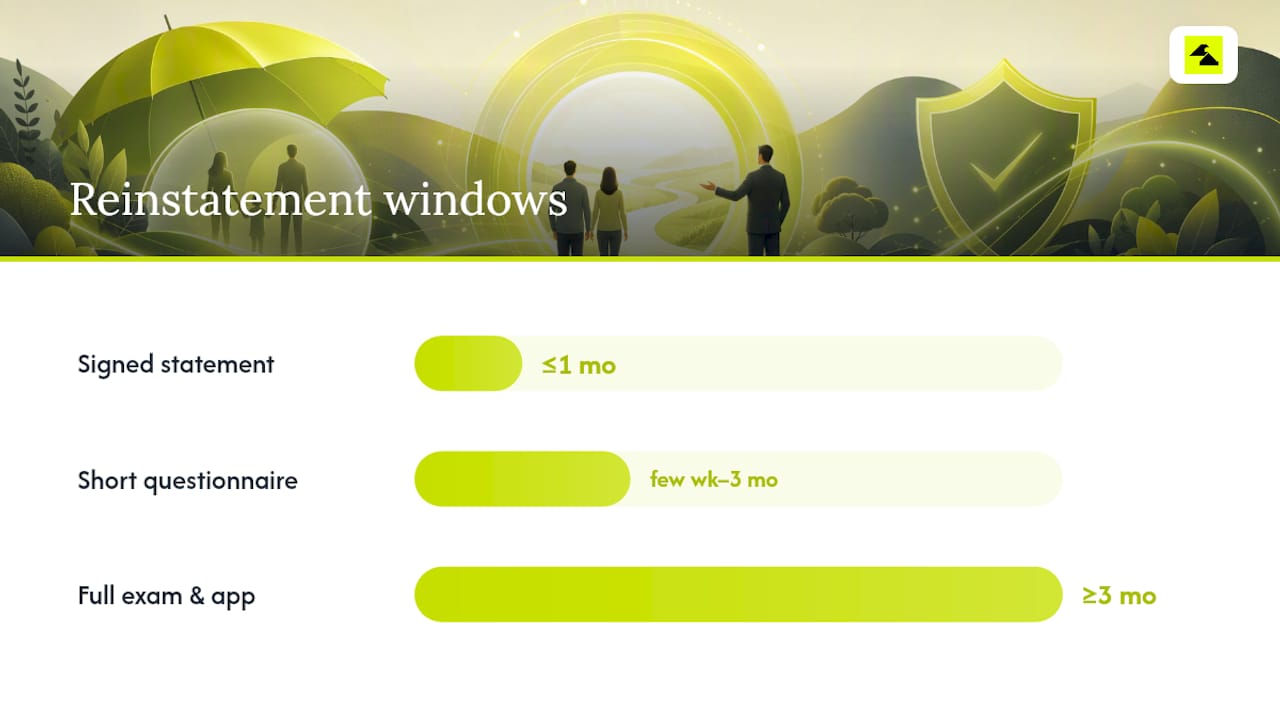
Reinstatement windows vary by carrier and policy type, but industry patterns are consistent enough to plan around. Permanent policies typically allow reinstatement for a longer stretch than term policies, sometimes several years, while term coverage often closes the door much sooner.
What changes the most is how much proof of health the insurer demands, and that scales directly with how long you waited.
Within about one month of lapse: many carriers accept a signed statement confirming you’re still in good health, no exam required.
A few weeks to about three months out: expect a short health questionnaire covering recent diagnoses, medications, and hospital visits.
Around three months or longer: insurers commonly require a full new application, a paramedical exam, and sometimes attending physician statements.
This tiered structure shows up across carrier practices reported in industry coverage, though the exact day counts differ by company. Whole life and IUL policies tend to offer longer reinstatement runways than term because insurers view the accumulated cash value as evidence the policyholder has skin in the game. The actual deadline depends on the specific contract’s reinstatement clause. It’s the document that controls the deadline, not a generic industry average.
What Documents and Evidence Do Insurers Require?
Every reinstatement starts with a formal application and a health statement, and what follows depends on how far your case falls outside a routine approval.
Underwriters commonly request paramedical exams, physician statements, prescription drug histories, or hospital records when your case suggests real risk. Age, face amount, and length of lapse all push a file toward deeper scrutiny. A $50,000 policy lapsed for six weeks gets a light look. A $2 million policy lapsed for eight months gets treated like a brand new application.
Gather the policy contract and locate the exact reinstatement clause and deadline.
Pull your payment history, including the last date a premium was actually paid and accepted.
List current medications, dosages, and the conditions they treat.
Collect recent lab or test results if you’ve had any in the past year.
Write down physician contact information so the insurer can request records without delay.
Complete the reinstatement application and health statement the carrier sends you.
Pro Tip: Call your insurer before you fill out anything. Ask exactly which tier of evidence applies to your specific lapse date. That single call can save weeks, because guessing wrong on the paperwork often means starting over.
What Does Reinstatement Actually Cost?
Reinstating a lapsed policy isn’t free, and the math changes depending on how your health has held up.
You owe every missed premium, and most carriers add interest on that back-premium balance, typically assessed as simple interest calculated from each missed due date. If underwriting finds your health has declined since the original policy was issued, the insurer may reclassify your risk rating, which raises your ongoing premium for the life of the policy, not just as a one-time penalty.
Back premiums owed for every month you missed, no partial forgiveness.
Interest charged on that overdue balance, compounding the longer you wait to act.
A possible rating change if underwriting turns up new health issues.
A likely cheaper new policy if you’re younger, healthier, or rates have dropped since you first applied.
Reinstatement often beats a new policy specifically because it preserves your original issue age and underwriting class. That’s the whole appeal. If your health has genuinely worsened, though, a fresh quote at today’s rates might still land lower than a reinstated policy carrying a worse rating. Before deciding, add up the back premiums, the interest estimate, and compare that total against a current quote for a new policy at your present age.
What Are the Legal Risks of Reinstating a Policy?
Reinstatement isn’t just paperwork. It’s a legal event, and getting it wrong can cost you the whole death benefit.
Whether your contestability period and suicide clause restart at reinstatement depends entirely on your policy’s wording, and courts have ruled differently depending on the contract language and state. Some policies explicitly restate that reinstatement opens a new contestability window; others don’t. Read yours, and consider reviewing how a contestability period actually works before you sign anything.
Material misrepresentation on a reinstatement application carries real teeth. In Spencer v. Kemper Investors Life Insurance, courts examined whether a misstatement on a reinstatement form was significant enough, and relied on heavily enough by the insurer, to justify denying a claim.
Courts generally ask two questions when an insurer denies a reinstated claim over a misstatement: was the misrepresentation material to the insurer’s decision, and did the insurer actually rely on it in approving reinstatement? Answering yes to both has been enough to uphold a denial.
Disclose everything honestly, get written confirmation of whether your contestability clock resets, and keep copies of every form you submit.
Should You Reinstate Your Policy or Apply for New Coverage?
The right call usually comes down to how much time has passed and how your health has changed since the lapse.
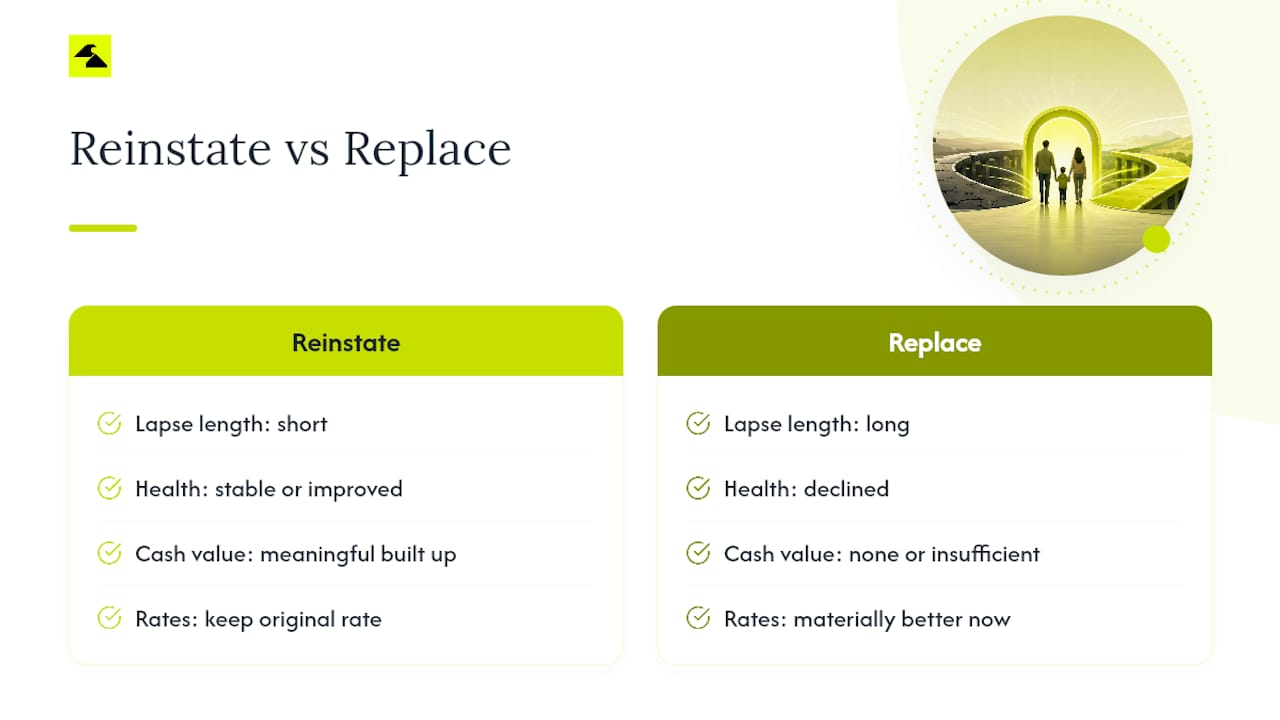
Reinstating tends to make sense with a short lapse, stable or improved health, meaningful cash value already built up, and a strong desire to keep your original issue age and underwriting class intact. Replacing tends to win out after a long lapse, a real decline in health, materially better rates now available, or a coverage need that’s simply shrunk since you first bought the policy. Before deciding, ask yourself: has my health changed since I applied? Is my original rate still competitive today? Would I qualify for the same class again? A closer look at whether replacing your policy makes sense can help sort out the answer.
How Do You Apply for Reinstatement? Step-by-Step
Speed matters here. The longer you wait, the more evidence the insurer will want.
Retrieve your policy and read the reinstatement clause carefully, noting the exact deadline it names.
Contact your insurer or agent and ask for the reinstatement form plus a clear explanation of what evidence your lapse length requires, or explore options available through insurance agency loans if you need funding assistance.
Gather your documentation, meaning payment records, medication lists, and physician contacts, then submit promptly and request written confirmation of the terms.
Follow up on underwriting, and if you’re denied, ask for the reason in writing and consider working with a licensed adviser or applying elsewhere.
Pro Tip: Ask specifically whether accepting your back payment now, before formal approval, could be read as a waiver by the insurer. Some cases, like disputes over agent conduct in Roberts v. Metropolitan Life Insurance, turned on exactly that kind of administrative gray area.
Where Does an Independent Adviser Fit Into This Process?
Reading a reinstatement clause correctly, coordinating medical evidence, and pushing back on an underwriter’s decision is exactly the kind of work an independent adviser handles daily. Advisers specializing in life insurance strategies, including Infinite Banking, can help clients weigh reinstatement against replacement, run 1035 exchange comparisons, and negotiate directly with carriers when a case stalls.
What Actually Matters When You Need Coverage Back Fast
Most people treat reinstatement as a formality, a late payment with extra steps. It isn’t. Insurers treat it as fresh underwriting on a known risk, which is exactly why speed and honesty beat cleverness every time. File the paperwork the moment you notice the lapse, disclose everything even when it’s inconvenient, and don’t gamble on a technicality holding up in a claim dispute years later. If your case involves a large face amount, a long lapse, or any health change, get a licensed adviser involved before you submit anything.
— Jib Hunt
How East Two West Helps With Reinstatement and Replacement Decisions
If you’re staring down a reinstatement deadline or wondering whether replacing your policy makes more financial sense, East Two West gives you an independent read on the situation instead of a single carrier’s sales pitch.
[

East Two West works across Whole Life Insurance, Indexed Universal Life, Term Life Insurance, and Annuities, which means the comparison isn’t limited to “reinstate or don’t.” An adviser can review your reinstatement clause, help assemble the medical evidence underwriters actually want, and run side-by-side quotes so you can see whether keeping your original policy or starting fresh saves more over time. For anyone dealing with a health change since the original application, it’s also worth reading about getting coverage with pre-existing conditions before assuming a new policy is off the table. Some advisers are compensated by the carrier once a policy is placed, not by you directly, so a consultation may cost nothing upfront. Start by requesting a policy review and quote to see where you actually stand.
Sources
Claims in this article draw on Forbes Advisor’s reinstatement guide, Investopedia’s reinstatement entry, Daily Insurance News’ reporting on lapse windows, and case law including Spencer v. Kemper Investors Life Insurance. Your specific policy contract and state rules always govern the actual outcome.
This article is general information, not a substitute for advice from a qualified financial advisor. Consult a qualified financial professional about your own circumstances before acting on anything here.
FAQ
Can a Lapsed Life Insurance Policy Be Reinstated?
Yes, most permanent and term policies include a reinstatement clause allowing you to revive coverage after a lapse, provided you act within the window it specifies. You’ll need to pay back premiums plus interest and, depending on how long you waited, submit evidence of continued good health.
How Long Do You Have to Reinstate a Lapsed Permanent Life Policy?
Permanent policies commonly allow reinstatement for a longer period than term policies, in some cases several years, though the exact window is set by your specific contract. Term policies tend to have noticeably shorter reinstatement periods, so check your policy’s reinstatement clause directly.
How Long Does It Take to Reinstate Life Insurance?
Processing time depends on how much evidence the insurer needs. A reinstatement filed within about 30 days of lapse with just a signed health statement can often be approved in days, while cases requiring a full application and medical exam can take several weeks.
Can I Reinstate a Lapsed Policy if My Health Has Changed?
You can still apply, but a health decline since your original policy was issued may lead the insurer to reclassify your risk rating and raise your ongoing premium. If the change is significant, comparing reinstatement costs against a new policy quote, or getting help from an adviser familiar with post-diagnosis underwriting, is worth doing before you commit.
Recommended
Comments