Using Life Insurance to Reduce Estate Taxes: An ILIT Guide
- Jib Hunt

- 1 hour ago
- 11 min read

A properly structured irrevocable life insurance trust (ILIT) generally removes a life insurance death benefit from the insured’s gross estate, which is the mechanism that produces the estate tax savings. This only works if you avoid two things: retaining “incidents of ownership” over the policy and running afoul of the three-year lookback on transferred policies.
This strategy matters most for estates near or above the federal exclusion threshold, and for residents of the handful of states that tax estates at far lower dollar amounts than the federal government does. If your estate is well under both federal and state thresholds, an ILIT is probably unnecessary complexity.
Three moves to make before you do anything else:
Talk to an estate attorney licensed in your state before drafting or funding anything.
Decide whether you’re having a new policy issued in the trust’s name or transferring an existing one (the tax consequences differ sharply).
Total your assets, including retirement accounts and business interests, against current federal and state estate tax exclusions.
Key Takeaways
An ILIT removes life insurance proceeds from a taxable estate only when the trust owns the policy correctly, avoids incidents of ownership, and clears the three-year lookback.
Point | Details |
Ownership structure decides everything | The trust, not the insured, must hold every incident of ownership under IRC §2042. |
New policy beats transfer | Having the ILIT apply for a new policy avoids the three-year lookback under IRC §2035 entirely. |
Crummey notices are mandatory | Every gift to fund premiums needs a documented withdrawal notice to qualify for the annual gift exclusion. |
Check state thresholds separately | Several states tax estates well below the federal exclusion, so state rules need their own review. |
East Two West compares carriers independently | Readers can shop term, whole life, and IUL options across carriers online or through a consultation before funding an ILIT. |
Table of Contents
How Estate Tax Rules Treat Life Insurance Under IRC §2042
The reason life insurance can balloon a taxable estate comes down to one statute: 26 USC 2042. Under this rule, life insurance proceeds are pulled into the decedent’s gross estate if the decedent held any “incidents of ownership” at death, or if proceeds were payable to the estate itself. A reversionary interest exceeding a small percentage of the policy’s value can also trigger inclusion.
“Incidents of ownership” is a broader net than most people expect. It covers any meaningful control over the policy, not just legal title.
The right to change the beneficiary.
The right to borrow against the policy’s cash value.
The power to surrender or cancel the policy.
Pledging the policy as loan collateral.
Retaining a reversionary interest exceeding 5% of the policy’s value.
That reach is the whole reason ILITs exist as a planning tool. If you buy a $2 million policy and keep any of the powers above, that $2 million death benefit lands in your taxable estate right alongside your house and your investment accounts, even though you never touch a dollar of it personally. The IRS’s own estate tax guidance confirms this is treated as ordinary gross estate property, not a separate category. Miss this detail and the entire point of buying the coverage, protecting your heirs from a tax bill, gets undone by the policy itself.
How Life Insurance Provides Liquidity for Estate Taxes
Death benefits are ordinarily income-tax-free to beneficiaries under IRC §101(a), a separate and more forgiving rule than the estate tax provisions above. That distinction confuses a lot of people: a policy can be completely free of income tax to your beneficiaries and still be fully taxable as part of your estate if you retained ownership incidents. Income tax and estate tax are answering two different questions.
Where life insurance earns its keep in estate planning is liquidity. Estates full of real estate, closely held business interests, or restricted stock have value on paper but no cash on hand when the estate tax bill (or state-level filing) comes due nine months after death.
Paying the federal or state estate tax bill without forcing a fire sale of the family business or a rental property.
Buying illiquid assets out of the estate at fair value, giving the estate cash while keeping the asset among heirs who want it.
Funding equalization payments, so one child can inherit the business while others receive an equivalent cash amount.
Supporting buy-sell agreements between business partners so a surviving owner can buy out a deceased partner’s estate.
Financial planning coverage consistently frames ILITs as liquidity engines for illiquid estates, and that framing is accurate. The catch is that unless the policy is owned correctly, its own death benefit adds to the very estate value it’s supposed to help cover.
Pro Tip: Run the math both ways. Price out what your estate tax bill looks like with and without the death benefit counted as part of your estate. The gap is usually the clearest argument for or against setting up an ILIT.
Term, Whole Life, IUL, or Survivorship: Which Fits an ILIT?
Term insurance is temporary and cheap, which makes it a poor fit for most ILIT strategies since estate tax exposure doesn’t expire when a 20 or 30 year term does. Permanent coverage, whole life, indexed universal life, or guaranteed universal life, is far more common inside an ILIT because the death benefit needs to be there whenever death actually occurs, not just during a policy term.
Term policies: low premiums, but coverage lapses; only useful for a temporary, defined estate tax exposure window.
Permanent policies: higher premiums, lifetime coverage, and often cash value accumulation.
Survivorship (second-to-die) policies: pay out only after both spouses have died, timed to match when estate tax is actually owed under the marital deduction.
Cash value is where permanent policies get tricky inside a trust. If the insured personally borrows against the policy or retains any right to access that cash value, that’s an incident of ownership, right back to the §2042 problem. Inside an ILIT, the trustee, never the insured, controls any loan or withdrawal decisions.
For married couples, survivorship policies often make more sense than two individual policies. Since the federal marital deduction typically defers estate tax until the second spouse dies, a second-to-die policy times the liquidity to arrive exactly when it’s needed, usually at a lower combined premium than two single-life policies would cost.
Setting Up and Funding an ILIT the Right Way
Getting the structure right from day one matters more than almost any other decision in this process.
Have the trust apply for and own a new policy. This is the cleanest approach: the ILIT is the original applicant and owner from inception, so there’s no transfer to worry about and no three-year lookback period at all, an approach Investopedia’s overview of ILITs points to as the standard best practice.
If you’re transferring an existing policy instead, understand IRC §2035. Transfers of an existing policy into an ILIT within three years of death get pulled back into the taxable estate as if the transfer never happened. Transferring still makes sense if you’re young and healthy, but it carries real risk if health changes or death comes sooner than expected.
Build in Crummey withdrawal powers. Named beneficiaries typically get a 30 to 60 day window each year to withdraw a gifted amount from the trust. That temporary right is what converts an otherwise-taxable gift to an irrevocable trust into a gift qualifying for the annual gift tax exclusion, a mechanism Justia’s rundown of ILITs walks through in detail.
Send Crummey notices every time a gift is made. Beneficiaries need written notice of their withdrawal right, and the trustee needs to document that the notice went out and the window passed before paying the premium.
Fund it through gifts, not direct premium payments. You gift cash to the trust, the trustee sends notices, the window lapses, and only then does the trustee pay the insurance company. Keep contemporaneous records of every step.
Pro Tip: Set a recurring calendar reminder tied to your policy’s premium due date, not the calendar year. Crummey notices sent late or skipped entirely are one of the most common reasons these trusts fail on IRS review.
Timing Traps: The Three-Year Rule and State Tax Thresholds
The three-year rule under IRC §2035 is the single most common way a well-intentioned ILIT strategy backfires. Transfer an existing policy into the trust, then die within three years, and the IRS treats the transfer as if it never happened, pulling the full death benefit back into your taxable estate. This is exactly why private letter rulings on retained powers and transfers keep coming up in estate litigation: people assume a transfer alone solves the problem.
State estate and inheritance taxes add a second layer that a lot of people miss entirely. Several states impose estate tax at thresholds far below the federal exclusion, meaning a couple with an estate well under federal limits can still owe state estate tax. Every state’s rules differ, so check your specific state’s threshold rather than assuming federal numbers are the only ones that count.
Gift tax rules intersect here too. The IRS adjusts the annual gift tax exclusion most years for inflation, and Crummey gifts to fund ILIT premiums draw against that annual exclusion per beneficiary. Gifts beyond the annual exclusion use up part of your lifetime gift and estate tax exemption instead, so premium size and beneficiary count both affect how much exemption you’re spending.
Confirm your state’s specific estate or inheritance tax threshold, not just the federal number.
Check the current annual gift tax exclusion amount before calculating how much you can gift per beneficiary without using lifetime exemption.
Track the three-year clock from the date of transfer, not the date of the trust’s creation, if you’re moving an existing policy.
Common ILIT Mistakes That Trigger IRS Scrutiny
Most ILIT failures aren’t dramatic. They’re administrative lapses that quietly recreate the exact incidents of ownership the trust was designed to eliminate.
Missing or improperly worded Crummey notices, or sending them after the premium is already paid.
The grantor serving as trustee while retaining discretion over distributions or investment decisions.
The insured paying premiums directly to the insurance carrier instead of gifting to the trust first.
Vague trust language that doesn’t clearly separate the grantor’s role from the trustee’s authority.
No documented paper trail connecting gifts, notices, and premium payments.
Each of these hands the IRS an argument that the insured retained control in substance, even if the paperwork says otherwise. Justia’s guidance on ILIT administration flags failed Crummey notices and improper trustee powers as the leading causes of disqualification, and that pattern shows up repeatedly in practice.
Best practices are unglamorous but effective: name an independent trustee who isn’t the grantor or the grantor’s spouse, keep the trust language explicit about who controls what, send notices the same week every gift is made, and have the trustee and estate attorney check in at least annually.

Pro Tip: Keep a single folder, physical or digital, with every Crummey notice, gift record, and premium payment confirmation from the trust’s first year forward. If the IRS ever questions the trust, that folder is your entire defense.
Your Step-by-Step ILIT Implementation Checklist
Use this sequence with your advisors rather than trying to execute it solo.
Calculate your total estate value, including retirement accounts, business interests, and real estate, against current federal and your state’s estate tax thresholds.
Engage an estate planning attorney and a tax advisor before drafting trust documents.
Choose an independent trustee, someone other than yourself or your spouse, to hold real authority over the trust.
Decide between a new trust-owned policy or a transfer of an existing one, and if transferring, map the three-year clock against your health and timeline.
Draft Crummey withdrawal provisions into the trust document with clear notice requirements.
Fund the trust with gifts sized to the annual exclusion, and have the trustee send notices and pay premiums only after withdrawal windows lapse.
Review beneficiary designations on other accounts and coordinate the ILIT with your overall estate plan, including any family limited partnerships or charitable trusts already in place.
How East Two West Supports Life Insurance Estate Planning
East Two West provides independent quotes across multiple carriers, so readers building an ILIT can compare permanent policy options, term, whole life, or indexed universal life, without a single-carrier sales pitch. You choose between online self-service quoting or a personalized consultation, depending on how complex your situation is.
That flexibility matters most in a few recurring scenarios:
Funding a new policy for a trust that’s applying as owner from inception.
Evaluating a 1035 exchange versus a straight policy replacement when an existing policy no longer fits an ILIT strategy.
Coordinating coverage for high-net-worth households where survivorship policies or larger death benefits are part of a broader estate plan.
Estate tax planning with life insurance only works when the policy, the ownership structure, and the paperwork all point the same direction. Get an independent comparison before you commit to a carrier or a policy type.
Pro Tip: Bring your estate attorney’s coverage recommendation to East Two West’s quoting process. Comparing carriers after your attorney has specified the death benefit amount and policy type keeps the shopping process focused and fast.
Ready to compare policies for an ILIT or other estate planning need? Get a personalized quote and bring your specific coverage target to the conversation.
What the Conventional ILIT Advice Gets Wrong
Most articles on this topic treat ILIT formation as the finish line. It’s the starting line. The tax benefit lives or dies on administration that happens every single year afterward, not on the day the trust is signed.
The overrated part of the conventional playbook is the trust document itself. Attorneys draft solid ILIT language routinely; that’s not where these strategies fall apart. They fall apart when a grantor pays a premium directly out of habit, or a trustee forgets a Crummey notice during a busy year, quietly recreating the incidents of ownership the whole structure was built to avoid.
What deserves more attention than it gets: choosing a trustee who isn’t the grantor’s spouse or business partner, and treating notice and gift documentation as a permanent, recurring task rather than a one-time setup chore. The three-year rule gets plenty of ink, but sloppy year-two-and-beyond administration causes more real-world failures than mistimed transfers do.
If you take one thing from this: pick your trustee as carefully as you pick your policy, and calendar the Crummey notices before you ever sign the trust.
Frequently Asked Questions
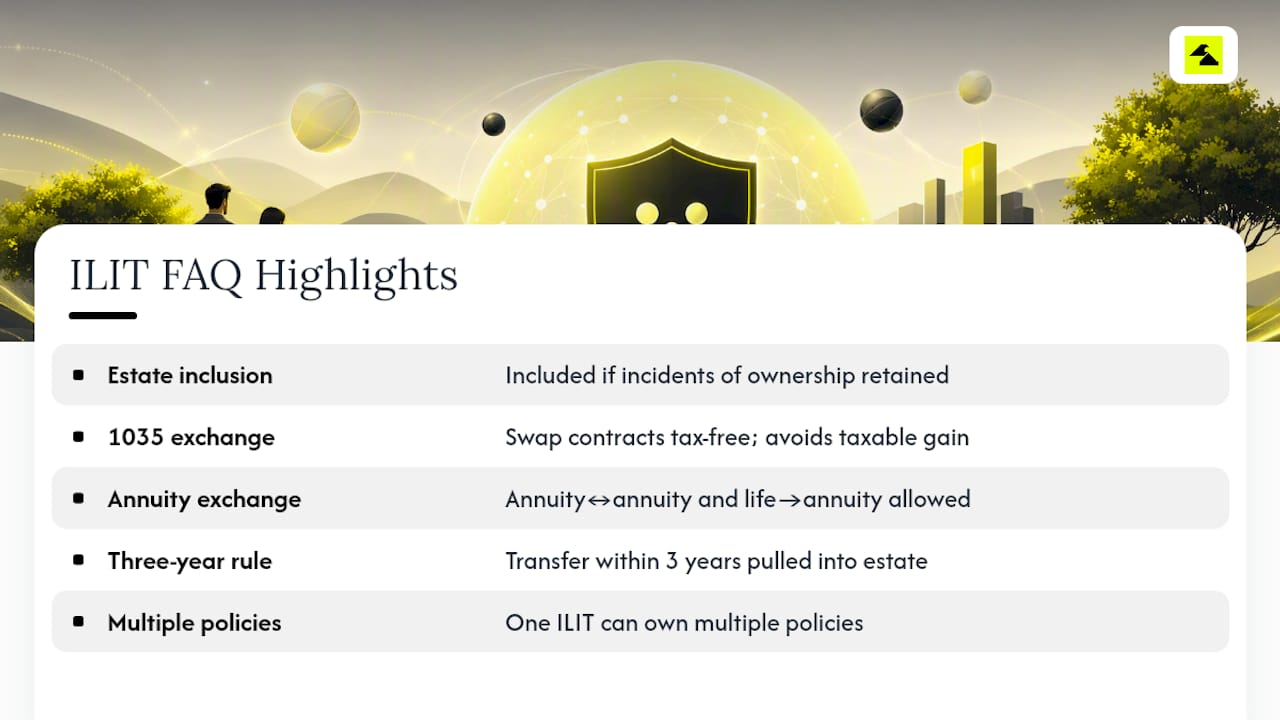
Does life insurance count toward the federal estate tax exclusion? Yes, if you retain any incidents of ownership under IRC §2042. If an ILIT owns the policy correctly from inception, the death benefit generally stays outside your gross estate.
What’s the difference between a 1035 exchange and replacing a policy? A 1035 exchange lets you swap one life insurance or annuity contract for another without triggering income tax on any gain, while a straight policy replacement (surrendering one and buying another separately) can create a taxable event. When evaluating policy replacement vs 1035 exchange for a trust-owned policy, the exchange route usually preserves more value.
Can I do a tax-free annuity exchange the same way as a life insurance exchange? Yes, IRC §1035 covers annuity-to-annuity and life-insurance-to-annuity exchanges under similar rules, though annuity-to-life-insurance exchanges aren’t permitted.
What happens if I transfer an existing policy to an ILIT and die within three years? The death benefit gets pulled back into your taxable estate under the three-year lookback rule, as though the transfer never happened.
Do I need a separate ILIT for each policy? No. One ILIT can own multiple policies, including survivorship policies, as long as the trust document and Crummey provisions are drafted broadly enough to cover them.
How does the generation-skipping transfer tax interact with an ILIT? If an ILIT names grandchildren or later generations as beneficiaries, GST tax exemption needs to be allocated to trust transfers separately from the regular gift and estate exemption, so this needs specific attention in the trust’s drafting.
Are there alternatives to an ILIT for owning life insurance outside my estate? Yes. Options include having an adult child or a spouse own the policy directly, or using a irrevocable life insurance trust structured as a dynasty trust for multi-generational planning. Each carries different control and flexibility trade-offs compared to a standard ILIT.
Does taking a loan against a permanent policy owned by an ILIT cause estate tax problems? It can, if the loan or withdrawal decision isn’t made independently by the trustee. Any retained control by the insured over policy loans reintroduces incidents of ownership.
Can an ILIT work alongside a family limited partnership or charitable trust? Yes. Coordinated estate plans commonly combine an ILIT for liquidity with family limited partnerships for business succession or charitable trusts for philanthropic and tax goals, all under one overall estate plan.
Is term life insurance ever appropriate inside an ILIT? Rarely, since estate tax exposure typically lasts a lifetime while term coverage expires. Permanent policies are the standard choice for ILIT funding.
This article is general information, not a substitute for advice from a qualified financial advisor. Consult a qualified financial professional about your own circumstances before acting on anything here.
Sources
Recommended
Comments