Waiver of Premium Rider: What Policybuyers Need to Know
- Jib Hunt

- 2 days ago
- 11 min read

A waiver of premium rider keeps your life insurance policy active by waiving your premium payments if a qualifying disability stops you from working. You keep the coverage. You stop paying for it, at least temporarily.
That’s the entire concept in one sentence, but three limits decide whether it actually helps you: the elimination period (usually 90 to 180 days before the waiver kicks in), the policy’s own definition of disability, and an age cutoff, typically somewhere between 60 and 65, after which the rider stops applying.
Before you decide anything, do this:
Check your policy’s disability definition, since “own occupation” and “any occupation” produce very different outcomes.
Note the exact length of the elimination period so you’re not surprised by weeks of continued billing.
Keep paying premiums during that waiting period. Missing a payment can lapse the policy before your claim is even reviewed.
Notify your insurer as soon as the disability begins. Waiting too long is one of the most common reasons claims get denied.
Key Takeaways
A waiver of premium rider protects your life insurance policy from lapsing during a qualifying disability, but strict disability definitions and firm age cutoffs limit exactly when it pays off.
Point | Details |
Core function | The rider waives premiums during a qualifying disability so your life policy stays active. |
Elimination period | Expect a 90 to 180 day waiting period, commonly six months, before the waiver activates. |
Disability definition matters most | Own-occupation, any-occupation, and hybrid definitions determine whether a claim actually succeeds. |
Add it at purchase | Most insurers require you to elect the rider at policy issue, not afterward. |
Typical cost | Expect roughly $10 to $50 per month depending on age, health, and policy type. |
Compare before you buy | East Two West compares rider costs and disability definitions across multiple carriers so you can weigh options directly. |
Where to Read More
Social Security’s disability program explains how federal disability determinations work and why an SSA award letter can support an insurance claim.
Investopedia’s waiver of premium overview covers definitions, eligibility, and how the rider differs from disability income insurance.
MoneyGeek’s cost analysis breaks down pricing factors in more detail.
For a broader look at income-protection options beyond this rider, see this overview of income protection strategies.
Table of Contents
What Is a Waiver of Premium Rider, Exactly?
A waiver of premium rider is an optional add-on to a life insurance policy that suspends your premium obligation if you become disabled and can’t work, without letting the coverage lapse, according to Investopedia’s overview of the rider. It’s not a separate policy. It’s a clause attached to a policy you already own or are applying for.
A few distinctions matter here:
Availability: Insurers offer it on both term and permanent policies, though the mechanics differ slightly by policy type.
Cash value effect: On whole life or universal life policies, waiving the premium generally lets cash value keep accumulating as if you were still paying, which is a meaningful benefit permanent policyholders often overlook.
What it isn’t: A premium waiver does not replace lost income. That’s the job of disability income insurance, which pays you a percentage of your salary. The waiver only protects the policy itself, not your paycheck.
How Does Waiver of Premium Actually Work?
The mechanics follow a predictable sequence. You become disabled, you notify the insurer, the disability has to persist continuously through the elimination period, and once the insurer approves the claim, it waives ongoing premiums and often refunds whatever you paid during that waiting window.
Elimination periods commonly run 90 to 180 days, with six months being a frequent standard across insurers, according to an explainer on how waiver of premium riders operate. You’re still on the hook for premiums during that stretch. Insurers typically reimburse those payments retroactively once they approve the claim, but you need the cash on hand in the meantime.
Confirm whether your policy refunds elimination-period premiums or simply stops future billing.
Ask what happens if you recover partway through the waiting period.
Find out whether the waiver has a maximum duration or automatically ends at a set age.
Pro Tip: Set aside a small reserve equal to two or three months of premiums specifically for this gap. If you’re ever disabled, that reserve buys you breathing room while the claim gets processed.
The rider usually terminates at a set age typically around retirement age, on recovery, or at the natural end of a term policy. Permanent policies tend to keep the waiver in force longer since there’s no built-in expiration date the way there is with term coverage.
Own-Occupation vs. Any-Occupation: Why the Fine Print Decides Your Claim

This is the single most consequential distinction in the entire rider. Own-occupation coverage pays out if you can’t perform the specific job you held before becoming disabled, even if you could technically do other work. Any-occupation coverage is stricter: you have to be unable to perform any job reasonably suited to your training and experience, according to an analysis of waiver of premium contract language.
A surgeon who loses fine motor control in one hand would likely qualify under own-occupation but might not qualify under any-occupation, since she could plausibly move into consulting or teaching.
Many policies use a hybrid: own-occupation for the first 24 months, then any-occupation afterward. That shift is exactly why some claimants who qualify initially lose the waiver two years later when the definition tightens.
Elimination period length and start date
Age at which the rider terminates
Pre-existing condition exclusions
Rules for what counts as “continuous” disability
Who Can Actually Get This Rider, and When?
You generally have to elect the rider when you buy the policy. Most insurers won’t let you bolt it on later, especially after any change in your health, according to Investopedia’s coverage of eligibility rules. Miss that window at application, and it’s typically gone for good on that policy.
Age matters too. Many carriers stop offering the rider to applicants above a certain age limit around retirement years, and underwriting will screen your health history and occupation. Certain pre-existing conditions can disqualify you outright.
If you have employer group life coverage with its own disability provisions, check how that interacts with an individual rider before assuming you’re doubly covered.
Occupation matters as much as health. Riskier jobs sometimes trigger higher rider pricing or exclusions.
Once you’re past the eligibility window, your only real option is comparing carriers with higher maximum issue ages.
How Much Does a Waiver of Premium Rider Cost?
Expect to pay somewhere between $10 and $50 a month, depending on your age, health, and the type of policy the rider attaches to, according to MoneyGeek’s cost breakdown of waiver of premium riders. Younger, healthier applicants land at the low end. Older applicants or those adding the rider to a large permanent policy pay more.
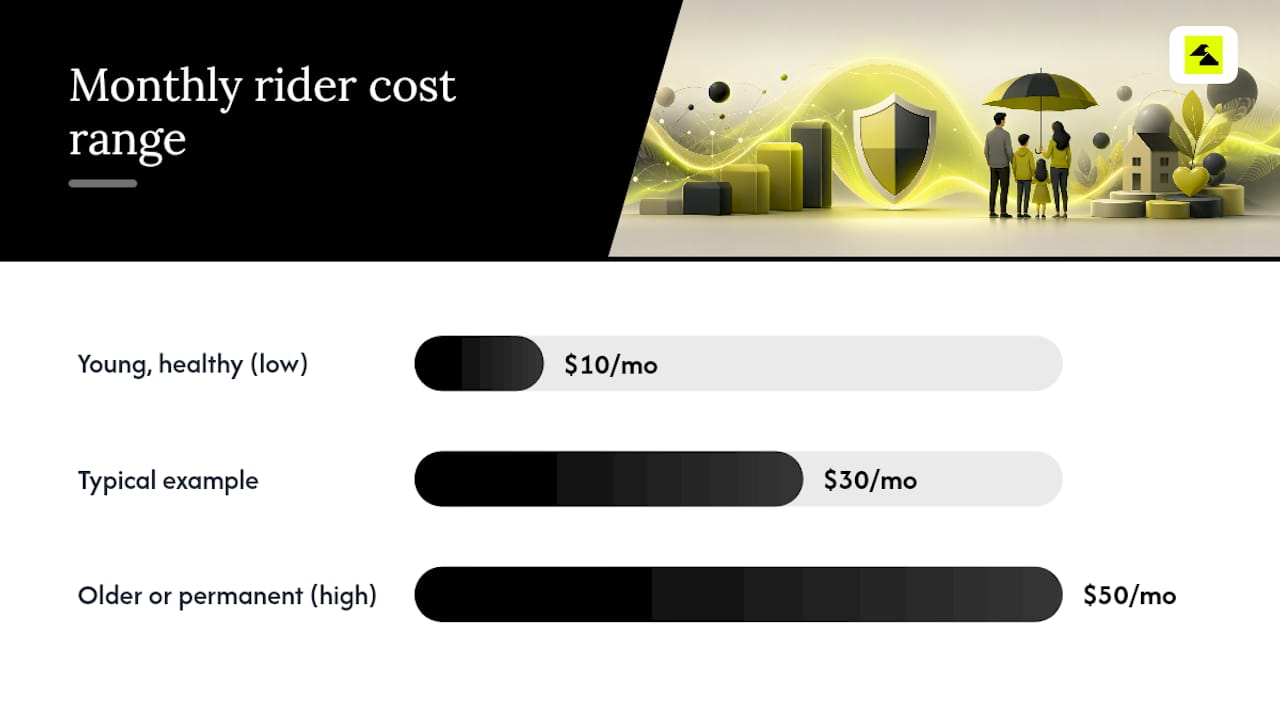
Run the math on a $30-a-month rider: that’s $360 a year to protect a policy that might carry a $500,000 death benefit. If a disability strikes and the policy lapses without the rider, you lose that entire benefit along with years of premiums already paid. Financial advisors frame the rider as cheap insurance for your insurance, since it shifts the lapse risk from you to the carrier during a financial crisis.
Occupation and hobbies factor in too. A commercial diver or a pilot will typically pay more than an office worker for identical coverage amounts.
Is a Waiver of Premium Rider Worth the Trade-Off?
The upside is straightforward: your policy stays active, your death benefit stays intact, and for permanent policies, cash value keeps growing even while you’re not paying. The incremental cost is modest compared to losing coverage altogether.
The downside is just as real. You’re paying extra every month for a benefit you’ll only use if you become disabled under the insurer’s specific definition, and that definition can be stricter than you expect. Age cutoffs mean older buyers may pay for years without ever qualifying for protection near retirement. And again, this rider does not replace your income. It only keeps the policy alive.
Benefits: Lapse protection, preserved death benefit, continued cash value growth, low added cost relative to the policy’s total value.
Drawbacks: Extra premium, strict and sometimes shifting disability definitions, waiting periods before payout, hard age cutoffs, no income replacement.
As a rough rule, the rider tends to make the most sense for primary household earners, people with thin emergency savings, and anyone in a physically demanding or high-injury-risk occupation.
How Do You File a Waiver of Premium Claim?
Speed and documentation determine most outcomes here. Follow this sequence:
Notify your insurer immediately. Most carriers require notice within 30 to 90 days of the disability’s onset, according to Progressive’s explanation of premium waiver claims. Late notice is one of the most frequent, and most avoidable, reasons claims fail.
Gather physician statements and medical records documenting the condition and its impact on your ability to work.
Submit the insurer’s claim forms, along with employment history if the policy uses an occupation-based definition.
Include your SSA disability determination if you have one. A Social Security award letter often corroborates a long-term disability claim and can carry real weight with the underwriting team reviewing your file, per Social Security’s disability program information.
Keep paying premiums throughout the elimination period. Approved claims typically come with a refund for that stretch, but only if the policy stayed in force the whole time.
If a claim gets denied, the two most common causes are a missed notification window or a condition that doesn’t meet the policy’s specific disability threshold. You can usually appeal. Continue paying premiums while the appeal is pending. Letting the policy lapse during a dispute forfeits your leverage entirely.
Pro Tip: Save every piece of correspondence with your insurer, including timestamps. If a dispute over notification timing comes up later, that paper trail is often the deciding factor.
Is the Rider Worth Adding for Your Situation?
Run through a short checklist before deciding:
Are you the primary or sole income earner in your household?
Do you have less than three to six months of expenses saved?
Do you already carry standalone disability income insurance?
Are you within the rider’s typical eligible age range (generally under 55 to 65)?
Does your occupation carry elevated injury or illness risk?
If you answered yes to most of these, the rider is generally worth the added cost. A primary earner with minimal savings and a physically demanding job has the most to lose if a disability derails premium payments and the policy lapses.
If you’re the second earner in a two-income household with substantial savings and low occupational risk, the rider matters less. Your financial cushion already does some of the same job.
For borderline cases, compare the rider’s cost against a standalone disability income policy, or consider a partial strategy: add the rider to your largest policy only, and self-insure the smaller ones. East Two West can walk through that math with you directly.
When and How Do You Add This Rider to a Policy?
You have to elect the waiver at policy issue. Once you’re approved and the policy is in force, most insurers won’t let you add it retroactively, especially if your health has changed since underwriting, according to Investopedia’s eligibility guidance.
During underwriting, expect questions about medical history, current occupation, and hobbies that carry elevated risk. Any of these can affect whether you’re approved for the rider, not just the base policy.
Compare rider costs across multiple carriers rather than accepting the first quote, since pricing for the same benefit varies meaningfully insurer to insurer.
If you’re near a common cutoff age, prioritize carriers known for higher maximum issue ages for this rider.
Pro Tip: Ask each carrier for the rider’s cost as a separate line item, not bundled into the total premium. That’s the only way to compare apples to apples.
What Does This Look Like in Real Numbers?
Term policy scenario: A 38-year-old with a 20-year term policy and a $30 monthly rider becomes disabled at year eight. After a six-month elimination period, the insurer waives premiums for the remaining 11.5 years of the term. Total premiums avoided: potentially thousands of dollars, and the death benefit stays fully intact throughout.

Whole life scenario: A policyholder paying $200 a month into a whole life policy becomes disabled. The insurer waives that $200 monthly premium going forward, and cash value continues accumulating as though payments never stopped, protecting both the death benefit and the long-term savings component.
Elimination-period refund: Someone pays $200 a month for six months while waiting on claim approval, a total of $1,200 out of pocket. Once approved, the insurer refunds that $1,200 and waives all future premiums for the disability’s duration.
What Should You Check Before You Sign?
Read the actual contract language, not just the summary your agent hands you. Look specifically for:
The exact elimination period length and start trigger
Whether the policy uses own-occupation, any-occupation, or a hybrid definition
The precise age at which the rider terminates
Whether premiums paid during the elimination period get refunded
Language covering recurrence: what happens if you recover, then become disabled again from the same condition
Ask your agent directly whether the rider is own-occupation or any-occupation, how “total disability” is defined in that specific contract, and whether elimination-period premiums come back to you. Request the rider wording in writing, and keep a dated record of every claim-related conversation.
How East Two West Thinks About This Rider
We typically recommend the waiver of premium rider for primary earners with thin savings or physically demanding jobs, and we’re candid when it isn’t worth the extra cost for someone else’s situation. Bring your policy wording to a consultation, and we’ll walk through the disability definition together before you commit to anything.
Compare Rider Costs Across Carriers Before You Commit
Rider pricing for identical coverage swings meaningfully from one carrier to the next, and reading fine print on your own is genuinely hard when every insurer phrases “total disability” a little differently. East Two West pulls quotes from multiple carriers side by side, so you can see rider costs and disability definitions next to each other instead of guessing which policy actually protects you best.
[

If you’re still deciding whether to add this rider, start with a free quote comparison and bring any policy wording you already have. If your needs are more complex, whether that’s a high-risk occupation, an approaching age cutoff, or an existing policy you’re trying to evaluate, a personalized consultation walks through the actual contract language with you before you sign anything. You can also compare life insurance and annuity options broadly if you haven’t settled on a policy type yet.
Frequently Asked Questions
What is a premium waiver rider, in plain terms? It’s an add-on to a life insurance policy that pays your premiums for you if you become disabled and can’t work, keeping the policy from lapsing while you’re unable to earn income.
How does waiver of premium work if I recover from my disability? Once you’re no longer considered disabled under the policy’s definition, you resume paying premiums yourself. The rider only covers the period you qualify as disabled.
Can I add a waiver rider insurance benefit after I already own a policy? Usually not. Most carriers require you to elect this rider when you first apply, and won’t add it later, particularly after any change in your health.
Are there affordable premium waiver plans for older applicants? Options exist, but pricing rises with age and availability often ends between roughly 55 and 65. Comparing carriers directly is the best way to find one with a higher maximum issue age.
Does the waiver of premium rider replace disability income insurance? No. It only protects the life insurance policy itself. It does not pay you a percentage of lost wages the way standalone disability income insurance does.
This article is general information, not a substitute for advice from a qualified financial advisor. Consult a qualified financial professional about your own circumstances before acting on anything here.
Sources
Recommended
Comments