Roth IRA vs Annuity: What Retirement Savers Need


For most retirement savers who want tax-free growth and full control over their money, a Roth IRA is the stronger accumulation tool. An annuity earns its place when you need a guaranteed paycheck for life, regardless of what markets do. Many savers end up using both.
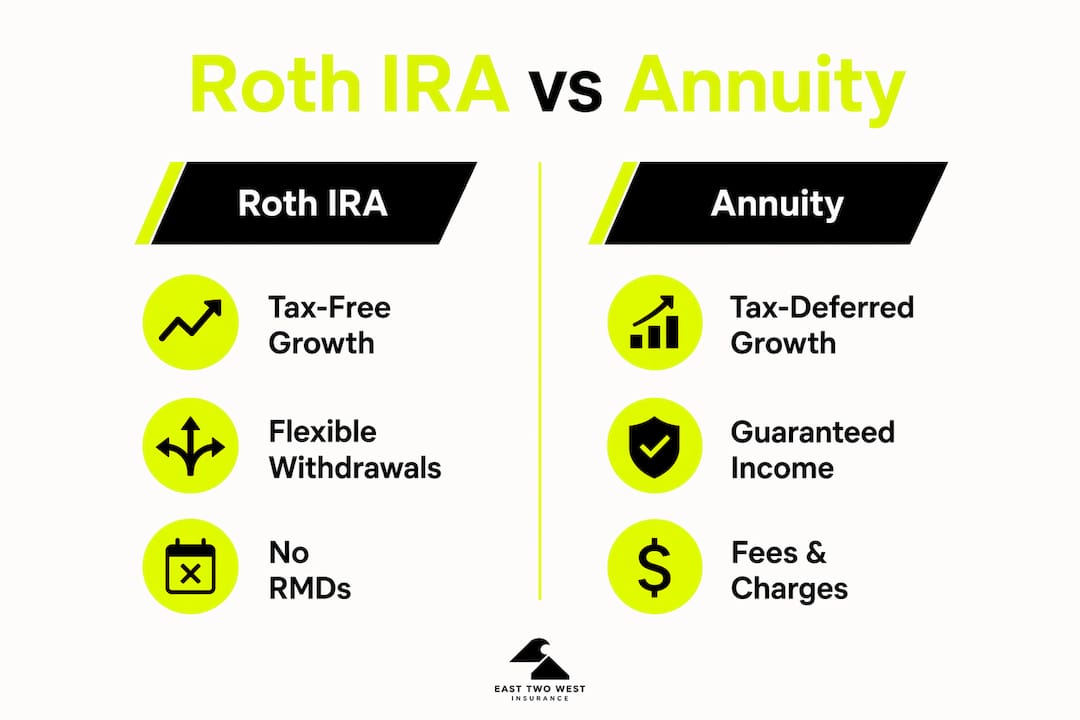
The core difference comes down to two things. Roth IRA earnings grow tax-free, and qualified withdrawals after age 59½ cost you nothing in federal taxes. Annuity earnings grow tax-deferred, but every dollar you pull out gets taxed as ordinary income. On the access side, Roth contributions can be withdrawn penalty-free at any time; most annuity contracts lock your money behind surrender charges for years.
Here is the quick decision map:
Need tax-free growth and flexibility: A Roth IRA fits best. You control the investments, there are no required minimum distributions (RMDs), and your heirs can inherit it cleanly.
Need a predictable income floor for essential expenses: An annuity delivers what a Roth cannot — a contractual guarantee that payments continue for life, no matter how long you live.
Need both: Many planners recommend a bucket approach: build savings in a Roth for growth and flexibility, then convert a portion into an annuity near retirement to cover non-negotiable monthly expenses.
Table of Contents
What is a Roth IRA, and what are the core rules?
A Roth IRA is an account wrapper, not an investment itself. You fund it with after-tax dollars, choose your own investments inside it (stocks, bonds, ETFs, mutual funds), and qualified withdrawals come out completely tax-free. The IRS sets the rules, and a few of them matter a lot when you are comparing this to an annuity.

Contribution limits. The IRS sets the 2026 Roth IRA limit at $7,000 per year, with a $1,000 catch-up contribution allowed if you are 50 or older. That is a combined limit across all your Roth and traditional IRAs.
Income phase-outs. High earners get phased out. The IRS publishes updated modified adjusted gross income (MAGI) thresholds each year, so check current Roth IRA limits before assuming you qualify for a full contribution.
The 5-year rule. Earnings inside a Roth are only tax-free if the account has been open for at least five years AND you are 59½ or older (or meet another qualifying exception such as disability or death). Miss either condition and earnings become taxable, possibly with a 10% penalty.
No RMDs. Unlike a traditional IRA or a 401(k), Roth IRAs have no required minimum distributions while the original owner is alive. That makes them powerful for estate planning — you can let the account grow untouched for decades.
Liquidity. Your original contributions (not earnings) can be withdrawn at any time, penalty-free and tax-free. That is a meaningful safety valve that annuities simply do not offer.
The investment control is real but comes with a catch: your Roth balance can shrink. Market downturns hit it directly. That is the trade-off for the growth potential and tax freedom.
Pro Tip: Verify the current income phase-out thresholds directly on IRS.gov each year before contributing. The limits adjust for inflation, and contributing above the limit triggers a 6% excise tax on the excess.
What is an annuity, and how do payouts actually work?
An annuity is an insurance contract, not an account. You hand a lump sum (or a series of payments) to an insurance company, and in return the carrier promises future payments under terms defined in the contract. That distinction matters: you are giving up ownership of capital in exchange for a contractual guarantee.
Main types you will encounter:
Immediate annuity: You pay now, payments start within a month or two. No accumulation phase.
Deferred annuity: Premiums accumulate for years before payouts begin. Comes in fixed, variable, and indexed flavors.
Fixed annuity / MYGA (multi-year guaranteed annuity): Earns a set interest rate for a defined term, similar to a CD but with tax deferral. Predictable, low-drama.
Variable annuity: Your premium goes into sub-accounts that mirror mutual funds. Returns fluctuate with markets; the insurance wrapper adds a death benefit or income rider, usually at a cost.
Fixed indexed annuity (FIA): Returns are linked to a market index (often the S&P 500) with a floor at zero, so you cannot lose principal to market drops, but gains are capped or subject to a participation rate.
Lifetime income annuity: Structured to pay for as long as you live, period-certain, or on a joint-survivor basis covering a spouse.
How the guarantee actually works. The carrier’s promise is backed by its own financial strength and, as a backstop, your state’s guaranty association. Coverage limits vary by state, so a very large annuity purchase with a single carrier carries concentration risk.
Fees and traps to know. Annuities often carry surrender charges, mortality and expense fees, and administrative fees that reduce effective returns compared to a brokerage account or Roth. Surrender periods commonly run six to ten years, with charges starting as high as 7–10% in year one and stepping down annually. Optional riders (guaranteed minimum income benefit, long-term care, enhanced death benefit) add annual costs, often 0.5–1.5% of the contract value each. Read the fine print on risk disclosures and guarantees before signing anything.

How do a Roth IRA and an annuity compare side by side?
The table below maps the eight dimensions that matter most when choosing between these two vehicles.
Dimension | Roth IRA | Annuity |
Tax treatment (growth) | Grows tax-free | Grows tax-deferred |
Tax treatment (withdrawals) | Qualified withdrawals fully tax-free | Distributions taxed as ordinary income |
Income guarantee / longevity protection | None — market-dependent | Contractual lifetime income available |
Liquidity / access to principal | Contributions withdrawable anytime penalty-free | Surrender charges apply for 6–10 years typically |
Investment control / market risk | Full control; full market exposure | Fixed: no market risk; variable: market risk; indexed: capped upside |
Fees and costs | Fund expense ratios only (often 0.1–0.5%) | Surrender charges, M&E fees, rider costs, admin fees |
Eligibility / holding rules | Income limits; 5-year rule; age 59½ for tax-free earnings | No income limits; surrender period defined by contract |
Legacy / estate treatment | Passes to named beneficiaries; no RMDs for owner | Death benefit varies by contract; may lose value at death |
Annuities are insurance contracts that can provide guaranteed lifetime income regardless of market performance, while a Roth IRA requires active investment management and carries full market risk. Neither is universally better — the right answer depends on what you need the money to do.
Four questions to answer before you decide:
Do you have other guaranteed income (Social Security, pension) that already covers your essential monthly expenses?
How long do you expect to live, and does longevity risk keep you up at night?
Will you need access to this capital before age 65 for emergencies or opportunities?
What is your expected tax bracket in retirement — and do you expect it to rise or fall?
Pros and cons of each, and who typically benefits
Roth IRA: strengths and limits
Pros:
Tax-free qualified withdrawals reduce retirement tax burden significantly
No RMDs, so the account can compound for decades or pass to heirs
Full investment control — choose any asset class available at your custodian
Contributions (not earnings) withdrawable anytime without penalty, providing a liquidity cushion
No surrender periods or insurance-company concentration risk
Cons:
Annual contribution limits cap how fast you can build the account
Income limits exclude high earners from direct contributions
Balance can shrink in a down market — no floor on losses
Requires active management decisions; neglect can cost returns
Annuity: strengths and limits
Pros:
Guaranteed lifetime income eliminates the fear of outliving your money
Fixed and indexed options protect principal from market losses
Tax deferral on growth (useful in taxable accounts, less so inside an IRA)
Payments can be structured for a surviving spouse
Cons:
Payouts taxed as ordinary income, which can be costly in higher brackets
Surrender charges lock up capital for years
Fees on variable and indexed products can meaningfully erode returns
Death benefits vary; some contracts pay little or nothing to heirs beyond the contract value
Who benefits from each
A younger accumulation-focused saver in their 30s or 40s almost always does better maxing a Roth IRA first. The decades of tax-free compounding are hard to beat. A near-retiree in their late 50s or early 60s without a pension may find that converting a portion of savings into a lifetime income annuity creates the income floor that lets the rest of the portfolio stay invested in growth assets. A pension-less retiree worried about longevity gets the most from an annuity’s guarantee — especially if Social Security alone does not cover fixed monthly costs.
Pro Tip: When evaluating an annuity with income riders, ask the agent to show you the net payout rate after all annual rider fees are subtracted from the contract value. A headline guarantee of 6% can shrink to 3–4% effective yield once fees are factored in.
How much will a $100,000 annuity pay? A worked example
Here is a straightforward illustration. A 65-year-old purchasing a $100,000 immediate fixed lifetime annuity (single life, no inflation rider, no period-certain guarantee) might receive roughly $500–$600 per month, depending on the carrier and the interest-rate environment at the time of purchase. These are illustrative estimates, not quotes.
Assumptions driving that range:
Age 65 at purchase (older buyers receive higher monthly payments because the payout period is shorter)
Single-life payout (payments stop at death; no survivor benefit)
No inflation adjustment rider
Fixed immediate annuity, not variable or indexed
Current interest-rate environment (rates directly affect payout levels — higher rates produce higher monthly payments)
Add a joint-survivor option for a spouse and the monthly payment drops, often by 10–20%, because the carrier is now guaranteeing payments over two lifetimes. Add an inflation rider and it drops further.
Tax treatment of the payout. If you buy the annuity with after-tax dollars (as you would from a Roth IRA distribution or personal savings), a portion of each payment is considered a return of your original principal and is not taxable. The earnings portion is taxed as ordinary income. The IRS’s Publication 575 covers how to calculate the taxable portion using the Simplified Method or General Rule. If you buy the annuity inside a traditional IRA with pre-tax funds, the entire payment is taxable as ordinary income when received.
Pro Tip: Annuity payouts depend on age, payout type, and interest rates and vary widely by carrier. Get quotes from at least three carriers before committing — a difference of $50–$80 per month on a $100,000 purchase is common across carriers quoting the same day.
Who should choose a Roth, an annuity, or both?
The answer usually comes from a short diagnostic. Work through these questions honestly:
Do you have guaranteed income covering your fixed monthly expenses? If Social Security and any pension already cover rent, utilities, and food, you may not need an annuity at all. A Roth for growth makes more sense.
Are you worried about outliving your savings? If yes, an annuity’s longevity protection addresses that directly. A Roth cannot guarantee income for life.
Do you need liquidity in the next five to ten years? If you might need the capital, a Roth’s flexibility wins. Annuity surrender charges make early access expensive.
What is your tax situation in retirement? If you expect a high bracket, tax-free Roth withdrawals are especially valuable. If you expect a low bracket, the ordinary-income tax on annuity payouts is less painful.
Do you have heirs you want to leave assets to? A Roth with no RMDs passes cleanly to beneficiaries. Annuity death benefits vary widely by contract.
The bucket approach in practice
Financial planners often recommend a hybrid strategy: use a Roth (or other IRA) for accumulation and tax planning, then convert a portion of savings into an annuity near retirement to create an income floor. As an illustrative example only, a retiree might allocate roughly 30–40% of savings to an annuity to cover essential expenses, keeping the remaining 60–70% in a Roth or other growth accounts for flexibility and legacy. The exact split depends on your Social Security income, expenses, health, and risk tolerance.
Red flags for annuity buyers:
A salesperson who cannot clearly explain the surrender schedule
Riders stacked on riders with no clear explanation of the net cost
Pressure to decide before you have compared at least two or three carrier quotes
A variable annuity pitched primarily for its tax deferral inside an already tax-advantaged IRA
Red flags for Roth misuse:
Concentrating a Roth entirely in speculative assets within five years of retirement
Treating Roth contributions as an emergency fund and withdrawing them repeatedly
Consult a CFP and a tax advisor before making a large annuity purchase or executing a Roth conversion. The stakes are high enough that a few hundred dollars in professional advice can save thousands in taxes or fees.
Rollovers, conversions, and combining the two
Annuities inside IRAs: usually a bad fit
Buying an annuity inside a traditional IRA typically adds no tax benefit because the IRA already provides tax deferral. You end up paying annuity fees for a feature you already have. Worse, if the annuity is inside a traditional IRA, RMDs still apply starting at age 73, which can complicate or even conflict with the annuity’s payout structure.
Putting a complex annuity inside a Roth IRA is even harder to justify. The Roth already delivers tax-free growth. Adding an annuity wrapper layers fees and surrender charges on top of a benefit you already own for free.
Key points on rollovers and conversions:
A Roth conversion (moving traditional IRA funds to a Roth) triggers ordinary income tax on the converted amount in the year of conversion. Timing matters — converting in a low-income year reduces the tax hit.
If you plan to buy an annuity, converting to a Roth first and then purchasing the annuity with after-tax Roth funds means a portion of each future payout will be a tax-free return of basis.
Rolling a traditional IRA directly into an annuity inside a traditional IRA preserves the pre-tax status but means every payout will be fully taxable as ordinary income.
A 60-day rollover rule applies when you receive a distribution and want to move it to another account. Miss the window and the distribution becomes taxable.
The cleanest structure for most people: keep the Roth IRA as a Roth IRA, and purchase any annuity with after-tax dollars outside the IRA, or inside a traditional IRA only when the annuity’s income guarantee is the specific goal and you have accounted for RMDs.
How East Two West helps you compare annuities
East Two West is an independent life insurance and annuity practice. The process is straightforward: use the online quoting tool to get fast comparisons across multiple carriers, or schedule a personalized consultation if your situation involves complex income needs, health considerations, or large policy amounts.
The practice compares lifetime income annuities, MYGAs, and other annuity types across carriers, showing you payout rates, surrender schedules, and rider costs side by side. That transparency is the point. You see what each carrier actually delivers after fees, not just the headline guarantee.
Disclosure: East Two West is an independent broker. When a policy is placed, the issuing carrier pays a commission. There is no direct fee charged to clients. That structure is standard in the insurance industry, and East Two West’s commitment is to present options that fit your needs, not to push a particular carrier.
Before making a final decision on any annuity, compare at least two or three carrier quotes, review the full surrender schedule, and confirm the death benefit terms. For tax questions related to Roth conversions or annuity taxation, consult a tax advisor or CPA. East Two West provides insurance guidance, not tax or legal advice.
Key Takeaways
A Roth IRA builds tax-free retirement wealth with full flexibility; an annuity converts savings into guaranteed lifetime income, and combining both often produces the most resilient retirement income plan.
Point | Details |
Tax treatment differs fundamentally | Roth withdrawals are tax-free when qualified; annuity payouts are taxed as ordinary income every time. |
Liquidity vs. guarantee trade-off | Roth contributions are accessible anytime penalty-free; annuities lock capital behind surrender charges for years. |
No RMDs on Roth IRAs | Roth IRAs require no distributions during the owner’s lifetime, making them powerful for estate planning. |
Get multiple annuity quotes | Payout rates vary widely by carrier; comparing at least three quotes is the single most effective way to avoid leaving money on the table. |
East Two West | Compare lifetime income annuities and MYGAs across multiple carriers with no-pressure online quotes or a personalized consultation at East Two West. |
Why both options deserve a seat at the table
The conventional framing of this comparison sets up a false choice. Most retirement planning articles treat Roth IRAs and annuities as rivals, as if choosing one means rejecting the other. That framing serves content structure more than it serves readers.
The more useful lens is function. A Roth IRA does one thing exceptionally well: it lets savings compound tax-free and gives you control. An annuity does a different thing exceptionally well: it removes the risk of outliving your money by converting a lump sum into a guaranteed income stream. These are not competing functions. They are complementary ones.
What I find most underappreciated in this debate is the psychological value of the income floor. Retirees with guaranteed income covering their fixed expenses consistently report less financial anxiety and make better investment decisions with the rest of their portfolio. They are not forced to sell growth assets in a down market to pay the electric bill. That behavioral benefit does not show up in a rate-of-return comparison, but it is real and it compounds over a long retirement.
The honest caveat: annuities are only as good as the carrier behind them and the terms you negotiate. A poorly structured annuity with opaque riders and a ten-year surrender period is a bad deal regardless of the guarantee. The due diligence is non-negotiable. Compare net payout rates after all fees, read the surrender schedule in full, and understand exactly what happens to the contract value when you die.
Getting a no-pressure annuity quote from East Two West
Comparing annuity options does not have to mean sitting through a high-pressure sales call. East Two West gives you two paths: complete the online quote form in a few minutes, or schedule a consultation call if you want to talk through your income needs, health situation, or how an annuity fits alongside your Roth IRA.
[

To get an accurate quote, have three things ready: your age (and your spouse’s age if you want a joint-survivor option), the lump sum amount you are considering, and your target start date for income. East Two West compares lifetime income annuities, MYGAs, and other products across multiple carriers, so you see real payout rates and surrender schedules, not just a single carrier’s pitch.
Transparent disclosure: East Two West is an independent broker compensated by the issuing carrier when a policy is placed. No fees are charged directly to you. Compare the quotes carefully, review rider costs, and consult a tax advisor or CFP for decisions involving Roth conversions or large annuity purchases. Visit East Two West to start comparing options on your own terms.
This article is general information, not personalized financial, tax, or legal advice. Verify current IRS rules and consult a qualified professional for your specific situation.
Authoritative sources and where to verify the rules
IRS — Roth IRAs: The primary source for contribution rules, income limits, the 5-year rule, and qualified withdrawal requirements. Check here annually — limits adjust for inflation.
IRS — Publication 575: Covers the tax treatment of annuity distributions, including how to calculate the taxable and non-taxable portions of each payment.
IRS — RMD FAQs: Confirms that Roth IRAs have no required minimum distributions for the original owner.
Investopedia — Annuities vs. IRAs: Accessible overview of how annuities, 401(k)s, and IRAs differ in tax treatment and structure.
CBS News — IRA vs. Annuity: Expert commentary on the guarantee-vs-liquidity trade-off and the bucket approach to retirement income.
Experian — Annuity vs. IRA: Practical discussion of how payout rates vary by carrier, age, and interest-rate environment.
Always confirm current IRS rules directly on IRS.gov before making contribution or conversion decisions. For personalized guidance, work with a CFP or tax advisor who has reviewed your full financial picture.
Recommended
Comments