SPIA vs MYGA: Which Annuity Fits Your Retirement?


A SPIA delivers guaranteed lifetime income starting within 30 days of purchase. A MYGA locks in a fixed crediting rate for a set term, typically 3–10 years, and grows your money tax-deferred without paying out immediately. In practical terms: if you need income now, a SPIA is almost always the right call. If you have a lump sum and a few years before you need the cash, a MYGA earns more efficiently while you wait.
Typical SPIA payout rates for a 65-year-old male often show monthly payouts well above what a savings account or CD pays. Recent 5-year MYGA rates have been reported around 5.6% in April 2026. Those numbers look close on paper, but they measure completely different things. SPIA payouts include mortality credits, which means the insurer pools longevity risk across thousands of policyholders and redistributes the savings of those who die early to those who live longer. A MYGA rate is pure interest.
The one-line rule: Retirees with an income gap choose a SPIA. Near-retirees with a 5–10 year runway before they need income choose a MYGA.
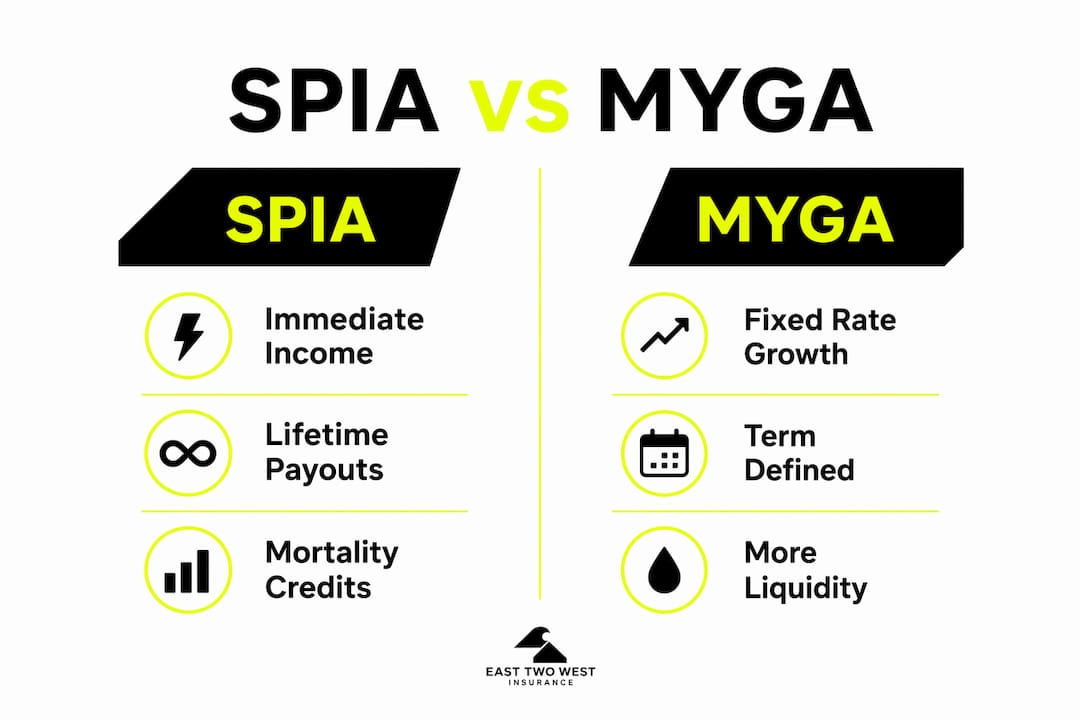
SPIA: immediate lifetime income, payments begin within 30 days, payout includes mortality credits
MYGA: fixed-rate accumulation, guaranteed crediting rate for a set term, tax-deferred growth
Age window: deferred annuities tend to suit ages 50–62.
SPIAs commonly make sense for ages 62–75 when income is needed now
Table of Contents
How SPIA vs MYGA compare across every key dimension
The table below maps both products across the dimensions that actually move the needle in a retirement plan.
Dimension | SPIA | MYGA |
Primary purpose | Immediate lifetime income | Fixed-term guaranteed accumulation |
Published rate metric | Payout % (income / premium) | Guaranteed crediting rate (APY) |
Tax treatment | Exclusion ratio: part of each payment is tax-free return of principal | Interest taxed as ordinary income upon withdrawal (LIFO for nonqualified) |
Liquidity / surrender | Generally irrevocable; limited commutation options | Surrender charges (typically starting ~7–8%) declining over term; 10% free withdrawal per year |
Guarantees & payout options | Life-only, period-certain, joint-life, inflation rider | Guaranteed rate for stated term; renewal rate set at end of term |
Credit risk | Carrier financial strength (AM Best, S&P); state guaranty limits | Same carrier risk; state guaranty limits apply |
Fees / riders | No explicit ongoing fees; margin embedded in payout rate | No explicit annual fees; optional rider costs reduce net yield |
Best for | Retiree needing income now, age 62–75 | Pre-retiree accumulating, age 50–62, 3–10 year horizon |
SPIA pros and cons
Pros: Guaranteed income you cannot outlive; no ongoing fees; exclusion ratio reduces taxable portion for nonqualified funds; payments start fast
Cons: Largely irrevocable once purchased; fixed payments lose purchasing power over time without an inflation rider; death benefit depends on payout option chosen
MYGA pros and cons
Pros: Tax-deferred compounding; predictable guaranteed rate; surrender period ends and you regain full access; 10% annual free withdrawal available at most carriers
Cons: Surrender charges start around 7–8% and decline over the term; interest is fully taxable upon withdrawal; no lifetime income guarantee without later annuitization
Sample 5-year comparison on $100,000 (illustrative assumptions only)
Assumptions: 65-year-old male, nonqualified funds, SPIA life-only payout at $650/month, MYGA at 5.6% guaranteed for 5 years.
SPIA: $650 × 60 months = $39,000 total received over 5 years. Principal is not returned separately; payments continue for life.
MYGA: $100,000 compounding at 5.6% for 5 years = about $131,500 at end of term. No income during accumulation phase.
These are not apples-to-apples comparisons of yield. The SPIA is an income stream; the MYGA is a growing lump sum. The right question is which one solves your actual problem.
How SPIA payouts and MYGA crediting are actually calculated
Understanding the math behind the headline numbers is what separates a confident buyer from someone who just picked the higher-looking percentage.

1. Mortality credits: why SPIA payouts look higher
A SPIA payout is not an interest rate. When you hand $100,000 to an insurer, they pool your premium with thousands of other annuitants. Those who die early effectively subsidize the payments of those who live longer. This redistribution is called a mortality credit, and it is why a 70-year-old can receive a payout percentage that no CD or bond can match. The older you are at purchase, the larger the mortality credit component.
2. The exclusion ratio for nonqualified SPIAs
For after-tax (nonqualified) money, the IRS allows you to recover your original investment tax-free over your expected payment period. The formula is straightforward:
Exclusion ratio = Total investment in contract ÷ Expected total payments
Example: $100,000 premium, life expectancy of 20 years, $650/month payout ($7,800/year).
Expected total payments: $7,800 × 20 = $156,000
Exclusion ratio: $100,000 ÷ $156,000 = 64.1%
Tax-free portion of each payment: $650 × 64.1% = $417
Taxable portion: $650 − $417 = $233 per month
Once you have recovered your full $100,000 investment, every subsequent payment becomes fully taxable. For qualified (IRA/401k) funds, there is no exclusion ratio and the full payment is taxable.
3. How MYGA crediting compounds
A MYGA credits interest daily or annually at the guaranteed rate. At 5.6% compounded annually, $100,000 grows as follows:
Year 1: $105,600
Year 3: $117,700 (approximate)
Year 5: $131,500 (approximate)
The quoted rate and the effective yield are the same when interest compounds annually with no fees. Where they diverge is when riders or administrative charges reduce the net credited amount. Always ask for the net effective yield after any rider costs.
4. Payout options and how they change the math
Life-only: Highest monthly payment; payments stop at death regardless of how much principal remains.
Period-certain (10 or 20 years): Lower monthly payment; if you die early, payments continue to a beneficiary for the remainder of the period.
Joint-life: Payments continue as long as either spouse lives; lower monthly amount than single-life.
Inflation rider: Payments increase annually (commonly 1–3%); starting payment is lower to fund future increases.
Pro Tip: Run a breakeven calculation before you annuitize. Divide your premium by the annual payout to find the number of years you need to live to recover your principal. For a $100,000 premium paying $7,800/year, breakeven is roughly 12.8 years. If your health history suggests you are likely to exceed that, a life-only SPIA is hard to beat.
How taxes hit SPIA payments and MYGA withdrawals differently
Tax treatment is where these two products diverge most sharply in practice, and it is the dimension most buyers underestimate.
For nonqualified SPIAs, the exclusion ratio (explained above) means a meaningful portion of each payment comes back to you tax-free. In the worked example, $417 of a $650 monthly payment is tax-free, and only $233 hits your ordinary income each month. That is a real structural advantage for retirees managing taxable income.
MYGAs handle taxes differently. Interest credited inside a nonqualified MYGA grows tax-deferred, which sounds great until you withdraw. At that point, MYGA interest is taxed as ordinary income under LIFO (last-in, first-out) rules, meaning the IRS treats your first withdrawals as interest, not principal return. You pay taxes on the gains before you touch your original investment. For a 5-year MYGA that grew from $100,000 to $131,500, the $31,500 in interest is fully taxable upon withdrawal.
Key tax comparison bullets:
Nonqualified SPIA: partial tax-free recovery via exclusion ratio; tax burden spread over payment years
Nonqualified MYGA: tax-deferred growth, but all gains taxed as ordinary income upon distribution (LIFO)
Qualified (IRA/401k) funds: both products are fully taxable upon distribution; no exclusion ratio applies
MYGA distributions can spike your Modified Adjusted Gross Income (MAGI) in the year you withdraw, which may trigger higher Medicare Part B and D premiums under IRMAA thresholds
Tax note: Annuity income, whether from a SPIA or a MYGA withdrawal, can push Social Security benefits into higher taxable brackets and affect Medicare means-testing. Before you commit to either product, run the numbers with a tax advisor or CPA who can model your full income picture.
This article provides general information, not tax or legal advice. Confirm current tax rules and your specific situation with a qualified tax professional.
Liquidity, surrender charges, and the risks you need to price in
A SPIA is essentially irrevocable. Once you hand over the premium and the contract is issued, the insurer owns the principal. Some carriers offer a commutation feature that lets you take a lump-sum present value of remaining payments, but it is not standard and the terms are rarely favorable. If liquidity matters to you, a SPIA requires careful sizing.
MYGAs offer more flexibility, but not unlimited access. Surrender charges typically start high in the first year and step down each year until the guarantee period ends. Most contracts allow a 10% free withdrawal annually without penalty. Pull more than that before the surrender period ends, and the charge reduces your net return materially.

Sample surrender schedule (illustrative, 7-year MYGA):
Year | Surrender Charge |
1 | 7% |
2 | 6% |
3 | 5% |
4 | 4% |
5 | 3% |
6 | 2% |
7 | 1% |
Primary risks for each product:
Inflation risk: Fixed SPIA payments lose purchasing power over time. A $650/month payment in 2026 buys less in 2036. An inflation rider helps but reduces the starting payment.
Longevity risk: MYGAs do not provide lifetime income. If you outlive the term and do not annuitize, you bear the reinvestment risk at whatever rates exist then.
Opportunity cost: Both products lock up capital. If interest rates rise sharply after purchase, you are stuck with the original rate (MYGA) or payout (SPIA).
Carrier credit risk: Both products are only as good as the issuing carrier. Check AM Best and S&P ratings before you buy.
Carrier financial strength is not a formality. State guaranty associations cover annuity contracts up to per-insurer, per-person limits that vary by state. If a carrier becomes insolvent, your coverage depends on both your state’s guaranty limit and the carrier’s ability to be absorbed by a solvent insurer. AM Best and S&P ratings are the first filter — look for A- or better before you place a large premium with any single carrier.
For large premiums, spreading across two carriers with strong ratings is a practical way to stay within state guaranty limits while maintaining the income or accumulation you need.
Which product fits your situation?
The right product depends less on which rate looks higher and more on where you are in retirement and what problem you are solving.
1. Retired at 68 with a monthly income gap
You need $800/month more than Social Security provides. A SPIA on $120,000–$140,000 of savings can close that gap immediately with a guaranteed payment you cannot outlive. A MYGA does nothing for you today.
2. Age 58 with a lump sum and a 7-year horizon
You have $200,000 from a pension rollover and do not need income until 65. A MYGA locks in a competitive rate, grows tax-deferred, and matures right when you need to convert to income. This is the textbook MYGA use case.
3. Couple wanting survivor income
A joint-life SPIA covers both spouses for as long as either lives. The monthly payment is lower than a single-life option, but the protection against one spouse outliving the other is built in. Compare joint-life quotes carefully because the pricing gap between carriers can be significant.
4. Single person with health concerns
If your health suggests a shorter-than-average life expectancy, a life-only SPIA may not be the right fit. A period-certain option protects a beneficiary, or a MYGA with a named beneficiary keeps the full account value in the family.
Hybrid strategies worth considering:
MYGA ladder into SPIA: Buy a MYGA now, let it compound for 5–7 years, then use the matured value to purchase a SPIA at a higher age (and therefore a higher payout rate). This is a common planning approach for near-retirees who want to maximize lifetime income.
Split allocation: Divide a lump sum among a liquid cash reserve, a MYGA for mid-term growth, and a SPIA for baseline income. This preserves emergency access while locking in guaranteed income.
Partial annuitization: Only annuitize the portion of savings needed to cover essential expenses. Leave the rest liquid for discretionary spending and emergencies. This approach, recommended by many financial planners, avoids over-committing to an irrevocable product.
Age matters in a concrete way: deferred products tend to make the most sense for buyers in their 50s and early 60s, while SPIAs become increasingly attractive from 62 onward when the mortality credit component grows with age.
How to shop for a SPIA or MYGA without getting burned
Shopping annuities without a process is how people end up with the wrong product at the wrong price. Here is a repeatable workflow.
1. Collect at least three quotes
Payout rates and crediting rates vary meaningfully across carriers. Get quotes from at least three carriers for the same product type, same premium, same age, and same payout option. Small differences in assumptions produce large differences in lifetime income.
2. Normalize your assumptions before comparing
When comparing quotes, hold these variables constant: age, gender, premium amount, payout option (life-only vs joint vs period-certain), and start date. A quote for a joint-life SPIA cannot be compared to a life-only quote without adjusting for the survivor benefit cost.
3. Request a formal illustration
Every carrier must provide a written illustration showing projected payments, guaranteed values, and any rider costs. For a SPIA, the illustration should show the monthly payment, the exclusion ratio calculation, and the total expected payments over your life expectancy. For a MYGA, it should show the guaranteed crediting rate, surrender schedule, and projected account value at maturity.
4. Check carrier financial strength
Look up the issuing carrier’s AM Best rating (target A- or better) and S&P rating before you sign anything. Also check your state’s guaranty association limit. For large premiums, splitting across two highly rated carriers keeps you within those limits.
5. Ask these specific questions before you buy
What is the commutation option on this SPIA, and what are the terms?
Does the MYGA allow a 10% free withdrawal annually, and does it compound?
What is the cost of an inflation rider, and how does it affect the starting payment?
What is the renewal rate assumption at the end of the MYGA term?
For joint-life SPIAs: what is the survivor benefit percentage (50%, 75%, 100%)?
6. Run a simple breakeven and present-value check
Divide your SPIA premium by the annual payout to find your breakeven in years. Then compare the present value of those payments (discounted at a reasonable rate) to the MYGA’s projected maturity value. Neither calculation is perfect, but together they reveal whether the income guarantee is worth the liquidity trade-off for your specific situation.
Pro Tip: For a MYGA, ask the carrier what the renewal rate has historically been at the end of prior terms. Carriers are not obligated to renew at the original rate, and some have a pattern of offering lower rates at renewal to capture inertia. Knowing that history before you commit is worth the five-minute conversation.
For readers exploring what to do with a large lump sum beyond annuities, life settlement options on existing permanent life insurance policies can also generate significant cash, which some retirees then use to fund an annuity purchase. It is a different path to the same goal of converting an illiquid asset into usable retirement income.
Key Takeaways
SPIAs solve the income problem now; MYGAs solve the accumulation problem for a defined term, and choosing between them comes down to whether you need cash flow today or guaranteed growth for a future date.
Point | Details |
Purpose is the deciding factor | SPIA = immediate lifetime income; MYGA = fixed-rate tax-deferred accumulation for 3–10 years. |
Rate comparison requires context | SPIA payout percentages include mortality credits; MYGA rates are pure interest. They are not the same metric. |
Tax treatment differs materially | Nonqualified SPIA payments benefit from an exclusion ratio; MYGA gains are fully taxable as ordinary income upon withdrawal under LIFO rules. |
Liquidity trade-offs are real | SPIAs are largely irrevocable; MYGAs carry surrender charges starting around 7–8% that decline over the term, with a 10% annual free withdrawal. |
East Two West for quotes | East Two West provides independent SPIA and MYGA quotes from multiple carriers, with no pressure and no single-carrier bias. |
What most people get wrong about this decision
The conventional framing treats SPIA vs MYGA as a rate competition. It is not. You are comparing two fundamentally different financial instruments that happen to both be called annuities.
The MYGA rate looks clean and familiar because it resembles a CD. You put money in, it grows at a stated rate, you get it back. That familiarity makes people underweight what they are giving up: the mortality credit, which is the one thing in personal finance that actually gets more valuable the longer you live. A 75-year-old buying a life-only SPIA is getting a payout that no bond, CD, or savings account can replicate, because the insurer is pricing in the probability that some portion of annuitants will not collect for long. The survivors benefit from that pooling. That is not a marketing claim; it is actuarial math.
The mistake I see most often is people buying a MYGA because it feels safer and more reversible, then rolling it into another MYGA at renewal, and another, until they are 78 and finally annuitizing at a point where they have spent 15 years deferring income they could have been spending. The flexibility of a MYGA is genuinely valuable in your 50s and early 60s. Past a certain age, that flexibility starts costing you more than it is worth.
The other underappreciated factor is the tax interaction. A retiree with a nonqualified SPIA paying $650/month is only recognizing $233 of that as taxable income each month, thanks to the exclusion ratio. A retiree pulling $650/month from a nonqualified MYGA is recognizing the full gain as ordinary income until the interest is exhausted. Over a decade, that difference can affect Medicare premiums, Social Security taxation, and your effective tax rate in ways that dwarf the difference in the headline rates.
Get illustrations for both. Run the after-tax numbers. Then decide.
Get SPIA and MYGA quotes without the sales pressure
Comparing annuity products across carriers is where most retirees lose time and money. Carrier illustrations use different assumptions, agents often represent only one or two companies, and the rate you see on a website is rarely the rate you get after your specific age, gender, and payout option are priced in.
[

East Two West is an independent practice that quotes SPIAs and MYGAs from multiple carriers at once, so you see real, side-by-side numbers for your specific situation rather than a single carrier’s best pitch. You can use the online quote tool to get a fast preliminary illustration, or request a personalized consultation if your situation involves qualified funds, a joint-life option, or a hybrid strategy that needs more modeling. East Two West receives commissions from the issuing carrier when a policy is placed, not from you directly, and quotes across multiple carriers so the recommendation reflects your needs rather than a single relationship.
Disclosure: East Two West is compensated by carriers upon policy placement. Quotes are provided across multiple carriers to support independent comparison.
Useful sources for further research
These are the primary and industry sources cited in this article. Each one is worth bookmarking if you want to go deeper on a specific dimension.
Deferred vs. Immediate Annuity: Which Is Right? — Annuity Journal’s comparison of SPIA and MYGA mechanics, including rate snapshots and tax treatment. Good starting point for understanding the structural differences.
Immediate Annuity overview — Annuity.org’s explainer on SPIA mechanics, payout options, and the partial annuitization strategy. Useful for understanding how to size a SPIA purchase.
Immediate vs. Deferred Annuities Compared — eMedicare’s side-by-side on timing, surrender schedules, and MYGA crediting mechanics. Clear on the surrender charge structure.
SPIA vs DIA vs MYGA — My Annuity Store’s breakdown of mortality credits and why SPIA payout percentages are not directly comparable to MYGA interest rates.
SPIA vs MYGA at The Retirement Atlas — Practical age-window guidance and carrier rating considerations. Good reference for the 50–62 vs 62–75 framing.
FINRA on indexed annuities — FINRA’s investor guidance on annuity risks and rewards; useful background on carrier risk and regulatory context.
Comparing MYGA and SPIA rates — Stan The Annuity Man’s plain-language explanation of why MYGA rates and SPIA payout percentages measure different things.
Verify current rates and payout illustrations directly with carrier-issued documents. Rate environments change, and any figure in this article reflects a specific market snapshot, not a guaranteed future rate.
Recommended
Comments