Avoid Losing the Guarantee: East Two West on Guaranteed Universal Life


Guaranteed universal life is a permanent life policy that locks in a death benefit and a fixed premium through a chosen guarantee age, often 90 to 121, while building little to no cash value. It works best for people who want lifelong coverage at a lower cost than whole life; it is not a place to grow savings. The trade-off is real: miss a payment or underfund the policy, and the guarantee can collapse.
TL;DR:
GUL premiums are primarily fixed and generally lower than whole life because they do not fund cash-value growth, making it a cost-effective option for lifelong coverage.
The no-lapse guarantee requires strict premium payments; missing or underpaying a single premium can permanently void the guarantee and end the death benefit protection.
Choosing a guarantee age of 90 offers lower premiums but risks expiration if the insured outlives this age, while 121 guarantees coverage for life at a higher cost.
GUL is best suited for estate liquidity, final expense planning, and income replacement, but not for building savings or accessing cash during a lifetime.
Buyers should directly verify guarantee terms, carrier strength, and illustration assumptions to avoid misunderstandings and ensure the policy will meet long-term needs.
Table of Contents
What Is Guaranteed Universal Life (GUL) Insurance?
Guaranteed universal life insurance pairs a guaranteed death benefit with level premiums paid to a maturity age you select at purchase. Unlike whole life, GUL is engineered to keep costs down by skipping the heavy cash-value accumulation that drives up whole life premiums. You’re paying almost entirely for the death benefit itself.
The guarantee age matters more than most buyers realize. Choose age 90 and your premium is lower, but the guarantee expires if you outlive it. Choose age 121, which effectively means lifetime coverage, and you’ll pay more each month for that extended protection.
Cash value in a GUL policy typically stays minimal throughout the life of the contract. That’s not a flaw, it’s the design. You’re not building a living benefit account the way you would with whole life or indexed universal life; you’re buying a guarantee.
Key features to understand upfront:
Level premiums that don’t change as long as you pay on schedule
A fixed death benefit that stays level (unless you add specific riders)
Minimal cash value, which keeps the internal cost of insurance lower than whole life
Full underwriting in most cases, though simplified or guaranteed-issue versions exist for older or higher-risk applicants at a premium cost
How Does a GUL Policy Actually Work?
The mechanics are simpler than most life insurance products, which is part of the appeal. Your premium is calculated to fund a “shadow account,” an internal calculation the insurer uses to track whether you’ve paid enough to keep the no-lapse guarantee active. It’s not your cash value. It’s a bookkeeping tool that determines whether the guarantee holds.

The no-lapse guarantee is the entire point of a GUL contract. As long as you pay the required premium on time, every time, the death benefit stays in force even if the policy’s actual cash value drops to zero. That’s the guarantee working as designed.
Here’s where people get into trouble. GUL sits in the universal life insurance family, and universal life products are built around flexible premiums by nature. Some policyholders assume they can skip a payment or pay less one year and catch up later, the way they might with a flexible-premium universal life policy. With GUL, that assumption can quietly void the no-lapse guarantee.
Miss a payment or underpay, even once, and many contracts will shift you off guaranteed status
Once the guarantee lapses, restoring it can require a lump-sum “catch-up” payment or new underwriting
“Maturity” or “guarantee to age” simply marks the point through which your death benefit is contractually protected, not an investment payout date
Pro Tip: Treat your GUL premium like a mortgage payment, not a flexible contribution. Set it on autopay and never rely on the policy’s flexible-premium language as a safety net.
What Are the Pros and Cons of GUL Life Insurance?
GUL earns its reputation as the budget-conscious option in permanent coverage, but it’s not the right fit for every goal.
Affordability. For the same death benefit, GUL is often priced meaningfully lower than whole life because it isn’t funding a large cash-value account.
Guaranteed payout. As long as premiums are paid as scheduled, the death benefit is contractually secure, regardless of market performance or the insurer’s internal returns.
Access for older buyers. GUL remains available and reasonably priced for applicants in their 60s and 70s who find whole life premiums prohibitive at that age.
Minimal living benefit. The flip side of low cost is a policy with little to no cash value to borrow against or use during your lifetime.
Lapse risk. A single missed or underfunded premium can undo the entire guarantee, sometimes permanently.
GUL fits estate liquidity needs, final expense planning, and income replacement for a surviving spouse. It doesn’t fit anyone hoping to build a supplemental retirement account inside the policy.
What Does GUL Insurance Cost, and Who Buys It?
Premiums come down to five variables: your age at purchase, health classification, chosen guarantee age, coverage amount, and tobacco status. Push any one of those higher, longer guarantee age, larger death benefit, tobacco use, and the premium climbs accordingly.
Health class does the heaviest lifting. A “preferred plus” nonsmoker in good health can pay dramatically less than someone rated “standard” or “table-rated” for the identical death benefit and guarantee age. This is where accurate underwriting information matters more than shopping around for a lower quoted rate.
Directionally, GUL tends to price below whole life for equivalent coverage because whole life premiums also fund cash-value growth and dividend participation. GUL usually costs more than level term for the same face amount over a defined term, but term coverage ends. GUL doesn’t, as long as premiums are maintained.
Typical GUL buyers fall into a few clear groups:
People in their 50s through 70s who want lifelong coverage without whole life’s price tag
Business owners covering estate tax exposure or buy-sell agreements
Anyone whose main goal is a guaranteed final-expense payout, not asset accumulation
A rough coverage-need estimate is easy to run yourself using a free life insurance calculator before you request formal illustrations, though actual pricing depends entirely on underwriting.
GUL vs. Whole Life vs. Term: Which Fits Your Goals?
The comparison usually comes down to what you actually want the policy to do beyond paying a claim.
Cash value and borrowing: Whole life builds a meaningful cash-value account you can borrow against during your lifetime. GUL’s cash value stays minimal by design, so there’s little to draw on.
Cost for the guarantee: You pay more for whole life because part of every premium funds that living benefit and dividend potential. With GUL, nearly the entire premium buys the guarantee itself, which is why it prices lower for the same death benefit.
What you’re really buying: Whole life is a guarantee plus a living asset. GUL is a guarantee, full stop. Our comparison of universal and term life breaks down where permanent coverage beats a term policy on cost over a full lifetime.
Term insurance paired with separate investing can outperform both if you’re disciplined and healthy, since term premiums are far lower and the difference can be invested. But term expires, and health changes can make replacing it later expensive or impossible. Whole life makes more sense when liquidity and cash access matter as much as the death benefit. GUL makes sense when the death benefit is the entire goal and you want it locked in at the lowest sustainable cost.
What Riders Come With GUL Policies?
Riders can reshape what your GUL policy actually delivers, and they’re worth understanding before you sign an illustration.
Return of premium rider: Refunds some or all premiums paid if you surrender the policy after a set period, at a meaningful cost increase.
Accelerated death benefit rider: Lets you access part of the death benefit early if diagnosed with a qualifying terminal or chronic illness, often included at no extra charge.
Long-term care rider: Advances a portion of the death benefit for qualifying LTC expenses, usually for an added premium.
Every rider charge draws from the same funding that supports your no-lapse guarantee. Loading up on riders without adjusting your premium can quietly undermine the guarantee you bought the policy for. Your annual statement should clearly show guaranteed status; if that language turns vague or conditional, call your carrier immediately.
How Do You Choose the Right GUL Policy?
A good GUL purchase comes down to reading the guarantee language carefully and asking the right questions before you sign anything.
Confirm the exact guarantee age and get it in writing, not just in a sales illustration.
Ask whether the premium is truly fixed for the full guarantee period or contingent on interest crediting assumptions.
Check the carrier’s financial strength rating; a guarantee is only as good as the company backing it decades from now.
Request an in-force illustration showing what happens if you pay exactly the minimum required premium every year.
Verify the advisor’s background through FINRA BrokerCheck before relying on their recommendation.
Red flags include vague phrases like “premiums may vary” attached to a policy marketed as guaranteed, and illustrations that only show best-case flexible-premium scenarios rather than the guaranteed minimum.
Pro Tip: Ask every agent to show you the guaranteed column of the illustration, not just the current-assumption column. If they hesitate, that’s your answer.
How Is a GUL Death Benefit Taxed?
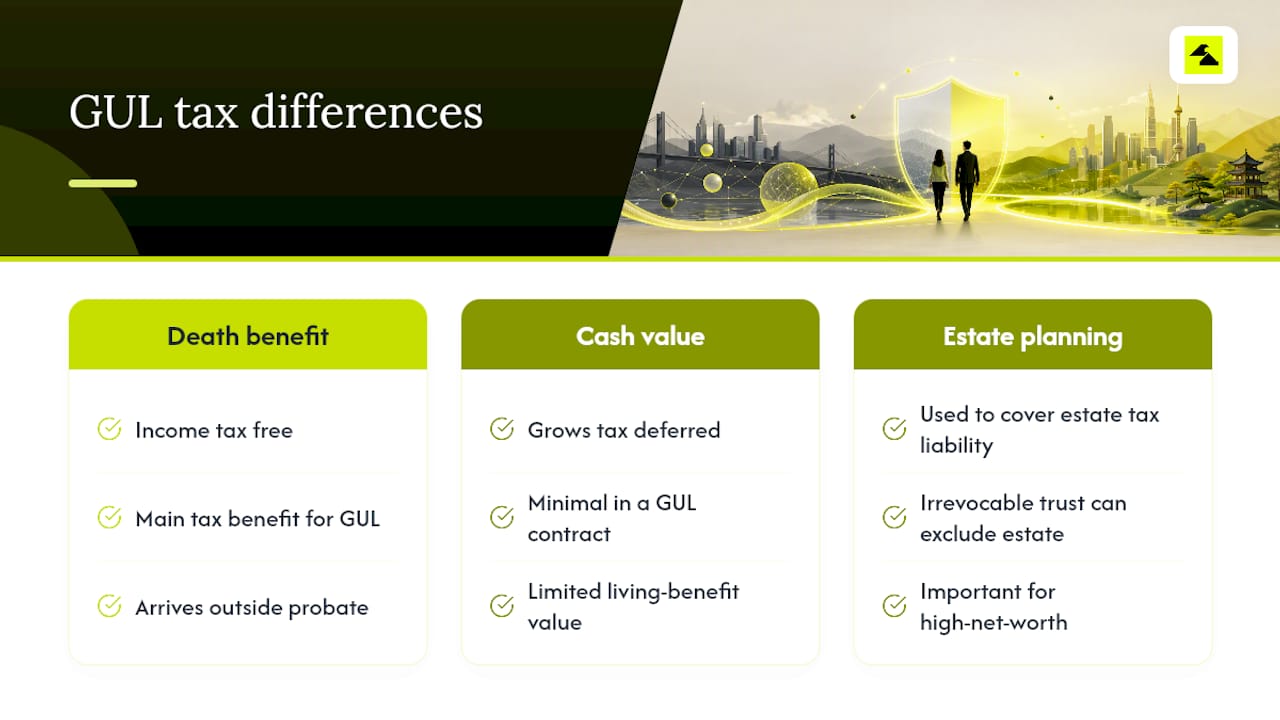
The death benefit paid to your beneficiaries is generally income tax free, the same tax treatment that applies across nearly all life insurance products, GUL included. Any cash value that does accumulate, though minimal in a GUL contract, grows tax deferred, meaning you don’t owe tax on internal gains year to year the way you would on a taxable brokerage account.
Where GUL differs from whole life is simply in scale. Because so little cash value builds up, the tax-deferred growth advantage that whole life owners lean on for living benefits barely applies to GUL. The tax benefit that matters most with GUL is the tax-free death benefit itself, not any accumulation feature.
Estate size changes the calculus. For high-net-worth households, GUL is frequently used to cover projected estate tax liability, since the death benefit arrives outside probate and, when properly structured through an irrevocable trust, outside the taxable estate entirely. Our guide to reducing estate taxes with an ILIT walks through how that structure works in practice. For a broader rundown of how life insurance is taxed across products, see our overview of life insurance tax benefits.
None of this replaces advice from a tax professional familiar with your estate size and state rules, since thresholds and treatment can shift with tax law changes.
Can You Customize a GUL Policy Beyond Standard Riders?
Riders aren’t the only lever. Several structural choices shape how a GUL policy actually behaves over decades.
Guarantee age is the biggest customization decision you’ll make. Dialing it down from age 121 to age 100 or 90 lowers your premium meaningfully, but it also sets a hard ceiling on when the guarantee protection ends, a real consideration if longevity runs in your family.
Death benefit options offer another layer of flexibility. Most GUL policies default to a level death benefit, but some carriers allow an increasing option tied to premiums paid, useful for policies also carrying a return-of-premium rider.
Some contracts allow face amount reductions later, letting you lower coverage (and premium) if your needs shrink, say, after a mortgage is paid off or children become financially independent. Fewer allow increases without new underwriting, so build in extra coverage upfront if you expect needs to grow.
Multi-life or survivorship structures also exist for couples or business partners, paying out on the second death rather than the first, which can lower premiums for estate-planning purposes. None of these options fix GUL’s fundamental limitation: it’s still not a cash-value or investment vehicle, no matter how it’s customized.
GUL vs. Indexed Universal Life vs. Variable Universal Life: What’s the Real Difference?
All three live in the universal life family, but they solve different problems entirely.
GUL prioritizes certainty. Your death benefit and premium are locked in as long as you fund the guarantee, and cash value is a minor footnote. Indexed universal life trades some of that certainty for upside potential, crediting interest based on the performance of a market index, subject to caps and floors, which can build meaningfully more cash value over time, though not with the same guarantee strength as GUL.
Variable universal life goes further, letting you invest cash value directly in subaccounts similar to mutual funds. That means real growth potential, and real risk. Poor market performance can erode cash value fast enough to threaten the policy’s ability to stay in force, since VUL typically carries no comparable no-lapse guarantee.
If your priority is a locked-in death benefit at the lowest sustainable cost, GUL wins. If you want living benefits and are comfortable with some variability, IUL is the middle ground. VUL suits buyers who understand market risk and want direct investment exposure inside a life insurance wrapper, a smaller and more specialized audience than either GUL or IUL attracts.
What Mistakes Do GUL Buyers Commonly Make?
The single most common mistake is treating GUL’s flexible-premium mechanics as an invitation to pay less than required. GUL sits in the universal life category, and that category is built around premium flexibility, but exercising that flexibility on a guaranteed product is how guarantees get quietly voided.
A second mistake is buying based on the lowest illustrated premium without confirming the guarantee age matches life expectancy expectations. Saving a modest amount monthly by choosing a guarantee age of 90 instead of 121 backfires badly if you’re still alive and uninsured at 92.
Buyers also frequently skip requesting an in-force illustration years after purchase, missing early signs that a policy has drifted off guaranteed status due to an underpayment years earlier. And some assume GUL builds meaningful savings the way whole life does, then feel blindsided when there’s little cash value to access for an emergency.
Finally, many buyers never verify their advisor’s licensing or the carrier’s financial strength rating before signing, treating the purchase as a one-time transaction rather than a decades-long contract that depends on the insurer remaining solvent.
East Two West’s Practical View on Where GUL Fits
GUL earns its place as a death-benefit play: affordable, predictable, and built for people who want the guarantee without paying for a savings feature they’ll never use. That clarity is exactly why it gets misunderstood, buyers sometimes expect universal life flexibility and guaranteed life certainty at the same time, and those two things don’t coexist well in one contract.
At East Two West, GUL often shows up as one piece of a larger plan, paired with whole life for clients who also want living-benefit liquidity, or standing alone for someone whose only goal is locking in an affordable death benefit. The right mix depends entirely on what the coverage needs to accomplish.
— Jib Hunt
Get Independent Quotes and Illustration Reviews
You can get side-by-side quotes across multiple insurers to compare guarantee ages, premium structures, and rider costs before committing to a long-term contract.
[

A consultation typically starts with your numbers, current health class, coverage goals, budget, and estate or income-replacement needs, then moves into pulling real illustrations from carriers that fit your profile. If you already have a GUL illustration from another source, the guarantee language can be reviewed line by line to flag anything that looks flexible-premium in disguise. Whether you’re weighing GUL against whole life or trying to figure out the right guarantee age for your situation, the fastest way to get clarity is a real quote instead of a rough estimate. You can compare life insurance and annuity quotes or request a personalized quote directly.
Selected Sources and Official References
This article is general information, not a substitute for advice from a qualified financial advisor. Consult a qualified financial professional about your own circumstances before acting on anything here.
FAQ
Is Guaranteed Universal Life Insurance Worth It?
It’s worth it if your priority is a locked-in death benefit at a lower cost than whole life; it’s a poor fit if you also want cash-value growth or living benefits, since GUL typically builds minimal cash value.
How Much Does a $100,000 Life Insurance Policy Cost Per Month?
Cost varies significantly by age, health class, and guarantee age, so there’s no single accurate figure; getting a real quote based on your underwriting profile is the only reliable way to know your actual premium.
What Does Dave Ramsey Say About Universal Life Insurance?
Dave Ramsey generally advises against cash-value life insurance products, including universal life, favoring term insurance paired with separate investing instead, though this stance doesn’t account for GUL’s specific use as an affordable permanent death-benefit tool for older buyers or estate planning.
What Are the Drawbacks of Guaranteed Universal Life Insurance?
The main drawbacks are minimal cash value, no living-benefit liquidity, and the risk that a single missed or underfunded premium can void the no-lapse guarantee entirely.
Recommended
Comments