Before You Buy an IUL: 5 Questions U.S. High Earners Must Answer


An IUL for retirement works best as a supplemental play for high earners who’ve already maxed out their 401(k) and IRA, and who separately need permanent life insurance. The tradeoff is real: tax-free loan access and downside protection on one side, rising internal costs and real complexity on the other. If you haven’t captured your full employer match or maxed your qualified accounts, look there first.
TL;DR:
An IUL is best suited for high earners who have already maxed out their 401(k) and IRA contributions and need permanent life insurance.
Caps, participation rates, and fees can adjust over time, which may reduce potential gains and increase costs, especially for older buyers.
Overfunding or early cancellation can trigger modified endowment contract status, stripping away tax advantages and increasing lapse risk.
Internal costs such as insurance and admin fees are deducted before index interest is credited, which can cause cash value erosion despite a zero percent floor.
An IUL typically offers tax-deferred growth, tax-free policy loans, and flexible premiums, but it is not a substitute for employer-sponsored plans or annuities in most cases.
Table of Contents
What Is an IUL and How Does Index Crediting Work?
Indexed universal life insurance is permanent life insurance. It carries a guaranteed death benefit and builds cash value, but instead of a fixed interest rate, that cash value growth gets linked to the performance of a market index, usually the S&P 500. You never actually own the index or collect its dividends. The insurer credits interest based on index movement, filtered through three mechanical levers.
The participation rate determines how much of the index’s gain you actually get credited. A 70% participation rate on a 10% index gain means you’re credited 7%, not 10%. The cap sets a ceiling on the credited rate no matter how well the index performs. A 9% cap on a year the S&P 500 returns 24% means you’re credited 9%, full stop. Some contracts use a spread instead of or alongside a cap, subtracting a fixed percentage from the index gain before crediting. And nearly every IUL carries a 0% floor, meaning a bad index year credits you nothing, but not a loss either.
That floor is the headline selling point, and it’s legitimate. It’s also incomplete. A 0% credited rate still doesn’t mean a 0% year for your cash value, because internal costs get deducted regardless of what the index did. SmartAsset’s analysis of IUL mechanics points out that cost of insurance and administrative fees come out before any interest gets credited, so a flat index year can still show a net decline in cash value once fees are subtracted.
Here’s the part that catches people off guard:
You don’t receive index dividends, ever, even in strong years, because you’re not invested in the index itself.
Caps and participation rates are not guaranteed for the life of the policy; carriers can and do adjust them at renewal.
The 0% floor protects against negative index years but not against fee-driven cash value erosion.
Illustrations show projected performance under stated assumptions, not promises. The guaranteed columns in any illustration are the only numbers the carrier is actually on the hook for.
That last point matters more than most buyers realize. An illustration running an 6% or 7% average assumed rate looks compelling on paper. LegalClarity’s breakdown of IUL mechanics notes that insurers can change credited rates and internal charges over the life of the contract, so a projection built on today’s cap rate can drift meaningfully by year fifteen. Read the guaranteed column first, the illustrated column second.
Pros and Cons of Using an IUL for Retirement
The case for an IUL rests on a specific combination of tax treatment and protection that no other retirement vehicle bundles quite the same way. The case against it rests on cost and complexity that compound quietly over decades.
What works in your favor:
Tax-deferred cash value growth, similar in spirit to a 401(k), but without contribution caps set by the IRS.
Policy loans against cash value are generally income-tax-free if the policy stays in force, giving you a retirement income stream that doesn’t show up on a 1040.
No required minimum distributions. You control when and how much you access, unlike a traditional IRA or 401(k) after age 73.
The permanent death benefit means your family gets a payout regardless of when you die, something a 401(k) simply doesn’t offer.
Premium flexibility lets you adjust payments within limits as income changes, more forgiving than a fixed annuity contribution schedule.
What works against you:
Internal costs, especially cost of insurance, rise every year you age, and they’re deducted whether the market helps you or not.
Caps and participation rates limit your upside in strong years, meaning you’ll rarely capture a genuinely great market year in full.
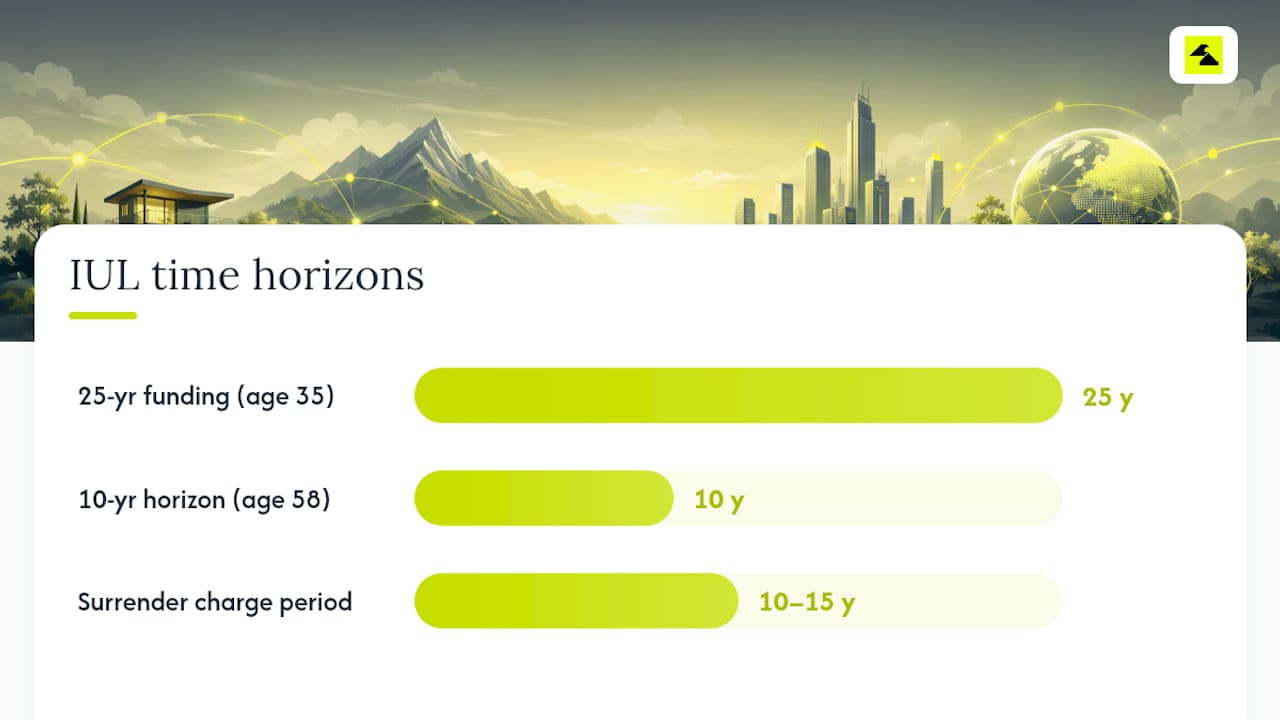
Surrender charges during the first 10 to 15 years can be steep enough to make early cancellation a costly mistake.
Overfunding the policy can trigger modified endowment contract status, which strips away the tax-free loan treatment that makes an IUL worth considering in the first place.
Underwriting means health issues or older age can make coverage expensive or unavailable, unlike a Roth IRA that has no medical requirements.
Investopedia’s review of IUL tradeoffs frames this well: IULs tend to make sense for people who’ve already maxed out retirement accounts and separately need permanent coverage, not as a first-dollar retirement strategy.
Where the math flips. A 35-year-old high earner funding a policy for 25 years and letting it season has time to absorb early-year drag and benefit from compounding tax-deferred growth. A 58-year-old buying an IUL with a 10-year horizon to retirement is fighting rising cost of insurance with far less runway to outpace it. Age at purchase changes the entire risk profile of the same product.
How IUL Compares to a 401(k), Roth IRA, and Annuities
Sequencing matters more than product choice here. Get the order wrong and you leave free money and lower fees on the table before you ever get to the question of whether an IUL fits.
401(k): If your employer matches contributions, that match is the highest guaranteed return available anywhere in your financial plan. Department of Labor and IRS data comparing plan costs shows typical 401(k) fees running roughly 0.5% to 1.5% annually, well below the layered premium loads, cost of insurance, and rider charges stacked inside most IUL contracts. Contributions are pre-tax, but withdrawals are taxed as ordinary income, and RMDs kick in at 73.
Roth IRA: Contributions are after-tax, qualified withdrawals in retirement are completely tax-free, and there’s no RMD requirement. The catch is the contribution limit, which is far lower than what many higher earners want to save annually, and income limits can phase out eligibility entirely at higher earnings. If you’ve compared the two directly, a detailed IUL vs Roth IRA breakdown walks through where each one wins depending on your bracket.
Traditional IRA: Similar tax deferral to a 401(k), smaller contribution ceiling, and RMDs apply. Useful for tax diversification, but not a volume play for large savers.
Annuities: A fixed or fixed indexed annuity is built to solve a different problem than an IUL. Annuities convert a lump sum into guaranteed income you can’t outlive; an IUL is built around a death benefit with living-benefit access layered on top. If guaranteed lifetime income is the actual goal, an annuity usually does that job more directly than an IUL ever will.
Where IUL earns its spot in the lineup:
You’ve captured 100% of any employer match.
You’ve maxed your 401(k) and IRA contribution limits for the year.
You still have investable income left over and want tax diversification beyond what qualified accounts offer.
You have an independent, ongoing need for permanent life insurance, not just retirement savings.
The sequencing rule of thumb is straightforward: match first, qualified account limits second, IUL third, and only if permanent coverage is genuinely part of the plan. Skipping ahead to an IUL before maxing a 401(k) match is, functionally, walking away from guaranteed money.
Costs, Loan Mechanics, and Lapse Risk in an IUL Policy
An IUL’s fee structure is layered, and each layer chips away at the cash value the policy is supposed to be building. Understanding the line items matters more than understanding the crediting formula, because the fees are guaranteed to happen and the crediting isn’t.
The main charges include premium loads (a percentage taken off the top of each payment), monthly cost of insurance (COI), administrative fees, and rider costs if you’ve added features like a chronic illness or overloan protection rider. Surrender charges apply if you cancel or heavily reduce the policy in the early years, often the first decade to fifteen years.
Cost of insurance rises every year because it’s priced off your net amount at risk, the gap between the death benefit and the accumulated cash value. As you age, mortality risk increases in the insurer’s pricing tables, so COI climbs steadily, sometimes sharply in later decades. A policy that looked affordable at age 45 can carry a materially heavier internal cost load by age 70.
On the math behind that math: SmartAsset’s analysis confirms that IULs offer a 0% floor and tax-deferred growth, but flags that rising internal costs and premium demands with age are a primary reason cash value can underperform expectations even in years the index performs well.
Loan mechanics deserve real attention. LegalClarity’s review of IUL loan structures explains that policy loans are collateralized against your cash value and accrue interest like any loan. A “wash loan” tries to match the loan interest rate to the credited rate so you break even; a “participating loan” leaves your full cash value exposed to index crediting while you still owe loan interest, which can work for you or against you depending on market performance. Unpaid interest capitalizes, adding to the loan balance, which can spiral toward lapse if left unmanaged.
If a policy lapses with an outstanding loan balance larger than the cost basis, the IRS treats that gap as taxable income, often arriving as an unpleasant surprise the year after the policy is already gone.
Premium loads and admin fees reduce every dollar you put in before it even starts earning.
Cost of insurance rises with age and net amount at risk.
Surrender charges punish early cancellation.
MEC status, once triggered, cannot be undone for that policy.
Loan interest that capitalizes unpaid accelerates lapse risk.
Pro Tip: Ask your carrier for an in-force illustration that runs at a reduced, conservative crediting rate rather than the historical average. If the policy still performs acceptably at that lower assumption, you’ve stress-tested it. If it doesn’t, you’ve just found out before it mattered.
Who Should Consider an IUL and a Practical Checklist
The strongest candidates for an IUL share a specific profile: consistent high income, a tax bracket where deferral and tax-free access genuinely move the needle, an independent need for permanent life insurance, and enough time horizon to let the policy season past its early-cost years. Someone funding steadily for 20 years looks nothing like someone hoping to fund for eight and retire.

Red flags that suggest an IUL is the wrong tool right now: tight cash flow that makes consistent premium funding uncertain, a retirement horizon under a decade, or simple unwillingness to review the policy annually. An IUL is not a “set it and forget it” product, and treating it that way is how policies drift toward lapse.
Run through this checklist before moving forward:
Have you captured 100% of any employer 401(k) match available to you?
Are your 401(k) and IRA contributions already maxed for the year?
Do you have a genuine, independent need for permanent life insurance, not just a savings vehicle?
Can you commit to funding the policy consistently for at least 10 to 20 years?
Are you prepared to review the policy annually rather than ignore it after purchase?
If you answered yes to all five, an IUL is worth a serious conversation. If you answered no to two or three, other tools deserve your dollars first, and our comparison of universal versus term life is a useful next read on whether permanent coverage even makes sense for your situation yet.
How East Two West Insurance Approaches IUL Policy Design
Good IUL design starts with the goal, not the product. If the objective is retirement supplementation with a permanent death benefit attached, the death benefit gets sized to the minimum needed to serve that goal, which keeps the net amount at risk lower and cost of insurance more manageable over time.
Max-funding a policy, paying in as much as possible without tripping MEC status, makes sense for someone prioritizing cash value accumulation with years to let it compound. Standard funding fits someone who wants the death benefit as the primary driver and cash value as a secondary benefit. These are different strategies wearing the same policy type.
Before signing anything, ask the carrier direct questions:
What has this specific product’s cap and participation rate actually done over the past 10 to 15 years, not just what’s assumed in the illustration?
What loan options exist, and is overloan protection available as a rider to guard against lapse late in life?
What do the rider costs actually add to the annual internal charge?
Annual monitoring should include a loan-to-value review if you’re taking distributions, a re-run of projections using conservative assumptions rather than the original sales illustration, and a policy anniversary check on how credited rates and fees have moved.
Building IUL Into a Full Retirement Income Plan
Sequencing comes first: capture the full employer match, max out 401(k) and IRA space, and only then direct excess savings toward an IUL if permanent coverage is genuinely needed alongside the tax diversification.
Fund tax-advantaged accounts to their limits before funding a policy.
Choose steady funding if the death benefit is the priority, or targeted max-funding if cash value growth is the priority, always staying under MEC thresholds.
In distribution years, withdraw up to cost basis first since that portion isn’t taxable, then shift to policy loans for amounts beyond basis.
Set a personal loan-to-cash-value tolerance, many advisors suggest keeping it well under 50%, and review it every year rather than letting it drift.
Request conservative, reduced-rate illustrations from the carrier annually to stress-test the plan against a weaker market environment than the original sales pitch assumed.
What Realistic Growth Looks Like Under Different Index Scenarios
Run the same policy through three index environments and the outcomes diverge fast. That’s a very different accumulation curve than the illustrated average implies.
The scenario that catches buyers off guard is the “average return, bad sequence” problem. Two policies can share the identical long-term average index return and still produce very different cash values, because fees get deducted every single year regardless of performance, while credited gains only show up in good years. A run of flat years early in the policy, before cash value has built any cushion, does more damage than the same flat years arriving after two decades of compounding.
This is exactly why the guaranteed column in an illustration matters more than the illustrated one. If that column still shows a plan you could live with, the policy has real margin. If the guaranteed column shows the policy lapsing at age 80, no amount of optimistic index performance should make you comfortable signing.
Choosing and Reviewing the Index Options in Your Policy
Most IUL contracts offer several index-crediting strategies within the same policy, not just a single S&P 500 point-to-point option. You might see a monthly average strategy, a multi-index blend, or a volatility-controlled index designed to smooth returns in exchange for a higher participation rate.
Volatility-controlled indices deserve a closer look before you pick one just because it carries a higher cap or participation rate. These indices are engineered to reduce swings, which can mean sacrificing some upside in genuinely strong years in exchange for steadier crediting.
Review your allocation at least once a year, ideally at the policy anniversary when new caps and participation rates take effect. Ask specifically whether the carrier has changed the cap or participation rate on your chosen strategy since last year, and whether reallocating to a different available index inside the same policy makes sense given how each one has performed. Splitting cash value across two or three index strategies inside the same policy is common and can reduce the risk of any single crediting method underperforming for several years running.
How Inflation Affects IUL Retirement Income
A fixed death benefit and a capped crediting rate both lose real purchasing power over a 20 or 30 year retirement horizon, and that erosion happens quietly enough that it’s easy to miss until distributions start feeling smaller than expected.
Some carriers offer increasing death benefit riders that adjust the payout over time, though they typically raise the cost of insurance since the net amount at risk grows too. On the accumulation side, there’s no built-in inflation adjustment to caps or participation rates. Those move at the carrier’s discretion based on options pricing and interest rate environments, not a formal cost-of-living formula.
The practical mitigation is straightforward: build inflation assumptions into your funding math from the start rather than treating the illustrated numbers as fixed targets. If you’re funding toward a retirement income goal, size that goal in future dollars, not today’s dollars, and revisit the target every few years as actual inflation data comes in. Pairing an IUL with other inflation-responsive income sources, like Social Security, which carries its own cost-of-living adjustments, gives you a blended income stream where not everything is exposed to the same erosion risk at once.
Why Reading the Illustration Carefully Matters
Every IUL sale comes with an illustration, and every illustration contains at least two columns worth studying closely: the guaranteed column and the current-assumption column. The current-assumption column, often the one highlighted in a sales presentation, projects performance using today’s cap, participation rate, and cost structure held constant for decades. That’s not a forecast. It’s a snapshot.
Carriers can and do change caps, participation rates, and internal charges over a policy’s life.
Focus on three things when reviewing any illustration: the guaranteed column’s outcome at your target retirement age, the year cash value starts meaningfully exceeding the surrender charge (so you’re not trapped), and how sensitive the projection is to a lower assumed rate. Ask for a version run at 2 to 3 percentage points below the illustrated rate. If the policy still functions reasonably at that lower number, you’re looking at a design with real margin built in, not one that only works if every assumption holds for thirty straight years.
A Practitioner’s View on What Actually Breaks IUL Policies
The IUL policies that work are the ones funded consistently and reviewed honestly. The ones that fail almost never fail because the index underperformed. They fail because someone underfunded the policy while assuming an aggressive illustrated rate, then leaned on loans to cover the gap, and nobody caught the drift until the annual statement showed a shrinking cash value near retirement. Ask for the guaranteed column, run the numbers conservative, and work with someone licensed to walk through your specific illustration line by line.
— Jib Hunt
Get Help Designing an IUL That Fits Your Retirement Plan
You can find alternatives to shopping blind through captive agents pushing a single carrier’s product. Working across multiple carriers, it is possible to get quote comparisons and policy design built around your actual numbers, not a one-size-illustration pitch.
[

The work can include consultative policy design, side-by-side quote comparison across carriers, and expertise in Infinite Banking Concept structuring for clients who want more control over how their cash value gets used, not just how it grows. If you’re evaluating whether an IUL fits your retirement plan, bring your recent account statements, any existing policy illustrations, your retirement income projections, and notes on your current health status. Underwriting eligibility can shift the math quickly, so it’s worth knowing where you stand before comparing options.
If you’ve already maxed your 401(k) and IRA and want a clear-eyed second opinion on whether an IUL earns a place in your plan, compare life insurance and annuity quotes with East Two West and schedule a consultation to review your specific numbers against a conservative illustration, not an optimistic one.
Sources
For readers who want to verify the tax and regulatory details directly: LegalClarity’s IUL cost and risk breakdown, Investopedia’s pros and cons overview, and FINRA for how insurance products differ from securities protections. These sources reflect U.S. tax and regulatory treatment specifically.
This article is general information, not a substitute for advice from a qualified financial advisor. Consult a qualified financial professional about your own circumstances before acting on anything here.
Pros and Cons of Using an IUL Account for Retirement — SmartAsset
FAQ
Is an IUL a Good Investment for Retirement?
An IUL isn’t an investment in the securities sense; it’s permanent life insurance with tax-advantaged cash value growth. It works well as a supplemental retirement tool for high earners who’ve maxed other accounts, but it carries higher fees than most retirement-specific vehicles.
Can You Use Your IUL for Retirement Income?
Yes, typically through tax-free policy loans against the cash value, as long as the policy stays in force and isn’t classified as a modified endowment contract. Managing loan interest carefully is essential to avoid lapse risk later in retirement.
Can a 70-Year-Old Get an IUL?
It’s possible but often expensive and harder to qualify for, since underwriting and cost of insurance both increase sharply with age. Most advisors, including East Two West, recommend a longer funding horizon, ideally 10 to 20 years, which makes an IUL a poor fit for most buyers starting at 70.
Is an IUL Better Than a 401(k)?
No, not as a first choice. A 401(k) with an employer match offers guaranteed returns and typically lower fees than an IUL, so capturing that match and maxing contribution limits should come before considering an IUL at all.
Recommended
Comments