$550/mo at 40: U.S. Whole Life Costs and Agent Ways to Cut Your Rate


A healthy 40-year-old buying $500,000 of whole life insurance typically pays around $550 a month, while the same coverage in term life usually costs much less. Age, health class, tobacco use, and coverage amount drive most of that price. Premiums stay level for the rest of your life once you lock in a rate, which is exactly why buying earlier costs so much less over time.
TL;DR:
Buying whole life insurance at a younger age can lock in lower premiums, which stay level for the policyholder’s lifetime.
Larger policies have a lower cost per thousand dollars of coverage because fixed costs are spread over a bigger base.
Premiums are most affected by age, health, tobacco use, and underwriting class, with tobacco users paying two to four times more.
The true cost of a policy includes mortality charges, administrative expenses, and cash-value growth, which takes 10 to 20 years to become substantial.
Whole life costs 10 to 15 times more than term for the same coverage, making it suitable mainly for permanent needs or estate planning.
Table of Contents
How Much Does Whole Life Insurance Cost by Age and Coverage Amount?
Whole life pricing follows a predictable pattern once you see it laid out. The younger and healthier you are, the less your insurer charges per $1,000 of coverage, because you’re statistically farther from a claim. The numbers below use non-smoker, average-health applicants as the baseline, which is where most quotes for healthy adults land.
Age | $100,000 | $250,000 | $500,000 | $1,000,000 |
30 | $95/mo | $210/mo | $390/mo | $740/mo |
40 | $135/mo | $310/mo | $1,050/mo | |
50 | $210/mo | $480/mo | $890/mo | $1,700/mo |
60 | $340/mo | $780/mo | $1,480/mo | $2,850/mo |
These are directional averages built around published industry benchmarks, not a quote for you specifically. Your actual premium depends on the carrier, your state, and how underwriting classifies your health.
A few patterns matter more than the raw numbers:
Gender gap: Women generally pay 5% to 10% less than men at the same age, largely because CDC life expectancy data shows women living longer on average, which lowers the insurer’s expected payout timeline.
Smoker penalty: Tobacco users pay 2 to 4 times more than non-smokers for identical coverage, a gap wide enough that quitting before you apply can be the single biggest cost lever available.
Per-thousand pricing improves with size: A $100,000 policy might cost you $1.35 per $1,000 of coverage monthly, while a $1,000,000 policy on the same person often prices closer to $1.05 per $1,000. Insurers spread fixed administrative costs over a bigger base, so buying more coverage doesn’t cost proportionally more.
That last point surprises a lot of shoppers. If you’re debating between $250,000 and $500,000 of coverage, the jump in monthly cost is rarely double.
What Would You Actually Pay Each Month?
Numbers on a chart feel abstract until you match them to a real person. Here’s how a handful of common buyer profiles shake out, using the same non-smoker, average-health assumptions as above:
30-year-old male, $250,000: roughly $210 to $230 a month, one of the cheapest entry points you’ll ever see for permanent coverage.
40-year-old female, $100,000: around $125 to $135 a month, a common starter amount for younger parents.
40-year-old female, $500,000: about $540 a month, matching the MoneyGeek benchmark for this exact profile.
40-year-old male, $500,000: closer to $574 a month, reflecting the small but consistent gender pricing gap.
50-year-old male, $1,000,000: in the neighborhood of $1,700 a month, often chosen for estate planning or business protection.
60-year-old female, $250,000: roughly $700 to $750 a month, a typical range for late-stage legacy planning.
Treat every figure here as a planning anchor, not a locked-in rate. Your actual premium shifts based on which carrier you apply with, which state you live in, and which underwriting class you land in after your medical exam. Two people with identical ages and coverage amounts can get quotes that differ by hundreds of dollars a year depending on how their health history is scored.
If you want a number tied to your actual situation rather than a national average, comparing personalized quotes is the only way to know what you’ll really pay.
What Factors Change Your Whole Life Premium the Most?
Six variables do almost all the work in determining your final rate, and they don’t carry equal weight.
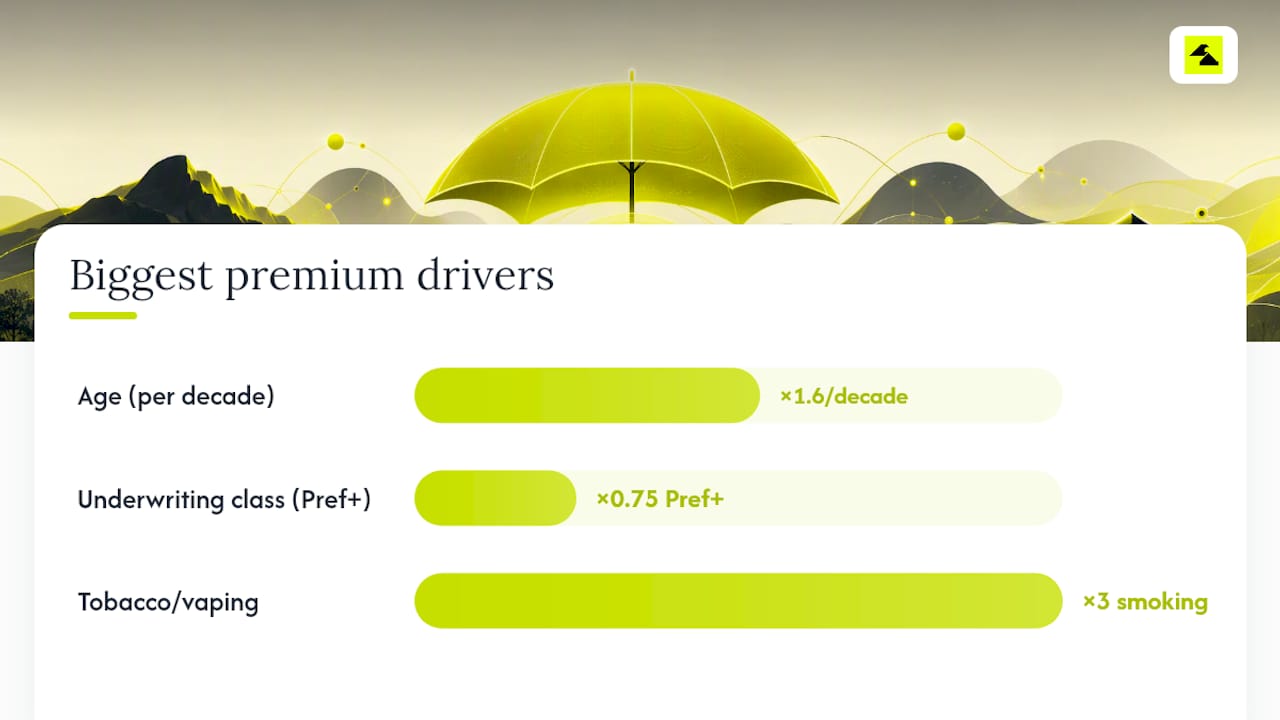
Age. Each decade you wait to buy adds roughly 50% to 70% to your premium for the same coverage, since mortality risk climbs steadily and the insurer has fewer years to collect premium before eventual payout.
Underwriting class. Preferred Plus applicants (excellent health, no risk factors) might pay 20% to 40% less than Standard-rated applicants for identical coverage. Preferred sits in between.
Tobacco and vaping use. Smokers pay 2 to 4 times more than non-smokers, and most carriers classify vaping the same as smoking regardless of what’s actually being inhaled.
Medical history. Conditions like diabetes, high blood pressure, or a family history of certain cancers can push you into a higher-cost rating tier, though many conditions are manageable with the right carrier. If you’re navigating a diagnosis, it’s worth reading how pre-existing conditions affect life insurance applications before you apply.
Occupation and hobbies. Pilots, commercial divers, and other high-risk occupations sometimes pay rated premiums or face exclusions.
Policy design. Adding paid-up additions riders or choosing a participating (dividend-paying) policy over a non-participating one changes your premium structure, sometimes raising near-term cost in exchange for long-term value.
State and carrier differences round things out. The same 45-year-old applicant can get meaningfully different quotes from five different carriers, because each company weighs risk factors differently and files its own rate tables with state regulators.
Pro Tip: Ask any agent quoting you for the exact underwriting class assumption behind the number. A “best case” quote assuming Preferred Plus status is a very different number than what you’ll actually qualify for.
What Does Your Premium Actually Pay For?
Every dollar you send in splits into three buckets, even though your statement never shows the breakdown.
The first bucket is the mortality charge, the pure cost of insuring your life based on actuarial mortality tables. This portion rises every year you age, even though your total premium stays level, because the insurer is quietly using excess early payments to subsidize the higher mortality cost of your later years.
The second bucket covers expense loads: agent commissions, administrative overhead, and state premium taxes. These costs are heavily front-loaded in the first several policy years, which is a major reason cash value grows so slowly at first.
The third bucket funds cash-value accumulation, the savings component that eventually becomes accessible to you through loans or withdrawals.
Mortality charges increase with age but are smoothed into a level premium
Expense loads eat a disproportionate share of your premium in years one through five
Cash-value funding is what’s left over after mortality and expenses are covered
Guaranteed cash value grows on a schedule set at issue; non-guaranteed dividends (if the policy participates) add to that on top
It typically takes 10 to 20 years for cash value to grow into a meaningful sum relative to premiums paid, which is the single most misunderstood fact about whole life insurance. Anyone expecting fast liquidity from a new policy is going to be disappointed for a while.
Whole Life vs. Term: What’s the Real Cost Gap?
The dollar gap between whole life and term for identical coverage is not small. Whole life commonly costs 10 to 15 times more than a comparable 20 year level-term policy on the same person, because term only covers a fixed window while whole life pre-funds mortality risk for your entire lifetime plus builds cash value.
That gap makes sense in some situations and not others.
Term usually wins when your need is temporary: a mortgage, kids’ college years, or income replacement until retirement savings mature.
Whole life earns its cost when you need permanent coverage, want tax-deferred cash-value growth, or are using the policy for estate liquidity or business succession planning.
A hybrid approach (term for the temporary gap, a smaller whole life policy for the permanent piece) often balances cost against long-term goals better than an all-or-nothing choice. If you’re weighing this trade-off in more depth, term life insurance cost breaks down the pricing side of that comparison.
How Do You Get a Lower Premium Before You Apply?
Buying younger locks in a lower mortality charge for life, since your rate is set at issue and never rises again for that policy.
Apply now rather than waiting, since even a two or three year delay can raise your locked-in rate meaningfully.
Quit smoking or vaping at least 12 months before applying. Most carriers require a full year of tobacco-free status to qualify for non-smoker rates.
Address controllable health markers. Losing weight, stabilizing blood pressure, or getting cholesterol into a normal range in the months before your exam can shift your underwriting class.
Ask your agent directly how dividends are used, which values are guaranteed versus projected, and what each rider actually costs.
Pro Tip: Gather your medications list, recent lab results, and family medical history before your underwriting call. Applicants who show up prepared often move through underwriting faster and with fewer surprise rating adjustments.
Who Designs the Whole Life Policies Behind These Numbers?
The firm is built around one core specialty: using properly designed participating whole life insurance for the Infinite Banking Concept, a strategy focused on long-term liquidity and control over capital, not just a death benefit.
The process starts by mapping a client’s cash flow, protection needs, liquidity requirements, and long-term goals before recommending whole life, indexed universal life, term, or an annuity strategy.
East Two West is a licensed insurance practice. Every premium figure in this article is a general estimate. Request a personalized illustration before making any purchase decision.
How Do Dividends Affect What You Actually Pay?
Participating whole life policies, the kind issued by mutual insurance companies, pay policyholders a share of the insurer’s surplus each year in the form of dividends. These dividends aren’t guaranteed, but many mutual carriers have paid them consistently for over a century.
Dividends don’t lower your billed premium directly in most designs. Instead, you typically choose how to apply them: buy paid-up additional insurance (which increases both your death benefit and cash value), take them as cash, apply them toward future premiums, or leave them to accumulate with interest. The paid-up additions option is the one most closely tied to Infinite Banking strategies, since it compounds both coverage and accessible cash value over time.
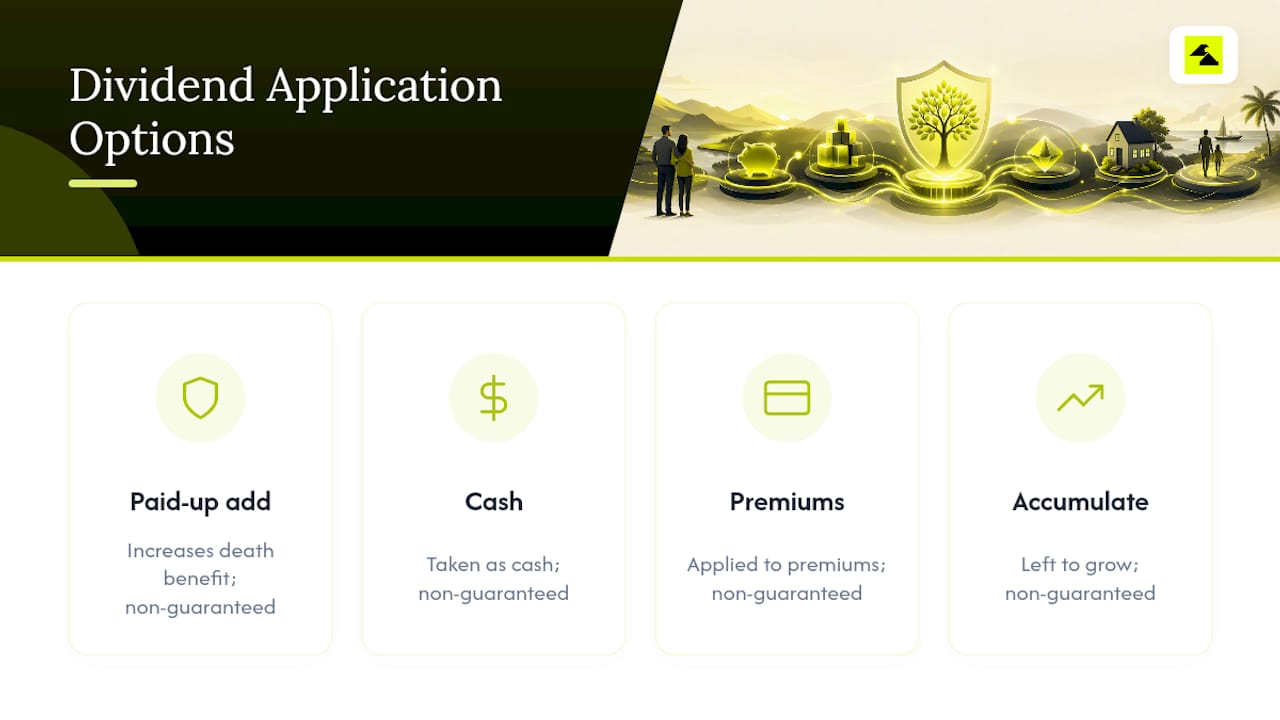
Here’s the nuance most sales pitches skip: a policy’s projected dividend scale is not a promise. Guaranteed values and non-guaranteed dividend projections are two different things, and any illustration you review should show both columns clearly, side by side. A policy that looks attractive on paper because of an optimistic dividend assumption can underperform if the insurer’s actual dividend scale drops in later years. Ask to see the guaranteed column in isolation before you judge whether a policy fits your budget.
What Fees Beyond the Premium Should You Expect?
Your quoted premium isn’t the only cost tied to a whole life policy. A flat policy fee, often somewhere between $50 and $100 a year, typically gets built into your premium to cover the insurer’s basic administrative cost of maintaining your account. It’s small, but it’s there every single year you keep the policy active.
Surrender charges matter far more. If you cancel a whole life policy in its early years, you’ll usually get back significantly less than what you paid in, because commissions and administrative costs were front-loaded against your cash value from day one. Surrender charge schedules commonly decline over 10 to 15 years before disappearing, which is one more reason whole life works best as a decades-long commitment rather than a short-term product.
Rider costs add up too. Riders for waiver of premium, accidental death benefit, or additional term coverage each carry their own charge layered on top of your base premium. None of these are hidden exactly, they’re disclosed in your policy illustration, but they’re easy to skim past. Reviewing the full illustration line by line, rather than just the bottom-line premium number, is the only way to see the true total cost of a policy over its lifetime.
When Does Paying More for Whole Life Actually Make Sense?
Whole life earns its premium when you have a genuinely permanent need: a special-needs dependent, an estate tax liability, or a business succession plan that depends on cash value access decades from now. The evidence supports it least when someone buys it expecting fast liquidity or treats it as a short-term savings account.
The most common client mistake isn’t picking whole life. It’s expecting meaningful cash value in year two or three. Get more than one illustration, compare the guaranteed columns specifically, and only move forward once the guaranteed numbers alone justify the cost.
— Jib Hunt
Get an Accurate Whole Life Quote Built Around Your Situation
Every number in this article is a starting point, not your actual rate. Your real premium depends on your health class, your state, and which carrier’s underwriting guidelines fit you best; working across multiple carriers to find that fit matters because a difference of one underwriting class can swing your monthly cost significantly, and no single insurer is the cheapest option for every applicant. That matters because a difference of one underwriting class can swing your monthly cost by 20% or more, and no single insurer is the cheapest option for every applicant.
[

Before a consultation, it helps to have your age, general health history, tobacco status, desired coverage amount, and rough budget in mind. From there, you can review guaranteed versus projected values, see how riders affect your total cost, and decide whether whole life, term, or a blended approach actually fits your goals. Start by comparing life insurance and annuity quotes across carriers, or go straight to requesting a personalized quote to see what you’d actually pay.
Where This Article’s Numbers Come From
MoneyGeek’s whole life cost breakdown supports the age and coverage rate examples throughout the article.
UCSF’s overview on smoking and life insurance backs the smoker premium multiplier.
Forbes’ analysis of whole life premium calculation supports the term comparison and guaranteed versus projected value distinction.
Insurance Curator’s premium mechanics breakdown informs the mortality charge and cash-value timeline sections.
The Insurance Information Institute’s policy type overview supports the explanations of participating and non-participating policies.
This article is general information, not a substitute for advice from a qualified financial advisor. Consult a qualified financial professional about your own circumstances before acting on anything here.
Sources
FAQ
How Much Does a $1,000,000 Whole Life Policy Cost?
For a healthy 40-year-old non-smoker, expect roughly $1,000 to $1,050 a month, though age, gender, and health class can shift that figure by several hundred dollars either direction.
How Much Does a $500,000 Whole Life Policy Cost?
A 40-year-old non-smoker typically pays around $540 a month for women and $574 for men, based on average-health underwriting.
How Much Does $100,000 in Whole Life Insurance Cost per Month?
For a healthy 40-year-old, expect roughly $125 to $135 a month, with younger buyers often paying closer to $95 and older buyers paying considerably more.
How Much Does a $300,000 Whole Life Insurance Policy Cost?
A healthy 40-year-old might pay around $310 to $540 a month depending on coverage amount and other factors.
Why Is Whole Life So Much More Expensive Than Term?
Whole life pre-funds mortality costs across your entire lifetime and builds cash value, which is why it commonly runs 10 to 15 times higher than level-term for the same coverage amount.
Recommended
Comments