Stop Taxable Payouts: Key Person Insurance for Businesses, 3 Sizing Methods


Key person insurance is a business-owned life or disability policy that pays your company, not the employee’s family, when a critical team member dies or becomes disabled. The payout covers lost revenue, replacement hiring, and outstanding debt tied to that person’s role. If your business depends on one or two people who drive most of the revenue or hold the relationships that keep the lights on. Run a coverage estimate this week rather than after something happens.
TL;DR:
Proper documentation of employee consent and notice is critical; missing steps can make the death benefit taxable and negate tax advantages.
Using the right coverage type depends on the risk timeline; term life is often more cost-effective than permanent policies when the risk has a clear end date.
Coverage should be calculated based on the higher of the compensation or revenue method, then adding debt and buy-sell obligations for an accurate figure.
Regularly reviewing coverage after major business events ensures the policy remains aligned with current operations and financial needs.
Coordinating policy size, paperwork, and existing buy-sell agreements minimizes tax risks and ensures comprehensive protection against key person loss.
Table of Contents
What Key Person Insurance Is and Who Benefits
The mechanics are simple, even if the paperwork isn’t: the business applies for the policy, pays the premiums, and names itself as beneficiary. The insured employee has no ownership stake in the payout. This is fundamentally key man life insurance built around a corporate interest, not a personal one, which is exactly why the tax treatment works differently from a typical policy.
Not every employee qualifies as a “key person.” The role matters more than the title. Common examples include:
Founders whose relationships or technical knowledge are irreplaceable in the short term
Top sales performers who personally hold 20% or more of annual revenue
Licensed specialists whose credentials are required to legally operate (a chief engineer, a surgeon in a small practice, a master distiller)
Anyone personally guaranteeing a business loan or line of credit
Key person coverage protects operational continuity. A buy-sell agreement, funded separately, protects ownership continuity when a partner dies or exits. Businesses often need both, but they solve different problems: one keeps the company running, the other keeps the ownership structure from collapsing into a fight between surviving partners and an heir who suddenly owns 40% of a company they’ve never worked in.
How Key Person Insurance Works and Which Policy Type Fits
The employer completes the application and pays premiums, but the insured employee has to sign off too. Federal law requires written notice to the employee and written consent before the policy is issued. Skip that step and you risk losing the tax benefits entirely, a point worth flagging early because it trips up more businesses than any other part of the process.
Once consent is documented, the policy decision usually comes down to three options:
Term life insurance: the default for most businesses, because it’s inexpensive and matches the actual risk window, such as the length of a loan or the years until a planned succession
Permanent coverage (whole life or IUL): considered when the business also wants to build cash value or when the key person arrangement is layered into a longer-term compensation or split-dollar structure
Disability buyout coverage: a companion policy that funds a buyout or covers lost productivity if the key person survives but can no longer work
Disability is worth taking seriously here. It’s statistically more likely to interrupt a career than death is, and a disabled key person who stays on payroll without contributing creates a slow drain that a life policy alone never addresses.
Pro Tip: Don’t default to permanent coverage just because a broker mentions cash value. If the underlying risk has a clear end date, like a five-year loan or a planned exit, term coverage that matches that window is almost always the more efficient choice.
How to Calculate How Much Coverage You Need
Most businesses undersize this coverage because they guess at a round number instead of running the math. Three methods, used together, produce a defensible figure.
Compensation multiplier. Take the key person’s total compensation and multiply by 5 to 10, depending on how critical and how replaceable they are. A founder with irreplaceable client relationships justifies the higher end.
Revenue or replacement method. Estimate the profit this person directly drives, how many years it would realistically take to recover from their loss, and what it would cost to recruit, hire, and train a replacement.
Debt and buy-sell overlay. Add any outstanding loans this person personally guaranteed, plus any funding obligations tied to a buy-sell agreement.
The rule for combining them: take the higher of the compensation or revenue method, then add the debt and buy-sell figure on top rather than blending it in.
Here’s a quick example. A $2 million agency’s founder earns $180,000. The revenue method, estimating two years to rebuild the client base, points closer to $1.8 million. The business also has a $250,000 SBA loan the founder personally guaranteed. Take the higher base figure ($1.8 million) and add the debt ($250,000) for a target of roughly $2.05 million.
Calculators that run these methods side by side and show each component tend to produce numbers boards and lenders actually trust, which matters more than most owners expect when a lender asks how you arrived at your number. Run the numbers yourself first, then confirm the target with a broker or CPA before you lock in a face amount.
Tax Treatment and the Paperwork That Protects It
The tax rules cut both ways, and missing either side creates a costly surprise. Premiums the business pays on a policy where it’s the beneficiary are generally not deductible under IRC §264(a)(1). In exchange, the death benefit is generally received completely income-tax-free under IRC §101(a), but only if you clear a specific hurdle first.
That hurdle is IRC §101(j), and it has three parts:
Written notice to the employee before the policy is issued, explaining the coverage amount and that the employer will be the beneficiary
Written consent from the employee, given before issuance, agreeing to be insured
Confirmation the employee still qualifies as a key person (by title, compensation, or ownership) at the time of death
Miss any one of these steps and the entire death benefit can become taxable income to the business, turning a clean payout into a tax event nobody budgeted for. Brokers typically handle notice and consent forms before submitting the application, and the employer files Form 8925 annually reporting how many employer-owned policies are in force. Keep signed copies of both forms in the same file as the policy itself, not just in the broker’s records.
When to Buy, When to Review, and What to Keep on File
Coverage decisions shouldn’t wait for a scheduled renewal. Certain events call for action immediately:
The business takes on new debt that a key person personally guarantees
Revenue grows significantly year over year, which usually means the financial impact of losing a key person has grown too
You hire someone whose role now meets the definition of a key person
A partner or executive starts planning an exit or ownership transition
Outside of those triggers, review coverage annually alongside your regular financial planning, and update it immediately after any of the events above rather than waiting for the next review cycle.
Pro Tip: Keep a single folder, physical or digital, with the signed notice and consent forms, a summary of the policy terms, any lender instructions tied to the coverage, and the relevant pages of your buy-sell agreement. When a claim happens, nobody wants to be searching for paperwork.
Advisor Checklist and How East Two West Approaches Key Person Placements
Jib Hunt, founder of East Two West and author of The Capital Loop, built his approach to business protection after years running companies in the action sports industry before moving into financial services. That background shows up in how the firm handles key person cases: fewer moving parts, clearer paperwork, and a bias toward coverage that matches the actual risk timeline.
The advisor process generally runs in this order:
Gather compensation, revenue, and debt figures for the key person in question
Run the sizing methods above and compare results
Coordinate §101(j) notice and consent paperwork before any application goes to underwriting
Select term, permanent, or a disability buyout structure based on the risk horizon, not on which product pays a higher commission
Confirm the coverage aligns with any lender requirements or existing buy-sell agreement language
Most key person shortfalls trace back to skipped paperwork, not bad math. A business can size coverage perfectly and still lose the tax benefit entirely because nobody documented consent before the policy was issued.
Common Claims Scenarios and How They’re Handled
Claims on key person policies tend to fall into a few predictable patterns, and knowing them ahead of time speeds up what happens when one hits.
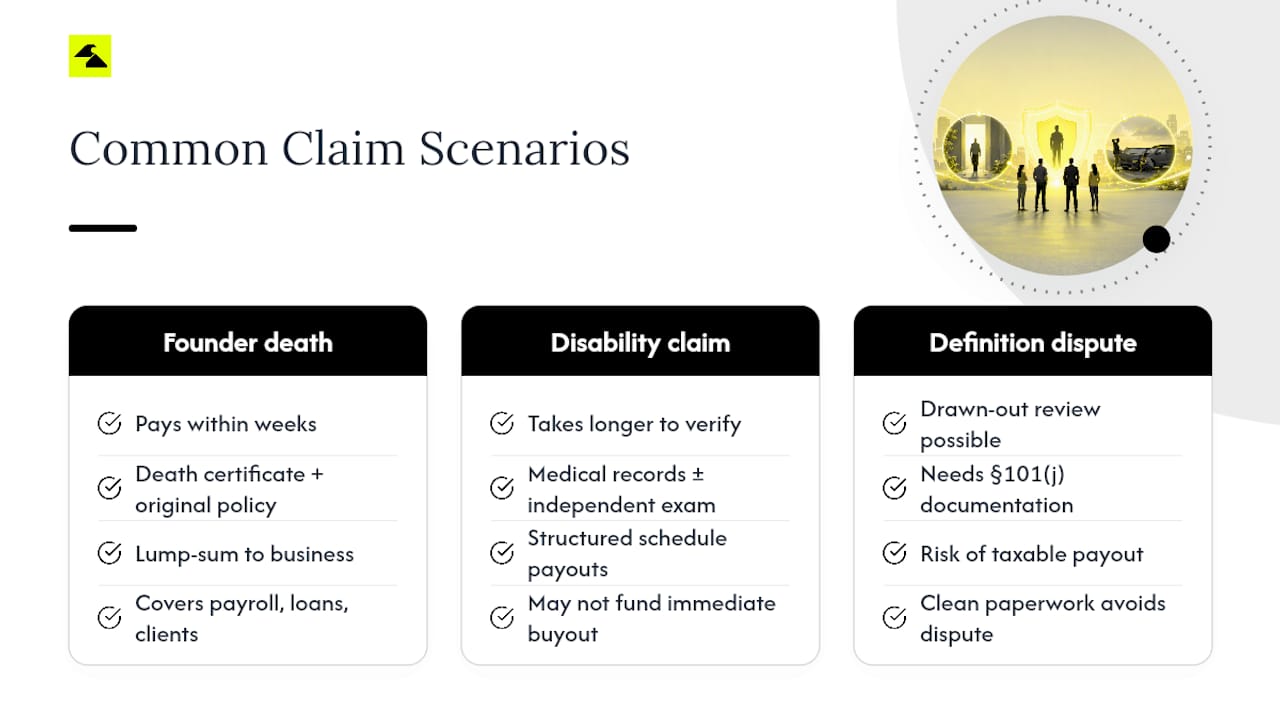
The most common scenario is a founder or majority owner passing away unexpectedly. The insurer pays the death benefit directly to the business, typically within a few weeks of receiving the claim, a certified death certificate, and the original policy documents. The business then uses those funds to cover the immediate cash gap, whether that’s payroll continuity, a client relationship in free fall, or a loan payment coming due.
A second common scenario involves a disability claim rather than a death claim. These take longer to resolve because the insurer has to verify the disability meets the policy’s definition, which can involve medical documentation and, occasionally, an independent medical exam. Disability buyout claims often pay out over a structured schedule rather than as a single lump sum, which is worth knowing before you rely on one to fund an immediate buyout.
A third scenario, less discussed but increasingly common, involves disputes over whether the deceased or disabled employee still met the definition of “key person” at the time of the claim. This is exactly why the §101(j) documentation matters. A policy with clean, current paperwork showing the employee’s role and compensation at issuance rarely runs into a dispute. One without it can end up in a drawn-out review, or worse, a taxable payout.
Alternatives and Complements to Key Person Coverage
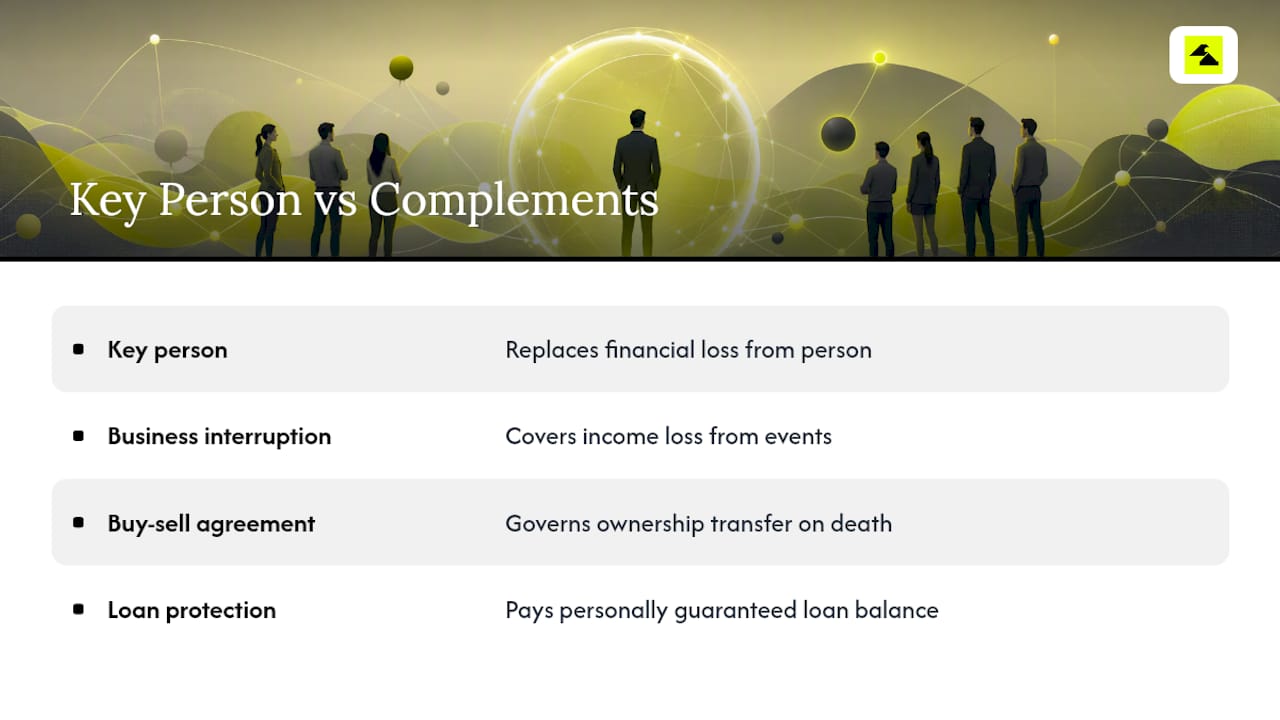
Key person insurance solves one specific problem well: replacing the financial impact of losing a critical person. It’s not the only tool a business needs, and in most cases, it works best paired with two others rather than standing alone.
Business interruption insurance covers a different risk entirely: lost income from a physical event like a fire, flood, or forced closure. It doesn’t respond to the loss of a person, which is why relying on it as a substitute for key person coverage leaves a real gap. The two are complementary, not interchangeable.
Buy-sell agreements address ownership transfer rather than operational disruption. If a co-owner dies, a buy-sell agreement sets the terms for how their shares get bought out, by whom, and at what valuation. Key person insurance can fund part of that buyout, but the agreement itself is a legal document, not an insurance product, and needs its own drafting and periodic review.
A smaller but relevant complement is loan protection insurance tied specifically to a personally guaranteed debt. If a lender requires collateral assignment on a key person policy, that policy can serve double duty: covering both the operational loss and the loan balance, as long as the coverage amount accounts for both. Layering these tools rather than picking one is usually what separates businesses that recover from a key person loss and businesses that spend a year scrambling.
Why Most Businesses Undersize This Coverage
The conventional advice on key person insurance stops at “get a policy sized to a multiple of salary” and calls it done. That’s not wrong, exactly, but it’s incomplete, and incomplete advice on a topic with this much tax exposure is where businesses get burned.
The bigger issue I see is sequencing. Owners run the compensation math, pick a face amount, and only think about §101(j) notice and consent after the policy is already in underwriting, sometimes after it’s already issued. That’s backwards. The paperwork should be the first conversation, not the last, because a perfectly sized policy with missing consent documentation can turn a tax-free payout into a taxable one. That’s not a hypothetical: it’s the single most common way employer-owned life insurance backfires.
The other place I’d push back on standard guidance: don’t treat key person coverage and a buy-sell agreement as substitutes for each other. They’re solving different problems, and a business that has one but not the other is only half protected. Size the coverage properly, document the consent, and coordinate with whoever drafted your buy-sell language. That’s the order that actually works.
— Jib Hunt
How East Two West Helps You Get This Right
East Two West is the alternative to guessing at a face amount and hoping the paperwork sorts itself out later. We pull quotes across multiple carriers, walk you through §101(j) notice and consent before anything goes to underwriting, and coordinate the coverage amount with any existing buy-sell agreement or lender requirement your business already has in place.
[

Before a consult, it helps to have a few things ready: recent financials, the key person’s compensation history, a debt schedule showing any personally guaranteed loans, and a copy of your buy-sell agreement if one exists. That’s enough for us to run the sizing methods and come back with a real number instead of a guess. If you want to see how the numbers look for your business, compare life insurance and annuity quotes with East Two West, or head straight to request a business key person quote and we’ll walk you through the rest.
This article is general information, not a substitute for advice from a qualified financial advisor. Consult a qualified financial professional about your own circumstances before acting on anything here.
Sources
FAQ
What is meant by key person insurance?
It’s a life or disability policy the business owns and pays for, covering an employee whose death or disability would cause serious financial harm to the company. The business, not the employee’s family, receives the payout.
What is key person insurance intended for?
It’s intended to replace lost revenue, cover the cost of finding and training a replacement, and pay down any debt the key person personally guaranteed, keeping the business operating through the transition.
Is key person insurance worth it?
For businesses where one or two people drive most of the revenue or hold irreplaceable relationships or credentials, yes. It’s a relatively low-cost way to prevent a single loss from becoming an existential threat, particularly when the coverage is sized using compensation, revenue, and debt methods together rather than a rough guess.
Who benefits from key person insurance?
The business is the direct beneficiary and uses the proceeds to stabilize operations. Employees, lenders, and remaining owners benefit indirectly because the company stays solvent and can meet its obligations during a difficult transition.
How much does key person insurance cost?
Cost depends on the insured’s age, health, and the coverage amount, but term life insurance is typically the lowest-cost option for most businesses, since it matches a defined risk window like a loan term without the added cost of a cash-value component.
Recommended
Comments