Protect Family Now After a DUI: U.S. Life Insurance, Lower Rates
- Jib Hunt

- 2 hours ago
- 12 min read

Yes, you can usually get life insurance after a DUI, but expect delays or higher rates depending on recency and how many offenses show up on your record. Most people find coverage within a year or two, often with a temporary surcharge. A single DUI rarely closes the door for good. Multiple convictions or a recent one, though, can push you toward waiting periods or fallback products until your record ages out of underwriting scrutiny.
TL;DR:
Most applicants can obtain life insurance within one to three years after a DUI, especially with a clean driving record and good health markers.
Carriers often impose table ratings or flat extras that increase premiums for several years depending on recency, blood alcohol levels, and involvement in accidents or injuries.
Comprehensive underwriting reviews incorporate driving records, medical labs, and sometimes direct physician reports or alcohol testing, reinforcing the importance of honesty.
Multiple DUI convictions significantly extend waiting periods and decrease approval chances, making fallback options like guaranteed issue policies more relevant.
Working with an independent broker who shops multiple insurers increases the likelihood of approval at a better rate, especially for impaired risk cases.
Table of Contents
How Does a DUI Affect Life Insurance Eligibility and Pricing?
A DUI does not usually make you uninsurable, but it changes how carriers price the risk and how fast they’ll say yes. Underwriters treat a DUI as a dual signal: a driving hazard and a potential marker of ongoing alcohol use. That second interpretation matters more than most applicants realize. Two people with identical driving records but different lab results can land in completely different rate classes.
Carriers translate that risk into your premium two main ways.
Table ratings add a percentage surcharge on top of standard rates, often labeled Table 2 through Table 8 (roughly 25% to 100%+ above standard, depending on the carrier and table system).
Flat extras add a fixed dollar charge per $1,000 of coverage, layered on top of your base premium and sometimes phased out after a set number of years.
Picture two scenarios. Someone one year past a first DUI with clean labs might land at Table 2, adding a modest percentage to their base premium. Someone two years out with a slightly elevated liver panel might instead see a Table 4 rating plus a temporary flat extra of $2 to $3 per $1,000, which drops off once the carrier’s review period passes. Neither applicant is uninsurable. They’re just priced for the specific risk profile their file shows.
Carriers commonly postpone very recent DUI cases and shift toward rated or surcharged offers as the conviction ages into the two to five year window. Recency, blood alcohol content at the time of arrest, and whether an accident or injury was involved all factor into where you land.
What Do Insurers Actually Check During Underwriting?
Carriers don’t take your word for it, and they don’t rely on a single data point. A DUI application typically triggers a multistep review that pulls from several independent sources, and each one can shift your outcome.
Motor Vehicle Record (MVR) pull. Lookback windows vary by carrier, but most examine three to seven years of driving history, and some go further for serious violations.
Paramedical exam and labs. Blood and urine panels can flag liver enzymes like GGT and AST/ALT, along with markers such as CDT that suggest heavier or more recent alcohol use.
Recent-use testing when flags appear. If something in your file raises a question, carriers sometimes order urine EtG or PEth tests, which detect alcohol consumption in the days or weeks before the exam.
Attending Physician Statement (APS). Underwriters may request records directly from your doctor to confirm treatment, diagnoses, or follow-up care tied to the incident.
MIB Group check. This shared database flags whether you’ve disclosed similar risk factors to other insurers in the past, and inconsistencies here raise red flags fast.
The reason honesty matters here isn’t abstract. Driving records and medical exam results both feed directly into how a carrier prices your file, and underwriters cross-reference what you report against what the MVR and MIB actually show. Omitting a DUI on your application doesn’t make it disappear. It surfaces during underwriting anyway, or worse, during a claim, when a discrepancy discovered inside the contestability period can lead to a rescinded policy right when your family needs the payout most. Disclosing upfront, with context, is almost always the safer play.
How Long After a DUI Can You Get Life Insurance?
Timing is the single biggest lever you control. Here’s roughly how the landscape shifts as your conviction ages.
0 to 12 months out: Most fully underwritten carriers will postpone your application entirely. This is the window where group life through an employer or a guaranteed-issue policy makes the most sense as a stopgap.
1 to 3 years out: Simplified-issue and fully underwritten policies start becoming available, typically with table ratings or flat extras attached. This is also where the choice between no-exam and traditional underwriting matters most, since no-exam products often carry stricter DUI cutoff windows than a human underwriter reviewing your actual medical file and rehabilitation record.
3 to 5 years out: Applicants with a clean MVR since the conviction and solid health markers can often reach standard or near-standard rates, especially with a single DUI on file.
5 or more years out: A single, isolated DUI frequently stops factoring into underwriting decisions at all, assuming nothing else in your record raises concerns. Multiple convictions extend every one of these windows, sometimes substantially.
The takeaway is simple: applying too early with the wrong carrier can lock in an unnecessary decline on your record, while waiting a year or two and shopping smart can mean the difference between a flat extra and standard rates.
What Are Your Fallback Options If You Get Declined?
When fully underwritten coverage isn’t available yet, you’re not without options. You just need to understand the tradeoffs.
Guaranteed issue policies accept you regardless of health or driving history, but they cap face amounts low and apply a graded death benefit for the first two to three years, meaning beneficiaries may only get premiums back plus interest if you die of natural causes early on.
Simplified-issue or no-exam policies skip the paramedical exam for faster approval, but often apply stricter DUI lookback cutoffs and charge noticeably higher premiums for the convenience.
Employer or group life plans are frequently guaranteed acceptance up to a set amount, making them a solid interim foundation while you rebuild your record.
Accidental death coverage can bridge a gap in a pinch, but read the exclusions around intoxication carefully. Many policies won’t pay if alcohol contributed to the death.
Pro Tip: Never let a guaranteed-issue policy be your only coverage for more than a year or two. Treat it as a bridge, and revisit fully underwritten options as your DUI ages past the one and three year marks.
How Can You Improve Your Odds of Approval?
A few deliberate moves can shift your outcome from a decline to a workable offer, sometimes at a meaningfully better rate.
Disclose the DUI honestly and add context. A brief written explanation of the circumstances, especially if it was an isolated incident, helps underwriters see the full picture instead of a bare flag on an MVR.
Gather documentation. Treatment completion letters, SR-22 filings, and court records showing the case is closed all support your case and speed up review.
Prepare for the paramedical exam. Avoid alcohol for at least 48 to 72 hours beforehand, get recent bloodwork in order if you have it, and don’t go in fasting or dehydrated, since that skews some markers.
Shop the market instead of applying blind. The same file can get declined at one carrier and approved at another, because each company weighs impaired driving risk differently. This is where working with an independent broker who handles impaired risk cases regularly, rather than a single captive agent tied to one carrier’s rules, changes the outcome.
Pro Tip: Ask any broker upfront how many DUI cases they’ve placed in the last year. A broker who shops multiple carriers routinely for impaired risk clients will know which companies are lenient before you ever submit an application.
Does a DUI Affect Term, Whole, or Universal Life Differently?
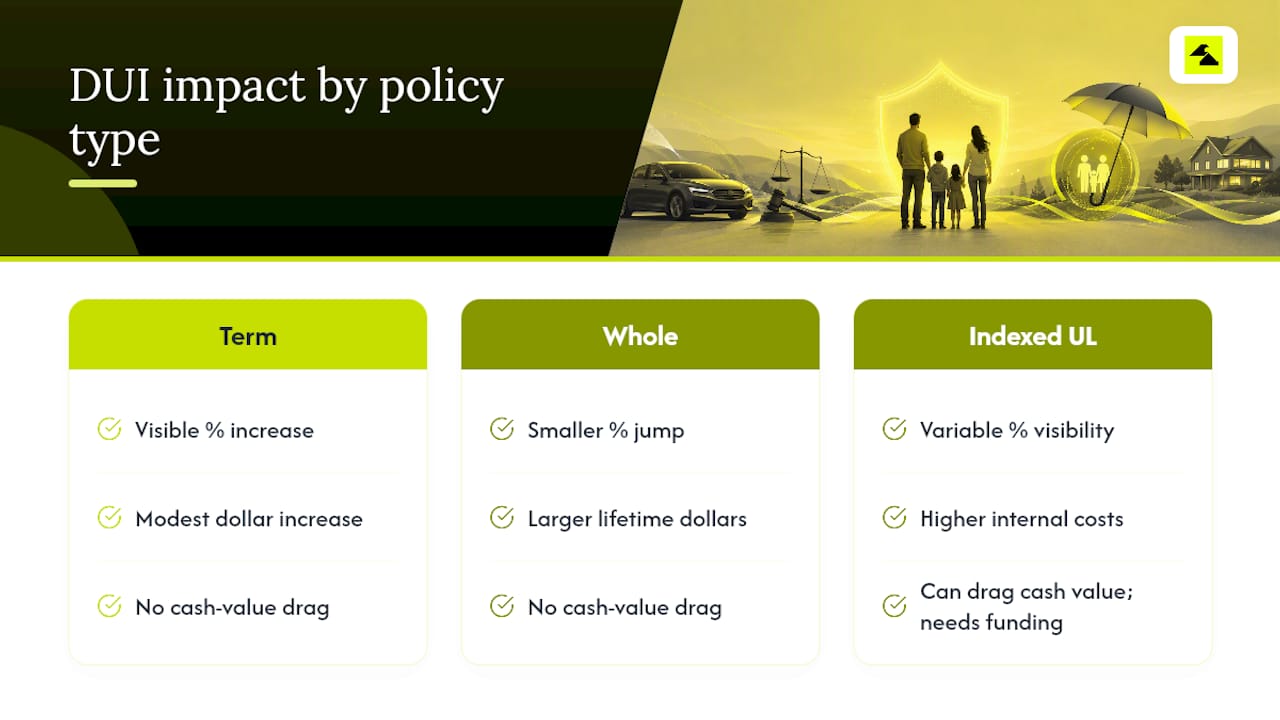
The type of policy you choose changes how much a DUI actually costs you, not just whether you qualify. Term life insurance tends to show the DUI’s impact most sharply in percentage terms, because base premiums are already low. A table rating or flat extra on a $500,000, 20 year term policy can meaningfully raise the monthly payment relative to a clean applicant, even though the dollar amount stays modest.
Whole life insurance carries higher base premiums to begin with, so a DUI surcharge is a smaller proportional jump, but it compounds over decades of level premium payments, making the lifetime cost difference larger in absolute dollars.
Indexed universal life (IUL) policies add another layer of complexity, since flexible premiums and cost-of-insurance charges inside the policy mean a DUI rating can quietly eat into cash value growth if you’re not funding the policy aggressively enough to outpace the higher internal costs. If you’re using permanent insurance for long-term accumulation goals, that extra drag deserves a real conversation with whoever designs the policy, not just a rate quote.
Across all three, the pattern holds: term shows the DUI most visibly, whole life absorbs it more gradually, and permanent policies built for cash value need extra attention to funding levels so the rating doesn’t quietly undercut your goals.
Can a DUI Affect a Claim or Contestability Later?
Here’s where disclosure stops being a courtesy and starts being a financial necessity for your beneficiaries. Every life insurance policy carries a contestability period, typically the first two years after issue, during which the insurer can investigate and deny a claim if it finds a material misrepresentation on the application.
If you failed to disclose a DUI, and death occurs within that window under circumstances connected to alcohol, the insurer has grounds to investigate the original application. A rescinded claim doesn’t just mean a delay. It can mean your family receives nothing but a refund of premiums paid, at exactly the moment they need the death benefit most.
The DUI itself, once disclosed and priced into the policy at issue, does not create ongoing contestability risk. It’s baked into your rate class and done. The risk lives entirely in what you didn’t disclose, not in the conviction itself. This is one area where the honest path and the financially safer path for your beneficiaries are the exact same path.
Do State Laws Affect Life Insurance After a DUI?
Life insurance underwriting rules are set by each carrier, but state insurance regulators still shape the landscape in ways worth knowing. States regulate how long a DUI can legally remain on your driving record for insurance purposes, and that lookback window varies. Some states purge certain violations from public MVR access after a set number of years, while others keep DUI convictions visible indefinitely for underwriting purposes.
States also set their own rules around guaranteed-issue product availability and free-look periods, which affect how much flexibility you have if you accept a policy and then find a better offer elsewhere. A handful of states have stricter insurable interest and rate-filing requirements that limit how aggressively a carrier can surcharge a DUI-related file, though this varies enough that it’s worth confirming with a licensed agent in your state rather than assuming a blanket rule applies.
None of this changes the core underwriting logic (recency, BAC, accident involvement, and pattern of repeat offenses still drive the decision) but it does mean two applicants with identical DUI histories in different states can occasionally see different lookback treatment depending on how their state’s DMV reporting rules interact with the carrier’s own underwriting guidelines.
How Do Multiple DUIs Change Your Underwriting Outlook?
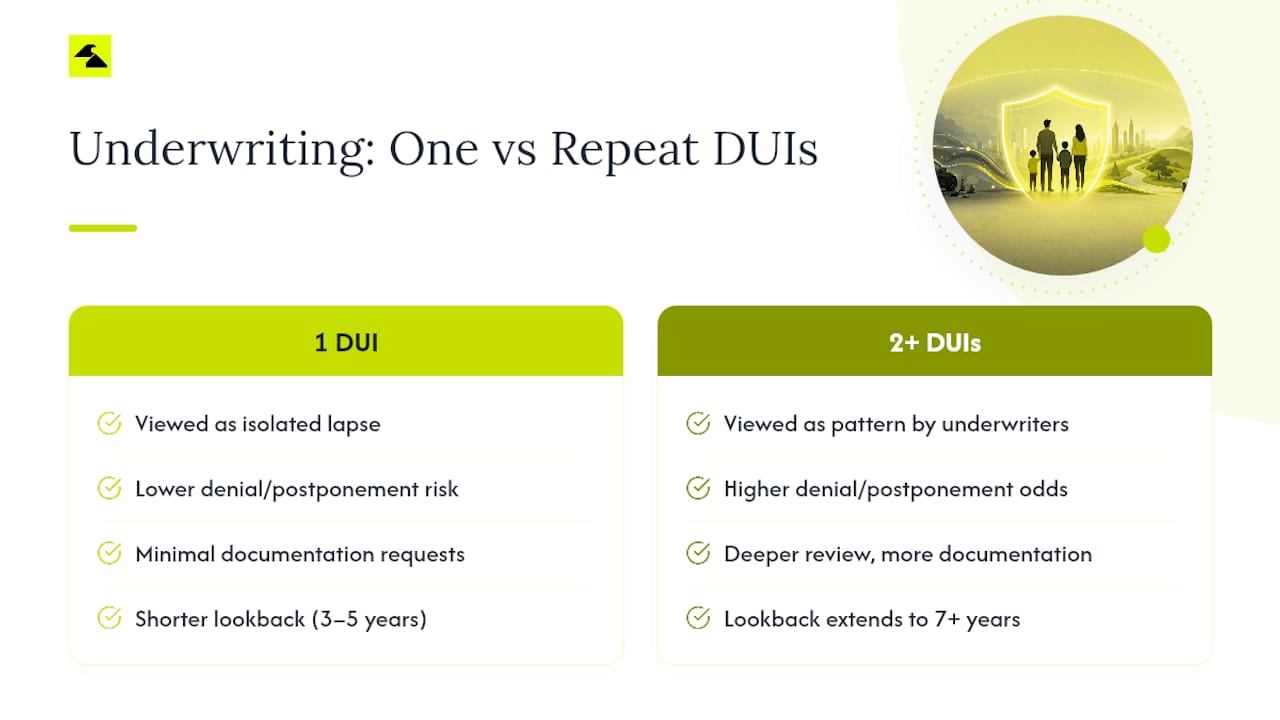
One DUI is a bad night. Two or more within a short window starts to look like a pattern to an underwriter, and pricing shifts accordingly. Two or more DUI convictions within a 10 year period significantly raise the odds of a denial or a much longer postponement, because carriers stop treating the case as an isolated lapse and start doing deep-dive underwriting on the applicant’s full record.
That deeper review typically means more documentation requests, longer processing times, and a real chance that standard fully underwritten term or permanent coverage simply isn’t available for several years. Lookback windows also stretch. A carrier that might overlook a single DUI after three to five years may extend that same forgiveness timeline to seven, eight, or more years when a second offense shows up, especially if the offenses happened close together or involved elevated BAC.
For applicants in this position, the fallback products covered earlier (guaranteed issue, group coverage through an employer, or an accidental death policy as a bridge) matter more, not less. So does documentation. Proof of long-term sobriety, completed treatment programs, and a clean MVR since the most recent offense can eventually move the needle, but the timeline to standard rates is longer, and shopping across multiple carriers becomes even more important since underwriting appetite for repeat offenses varies widely from company to company.
How Does a DUI Compare to Other Life Insurance Risk Factors?
Underwriters see a DUI in context, not isolation, and it’s worth knowing where it ranks against other common risk flags. A single DUI with no accident, no injury, and good subsequent labs often sits in a similar risk tier to a moderate health flag, something like well controlled high blood pressure or a past smoking history that’s since stopped. It’s meaningful, but manageable.
Where a DUI gets treated more seriously is when it overlaps with other factors: a DUI involving an accident or injury, a DUI combined with elevated liver enzymes suggesting ongoing heavy drinking, or a DUI paired with a pending related legal matter such as an injury charge. In those cases, the DUI stops being an isolated data point and starts compounding with other red flags, which pushes the file toward a higher table rating or a longer postponement than the DUI alone would trigger.
Compared to something like a serious cardiac event or a cancer diagnosis, a DUI is generally viewed as more manageable and more time-limited. Health conditions can represent an ongoing, unresolved risk, while a DUI is a discrete event whose risk fades as time passes with a clean record. That’s a meaningful distinction, and it’s part of why the timeline strategies covered earlier work as well as they do.
Are Some Insurers More Lenient on DUI Applicants?
Carrier appetite for DUI risk varies more than most applicants expect, and this is exactly where blind applications cost people money. Some carriers have underwriting guidelines that treat a single, older DUI with clean labs almost the same as a standard applicant, while others apply a rigid table rating formula regardless of context or documentation provided.
The practical reality is that the same file can be declined at one carrier and approved at a reasonable rate at another, simply because each company’s underwriting manual weighs impaired-driving history differently. This is precisely why naming a “most lenient” carrier publicly rarely helps readers. Guidelines shift, appetite changes with a carrier’s claims experience, and what’s lenient this year may tighten next year based on internal loss data.
What actually helps is working with someone who tracks that shifting appetite across multiple carriers in real time and places files accordingly, rather than applying to a single company and hoping for the best. That’s the entire value proposition of an independent broker in impaired-risk cases: knowing which of the available carriers is currently the best fit for your specific record, rather than guessing.
An Editorial Take on Getting Covered After a DUI
Most of the fear around this topic comes from people applying to the wrong carrier first and assuming that one decline defines their options everywhere. It doesn’t. What I’ve seen work consistently is treating DUI-related coverage as a two-stage problem: get something in place now, even if it’s imperfect, and optimize the rate later once the record ages and the documentation catches up.
The mistake I’d push back on hardest is waiting years to apply at all out of fear of rejection. A graded guaranteed-issue policy or group coverage today beats no coverage while you wait for a “clean enough” record. Protect the family first. Fix the rate later.
— Jib Hunt
Get Independent Life Insurance Quotes After a DUI
We work with applicants who have a DUI on record, shopping files across multiple carriers instead of betting everything on one company’s underwriting appetite. That matters because, as the carrier comparisons above show, the exact same record can get declined in one office and approved at a fair rate in another.
[

The process starts with a short consultation to understand your timeline, your documentation (court records, SR-22, treatment completion if applicable), and what kind of coverage actually fits your situation, whether that’s term, whole life, or a guaranteed-issue bridge while your record ages. From there, we identify which carriers are currently the best match for your specific case rather than running you through a one-size-fits-all application. If you’re ready to see real numbers, get a quote online or start with a consultation to map out your options before you apply anywhere.
This article is general information, not a substitute for advice from a qualified financial advisor. Consult a qualified financial professional about your own circumstances before acting on anything here.
FAQ
How long after a DUI can you get life insurance?
Most applicants find workable coverage within one to three years, with many reaching standard or near-standard rates by the three to five year mark if their record stays clean and health markers look good.
Does a DUI conviction disqualify you from life insurance?
A single DUI rarely disqualifies you outright; it typically leads to a temporary table rating or flat extra rather than a flat denial, though multiple recent convictions can push toward postponement.
Does anxiety or another mental health condition affect life insurance alongside a DUI?
Anxiety alone usually has a mild effect on rates, but if it’s documented alongside heavy alcohol use tied to the DUI, underwriters may look more closely at the combined picture during the medical exam and APS review.
What disqualifies you from getting life insurance?
Outright disqualification is rare, but factors like a very recent DUI, multiple convictions with an accident involved, or terminal illness diagnoses can lead a specific carrier to decline, even though other carriers may still offer coverage.
How can you rebuild your insurance profile after a DUI?
Keep your driving record clean, complete any court-ordered treatment and keep the documentation, and reapply through an independent broker once you hit the one and three year marks, when rating options typically improve.
Recommended
Comments