U.S. Pension Maximization: Licensed Quotes and Underwriting Realities
- Jib Hunt

- 1 day ago
- 11 min read

Pension maximization works when the gap between your single-life and joint-and-survivor pension payouts is wide, you’re insurable at a reasonable rate, and your spouse is significantly younger or healthier than the plan assumes. It rarely works when that gap is thin, since permanent life insurance premiums often cost more than the extra pension income covers. The rule of thumb: run the actual numbers with a licensed advisor before you elect anything, because pension elections are usually irreversible.
TL;DR:
Pension maximization is only advisable when the pension spread is wide enough to cover the premium cost of a permanent life insurance policy that adequately replaces the survivor benefit.
A spread under 10% between single-life and joint options often cannot fund the necessary insurance, especially when premiums exceed the benefit, risking a net loss.
The strategy is more suitable if the spouse is significantly younger or healthier, you are insurable at standard rates, and the pension plan includes a pop-up option that restores full benefits if the spouse predeceases you.
Proper modeling requires obtaining actual insurance quotes and simulating tax impacts, longevity scenarios, and the true cost of coverage before making irreversible pension elections.
For public pensions, rules around spousal consent, survivor benefits, and plan-specific protections vary widely, so verifying details directly with your plan is essential.
Table of Contents
What Is Pension Maximization Life Insurance and How Does It Work?
Timing the Decision: Underwriting, Consent, and Coordination
Pension Maximization vs. Joint Pensions and Lump-Sum Withdrawals
Public vs. Private Pensions: Does Pension Maximization Work the Same Way?
Compare Quotes and Model Your Own Pension Maximization Scenario
What Is Pension Maximization Life Insurance and How Does It Work?
Pension maximization pairs a single-life pension election, which pays the highest possible monthly amount but stops at your death, with a life insurance policy that replaces the survivor income your spouse would otherwise lose. The idea is straightforward: pocket the bigger check every month, use part of that extra income to pay insurance premiums, and let the death benefit become your spouse’s replacement pension.
Here’s how the trade-off usually breaks down:
Single-life payout. You receive the maximum monthly benefit, often noticeably higher than a joint option, but payments end when you die.
Joint-and-survivor payout. You accept a reduced monthly check, typically dropping to a portion of your amount for your spouse after you die, but the income never disappears.
The insurance replacement. You take the difference between those two payouts and route it toward a life insurance premium, betting the death benefit will outlast and outperform the survivor annuity.
Outcome scenarios. If you die first and the policy is in force, your spouse gets a lump sum instead of a reduced monthly check. If your spouse dies first, you keep the higher pension with no survivor obligation. If you outlive the policy term, you’re exposed with no coverage and no survivor benefit. If you cancel coverage early, you’ve spent premiums with nothing to show for it.
Some pension plans include a “pop-up” provision that restores your full single-life amount if your spouse predeceases you, which changes the math considerably. Check for this feature before assuming you need insurance at all.
Pros, Cons, and Common Pitfalls
The upside is real: more monthly cash flow while you’re alive, flexibility to name a different beneficiary or split the death benefit, and a payout that’s generally income-tax-free rather than taxed as ordinary income. But the downside list is longer than most people expect.
Outliving a term policy leaves your spouse with nothing, since the higher pension payments stop the day you die.
Premiums frequently exceed the pension spread, turning a “smart” strategy into a monthly loss.
Canceling a permanent policy for cash needs erases the entire safety net.
Some plans tie survivor pensions to health coverage, meaning your spouse could lose more than income if you drop the joint option.
Advisors frequently find that the spread between single-life and survivor payouts simply isn’t large enough to fund a permanent policy that adequately replaces the lost income, which is why many recommend against pension maximization without detailed modeling first.
Pro Tip: If your health is borderline or your spread is modest, lean toward permanent coverage over term. A term policy that expires at 75 does nothing for a spouse who’s still alive at 90.
Term, Universal, or Whole Life for Pension Maximization?
Which policy type fits depends on how long you need coverage and how much risk you’re willing to carry.
Term life costs the least upfront, which makes it tempting when the pension spread is small. The risk: if you outlive a 20 or 30-year term, your spouse loses the survivor benefit entirely, with no payout to replace it.
Universal life and indexed universal life (IUL) offer flexible premiums and a death benefit tied partly to market performance or an index. The catch is that cash value assumptions can underperform, and an underfunded policy can lapse right when your spouse needs it most.
Whole life guarantees a death benefit and a fixed premium for life, at a meaningfully higher cost than term. For pension maximization specifically, that permanence is often the point, since your spouse’s need for survivor income doesn’t expire on a schedule.
In practice, many advisors blend term with a small permanent policy, using cheaper term coverage to bridge early retirement years while a smaller whole life or IUL policy carries the guarantee into old age.
Is Pension Maximization Right for You? A Quick Checklist
Run through these five questions before spending time on a full analysis:
How wide is the spread? A gap under 10% between single-life and joint options rarely covers a decent insurance premium.
What’s the age and health gap between you and your spouse? A younger, healthier spouse increases the survivor benefit’s real cost under the pension, making insurance replacement more attractive.
Are you insurable at standard or better rates? A declined application or a substandard rating can end the strategy before it starts.
Does your spouse have other income? Social Security, savings, or a second pension change how much replacement income is actually needed.
Can you commit to managing a policy for decades? Missed premiums or a lapsed policy leave your spouse exposed exactly when the pension election can’t be undone.
If you answer favorably to at least three of these, a full calculation is worth the time. If not, the joint-and-survivor option is probably the safer default.
How to Run the Numbers on Pension Maximization
Four inputs drive the calculation: your single-life monthly payout, your joint-and-survivor monthly payout, an insurance quote for the death benefit you’d need to replace lost survivor income, and both spouses’ tax brackets.
Here’s a simplified example. Say your single-life pension pays $3,200 a month and your joint option pays $2,700. That $500 monthly spread, or $6,000 a year, is your premium budget. A healthy 65-year-old might secure a permanent policy with a death benefit large enough to generate comparable survivor income for close to that premium, depending on underwriting.
Estimate the survivor’s needed monthly income and back into a death benefit using a conservative withdrawal or annuitization rate.
Get an actual insurance quote, not an estimate, before comparing numbers.
Run the comparison after tax, since pension income is generally taxed as ordinary income while life insurance death benefits are typically received free of federal income tax.
Stress-test for longevity: what happens if you live to 95 instead of 85, and premiums keep coming due?
The after-tax gap often narrows the case for pension maximization less than expected, because a tax-free death benefit can outperform taxable survivor income even on a smaller nominal amount.
Timing the Decision: Underwriting, Consent, and Coordination
Pension elections and insurance underwriting run on different clocks, and that mismatch causes most execution failures.
Start the insurance application before you touch the pension paperwork. Full underwriting, including labs and medical records, can take four to eight weeks, and rushing it against a plan deadline is the single biggest scheduling mistake retirees make.
Get a licensed consultation that produces a conditional quote before you request pension election paperwork, so you know your actual rating class, not a guess.
Married participants electing anything other than the joint-and-survivor default typically need written spousal consent under federal rules, and that consent has to be notarized and filed with the plan before the deadline.
Coordinate beneficiary designations across the policy and any other retirement accounts so the death benefit actually reaches the intended survivor.
ERISA, QJSA, and PBGC: What U.S. Retirees Need to Verify
Federal law shapes this decision more than most retirees realize.
Under the Retirement Equity Act, married participants in defined benefit plans must be offered a Qualified Joint and Survivor Annuity, and choosing anything else requires your spouse’s written, notarized consent.
The Pension Benefit Guaranty Corporation insures many private-sector pensions if a plan fails, but that protection has payout caps and doesn’t extend to most public pensions or the insurance policy you buy privately.
Pension distributions are taxed as ordinary income, while life insurance death benefits are generally received free of federal income tax, a difference that materially changes the after-tax comparison covered above.
Plan rules vary widely. Confirm pop-up provisions, consent deadlines, and any coordination with retiree health coverage directly with your plan administrator, and verify any advisor’s credentials through FINRA’s BrokerCheck before acting on a recommendation.
How East Two West Approaches Pension Maximization Cases
Jib Hunt, founder of East Two West and author of The Capital Loop, built the firm’s approach around one principle: insurance decisions should follow the numbers, not a sales script. When a pension maximization case comes through the door, East Two West models the actual spread, pulls real underwriting quotes across multiple carriers, and blends term and permanent coverage the way Section 4 describes, rather than defaulting to a single product. Every recommendation accounts for the survivor’s tax bracket, other income sources, and the tax treatment of the death benefit itself. That’s the same discipline the firm applies to Infinite Banking and annuity work: figure out what the client’s cash flow and risk tolerance actually support before recommending a structure.
How Changing Pension Laws Affect This Strategy
Pension maximization isn’t a static calculation. It moves with regulatory changes, and 2026 retirees are navigating a landscape shaped by several shifts that didn’t exist a decade ago.
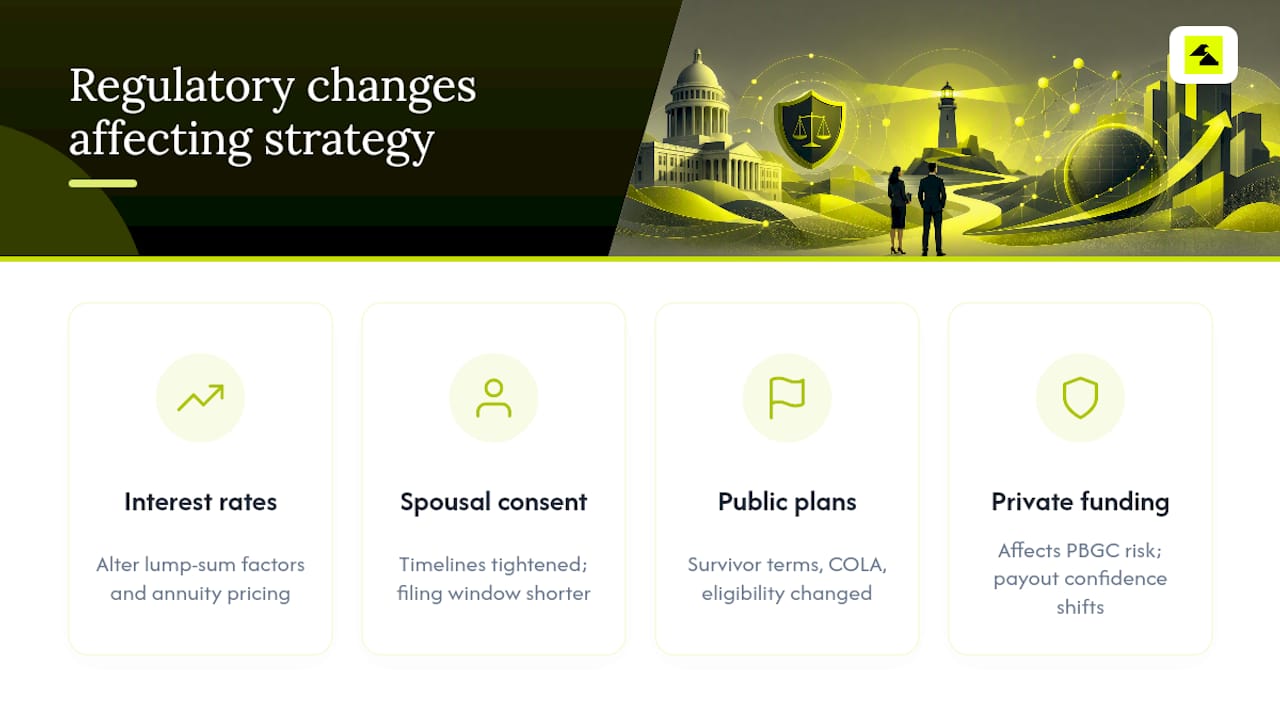
Interest rate environments directly affect lump-sum conversion factors and annuity pricing, which means the same pension can produce a different single-life versus joint-and-survivor spread depending on when you retire. Plans have also tightened administrative timelines for spousal consent filings, partly in response to disputes over late or improperly notarized consent forms. That tightening cuts both ways: it protects spouses from being cut out of survivor benefits without real consent, but it also shrinks the window retirees have to line up insurance underwriting before a pension election deadline.
Public pension systems, many of which operate under state-specific statutes rather than ERISA, have moved independently to adjust survivor benefit formulas, cost-of-living provisions, and eligibility rules. A public pension’s survivor terms this year may look nothing like they did five years ago, so retirees relying on older plan summaries risk basing insurance decisions on outdated numbers.
There’s also ongoing legislative attention on private pension funding requirements, which indirectly affects the PBGC’s risk profile and the confidence retirees should place in guaranteed payouts from underfunded plans. None of this changes the core mechanics of pension maximization, but it does mean the inputs, spread size, consent deadlines, and survivor protections, deserve a fresh look at the actual election, not a one-time calculation made years earlier.
Pension Maximization vs. Joint Pensions and Lump-Sum Withdrawals
Pension maximization isn’t the only path to protecting a spouse’s retirement income, and it’s worth weighing against the two most common alternatives.
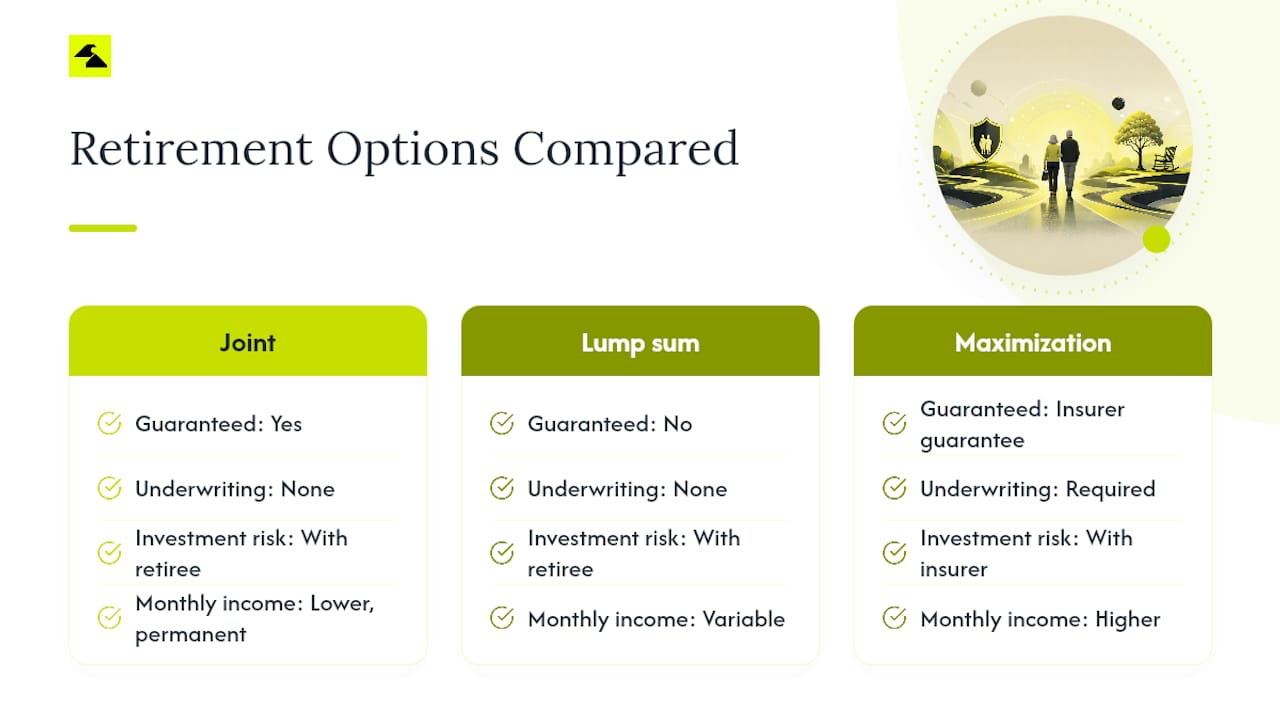
Joint-and-survivor election is the default for a reason: it’s guaranteed, requires no underwriting, and never lapses from a missed premium. The cost is a permanently lower monthly check for both spouses’ lifetimes, regardless of who dies first or how long the survivor lives afterward. For couples with a thin pension spread or health issues that make insurance expensive or unavailable, this is usually the safer choice.
Lump-sum withdrawal, when a plan offers it, hands you the present value of your entire pension in one payment, which you then invest or annuitize yourself. This gives you control and flexibility that neither pension option offers, but it also transfers all the investment and longevity risk onto you. A lump sum invested too conservatively may not last as long as a guaranteed pension would have; invested too aggressively, a market downturn early in retirement can permanently damage the balance.
Pension maximization sits between these two: more monthly income than the joint option, but with insurance underwriting risk instead of investment risk. If you’re uninsurable or facing high premiums, the lump sum or joint election becomes the more realistic route. If you’re healthy with a wide spread, pension maximization can outperform both. There’s no universally superior choice here. It depends entirely on your specific pension numbers, health, and how much risk you want to carry personally versus transfer to an insurer or the market.
Public vs. Private Pensions: Does Pension Maximization Work the Same Way?
Private-sector defined benefit plans generally fall under ERISA, which mandates the QJSA and spousal consent process described earlier, and many carry PBGC insurance as a backstop if the plan becomes underfunded. That combination gives private pension participants a relatively standardized, well-documented path into pension maximization, since the consent rules and plan disclosures are federally required.
Public pensions, covering teachers, police, firefighters, and other government employees, operate under state or municipal statutes instead of ERISA, and they vary enormously. Some state systems don’t require spousal consent for a single-life election at all, which removes a procedural step but also removes a protection your spouse would otherwise have under federal law. Others build in survivor benefit percentages that are fixed by statute and can’t be adjusted the way many private plans allow.
The practical takeaway: don’t assume your public pension follows the same rules as a private one, or vice versa. Contact your specific plan administrator for the exact consent requirements, survivor benefit percentages, and any pop-up provisions before assuming pension maximization math from a private-sector example applies to your public pension. The mechanics of buying insurance to replace survivor income work the same regardless of plan type, but the rules governing how you elect your pension option can differ sharply.
Why We Push Back on Blanket Pension-Max Advice
We built our process around individualized, numbers-first evaluations because pension maximization gets recommended far too casually elsewhere. The spread rarely covers a permanent policy the way people assume, and health changes can eliminate the strategy overnight. We’d rather tell a client the joint option is the smarter move than sell a policy that doesn’t actually replace what’s being given up. Run your scenario with a licensed advisor before you elect anything irreversible.
— Jib Hunt
Compare Quotes and Model Your Own Pension Maximization Scenario
You can obtain real quotes from multiple carriers and an actual side-by-side comparison, instead of guessing whether your pension spread justifies a policy, rather than relying on a generic worksheet.
[

A consultation walks through your specific pension numbers, pulls conditional insurance quotes across term, whole life, and IUL options, and lays out the after-tax outcome for each scenario so you can see exactly where the numbers land before you sign anything. This is licensed insurance placement, not fiduciary investment advice, so the final election decision and any tax filing questions still belong with your plan administrator and tax professional. Compare life insurance and annuity quotes directly, or book a consultation to get your specific spread and underwriting class modeled before your pension deadline arrives.
This article is general information, not a substitute for advice from a qualified financial advisor. Consult a qualified financial professional about your own circumstances before acting on anything here.
Sources
FAQ
How can I maximize my pension using life insurance?
You elect the higher single-life pension payout, then use the extra monthly income to fund a life insurance policy sized to replace the survivor benefit your spouse would have received under the joint option. The strategy only works if the insurance premium fits within that pension spread.
How much is a $100,000 pension worth per month?
There’s no fixed conversion since payout amounts depend on your plan’s formula, your age at retirement, and whether you choose single-life or joint-and-survivor options. Ask your plan administrator for your specific monthly figures under each election before running any comparison.
Is pension maximization a good idea?
It can work well for a healthy retiree with a wide spread between pension options and a spouse who has other income sources, but advisors often find the spread too thin to justify it without a detailed, numbers-based analysis first.
What percentage of Americans retire with $1,000,000?
Specific figures for this vary by data source and year, so we won’t cite an unverified number here. What matters more for pension maximization is your household’s actual pension spread, insurability, and survivor income needs, not a national savings benchmark.
Recommended
Comments