Apply Right First: U.S. Life Insurance for People Living With HIV
- Jib Hunt

- 2 days ago
- 10 min read

Yes, people living with HIV can get life insurance in 2026, including fully underwritten term and whole life policies from mainstream carriers. The deciding factor almost always comes down to one thing: well-managed HIV, meaning an undetectable viral load and sustained antiretroviral therapy (ART) adherence over time. If your labs aren’t there yet, guaranteed issue or group coverage through an employer can still get you protection now.
TL;DR:
Most applicants with well-controlled HIV, including an undetectable viral load for over a year and CD4 counts above 350, qualify for fully underwritten policies.
Carriers often require 6 to 24 months of consistent ART before considering applicants for standard risk assessments, emphasizing the importance of stable lab results.
If labs are borderline or trending upward, buying a small policy now and reapplying later can be more cost-effective than overpaying for guaranteed issue coverage.
The underwriting process involves detailed lab review, medical record requests, and longer approval times than standard cases, often taking several weeks.
Matching your health profile with the right carrier, working with experienced brokers, and maintaining disclosure transparency significantly improve your chances of approval.
Table of Contents
Life Insurance for HIV: Who Actually Qualifies?
Underwriters don’t look at an HIV diagnosis the way they did twenty years ago. They look at control. A suppressed viral load and stable CD4 count are the two numbers that carry the most weight, and they’re often the difference between a decline and a standard offer.
Most carriers want to see a viral load that’s been undetectable for a defined stretch, paired with a CD4 count that’s stayed above 350, ideally well above 200 at every reading. Nadir CD4 (your lowest historical count) still matters, because it tells an underwriter how the infection behaved before treatment started. A rocky early history followed by years of stability reads differently than a diagnosis that’s never been fully controlled.
Time on ART matters almost as much as the numbers themselves. Carriers commonly want somewhere between 6 and 24 months of consistent treatment before they’ll consider a fully underwritten policy, and longer is better. A single strong lab result won’t move an underwriter. A pattern of strong results will.
Other factors that get weighed alongside HIV status:
Hepatitis B or C co-infection, which can push a case into a higher rating tier or trigger a decline depending on liver function
History of intravenous drug use, even years in the past
Current smoking status, which compounds risk in ways that matter more for HIV-positive applicants than for the general population
Age at application, since older applicants face compounding mortality assumptions on top of HIV-related ones
You’re in a strong position for fully underwritten coverage if your viral load has been undetectable for at least a year, your CD4 count is comfortably above 350, you’ve been on the same ART regimen without major changes, and you don’t smoke. Guardian Life is one of the insurers now writing individual policies for applicants who meet criteria like these, and it isn’t the only one.
Pro Tip: Pull your last two to three years of viral load and CD4 results before you apply, not just your most recent test. Underwriters trust a trend line far more than a single good number.
What Types of Life Insurance Are Actually Available?
The product that fits you depends heavily on where your labs stand right now.
Fully underwritten term and whole life offer the best value when you qualify. Coverage amounts can run into the hundreds of thousands of dollars, premiums are priced individually based on your risk profile, and whole life adds a cash value component that grows over time. This is the tier worth aiming for if your medical history supports it.
Simplified issue life insurance skips the medical exam and relies on a health questionnaire instead. Coverage caps are lower, usually in the tens of thousands, and pricing runs higher than fully underwritten policies because the insurer is taking on more uncertainty.
Guaranteed issue accepts nearly anyone regardless of health status, but the trade offs are real: lower caps, a graded death benefit that limits payouts in the early years, and premiums that are expensive relative to the coverage you get.
Group or employer coverage is guaranteed issue by nature and often comes free or heavily subsidized. The catch is continuity. If you leave the job, coverage usually ends or becomes far more expensive to convert.
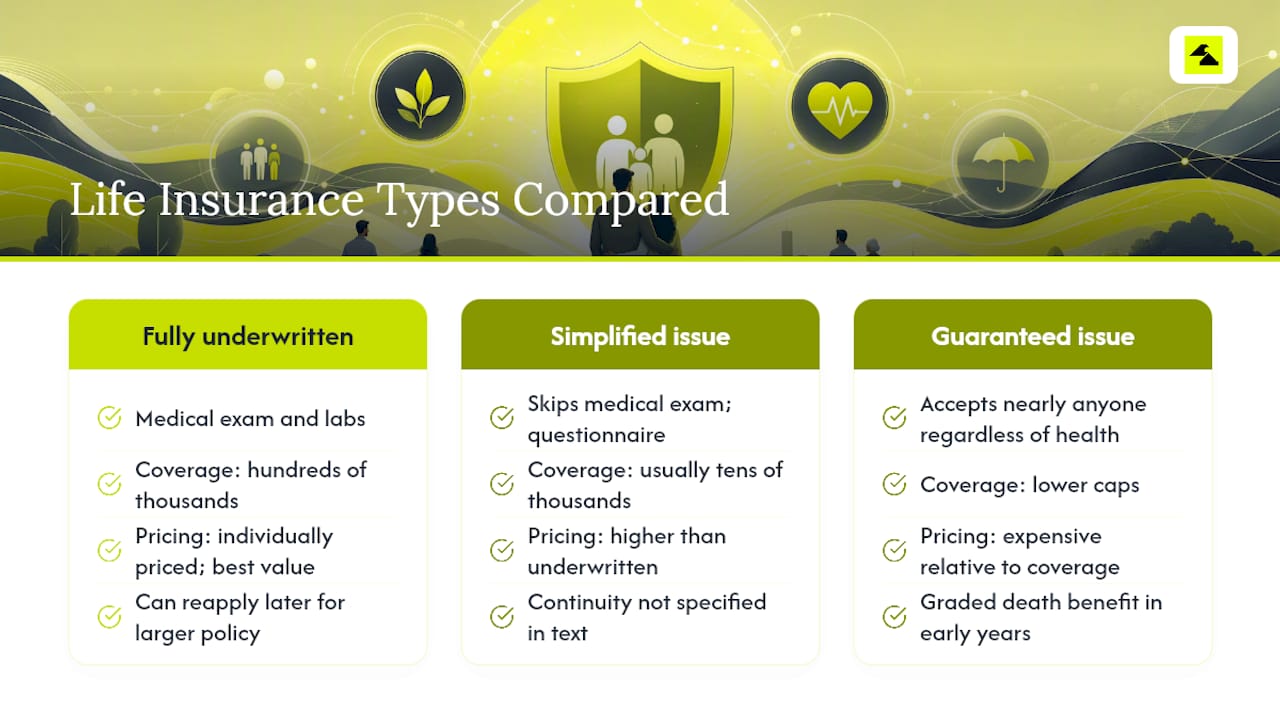
If your labs are borderline today but trending in the right direction, buying a smaller policy now and reapplying for larger fully underwritten coverage in a year or two is often smarter than overpaying for guaranteed issue at a size you don’t need.
What Happens During the Underwriting Process?
Applying for life insurance with HIV follows the same basic sequence as any impaired risk case, just with more documentation involved.
You submit a formal application, answering health questions truthfully, including any HIV diagnosis.
A paramedical exam is scheduled, involving bloodwork, sometimes a urine sample, and basic vitals.
The insurer requests your medical records directly from your HIV specialist or primary care provider.
An underwriter reviews viral load history, CD4 trends, ART adherence, and any comorbidities.
You receive a decision: approval at standard rates, approval with a rating (higher premium), or a decline.
HIV testing consent varies by state. New York, for example, has specific rules governing how HIV test results can be used and disclosed in insurance underwriting, with privacy protections built into the process. Most states allow insurers to require an HIV test as part of the exam, but they can’t test without your knowledge.
The Medical Information Bureau (MIB) is a database that carriers check to see if you’ve applied elsewhere and disclosed differently. This is why full disclosure matters: a mismatch between what you told one carrier and what MIB shows can trigger a rescission during the contestability period, which typically runs two years from policy issue.
By the numbers: Underwriting for an impaired risk case like HIV commonly takes longer than a standard application, often stretching several weeks once medical records requests are factored in, compared to a much faster turnaround for healthy applicants with no records to chase.
What If You Don’t Meet the Underwriting Markers Yet?
Not qualifying for a fully underwritten policy today doesn’t mean going without coverage while you wait for better labs.
Guaranteed issue policies typically cap coverage between $2,000 and $50,000 and include a graded death benefit for the first two to three years, meaning beneficiaries get a return of premium (plus interest) rather than the full face amount if death occurs early.
Simplified issue products skip the exam entirely and rely on a questionnaire, with coverage ceilings usually fall in the tens of thousands, depending on the carrier.
Stacking coverage by combining employer group benefits with a small individual policy can get you meaningfully more total protection than either option alone.
If your CD4 and viral load are trending toward qualifying thresholds, waiting six to twelve months and reapplying for a fully underwritten policy is often the better financial move than locking into an expensive small policy long term.
What Drives the Price of HIV Life Insurance?
Premiums for applicants with HIV tend to run higher than standard rates, but “higher” covers a wide range depending on your file.
The main drivers are viral load stability, CD4 count, age at application, smoking status, and any comorbidities like hepatitis co-infection. Policy type matters too. Fully underwritten term is usually the most cost-efficient path per dollar of coverage, while guaranteed issue costs far more per dollar of death benefit.
Carriers generally sort applicants into standard or substandard rating tiers. A substandard rating means a premium loading, sometimes described in multiples of the standard rate, to account for elevated mortality risk. Reinsurers like Swiss Re have published underwriting guidance showing that modern HIV mortality, when the condition is well managed, is priceable rather than uninsurable. That shift is part of why more carriers write these policies at all.
Improving your CD4 count and maintaining undetectable viral load for a longer stretch can move you from a substandard rating to something closer to standard.
Quitting smoking has an outsized effect on premium loading for HIV-positive applicants specifically.
Waiting a year with stable labs can sometimes cut the rating class in half, though results vary by carrier.
One data point worth knowing: Guardian and other carriers accepting HIV applicants generally treat sustained ART adherence and undetectable viral load as the two variables most likely to move you into a lower-cost rating tier.
How Do You Prepare a Strong Application?
Preparation is where most applicants either win or lose their case before an underwriter even opens the file.
Gather your viral load history going back at least two to three years, showing multiple readings rather than a single test.
Collect your CD4 count history over the same period, including your nadir CD4 if it’s documented.
Get a letter or records summary from your HIV specialist confirming your current ART regimen and adherence.
Request copies of any specialist notes addressing comorbidities like hepatitis status or cardiovascular health.
Wait for stability after any regimen change. Applying immediately after switching ART medications often results in a postponement or decline simply because there isn’t enough post-change data yet.
Work with an independent broker who has direct experience placing impaired risk cases. Ask specifically which carriers they’ve placed HIV cases with recently, not just which carriers claim to accept them.
Disclose everything, every time, on every application. Inconsistency between applications is what MIB checks are designed to catch.
Pro Tip: Submit your strongest file to the carrier most likely to approve it first. A decline on a borderline case can complicate future applications, since some carriers ask if you’ve been declined elsewhere.
If you get declined, ask for the specific reason in writing. Sometimes it’s a single lab value or a documentation gap, not a blanket policy against HIV applicants, and a different carrier with more inclusive guidelines may approve the same file.
What Legal Protections Apply to HIV Life Insurance Applicants?
The Affordable Care Act’s pre-existing condition protections cover health insurance. They do not apply to life insurance. Life insurers can legally use HIV status as an underwriting factor, and LegalClarity’s guidance confirms carriers can decline or rate a policy based on medical risk as long as the decision has an actuarial basis rather than being a blanket exclusion.
Some states go further. California’s Equal Insurance HIV Act prohibits insurers from denying a life insurance application solely because an applicant tested positive for HIV, while still allowing carriers to use actuarially sound underwriting criteria tied to the actual clinical markers. New York has its own testing and consent framework governing how HIV test results can be collected and disclosed during underwriting, with added privacy protections around how that information is stored and shared.
Rules differ meaningfully by state, so before you apply, ask your agent:
Does my state restrict how insurers can use HIV status in underwriting decisions?
What consent is required before an HIV test can be administered as part of my exam?
How is my test result protected once it’s in the insurer’s file?
If a health condition unrelated to HIV is also part of your picture, it’s worth understanding how critical illness plans generally affect underwriting too.
Why This Market Has Changed Faster Than Most People Realize
Most people still assume an HIV diagnosis is an automatic decline. That assumption is outdated, and it’s costing people money and peace of mind. Reinsurers like Munich Re have been publishing guidance for years showing that modern antiretroviral therapy has changed the mortality math enough that HIV is now a manageable, priceable risk in the same category as diabetes or controlled hypertension. Carriers have been slow to update their public messaging, but the underwriting guidelines have moved.
The bigger issue isn’t whether you can qualify. It’s that too many people apply to the wrong carrier first, get declined based on outdated assumptions built into that specific company’s guidelines, and give up. Every carrier prices HIV risk differently, and a file that gets declined at one company can get approved at standard rates at another. That’s not a loophole. It’s just how impaired risk underwriting works across the industry, and it’s exactly why matching the file to the right carrier the first time matters more than most applicants realize.
— Jib Hunt
Get Help Finding the Right Carrier for Your File
Some brokers work with people whose health history makes off-the-shelf insurance shopping frustrating, including applicants managing HIV. Instead of applying blind to one carrier and hoping for the best, you can access quotes from multiple carriers with different underwriting appetites, so your file goes to the insurer most likely to say yes at a fair rate.
[

A consultation starts with a straightforward conversation about your labs, your ART history, and your coverage goals. Bring whatever viral load and CD4 records you have, even if they’re incomplete. Some advisors can help identify what’s missing and whether stacking a smaller policy now while building a stronger file for later makes more sense than waiting entirely. If a comorbidity like hepatitis co-infection is part of your picture, that gets factored into carrier selection too rather than treated as an automatic disqualifier.
Ready to see where you stand? Request a quote or reach out through East Two West to start the conversation with someone who places impaired risk cases regularly, not occasionally.
Sources
For clinical background on HIV and treatment outcomes, see the CDC’s HIV statistics. For legal nuance on disclosure and state protections, LegalClarity offers detailed guidance. For industry underwriting standards, review Swiss Re’s Life Guide and consult your state’s department of insurance for local rules.
FAQ
Do People With HIV Get Life Insurance?
Yes. Multiple carriers, including Guardian Life, now underwrite fully underwritten term and whole life policies for applicants with well-managed HIV, meaning undetectable viral load and stable CD4 counts over time.
Does Having HIV Disqualify You From Life Insurance?
No, HIV alone doesn’t disqualify you. Underwriters look at control markers like viral load, CD4 count, and time on ART rather than the diagnosis itself, though poorly controlled cases face higher premiums or decline.
How Long Can a Person Live With HIV?
With sustained antiretroviral therapy, CDC data shows life expectancy for people with well-managed HIV has improved substantially, which is part of why insurers now treat it as a priceable chronic condition rather than a terminal one.
What Government Benefits Are Available for HIV Patients?
Programs like the Ryan White HIV/AIDS Program help cover medical care and medications for people who qualify, and HIV.gov maintains updated information on eligibility and enrollment for federal and state support programs.
Can I Get Life Insurance if My CD4 Count Is Low?
A low or historically low CD4 count makes fully underwritten approval harder but not impossible, especially if your recent trend shows sustained improvement; guaranteed issue or simplified issue coverage remain available in the meantime.
Recommended
Comments