Avoid a 10% Penalty: U.S. Seven Pay Test and MEC Life Insurance


A Modified Endowment Contract (MEC) is a permanent IRS tax classification that applies when a cash-value life insurance policy is funded too aggressively, too fast. Once a policy fails the seven-pay test under IRC §7702A, withdrawals and loans get taxed gains-first instead of basis-first, and a 10% penalty often applies before age 59½. The death benefit stays income-tax-free. The classification is permanent for contracts issued on or after June 21, 1988, and a 1035 exchange does not automatically erase it; for more life insurance concepts, see Life Insurance Insurance Articles | Insurance Spain.
TL;DR:
Most accidental MEC triggers stem from large, unscheduled premiums or dividend reinvestments into paid-up additions without prior written approval.
The seven-pay test compares cumulative premiums paid against a calculated limit; exceeding it in any year causes MEC status with permanent tax consequences.
Once classified as a MEC, withdrawals and loans are taxed as gains first, and early distributions before age 59½ face an additional 10% penalty.
Correcting MEC status is typically only possible within a short window after overfunding; after that, the classification remains permanent.
To avoid MEC issues, always request a written seven-pay calculation before large premiums and monitor dividend use on existing policies.
Table of Contents
What Is a Modified Endowment Contract (MEC) in Life Insurance?
Tax Consequences: Withdrawals, Loans, Surrenders, and Reporting
Remediation and Carrier Correction: What Insurers and the IRS Say
Adviser Checklist: What East Two West Recommends Before You Fund a Policy
How MEC Rules Differ Across Whole Life, Universal Life, and IUL
What Is a Modified Endowment Contract (MEC) in Life Insurance?
A MEC is a statutory label, not a product type. Any permanent life insurance contract, whole life, universal life, or indexed universal life, can become a MEC if it takes in more premium than the seven-pay test allows during its first seven years or after a material change. The label comes directly from IRC §7702A, which Congress wrote to stop people from using life insurance as a disguised savings account with no death benefit risk attached.
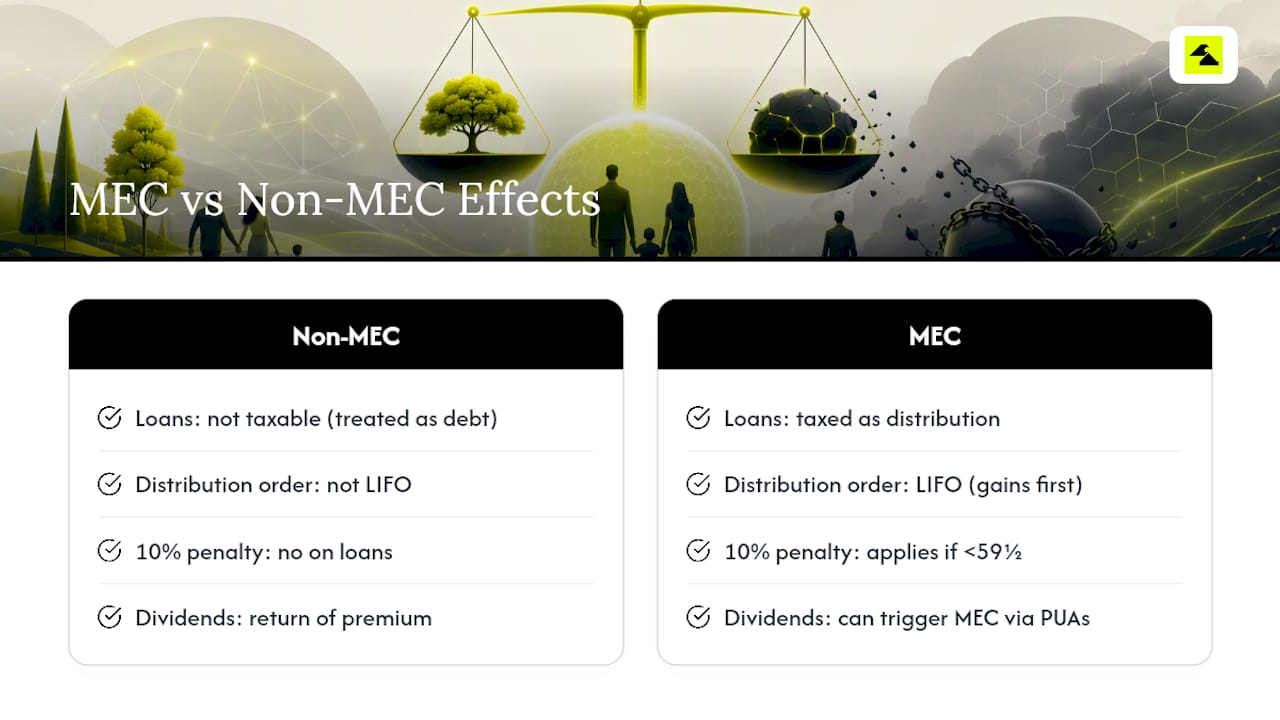
The practical shift is entirely about tax timing on distributions. A non-MEC policy lets you withdraw your own premium (basis) first, tax-free, before touching gains. A MEC flips that order.
Non-MEC: withdrawals are treated as basis first, tax-free until you exceed what you paid in.
MEC: withdrawals and loans are treated as taxable gain first, under a last-in, first-out rule.
Both: the death benefit paid to a beneficiary remains income-tax-free regardless of MEC status.
Once a contract crosses that line, it stays a MEC for as long as it exists, even if you later reduce premiums or the cash value shrinks.
The Seven-Pay Test: How and When a Policy Fails It
The seven-pay test asks a simple question: if you paid this policy off in seven level annual premiums, would the death benefit require more or less premium than what you actually paid in year one through year seven? If cumulative premiums paid ever exceed the cumulative “seven-pay premium” limit at any point in that seven-year window, the policy becomes a MEC starting with the payment that crossed the line.
The seven-pay limit is calculated once, based on the policy’s death benefit and design, then compared against actual premiums paid each year.
Single-premium and dump-in designs fail almost automatically, since paying seven years’ worth of premium in year one blows past any seven-pay limit.
Paid-up additions and large dividend allocations are common accidental triggers, especially on older whole life contracts where dividends are set to buy more paid-up insurance by default.
A material change resets the clock. Increasing the death benefit, adding certain riders, or making an unscheduled large payment can trigger a new seven-pay testing period on an existing policy.
The “necessary premium” exception matters here. IRS guidance allows carriers to factor in reasonable expense charges and necessary premium calculations when computing the deemed cash surrender value used for testing, which is why two seemingly identical policies can have different seven-pay limits.
The test runs automatically inside the carrier’s administrative system. Most policyholders never see the calculation until an in-force illustration flags it or a 1099-R shows up unexpectedly.
Tax Consequences: Withdrawals, Loans, Surrenders, and Reporting
MEC status changes how every dollar that comes out of the policy during your lifetime gets taxed. Under IRC §72(e)(10), distributions from a MEC follow a gains-first, or LIFO, ordering rule instead of the basis-first rule that applies to non-MEC contracts.
Withdrawals and surrenders. Any amount you take out is taxed as ordinary income to the extent the policy has gain, before you ever touch your own basis. If you surrender the policy entirely, the same gains-first math applies to the full cash value.
Loans are treated as distributions. This is the detail that surprises the most policyholders. On a non-MEC policy, a loan against cash value is not a taxable event. On a MEC, a loan is taxed the same way a withdrawal would be, gains come out first, and tax is due even though you have not actually surrendered anything.
The 10% penalty. If the taxable portion of a withdrawal, loan, or surrender comes out before you turn 59½, an additional 10% tax applies on top of ordinary income tax, similar to the early-distribution penalty on a retirement account. Exceptions exist for disability and for distributions taken as part of a series of substantially equal periodic payments (SEPPs), but most policyholders taking a lump sum before 59½ will owe the penalty.
The carrier issues a Form 1099-R showing the taxable amount in Box 1 and the taxable gain in Box 2a.
Box 7 carries a distribution code (commonly 2 or 1) that tells the IRS whether the early-distribution penalty applies.
You report the taxable portion on your Form 1040 as ordinary income and use Form 5329 to calculate the 10% additional tax if it applies.
Death benefit proceeds paid to a beneficiary are not reported on a 1099-R as taxable income; they remain income-tax-free under the general life insurance exclusion.
Here’s the part that trips people up: MEC status does not stop the policy’s growth from being tax-deferred. Cash value still compounds without annual tax drag. The tax bill only arrives when you actually pull money out during your lifetime, which is exactly why some owners accept MEC status on purpose when they never plan to access the cash while they’re alive.
How to Avoid Accidentally Turning a Policy Into a MEC
Most MEC problems are avoidable with one phone call before the money moves, not after.
Ask the carrier for a written seven-pay calculation before making any premium payment larger than the scheduled amount.
Favor level, scheduled premiums over single large deposits or “catch-up” lump sums.
Watch paid-up addition riders closely. Automatic dividend reinvestment into paid-up additions is a leading cause of unintentional MEC status on older whole life contracts.
If you’re increasing a death benefit or adding a rider, ask specifically whether that counts as a material change that resets seven-pay testing.
Insist on written confirmation from the carrier any time you’re told a payment is “within limits.” Verbal assurance from a call center is not documentation.
Pro Tip: Before sending any premium payment above your scheduled amount, request the policy’s current seven-pay limit in writing and confirm in the same email whether the payment would exceed it. That single email is often the only record that saves a policyholder from an unwanted 1099-R the following January.
Remediation and Carrier Correction: What Insurers and the IRS Say
Carriers generally offer a narrow window, often around 60 days or before the end of the contract year, to return excess premium and undo an accidental MEC failure. Once that window closes, the classification is permanent.
Contact the carrier immediately if a payment might exceed the seven-pay limit; most insurers have a standard return-of-premium process.
Request written confirmation of any returned premium, since disputes over whether a correction actually happened are common years later when a 1099-R arrives.
IRS guidance on the necessary premium test shows the agency accepts that reasonable expense charges factor into the deemed cash surrender value used in seven-pay calculations, which is one reason carrier math sometimes differs from a policyholder’s own back-of-envelope estimate.
A 1035 exchange into a new contract does not reset MEC status. If the original policy was a MEC, the IRS treats the replacement contract as a MEC too.
Pros and Cons: When Someone Might Intentionally Fund a MEC
Not every MEC is a mistake. Some are the plan.
Pro: Faster cash accumulation for someone who has no intention of touching the money during their lifetime, since MEC status has zero effect on the death benefit’s tax-free treatment.
Pro: Tax-deferred growth continues uninterrupted; the seven-pay limit restricts funding speed, not long-term compounding.
Con: Any lifetime access, loan or withdrawal, becomes taxable gains-first, which can be expensive if plans change and the owner needs liquidity later.
Con: The 10% early-distribution penalty applies to taxable amounts accessed before 59½, narrowing flexibility for younger owners.
Typical scenario: A business owner or high-net-worth individual funding a policy purely as a wealth-transfer vehicle, often paired with an irrevocable life insurance trust to keep proceeds outside a taxable estate, may accept MEC status without hesitation because they never planned to withdraw from the policy anyway.
Adviser Checklist: What East Two West Recommends Before You Fund a Policy
Jib Hunt and the team at East Two West Insurance work with policy design daily, and the pattern is consistent: MEC surprises almost always trace back to a payment made without a written seven-pay check first. Before any premium above the scheduled amount goes out, request a formal seven-pay worksheet and an in-force illustration showing the impact of paid-up additions on the testing limit.
Request a written seven-pay calculation and the carrier’s correction policy, including timeframes, in writing.
Verify how Form 1099-R will treat any distribution before, not after, you take it.
Coordinate with an estate attorney on ILIT structure if the policy is part of a wealth-transfer plan.
Ask when an in-force illustration makes sense versus considering a 1035 exchange or a low-bracket-year surrender instead.
The Impact of MEC Status on Policy Loans and Dividends
Loans are where MEC status bites hardest, because the tax treatment inverts what most policyholders expect from permanent life insurance. On a standard whole life or universal life policy that has not failed the seven-pay test, a policy loan is not a taxable event at all. You’re borrowing against your own cash value, and the IRS treats that as debt, not income. On a MEC, that same loan is taxed as a distribution the moment you take it, gains come out first under the LIFO rule, and if you’re under 59½, the 10% penalty applies to the taxable portion just as it would on a straight withdrawal.
This matters most for the Infinite Banking Concept style of policy design, where policy loans are the entire point of the strategy. A properly designed non-MEC whole life policy lets an owner borrow against cash value repeatedly without triggering tax, which is exactly why avoiding MEC status is a design priority, not an afterthought, for that kind of funding strategy.
Dividends behave differently. Dividends themselves are generally treated as a return of premium and are not taxable income regardless of MEC status. Where MEC status changes the picture is in how those dividends are applied. If dividends automatically purchase paid-up additions, and those additions push cumulative premium past the seven-pay limit, the dividend allocation itself can be the trigger that creates the MEC in the first place. An unpaid loan balance on a MEC also reduces the death benefit and can complicate the tax-free treatment of proceeds if the loan exceeds basis at death, so outstanding loan balances deserve regular review, not just a one-time check at issue.
How MEC Rules Differ Across Whole Life, Universal Life, and IUL
The seven-pay test applies identically across policy types under IRC §7702A, but the funding mechanics that trigger MEC status look different depending on the chassis.
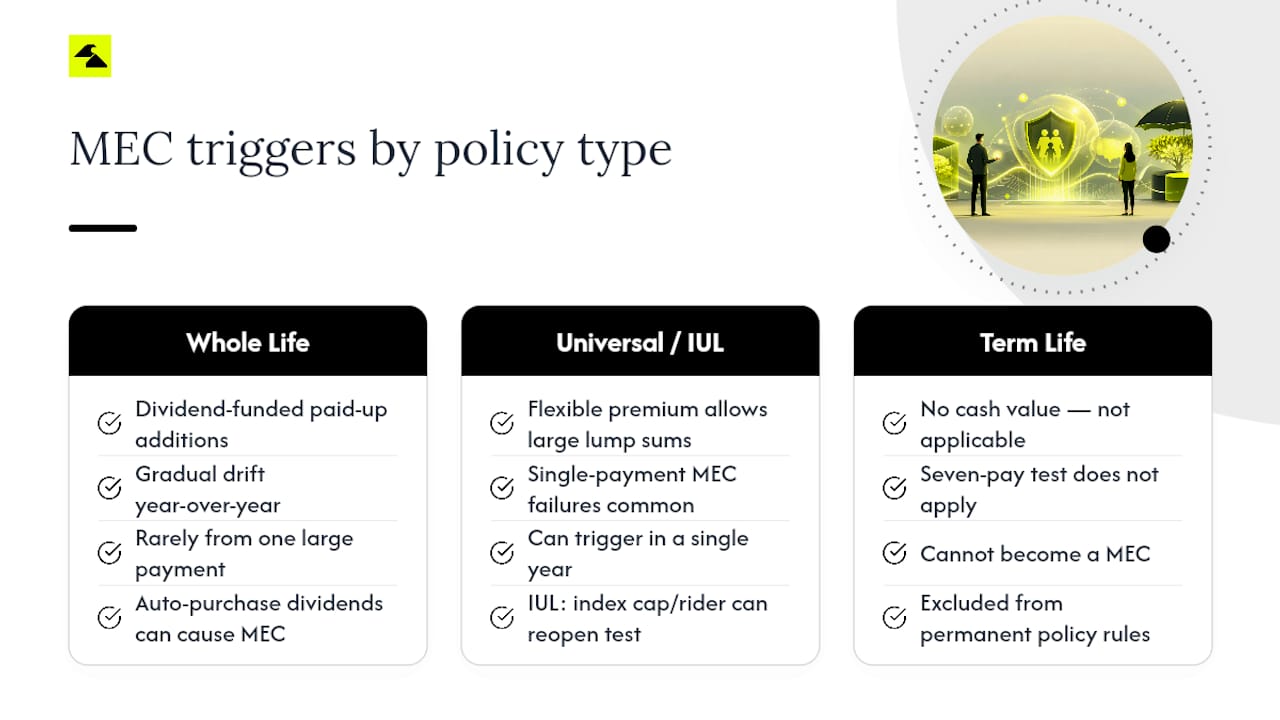
Whole life policies most often become MECs through dividend-driven paid-up additions rather than a single deliberate overpayment. Because dividends are frequently set to auto-purchase paid-up insurance, a policy can drift into MEC territory gradually, year over year, without the owner making any single large payment.
Universal life and indexed universal life policies are more prone to single-payment MEC failures, because their flexible-premium design lets an owner dump in a large sum in one year to boost cash value or maximize an index crediting strategy. That flexibility is also the risk: nothing in the policy structure stops an oversized payment the way a fixed premium schedule does. IUL contracts add another wrinkle, since increasing an index cap or adding an over-loan protection rider can sometimes qualify as a material change that reopens seven-pay testing.
Term life insurance is not part of this conversation at all. Since term policies build no cash value, the seven-pay test and MEC classification simply do not apply. MEC status is exclusively a permanent, cash-value life insurance issue.
Do State Rules Affect MEC Classification?
MEC status itself is entirely a federal tax question. IRC §7702A and IRS guidance govern the seven-pay test nationwide, and no state can override or modify that federal classification. A policy that fails the seven-pay test is a MEC whether it’s issued in Utah, New York, or Texas.
Where states do come into play is on the periphery. State insurance departments regulate how life insurance policies are designed, filed, and sold within their borders, including nonforfeiture standards and policy loan provisions, which indirectly shape how easy it is to overfund a policy in the first place. State premium tax rates and insurable interest rules also vary, though neither changes whether a specific funding pattern trips the federal seven-pay limit. If you’re weighing a policy replacement or exchange, state-specific replacement regulations can affect the paperwork and disclosure timeline, but they don’t touch MEC status itself. For any state-specific insurance regulation question beyond the federal tax classification, a licensed adviser in your state is the right resource.
Strategies for Policy Owners After a Policy Becomes a MEC
Discovering an existing policy is a MEC does not mean the policy is worthless, it means the strategy around it needs to change. The first move is figuring out whether you actually need lifetime access to the cash value at all. If the honest answer is no, a MEC can simply be left alone; tax-deferred growth continues, and the death benefit stays income-tax-free exactly as it would in a non-MEC policy.
If you do need liquidity, timing the distribution matters more than it would otherwise. Taking withdrawals in a lower-income year, or after age 59½ to avoid the 10% penalty, reduces the tax hit meaningfully. Some owners also consider a 1035 exchange into a different contract for better internal features or lower costs, understanding the MEC label carries over, or evaluate surrendering the policy during a year when their marginal tax bracket is unusually low. For owners using the policy’s cash value as loan collateral, reviewing how a collateral assignment interacts with MEC loan taxation is worth a conversation with an adviser before borrowing against it further. Annuitizing the contract is another option worth discussing with a carrier, since it converts the cash value into a stream of payments under its own tax rules rather than a single taxable lump sum.
Why Funding Discipline Matters More Than People Think
The MEC rules exist because Congress didn’t want life insurance turned into a tax-free savings account with no insurance risk attached. What gets lost in that framing is that most MEC failures aren’t strategic decisions, they’re funding mistakes made by people trying to catch up on retirement savings through a policy that was never designed for a lump-sum deposit. A single unscheduled payment, made with good intentions, can permanently change how every future dollar out of that policy gets taxed. Talk to a licensed adviser before any payment that deviates from your policy’s original schedule.
— Jib Hunt
Get a Seven-Pay Check Before You Fund Your Next Policy
East Two West gives you something most carriers won’t volunteer on their own: a straight answer on whether your next premium payment risks MEC status before you send it, not after the 1099-R shows up. As an independent agency working with multiple carriers, East Two West can run a seven-pay comparison across policy designs, review whether paid-up additions or dividend allocations on an existing policy are pushing toward a material change, and coordinate with your estate planning if an ILIT is part of the picture.
[

If you’re weighing a large premium payment, considering a policy redesign, or just found out an old policy already crossed into MEC territory, get a personalized quote comparison before making your next move. You can also start at E2wusa to compare whole life, IUL, and annuity options across carriers with a licensed adviser. Nothing here is a substitute for personalized tax advice from a CPA or licensed professional.
Sources
This article is general information, not a substitute for advice from a qualified financial advisor. Consult a qualified financial professional about your own circumstances before acting on anything here.
FAQ
What Is a MEC in Life Insurance?
A MEC, or Modified Endowment Contract, is a permanent life insurance policy that failed the seven-pay test under IRC §7702A, changing how lifetime withdrawals and loans are taxed.
What Happens to Money Taken Out of a MEC?
Withdrawals and loans are taxed gains-first as ordinary income, and a 10% additional tax applies to the taxable portion if you’re under 59½; the death benefit itself stays income-tax-free.
How Do You Avoid Creating a MEC?
Request a written seven-pay calculation from the carrier before any large or unscheduled payment, favor level scheduled premiums, and watch how dividends and paid-up additions are applied on existing policies.
What Are the Disadvantages of a MEC?
The main disadvantage is losing tax-free access to your own cash value during your lifetime, since loans and withdrawals become taxable gains-first, plus a potential 10% penalty before age 59½ on the taxable amount.
Can a 1035 Exchange Remove MEC Status?
No. If the original contract was already a MEC, the replacement contract from a 1035 exchange retains MEC status under IRS guidance.
Recommended
Comments