Annuity in a Roth IRA: Rules, Costs, and When It Makes Sense
- Jib Hunt
- a few seconds ago
- 15 min read

Yes, you can hold an annuity inside a Roth IRA. The IRS permits annuity contracts as Roth IRA assets, provided the account is properly designated as a Roth IRA when the contract is established. The Roth wrapper governs taxation; the annuity contract governs everything else, including when you can access your money without a carrier penalty.
The single most important caveat: qualified distributions require you to meet both an age threshold and a minimum Roth account holding period. Miss either condition and the distribution is nonqualified, potentially triggering taxes and a 10% early-withdrawal penalty on top of any surrender charge the carrier imposes. Converting a traditional IRA annuity into a Roth is also allowed, but the fair market value of the contract becomes taxable income in the conversion year.
Table of Contents
How a Roth IRA works as a tax wrapper
A Roth IRA is an after-tax retirement account. You contribute money you’ve already paid income tax on, the balance grows without annual taxation, and qualified withdrawals come out completely tax-free. That last part is what makes it attractive for high-growth or high-income assets.
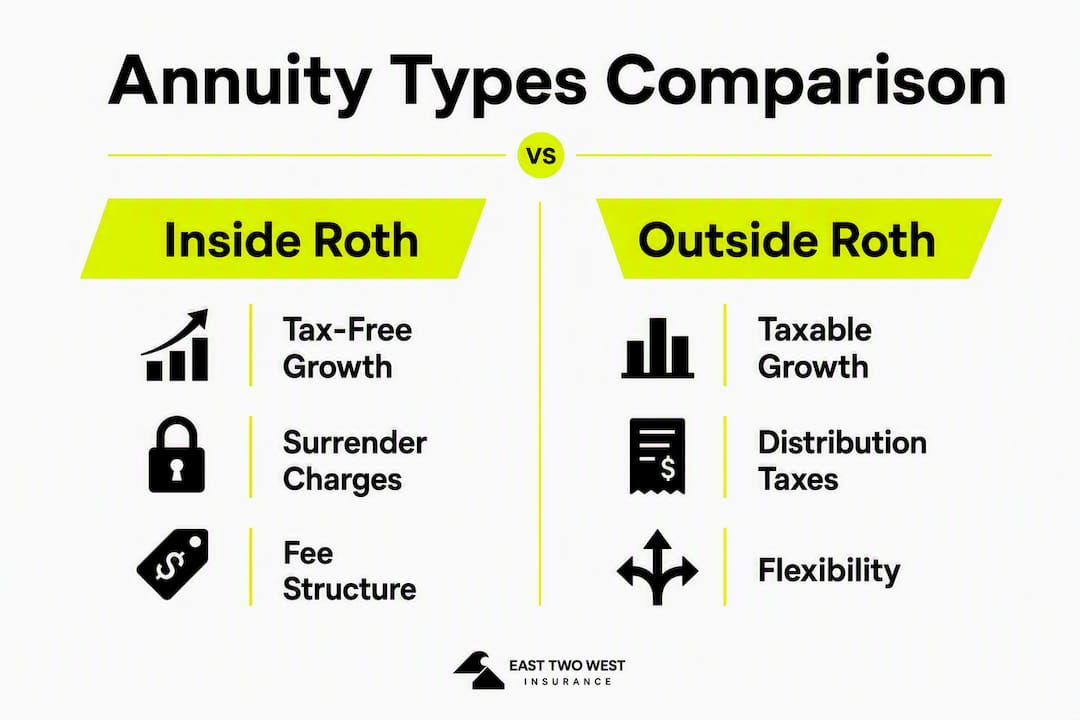
The “tax wrapper” concept is the key to understanding a Roth IRA annuity. The account’s rules determine how distributions are taxed; the investment or contract inside determines what you earn and when you can access it. Swap a stock fund for an annuity contract and the Roth tax treatment stays the same. The annuity’s surrender schedule, payout options, and fees are layered on top.
A few terms worth pinning down before going further:
Custodian: — The financial institution (bank, brokerage, or insurance company) that holds the Roth IRA on your behalf and reports to the IRS.
What a Roth IRA annuity actually is
A Roth IRA annuity is not a special product. It is a standard annuity contract held inside a Roth IRA account. Two separate legal structures are stacked: the Roth account rules sit on top, and the annuity contract terms sit underneath.

Roth IRA tax rules take precedence for taxation, but the annuity contract determines surrender charges, payout options, and liquidity. That split creates the most common confusion. People assume that because a Roth is tax-free, the annuity inside it is also free of restrictions. It is not. The carrier’s surrender schedule runs independently of IRS rules.
The money flow looks like this: your after-tax dollars move to a Roth IRA custodian, who holds the account and reports contributions and distributions to the IRS. The custodian then directs those funds to an annuity carrier, which issues the contract inside the account. The IRS enforces the Roth distribution rules; the carrier enforces the contract terms.
Pro Tip: Before purchasing, get written confirmation from the custodian that it accepts the specific annuity contract model you are considering. Some custodians restrict certain annuity types or require carrier addenda, and finding out after the fact is expensive.
The contract must be titled as Roth IRA property, not in your personal name. That titling is what triggers Roth tax treatment. A contract titled incorrectly may be treated as a taxable distribution.
Which annuity types can you hold inside a Roth?
All major annuity categories are eligible, but they are not equally useful inside a Roth. The fee structure and purpose of each type changes the calculus significantly.
Single-premium immediate annuity (SPIA): You hand over a lump sum and the carrier starts paying income immediately, usually within 30 days. Inside a Roth, those payments are tax-free once you meet the qualified-distribution rules. Best suited for retirees who need guaranteed income now and have already cleared the 59½ and five-year thresholds.
Multi-year guaranteed annuity (MYGA): Functions like a CD inside your Roth. You lock in a fixed interest rate for a set term (typically 3–10 years) with no market exposure. Fixed annuities and MYGAs have simpler fee profiles and can work as a Roth “CD”-like holding, making them among the most defensible choices inside a Roth. For a deeper look at how SPIAs and MYGAs compare, the SPIA vs. MYGA breakdown at East Two West walks through the tradeoffs directly.
Deferred fixed annuity: Similar to a MYGA but with a longer accumulation phase before annuitization. Useful if you want a guaranteed floor with some flexibility on when income begins.
Fixed-indexed annuity (FIA): Credits interest based on a market index (often the S&P 500) with a floor of 0%, so you cannot lose principal to market drops. Rider fees can add 0.5%–1% or more annually, so compare the net crediting rate carefully.
Variable annuity: Invests in subaccounts that mirror mutual funds. Growth potential is higher, but mortality and expense (M&E) charges plus rider fees often add 1%–2% or more annually. Inside a Roth, where tax deferral is already guaranteed, that fee drag rarely justifies the product.
Pro Tip: Variable annuities are the weakest fit for a Roth IRA. The Roth already provides tax deferral; paying an extra 1%–2% annually for an annuity’s tax-deferral feature inside an account that already defers taxes is paying twice for the same benefit.
How to buy or place an annuity inside a Roth IRA
Getting the mechanics right matters as much as choosing the right contract. A misstep in titling or transfer method can trigger an unintended taxable event.
Confirm your funding source. Are you using an existing Roth IRA balance, making a new annual contribution (subject to the annual contribution limits), or converting a traditional IRA annuity? Each path has different tax implications. New contributions are capped annually; conversions require you to pay income tax on the converted amount.
Verify custodian acceptance. Not every Roth IRA custodian accepts annuity contracts. Call the custodian before you apply and ask specifically whether it supports the contract type (SPIA, MYGA, FIA, or variable) and what titling language it requires. Get the answer in writing.
Compare contract terms before committing. Review the surrender period length, surrender charge schedule, rider fees, and M&E charges. Coordinate with both the custodian and the carrier to confirm minimum premium requirements and any addenda needed for IRA-qualified contracts. Section 1035 exchanges do not apply inside IRAs; if you are moving an annuity between carriers inside a qualified account, it must be handled as a trustee-to-trustee transfer.
Complete the purchase and confirm titling. The contract must be designated as Roth IRA property. Confirm the beneficiary designation matches your estate plan. Keep copies of the contract, the custodial agreement, and any carrier addenda. Record the Roth account’s opening date, since the five-year clock starts from the first contribution to any Roth IRA you own, not the date of the annuity purchase.
Pro Tip: If you are coordinating a trustee-to-trustee transfer, get a written timeline from both the sending and receiving custodians. Delays that push the transfer past a calendar year can create reporting complications.
What are the tax rules for a Roth IRA annuity?
The tax treatment of annuity payments inside a Roth depends entirely on whether the distribution is “qualified” under IRS rules.

Qualified distributions
A distribution from a Roth IRA is tax-free when the account owner is at least 59½ and the Roth account has been open for at least five years. Both conditions must be met. When they are, annuity payments from the contract are fully tax-free, even though those same payments would be partially taxable if the annuity were held outside a retirement account.
Nonqualified distributions and ordering rules
If you withdraw before meeting both conditions, the IRS applies ordering rules: contributions come out first (tax-free), then conversions (tax-free after five years), then earnings (taxable and subject to the 10% penalty). An annuity contract’s surrender schedule does not align with these ordering rules, which is where the liquidity mismatch bites.
Conversions from a traditional IRA annuity
Converting a traditional IRA annuity to a Roth is a taxable event. The IRS requires you to include the fair market value of the contract in your gross income for the conversion year. That value can exceed the cash surrender value if the contract carries guarantees such as a death benefit. Section 1035 exchanges, which allow tax-free swaps between nonqualified annuities, do not apply inside qualified accounts.
The core rule on conversions: The entire fair market value of a traditional IRA annuity, including the value of any embedded guarantees, is treated as ordinary income in the year of conversion to a Roth. There is no way to spread that tax cost across multiple years unless you convert in stages.
Scenario | Tax treatment | Penalty risk |
Qualified Roth distribution (age 59½+, 5-year rule met) | Tax-free | None |
Nonqualified Roth distribution (earnings portion) | Ordinary income | 10% early withdrawal penalty |
Conversion from traditional IRA annuity | Ordinary income on FMV | None (penalty waived on conversions) |
Surrender charge on early withdrawal | Does not reduce taxable amount | Stacks on top of tax/penalty |
What are the real advantages of a Roth IRA annuity?
The case for holding an annuity inside a Roth is narrower than most annuity marketing suggests, but it is real in the right circumstances.
Tax-free lifetime income. A SPIA or income rider inside a Roth, once qualified distributions begin, pays guaranteed income with zero federal income tax. Outside a Roth, a portion of every annuity payment is taxable as ordinary income. For someone in a high tax bracket in retirement, that difference compounds significantly over a 20-year payout period.
Estate-planning efficiency. Roth IRA assets pass to heirs income-tax-free, and many annuity contracts include death benefits. Combining both inside a Roth can create a tax-efficient inheritance, though beneficiaries must still follow the 10-year distribution rule for inherited Roth IRAs under current law.
Behavioral protection. This one is underappreciated. A guaranteed income floor prevents the panic selling that wipes out retirement portfolios during market downturns. If your Roth equity holdings drop 30%, a guaranteed annuity payment inside the same account keeps income flowing without forcing you to sell at the bottom.
The strongest argument for a Roth IRA annuity is not the tax treatment alone. It is the combination of guaranteed income that cannot be outlived, paid out completely tax-free, from an account that requires no minimum distributions during the owner’s lifetime.
What are the disadvantages and risks?
The fee structure is the most persistent problem. Variable annuities often add 1%–2% or more in fees through M&E charges and riders, and those costs compound against the very tax-free growth the Roth is supposed to protect. A Roth IRA invested in low-cost index funds at 0.05% annually versus a variable annuity at 2% annually produces a dramatically different balance over 20 years, even before accounting for surrender charges.
The liquidity trap is the second major risk. Surrender periods on many annuity contracts run 7–10 years. If you need access to funds during that window, you face the carrier’s surrender charge on top of any IRS penalties for nonqualified distributions. Surrender charges commonly start at 6%–8% and decline over the surrender period, and they do not care whether your withdrawal is for a medical emergency or a market opportunity.
The “triple cost” scenario is the worst case: if you take a nonqualified distribution (under 59½ or before the five-year rule is met), you face ordinary income tax on earnings, the 10% early-withdrawal penalty, and the carrier’s surrender charge simultaneously. All three stack.
Red flags that should stop a purchase or prompt renegotiation:
Surrender period longer than 7 years when you are within 10 years of retirement
Rider fees above 1% annually on a fixed or indexed contract
No IRA-qualified contract language or carrier addendum
Carrier unwilling to confirm trustee-to-trustee transfer procedures in writing
M&E charges above 1.25% on a variable annuity
Guaranteed benefit riders that require annuitization to activate, with no free-look period
Pro Tip: Ask the carrier for the “all-in” annual cost: M&E charge + administrative fee + rider fees + subaccount expense ratios (for variable). Compare that total to what a low-cost bond or CD ladder would cost inside the same Roth. If the annuity’s guarantees do not justify the gap, walk away.
How does converting a traditional IRA annuity to a Roth work?
Converting is allowed, but the tax bill can be larger than expected. The IRS values the contract at fair market value, not cash surrender value. If your contract carries a guaranteed death benefit or an income rider with accumulated value, the fair market value may be considerably higher than what you would receive if you surrendered the contract today. That entire amount becomes ordinary income in the conversion year.
To estimate the tax cost: request a fair market value statement from the carrier (required under IRS rules), multiply that figure by your expected marginal tax rate for the conversion year, and model whether a phased conversion across two or three tax years keeps you out of a higher bracket. Phased conversions are the most common planning tool here.
Trustee-to-trustee transfer is the required method. You cannot take a distribution from the traditional IRA annuity and redeposit it into a Roth; that would be treated as a taxable distribution plus a potential 60-day rollover complication. The carrier must transfer directly to the Roth custodian.
Pro Tip: Time conversions in years when your income is lower than usual, such as early retirement before Social Security begins, or a year with significant deductible losses. The tax cost of converting a $200,000 annuity at a 22% marginal rate is $44,000; at 32%, it is $64,000. The bracket you convert in matters more than almost any other variable.
Two additional pitfalls: first, the old contract may impose surrender charges on the conversion if you are still inside the surrender period. Those charges reduce your net proceeds but do not reduce your taxable income. Second, some carriers are slow to cooperate with trustee-to-trustee transfers or require specific forms that can delay the process by weeks. Start early and confirm the carrier’s timeline in writing before year-end if you are targeting a specific tax year.
A worked example: $100,000 annuity inside a Roth vs. outside
The following table uses illustrative assumptions to show how fee drag and tax treatment change outcomes over 20 years. These are not projections or guarantees; they are a framework for thinking through the tradeoffs.
Assumptions: $100,000 initial premium, 5% nominal annual growth or crediting rate, 20-year horizon, qualified distribution at year 20 (age 65+, five-year rule met).
Scenario | Annual fee drag | Effective net growth | Approximate value at year 20 | Tax on withdrawal | Net after tax |
Roth IRA, low-cost index fund (0.05%) | 0.05% | — | — | $0 (qualified) | — |
Roth IRA, MYGA or fixed annuity (0.5%) | 0.5% | — | — | $0 (qualified) | — |
Roth IRA, variable annuity | 2% | — | — | $0 (qualified) | — |
Non-Roth (taxable) fixed annuity (0.5%) | 0.5% | — | — | Ordinary income on gains (~22%) | — |
The variable annuity inside the Roth produces substantially less value than a low-cost index fund over a multi-decade horizon, primarily due to fee drag. The MYGA inside the Roth lands in the middle and still beats the taxable fixed annuity after taxes by roughly $29,000.
For income-focused investors, an annuity can produce estimated monthly payouts within a broad range that depends on age, payout option, and contract type. Inside a Roth, those payments are tax-free once qualified-distribution rules are met. Outside a Roth, a portion of each payment is taxable as ordinary income. For a retiree receiving $800/month for 20 years, the tax-free Roth version produces meaningfully more spendable income, particularly in higher tax brackets.
The biggest outcome drivers, in order: fee drag (especially for variable annuities), conversion tax cost (if converting from a traditional IRA), and surrender charges triggered by early access.
Should you hold an annuity in a Roth? A decision checklist
Advisors recommend growth-oriented assets for Roths unless guaranteed income is a specific need; annuities duplicate tax-deferral, so fees are the deciding variable. Use this checklist before proceeding.
Assess your situation first:
Do you need guaranteed income in retirement, or is growth your primary goal? (If growth, a low-cost index fund inside the Roth almost always wins.)
Are you within 5 years of needing income? (If yes, a SPIA or MYGA may be appropriate; if no, reconsider the liquidity tradeoff.)
Can you tolerate a surrender period of 5–10 years without accessing these funds?
Is your Roth account already at least five years old, or will it be by the time you need income?
Do you have other liquid assets outside the Roth for emergencies?
Questions to ask the carrier:
Is this contract IRA-qualified, and do you have a specific IRA addendum?
What is the full surrender schedule, and what are the charges in years 1–10?
What are all annual fees, including M&E, administrative, and rider costs?
Will you cooperate with a trustee-to-trustee transfer if I need to move the contract?
How do you calculate fair market value for IRS reporting purposes?
Questions to ask the custodian:
Do you accept this specific contract type and carrier?
What titling language do you require on the contract?
What is your process and timeline for trustee-to-trustee transfers involving annuity contracts?
Stop conditions: If the total annual fee stack exceeds 1.5% on a fixed or indexed contract, if the surrender period extends beyond your five-year Roth timeline, or if either the carrier or custodian cannot confirm IRA-qualified contract language in writing, do not proceed until those issues are resolved. Life events like divorce can also affect annuity titling and beneficiary designations inside a Roth; a guide on how divorce affects retirement accounts is worth reviewing if your marital status is in transition.
Key Takeaways
Holding an annuity inside a Roth IRA makes financial sense only when the insurance guarantees are worth more to you than the fee drag costs you over time.
Point | Details |
Legal permissibility | The IRS allows annuities inside Roth IRAs; the Roth rules govern taxation, the contract governs liquidity. |
Qualified distribution requirements | You must be at least 59½ and have held the Roth for five years for payments to be fully tax-free. |
Best annuity types for a Roth | SPIAs and MYGAs offer the cleanest fee profiles; variable annuities typically cost too much to justify inside a Roth. |
Conversion tax reality | Converting a traditional IRA annuity to a Roth triggers ordinary income tax on the contract’s full fair market value in the conversion year. |
East Two West | East Two West provides independent annuity quotes from multiple carriers with transparent fee breakdowns, helping you compare SPIA, MYGA, and fixed-indexed options for your Roth. |
The fee drag problem most people underestimate
Most articles about holding an annuity in a Roth IRA focus on whether it is allowed. The more useful question is whether it is worth it, and the answer almost always comes down to one number: the all-in annual cost of the contract.
A Roth IRA is one of the most tax-efficient vehicles in the U.S. tax code. Every dollar of fee drag inside it is a dollar of permanently tax-free growth you will never recover. That is a different calculation than paying fees inside a taxable account, where at least some of the cost is offset by reduced taxable gains. Inside a Roth, fees are pure loss.
The annuity industry’s standard response is that guarantees justify the cost. Sometimes they do. A guaranteed lifetime income stream that prevents you from outliving your money has real value, especially for someone without a pension. A SPIA or a MYGA with a clean fee structure inside a Roth can be a genuinely smart tool for a specific type of retiree: someone who has cleared the qualified-distribution thresholds, needs predictable tax-free income, and does not need liquidity from this particular account.
Where the strategy breaks down is when people buy variable annuities inside a Roth for “growth potential.” The Roth already provides the tax-free growth. Adding a 2% annual fee for a wrapper that duplicates a benefit you already have is a straightforward mistake, not a nuanced tradeoff. The worked example above makes this concrete: over 20 years, that fee difference can cost more than $80,000 in lost compounding on a $100,000 starting balance.
The checklist in this article is not a formality. It is the actual decision framework. If you cannot get written confirmation of IRA-qualified contract language, if the surrender period outlasts your planning horizon, or if the all-in fee stack exceeds what the guarantee is worth to you, the answer is no. A low-cost MYGA or a simple index fund inside the Roth will serve most people better than a complex annuity with riders they will never fully use.
How East Two West approaches annuities inside Roth IRAs
When clients come to East Two West with questions about placing an annuity inside a Roth, the first conversation is always about the fee stack and the five-year timeline, not the product. As an independent practice, East Two West pulls quotes from multiple carriers, which means you see the actual cost differences between a MYGA at 0.3% and a variable annuity at 2.1% side by side, without a single-carrier sales pitch shaping the comparison.
The two service paths reflect how different clients approach this decision. Some want to run the numbers themselves using the Roth IRA vs. annuity comparison and then request quotes online. Others want a phone consultation to work through the custodian coordination, contract titling, and conversion tax estimate before committing. Both paths lead to the same transparent fee breakdown and the same carrier options.
East Two West does not push a product because it pays a higher commission. The goal is to help you decide whether the annuity’s guarantees are genuinely worth the cost inside your Roth, and if they are, to get you the most competitive contract available.
Get annuity quotes and guidance from East Two West
Comparing annuity contracts for a Roth IRA means looking at more than the headline rate. You need the full fee stack, the surrender schedule, the carrier’s IRA-qualified contract language, and confirmation that your custodian will accept the contract.
[

East Two West makes that comparison straightforward:
Instant quotes from multiple carriers for SPIA, MYGA, and fixed-indexed annuities
Transparent, side-by-side fee breakdowns including M&E, rider, and administrative costs
Personalized consultations to work through custodian coordination and contract titling
Guidance on trustee-to-trustee transfer procedures and carrier cooperation requirements
Request a quote or schedule a consultation to compare annuity options for your Roth IRA. No pressure, no single-carrier pitch, just the numbers you need to make a confident decision.
Authoritative sources and further reading
Roth IRAs, Internal Revenue Service: Primary IRS guidance on qualified distributions, the five-year rule, and contribution rules.
IRS Publication 575: Pension and Annuity Income: Covers annuity taxation, trustee-to-trustee transfer rules, and why Section 1035 does not apply inside qualified accounts.
Roth IRA Contribution Limits for 2026, IRS: Current annual contribution caps that govern how much you can fund a Roth annuity directly.
Can You Buy an Annuity in a Roth IRA? LegalClarity: Practical breakdown of surrender charges, triple-cost scenarios, and custodian coordination risks.
Here’s the Full Story on Owning Annuities in IRAs, Forbes: Advisor perspective on when annuities inside IRAs make sense and when they do not.
Using a Roth IRA Annuity for Retirement, SmartAsset: Overview of how Roth rules and annuity contract terms interact.
SPIA vs. MYGA: Which Annuity Fits Your Retirement? East Two West: Product-level comparison of the two annuity types most suitable for a Roth IRA.
Roth IRA vs. Annuity: What Retirement Savers Need, East Two West: Broader strategic comparison for readers deciding between the two vehicles.
Recommended