IUL vs Roth IRA: Which Wins for Retirement?
- Jib Hunt

- 3 days ago
- 17 min read

For most retirement savers, a Roth IRA is the stronger primary vehicle. An indexed universal life policy makes sense as a supplement when you genuinely need permanent life insurance or have already maxed out every statutory tax-advantaged account available to you.
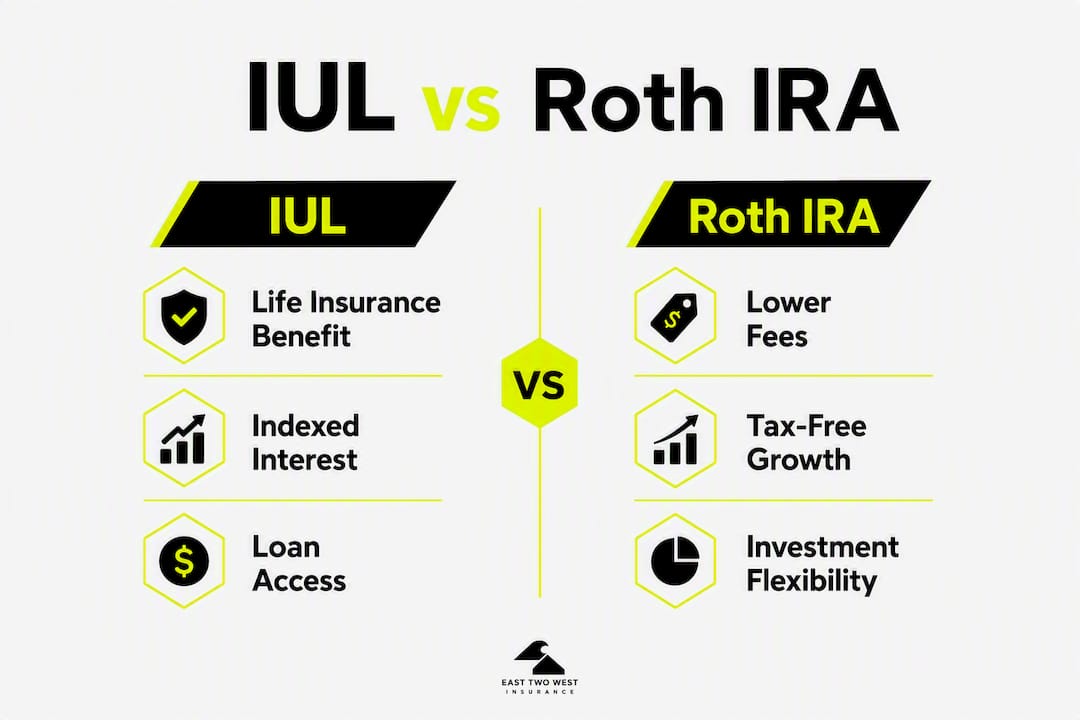
The core trade-off is straightforward: a Roth IRA under IRC §408A gives you uncapped market upside, near-zero fees, and statutory tax-free withdrawals after age 59½. An IUL gives you a death benefit, a 0% crediting floor, and no annual contribution ceiling, but it layers in insurance charges that commonly run 2–4%+ per year and caps that limit how much of any bull market you actually capture.
A few decisive differences worth knowing before you read further:
Contribution limits: The IRS caps 2026 Roth IRA contributions at $7,500 per year ($8,600 if you’re 50 or older) with income phase-outs starting at $153,000 for single filers and $242,000 for married filing jointly. IULs have no statutory annual limit, but overfunding triggers Modified Endowment Contract (MEC) status and changes the tax rules entirely.
Fees and caps: IUL internal charges erode compounding year after year. Index funds inside a Roth IRA can carry very low expense ratios.
Death benefit: An IUL delivers a permanent, income-tax-free death benefit under IRC §101(a). A Roth IRA does not.
Access mechanics: Roth IRA contributions (not earnings) can be withdrawn anytime, penalty-free, under the ordering rules. IUL cash value is accessed via policy loans, which are tax-free while the policy stays in force but carry lapse risk if loan balances compound unchecked.
East Two West can provide comparative IUL illustrations from multiple carriers if you’re weighing whether a policy fits your situation, with no sales pressure attached.
Table of Contents
What is an indexed universal life insurance policy?
An indexed universal life (IUL) policy is permanent life insurance with a cash value component that earns interest linked to an equity index, typically the S&P 500. It is governed under IRC §7702, which sets the rules for life insurance contracts to maintain their tax-favored status.

How index crediting actually works
The carrier does not invest your premiums directly in the index. Instead, it credits interest to your cash value based on the index’s performance, subject to three key parameters:
Participation rate: The percentage of the index gain you receive. A 100% participation rate means you get the full credited gain up to the cap; an 80% rate means you get 80% of it.
Cap: The maximum interest rate credited in any given period. Industry analysis places typical caps in the 8–12% range, though carriers adjust these over time and they are not guaranteed.
Floor: The minimum credited rate, usually 0–1%. A 0% floor means your cash value does not decrease due to index losses, but it also does not grow in a flat or down year.
That floor sounds appealing. The catch is that the cost of providing it, along with the carrier’s profit margin, is baked into the cap and participation rate. You give up upside to avoid downside.
Where your premiums actually go
Every premium payment is split before any cash value accumulates. The carrier deducts:
Cost of insurance (COI): Mortality charges that increase with age and can rise significantly in later policy years.
Mortality and expense (M&E) charges: Administrative overhead built into the policy structure.
Administrative fees: Flat or percentage-based charges that vary by carrier.
Surrender charges: Front-loaded penalties for exiting the policy early, often lasting 10–15 years.
What remains after those deductions goes into the cash value account and earns the index-linked credit. In early policy years, these charges consume a large share of each premium, which is why IULs have a long break-even horizon.
Accessing cash value: loans vs. withdrawals
You can take money out of an IUL two ways. A partial withdrawal permanently reduces the cash value and death benefit. A policy loan borrows against the cash value, leaves the death benefit intact, and is not treated as taxable income as long as the policy is not a MEC and remains in force.
The risk with loans is compounding. If loan balances plus interest grow faster than the cash value, the policy can lapse. A lapsed policy with outstanding loans triggers a taxable distribution on the full loan amount, potentially creating a large, unexpected tax bill.
One more risk worth naming: insurer credit risk. Unlike a brokerage account, the cash value and death benefit depend on the financial strength of the issuing insurance company. State guaranty associations provide some protection, but coverage limits vary by state and are not equivalent to SIPC or FDIC protections.
Pro Tip: Before signing any IUL application, ask the agent for the carrier’s current COI table and a net-of-fees illustration. Gross crediting rate illustrations can look dramatically better than what you will actually receive after charges.
What is a Roth IRA and what are the rules that matter?
A Roth IRA is an individual retirement account funded with after-tax dollars. Qualified withdrawals, meaning distributions taken after age 59½ once the account has been open for at least five years, are completely tax-free under IRC §408A. There is no required minimum distribution during the owner’s lifetime, which makes it one of the most flexible retirement accounts available.
2026 contribution limits and income phase-outs
The IRS sets the 2026 Roth IRA contribution limit at $7,500 per year for individuals under 50 and $8,600 for those 50 and older. Direct contributions phase out between $153,000 and $168,000 of modified adjusted gross income (MAGI) for single filers, and between $242,000 and $252,000 for married filing jointly. Above those ceilings, direct contributions are not allowed, though a Backdoor Roth conversion remains available for most high earners.
Key rules that affect how you use the account:
Ordering rules: Contributions come out first (always tax and penalty-free), then conversions (subject to a five-year holding period per conversion), then earnings.
Five-year rule: Earnings are tax-free only after the account has been open five years and you are 59½ or older.
No MEC risk: There is no equivalent of MEC status. You cannot accidentally change the tax treatment of your Roth IRA by contributing too much in a year; excess contributions simply carry a 6% excise tax until corrected.
What you can invest in
A Roth IRA held at a brokerage like Fidelity, Vanguard, or Schwab can hold virtually any publicly traded security: index funds, ETFs, individual stocks, bonds, REITs. A total-market index fund at Vanguard carries an expense ratio of 0.03%. There is no cap on how much of the market’s upside you capture, and no insurance company standing between your money and the index.

The liquidity advantage is real. Because contributions (not earnings) can be withdrawn at any time without tax or penalty, the Roth IRA doubles as an accessible emergency reserve for money you have already contributed, with no contract to surrender and no surrender charges to absorb.
How do IUL and Roth IRA compare side by side?
The table below covers the eight dimensions that most affect retirement outcomes. Short narrative notes follow for the rows where the practical implication is not obvious from the table alone.
Dimension | Roth IRA | IUL |
Tax treatment | After-tax contributions; qualified withdrawals tax-free under IRC §408A | Premiums paid with after-tax dollars; cash value grows tax-deferred; loans generally not taxable if policy is not a MEC and stays in force |
Contribution limits & eligibility | $7,500/$8,600 (2026); income phase-outs apply; Backdoor Roth available | No statutory annual limit; constrained by MEC rules under IRC §7702 |
Growth potential & downside protection | Uncapped; full index or market exposure; no floor | Index-linked with caps (typically 8–12%) and floors (typically 0%); participation rates may apply |
Access to cash | Contributions withdrawable anytime penalty-free; earnings subject to 5-year/59½ rules | Policy loans generally tax-free while in force; withdrawals reduce death benefit; lapse risk if loans compound |
Costs & fees | Index fund expense ratios as low as 0.03–0.20% | COI, M&E, admin, and surrender charges often total 2–4%+ annually |
Death benefit & estate use | None; beneficiaries inherit account under IRA distribution rules | Permanent income-tax-free death benefit under IRC §101(a); useful for estate/legacy planning |
Complexity & transparency | Simple; annual statement, brokerage account; no contract terms to monitor | Complex; requires monitoring of COI trends, loan balances, cap resets, and MEC compliance |
Regulatory/tax traps | Excess contribution excise tax (6%); early withdrawal penalty on earnings | MEC status if overfunded; policy lapse with outstanding loans triggers taxable distribution |
What the fee gap actually means over time
A modest annual drag in fees sounds modest. Over long time periods, the fee differential and uncapped upside cause a Roth IRA invested in low-cost index funds to generally produce higher after-cost balances than an IUL. The death benefit is real value, but it is not free. You are paying for it through reduced cash value accumulation.
The cap-and-floor trade-off
The 0% floor means your cash value does not go negative in a down year. That is genuinely useful for conservative savers or those with short-to-medium horizons. But the floor’s cost shows up in the cap: when the S&P 500 returns 25% in a year, an IUL with a 10% cap credits 10%. Over a full market cycle, those missed gains compound into a meaningful shortfall versus an uncapped Roth IRA holding the same index.
Death benefit and estate planning
IULs deliver an income-tax-free death benefit under IRC §101(a), which is a genuine structural advantage for estate planning and wealth transfer. Roth IRAs pass to beneficiaries and are inherited subject to IRA distribution rules. Beneficiaries do not owe income tax on qualified Roth distributions, but they must follow the 10-year distribution rule under the SECURE Act. Neither vehicle is subject to estate tax by default, though large estates may face exposure regardless of the vehicle.
What do fees and caps actually cost you in the long run?
The fee structure of an IUL is not a single line item. It is a stack of charges that interact and compound.
Common IUL fee categories and typical ranges:
COI charges: Rise with age; can increase substantially in later policy years, especially after 65.
M&E and administrative fees: Often 0.5–1.5% of account value annually, depending on the carrier.
Surrender charges: Front-loaded; can run 10–15% of cash value in year one, declining over a 10–15 year schedule.
Premium loads: Some policies deduct a percentage of each premium before it enters the cash value account.
IUL embedded charges commonly total 2–4% or more annually, compared with 0.03–0.20% for a broad index fund inside a Roth IRA. That gap is not a rounding error.
A simplified fee-impact illustration
The table below shows how a 2% annual fee drag affects a hypothetical $10,000 annual contribution over 20 years, using a 7% gross annual return assumption. These are illustrative figures only, not guaranteed outcomes.
Scenario | Gross annual return | Annual fee drag | Approximate net return | Approximate 20-year balance |
Roth IRA (index fund) | 7.0% | 0.10% | 6.9% | — |
IUL (mid-range fees) | 7.0% | 2.5% | 4.5% | — |
IUL (high-end fees) | 7.0% | 2% | — | — |
Assumptions: $10,000 annual contribution, contributions made at start of year, no taxes modeled (both vehicles assumed to produce tax-free distributions), no IUL cap applied to the gross return for simplicity. Actual IUL results would also be reduced by cap mechanics. These figures are illustrative only.
The 0% floor protects against negative crediting in down years, but caps and participation rates reduce upside in strong years. Over a full 20-year cycle that includes both bull and bear markets, the net effect on compounding is typically negative compared with an uncapped vehicle at lower cost.
Pro Tip: When reviewing an IUL illustration, ask the agent to run a scenario at the current illustrated rate AND at a rate 2–3 percentage points lower. Carriers are required to show a “non-guaranteed” column, but the assumptions behind it vary. A stress-tested illustration tells you far more than the headline projection.
Surrender-charge schedules and first-year premium loads create a front-loaded cost profile that makes early exit especially costly. If you surrender an IUL in years 1–7, you may recover significantly less than you paid in. That break-even timeline is a critical factor when comparing it to a Roth IRA, where you can withdraw contributions the day after you deposit them.
What are the tax traps that can turn an IUL’s advantage into a liability?
Both vehicles can produce tax-free retirement income, but the path to that outcome is very different, and the IUL’s path has more ways to go wrong.
Roth IRA: statutory certainty
The Roth IRA’s tax treatment is written into federal statute. Under IRC §408A, qualified distributions are tax-free, period. There is no ongoing compliance requirement beyond the five-year rule and the age-59½ threshold. The IRS does not re-examine your account structure each year to confirm it still qualifies.
IUL: contract compliance required
An IUL’s tax-favored treatment depends on the policy continuously satisfying IRC §§7702 and 72(e). Two specific traps deserve attention.
Modified Endowment Contract (MEC) rules. Overfunding an IUL can trigger MEC status under the seven-pay test in IRC §7702. Once a policy becomes a MEC, loans and withdrawals are treated as taxable income to the extent of gain, and a 10% penalty applies before age 59½. MEC status is permanent and cannot be reversed. This is the primary tax trap for buyers who try to fund an IUL aggressively as a Roth IRA substitute.
Policy lapse with outstanding loans. If aggressive loan withdrawals in retirement deplete cash value and the policy lapses, the entire outstanding loan balance is treated as a taxable distribution in the year of lapse. A retiree who has borrowed $200,000 from their IUL over the years could face a six-figure tax bill in a single year, with no ability to spread it. This is not a theoretical risk; it is a documented outcome of maximum-loan strategies that are sometimes illustrated without adequate lapse-risk disclosure.
Regulatory protections: what each vehicle actually has
Roth IRA assets held at a SIPC-member brokerage are protected up to $500,000 per account type against broker-dealer insolvency. The investments themselves are subject to market risk, not insurer credit risk.
IUL policies are backed by the issuing insurance company’s general account. State guaranty associations provide a safety net, but coverage limits vary by state and are generally lower than SIPC limits. The carrier’s financial strength rating (A.M. Best, Moody’s, S&P) matters.
Practical compliance questions to ask before funding an IUL:
What is the seven-pay MEC limit for this policy, and how close does the proposed premium come to it?
What are the current loan interest rates (fixed vs. variable)?
What does the illustration show at a 0% crediting rate for five consecutive years?
What is the lapse probability under the maximum-loan scenario?
Who actually benefits from each option?
The right answer depends on your income, your need for life insurance, and how much tax-advantaged space you have already used.
When a Roth IRA is the clear choice
Savers below the income phase-out: If your MAGI is below the income phase-out range for your filing status, you can contribute directly. The low cost and uncapped upside make the Roth IRA the default best-fit for most working Americans.
Early savers with long horizons: Compounding at low cost over 30–40 years is hard to beat. A 25-year-old contributing $7,500 per year to a Roth IRA invested in a total-market index fund has a structural advantage that an IUL’s floor cannot offset.
Anyone who does not need permanent life insurance: If your primary goal is retirement accumulation and your dependents will be financially independent before you retire, paying for a death benefit is paying for something you do not need.
When an IUL can make sense
High earners who have exhausted Roth and Roth 401(k) options: Once you have maxed a Roth IRA, a Roth 401(k), an HSA, and a Backdoor Roth, an IUL can provide additional after-tax, tax-deferred accumulation. The contribution flexibility is real at that level.
People who need permanent life insurance anyway: If you have a genuine estate-planning need, a business buy-sell agreement, or a dependent who will need lifelong support, the death benefit is not an add-on cost. You were going to buy permanent coverage regardless.
Estate and wealth-transfer planning: The income-tax-free death benefit under IRC §101(a) can be a meaningful tool for passing wealth to heirs, particularly for high-net-worth individuals whose estates may face estate tax exposure.
Term + invest vs. IUL: a simple decision rule
If your primary motivation for considering an IUL is the tax-advantaged cash value accumulation rather than a genuine need for permanent life insurance, run this comparison: price a level-term policy for the same death benefit, subtract that premium from the IUL premium, and model what the difference would grow to in a Roth IRA or taxable brokerage account. In most cases for savers under 50, the term-plus-invest approach produces more retirement wealth. The IUL wins when the permanent death benefit is genuinely needed and the policy is held for a long enough horizon to overcome the front-loaded cost structure.
Pro Tip: If an advisor recommends replacing your Roth IRA contributions with an IUL, ask for a net-of-fees, side-by-side illustration showing both options at the same gross return assumption. Any advisor who resists that comparison is telling you something important.
For readers exploring high-end insurance planning strategies that go beyond standard IUL products, boutique and family-office-style approaches exist, though they typically require substantially higher premium commitments.
A 20-year projection: what $10,000 per year actually becomes
The following example uses transparent assumptions so you can see how fees and caps change outcomes. These figures are illustrative only and are not a guarantee of any specific result.
Stated assumptions:
Annual contribution: $10,000 per year, paid at the start of each year.
Time horizon: 20 years.
Gross index return: 7.0% per year (consistent with long-run U.S. equity averages, not guaranteed).
Roth IRA fee: 0.10% expense ratio (broad index ETF).
IUL cap: 10% per year; floor: 0%; participation rate: 100%.
IUL net fee drag: 2.5% annually (mid-range embedded charges).
Tax treatment: both vehicles assumed to produce tax-free distributions at retirement; no income tax modeled on withdrawals.
No surrender charges modeled (assumes policy is held to full term).
The IUL balance reflects the 2.5% annual fee drag on a 7% gross return (net ~4.5%) and does not separately model cap mechanics, which would further reduce the IUL figure in strong-return years. The Roth IRA balance reflects a 6.9% net return after the 0.10% expense ratio. Both are compound-growth estimates, not carrier illustrations.
These figures are illustrative projections based on stated assumptions. Actual IUL results vary significantly by carrier, policy design, age at issue, health rating, and crediting history. Always request a carrier-signed, agent-certified illustration that shows both guaranteed and non-guaranteed columns before making a decision.
The gap in this example, roughly $164,000 after 20 years, comes almost entirely from the fee differential. Both vehicles are assumed to produce tax-free income. The IUL’s 0% floor would reduce the gap slightly in a scenario with several consecutive down years, but the fee drag operates every year, in up markets and down.
To evaluate any specific IUL offer on a fair basis, request the illustration in present-value terms and ask the agent to run a scenario where the crediting rate is 2% lower than illustrated for the full projection period.
How should you decide? A practical checklist
Work through these steps in order before committing to either vehicle or a combination of both.
Are you eligible for direct Roth IRA contributions? Check your MAGI against the 2026 phase-out ranges ($153,000–$168,000 single; $242,000–$252,000 married). If you are below the threshold, start here.
Are you contributing to your employer’s retirement plan? Max your 401(k) or Roth 401(k) at least to the employer match before considering any insurance product.
Are you eligible for an HSA? If you have a high-deductible health plan, an HSA offers triple tax advantages and should be funded before an IUL.
Have you explored Backdoor or Mega Backdoor Roth options? High earners above the phase-out can often still access Roth treatment through these strategies, which carry far lower costs than an IUL.
Do you have a genuine, ongoing need for permanent life insurance? If yes, an IUL may be worth evaluating alongside term coverage. If no, the case for an IUL as a retirement vehicle weakens considerably.
If you are evaluating an IUL, request these specifics from the agent or carrier:
Net-of-fees illustrated crediting rate (not just gross).
Current COI table and how charges increase by age.
Loan interest rate (fixed or variable) and the lapse scenario under maximum loans.
MEC seven-pay limit and how the proposed premium relates to it.
Surrender charge schedule by year.
A stress-test illustration at a crediting rate 2–3% below the illustrated rate.
For Roth IRA comparisons, confirm:
Expense ratios of the funds you plan to hold.
Custodial fees (most major brokerages charge none).
Tax implications if you are doing a Roth conversion rather than a direct contribution.
The goal is to compare both options on a net-of-fees, risk-adjusted, present-value basis, not on the marketing illustration the agent hands you.
Can you use a Roth IRA and an IUL together?
Yes, and for some savers it makes sense. The sequencing matters more than the combination itself.
A practical funding priority order:
First: Roth IRA (if eligible) up to the annual limit.
Second: Employer retirement plan (401(k) or Roth 401(k)) up to the employer match, then to the annual maximum.
Third: HSA, if you have a qualifying high-deductible health plan.
Fourth: Backdoor Roth or Mega Backdoor Roth if income exceeds direct contribution limits.
Fifth: Consider an IUL only if you have a genuine life-insurance need or have exhausted all of the above and still have capacity for additional tax-advantaged savings.
Combining a Roth 401(k) with a Roth IRA already provides materially higher annual after-tax retirement contributions than most savers realize, which often removes the primary argument for adding an IUL as a contribution-flexibility tool.
When both vehicles are in the plan, the Roth IRA handles market upside and low-cost accumulation. The IUL handles the death benefit and provides limited downside protection through the 0% floor. That division of labor can work, but only if the IUL is funded conservatively enough to avoid lapse risk in retirement. Using an IUL as the primary retirement income source, drawing maximum loans year after year, is the scenario most likely to end in a taxable lapse event. Treat it as a supplement, not a replacement.
For readers interested in wealth solutions that integrate insurance with broader financial planning, a coordinated approach across accounts, insurance, and non-securities vehicles can add real value at higher asset levels.
Key Takeaways
For most U.S. savers, a Roth IRA produces higher after-tax retirement wealth than an IUL because lower fees and uncapped growth outweigh the IUL’s downside protection and contribution flexibility over long horizons.
Point | Details |
Roth IRA wins on cost | IUL embedded charges run 2–4%+ annually vs. 0.03–0.20% for index funds in a Roth IRA. |
Contribution limits are tight | The 2026 Roth IRA limit is $7,500, or $8,600 if you are age 50 or older, with income phase-outs starting at $153,000 for single filers and $242,000 for married filing jointly; IULs have no statutory cap but MEC rules constrain aggressive funding. |
Tax certainty differs | Roth qualified withdrawals are statutorily tax-free under IRC §408A; IUL tax treatment depends on ongoing contract compliance and lapse avoidance. |
IUL adds value when insurance is needed | The permanent, income-tax-free death benefit under IRC §101(a) is a real advantage for estate planning and wealth transfer. |
East Two West for IUL comparisons | East Two West provides no-pressure, multi-carrier IUL quotes and net-of-fees illustrations for savers who have a genuine insurance need. |
The advisor incentive problem nobody talks about
Most articles comparing indexed universal life and Roth IRAs treat the two products as equally neutral choices sitting on a shelf. They are not. IULs carry substantially higher commissions than Roth IRA contributions, which means the financial incentive to recommend an IUL is structurally larger than the incentive to tell someone to open a Vanguard account and max their Roth.
That does not make every IUL recommendation wrong. There are legitimate use cases, and the death benefit is real value for the right buyer. But it does mean you should apply extra scrutiny when an advisor leads with an IUL before asking whether you have maxed your Roth, your 401(k), and your HSA. The sequencing question should come first, every time.
The net-of-fees illustration is the single most important document in this decision. Carriers are required to provide it, but agents are not always eager to lead with it. Ask for it explicitly, ask for a stress-test at a lower crediting rate, and ask for the lapse scenario under maximum loans. If those numbers still make the IUL look attractive for your situation, it may genuinely be the right tool. If the agent deflects those questions, that is your answer.
East Two West operates on a different model: you can compare IUL quotes from multiple carriers without sitting through a pitch designed to close you on one product. That kind of side-by-side access is exactly what this decision requires.
Get an IUL illustration or a second opinion from East Two West
If you have worked through the checklist above and still want to evaluate whether an IUL fits your plan, the next step is a net-of-fees illustration from a carrier you can actually compare against alternatives.
[

East Two West is an independent life insurance practice that pulls quotes from multiple carriers, so you see the actual numbers side by side rather than a single-carrier pitch. When you reach out, ask specifically for: a net-of-fees illustrated crediting rate, the COI schedule by age, the MEC seven-pay limit for the proposed premium, loan interest rates, and the surrender charge schedule. East Two West can walk you through all of it, or you can start online at your own pace.
If you are ready to compare, get a quote at East Two West and request the documents listed above. No pressure, no single-carrier lock-in.
Useful sources
The figures and rules in this article draw from the following primary and secondary sources. Statutory sources (IRS) take precedence over industry commentary for any regulatory claim.
IRS: Retirement Topics — IRA Contribution Limits — Statutory source for 2026 Roth IRA contribution limits and income phase-out ranges.
IRS Publication 590-B: Distributions from Individual Retirement Arrangements — Primary statutory source for IRC §408A Roth IRA rules, qualified withdrawal requirements, and IUL tax treatment under IRC §§7702 and 72(e).
IRS: Roth IRAs — IRS overview of Roth IRA eligibility, contribution rules, and distribution requirements.
MoneyGeek: IUL vs. Roth IRA — Differences, Pros & Cons — Industry commentary on cap and floor mechanics, death benefit rules, and comparative analysis. Not a statutory source.
This article is general educational information, not personalized financial, tax, or legal advice. Contribution limits, phase-out ranges, and tax rules can change. Confirm current figures with the IRS directly or consult a qualified financial professional before making retirement planning decisions.
Recommended
Comments