Annuity vs 401k: Which One Belongs in Your Plan?
- Jib Hunt

- 2 days ago
- 15 min read

A 401(k) builds wealth while you’re working. An annuity converts that wealth into guaranteed income you can’t outlive. Those are two different jobs, and confusing them is the most common retirement planning mistake Americans make.
The practical sequencing rule is simple: always capture your full employer match first, since that’s an immediate, guaranteed return no annuity can replicate. Once you’ve done that, evaluate whether an annuity makes sense to create an income floor as you approach retirement.
Two facts worth anchoring to right now:
The IRS raised the 2026 elective deferral limit for 401(k) plans to $24,500, with a catch-up contribution of $8,000 for those 50 and older and a special ‘super’ catch-up of $11,250 for employees ages 60 to 63.
An annuity is an insurance contract, not an investment account. It shifts longevity risk to the insurer and provides contractual lifetime income, which a 401(k) alone cannot guarantee.
Neither product is universally better. The right answer depends on where you are in your financial life and what problem you’re trying to solve.
Table of Contents
How a 401(k) works and why the employer match changes everything
Annuity vs 401k: side-by-side on the dimensions that actually matter
Taxes, early-withdrawal penalties, and RMDs: the rules that cost you if you miss them
Costs, fees, and conflicts of interest you need to know about
Rollovers and how to add an annuity to your retirement savings
How a 401(k) works and why the employer match changes everything
A 401(k) is a workplace retirement plan that lets you contribute pre-tax dollars (traditional) or after-tax dollars (Roth) directly from your paycheck. The money grows tax-deferred until withdrawal, at which point traditional distributions are taxed as ordinary income. Roth 401(k) qualified distributions come out tax-free, provided you’ve held the account at least five years and are 59½ or older.
The employer match is the most underappreciated feature in personal finance. If your employer matches 50 cents on every dollar up to 6% of your salary, that’s an immediate 50% return on those dollars before the market does anything. No annuity, no index fund, no savings account comes close to that.
2026 IRS 401(k) Contribution Limits The 401(k) elective deferral limit is $24,500, with a standard catch-up contribution of $8,000 for those 50 and older, and a ‘super’ catch-up of $11,250 for ages 60 to 63, as detailed by the IRS here.
Investment control inside a 401(k) is real but limited. You pick from whatever menu your plan offers, typically a mix of mutual funds and target-date funds. Some plans have 30 options; others have six. You bear the market risk entirely, which means a bad sequence of returns in the years just before retirement can do serious damage to your balance.
Liquidity rules matter too. You can take loans from many 401(k) plans, but withdrawals before age 59½ generally trigger a 10% federal penalty plus ordinary income tax. Required minimum distributions kick in at age 73 for traditional accounts, forcing taxable withdrawals whether you need the money or not.
What an annuity is and how the different types work
An annuity is a contract between you and an insurance company. You hand over a lump sum (or a series of payments), and the insurer promises to pay you income, either immediately or at a future date. The core value proposition is longevity protection: the insurer absorbs the risk that you live longer than your money does.

The accumulation phase is when your money grows inside the contract. The distribution (or annuitization) phase is when you start receiving income. Not all annuities require you to annuitize formally; many use income riders to generate withdrawals while keeping the contract intact.
The main annuity types and what each actually does:
SPIA (Single Premium Immediate Annuity): You pay a lump sum and income starts within a month. Simple, predictable, no accumulation phase. Best for retirees who need income now.
MYGA (Multi-Year Guaranteed Annuity): A fixed rate locked in for a set term, typically 3–10 years. Comparable to a CD but with tax-deferred growth. No market exposure.
Fixed Indexed Annuity (FIA): Growth tied to a market index (like the S&P 500) with a floor that prevents losses. Participation rates and caps limit upside. Good middle ground between growth and protection.
Variable Annuity: Invested in subaccounts that mirror mutual funds. Full market exposure, highest growth potential, highest fees, and no floor on losses without an added rider.
Deferred Income Annuity (DIA): You pay now, income starts at a future date you choose, sometimes 10–20 years out. Useful for locking in a future income stream at today’s rates.
Surrender charges are a critical trade-off. Most deferred annuities carry a surrender period, typically 5–10 years, during which withdrawing more than the free-withdrawal allowance (usually 10% annually) triggers a penalty. That charge declines over time and eventually disappears, but it’s a real liquidity constraint.
Pro Tip: Before buying any annuity, ask for the annuity’s “all-in” cost: the base contract fee, any income or death benefit rider fees, and the underlying fund expenses if it’s a variable product. A variable annuity with a guaranteed income rider can easily run 3–4% annually in total fees, which meaningfully reduces net returns.
For a deeper look at how SPIAs and MYGAs compare on income efficiency, the SPIA vs MYGA breakdown at East Two West walks through the trade-offs in plain terms.
Annuity vs 401k: side-by-side on the dimensions that actually matter
Dimension | Traditional 401(k) | Roth 401(k) | Fixed/MYGA Annuity | Variable Annuity |
Tax treatment | Pre-tax contributions; distributions taxed as ordinary income | After-tax contributions; qualified distributions tax-free | Depends on funding: qualified rollover = fully taxable; non-qualified = earnings only | Same as fixed; subaccount growth tax-deferred |
Employer match | Yes, if offered by plan | Yes, if offered by plan | No | No |
Investment control | Limited to plan menu | Limited to plan menu | None (fixed rate) | Subaccount selection |
Guaranteed income | No | No | Optional via annuitization or rider | Optional via rider (adds cost) |
Liquidity/penalties | 10% penalty before 59½; loans allowed | 10% penalty on earnings before 59½ | Surrender charges 5–10 years; 10% IRS penalty before 59½ | Same surrender + penalty structure |
Fees | Expense ratios + plan admin (low with index funds) | Same | Low (no subaccounts) | High (M&E + rider + subaccount) |
Portability/rollovers | Roll to IRA or new employer plan | Roll to Roth IRA | Qualified annuity rolls to IRA; non-qualified does not | Same rollover rules |
RMDs | Required at 73 | Required at 73 (unlike Roth IRA) | Depends on contract and funding source | Same |
Best for | Accumulation, employer match capture, long time horizon | Tax-free retirement income, younger earners | Guaranteed rate, capital preservation, income floor | Growth with optional income guarantee |
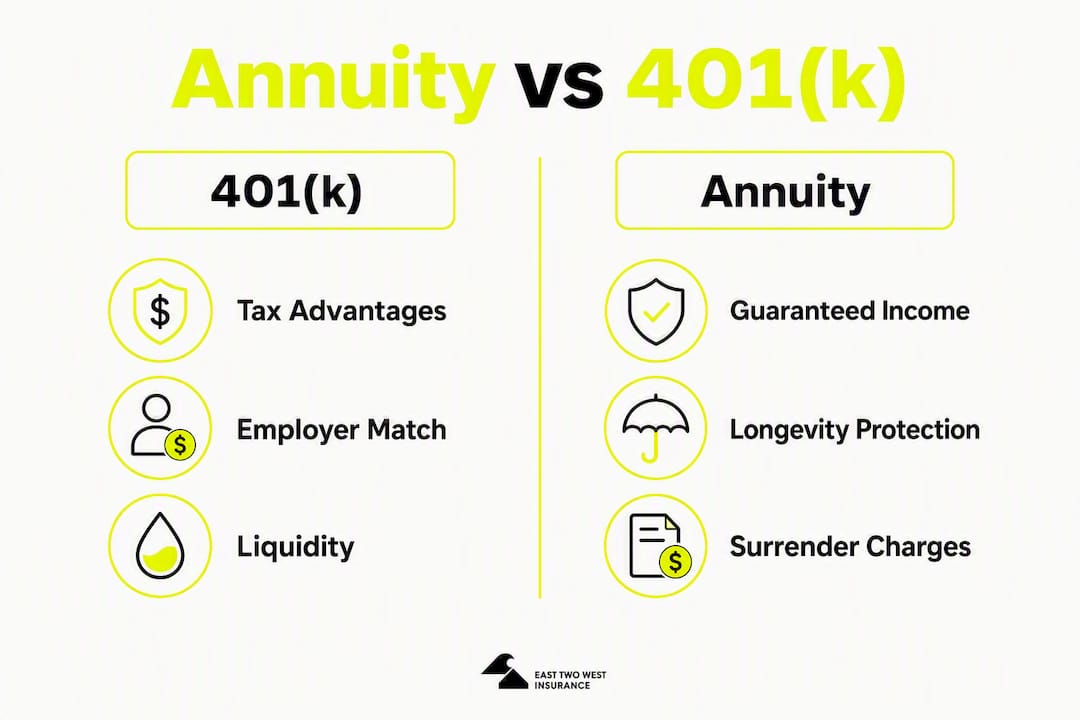
The single most decisive difference: a 401(k) cannot guarantee you won’t outlive your money. A properly structured annuity can.
Pros and cons of each: what actually tips the decision
401(k) pros and cons
Pros:
Employer match is an unbeatable immediate return on the matched dollars
Tax-deferred (or tax-free with Roth) compounding over decades is powerful
Low-cost index fund options in many plans keep fees minimal
High contribution limits allow serious wealth accumulation
Portable: rolls to an IRA or new employer plan when you change jobs
Cons:
Full market exposure means a bad year at 63 can hurt far more than a bad year at 33
RMDs at 73 force taxable withdrawals on a schedule you don’t control
Investment menu is limited to what your employer’s plan offers
No guaranteed income; you bear all longevity and sequence-of-returns risk
Plan fees vary widely; some employer plans carry high-cost fund options
Annuity pros and cons
Pros:
Contractual lifetime income eliminates the risk of outliving your savings
Fixed and indexed types offer principal protection options
Tax-deferred growth on non-qualified funds
Inflation riders and cost-of-living adjustments are available on some products
Can complement Social Security to cover essential monthly expenses
Cons:
Surrender charges lock up capital for years
Variable annuities can carry fees of 3–4% annually, which compounds against you
Complexity: riders, crediting methods, and participation rates require careful reading
No employer match or contribution-limit tax advantages
Inflation can erode fixed income payments over a 20–30 year retirement
Routing advice: If you’re under 45 with a long time horizon and an employer match, the 401(k) wins on almost every axis. If you’re within 10 years of retirement and have no pension, the annuity’s income guarantee starts to look much more valuable, especially for covering non-discretionary expenses.
Taxes, early-withdrawal penalties, and RMDs: the rules that cost you if you miss them
Tax treatment is where the annuity vs 401k comparison gets genuinely complicated, and where most people make expensive mistakes.
401(k) tax rules:
Traditional 401(k): contributions reduce taxable income today; every dollar withdrawn in retirement is taxed as ordinary income at your then-current rate.
Roth 401(k): contributions come from after-tax dollars; qualified distributions (age 59½+, account held 5+ years) are completely tax-free.
Early withdrawals before 59½ trigger a 10% federal penalty plus ordinary income tax on the full amount. Exceptions exist for disability, substantially equal periodic payments (72(t)), and a few other IRS-defined circumstances.
RMDs begin at age 73 for traditional 401(k) accounts. Miss one and the penalty is steep.
Annuity tax rules:
The IRS taxes annuity payments based on how the annuity was funded. Roll pre-tax 401(k) money into a qualified annuity and every payment is fully taxable as ordinary income, because the underlying dollars were never taxed. Fund an annuity with after-tax (non-qualified) money and the IRS applies an exclusion ratio: the portion representing your original principal comes back tax-free; only the earnings are taxed.
Qualified annuity (funded with pre-tax rollover): 100% of distributions taxed as ordinary income.
Non-qualified annuity (funded with after-tax dollars): Earnings taxed; principal returned tax-free via exclusion ratio.
Early withdrawal before 59½: same 10% federal penalty applies, plus any contractual surrender charges on top.
RMD rules for annuities held inside a qualified plan follow the same age-73 trigger. Annuities held outside a qualified plan have different rules depending on the contract.
Key figure: The combined employee and employer 401(k) contribution ceiling for 2026 is $72,000, as set by the IRS, representing the maximum tax-advantaged space available in a single plan year.
Pro Tip: If you’re considering a Roth conversion before buying an annuity, read the Roth IRA vs annuity comparison at East Two West first. The sequencing of a Roth conversion and an annuity purchase has real tax consequences that vary by your income bracket.
Costs, fees, and conflicts of interest you need to know about
Fees are where annuities and 401(k)s diverge most sharply, and where the wrong choice can quietly cost you tens of thousands of dollars over a retirement.
401(k) fee structure:
Expense ratios: The annual cost of the underlying funds. An S&P 500 index fund might charge 0.03–0.05% annually. An actively managed fund in the same plan might charge 0.75–1.25%.
Plan administration fees: Charged by the plan sponsor or recordkeeper. These vary by employer and are sometimes passed to participants.
The practical takeaway: a 401(k) with index fund options is one of the cheapest ways to accumulate retirement savings available to American workers.
Annuity fee structure:
Mortality and expense (M&E) charge: A fee unique to variable annuities, typically 1.0–1.5% annually, covering the insurer’s cost of providing the death benefit and other guarantees.
Income rider fees: If you add a guaranteed lifetime withdrawal benefit (GLWB) or similar rider, expect an additional 0.5–1.5% per year.
Underlying subaccount expenses: Variable annuity subaccounts mirror mutual funds and carry their own expense ratios, often higher than comparable retail funds.
Surrender charges: Not an annual fee, but a penalty for early exit, typically starting at 7–9% and declining to zero over the surrender period.
Fixed and indexed annuities generally carry lower explicit fees, but the insurer earns its margin through the spread between what it earns on your money and what it credits to your account.
Conflicts of interest are real in the annuity market. Annuity commissions can run 4–8% of the premium on some products, which creates an incentive for advisors to recommend higher-commission products. Ask any advisor recommending an annuity to disclose their compensation in writing and whether they are acting as a fiduciary.
Pro Tip: To compare the true cost of guaranteed income, calculate the “income cost ratio”: divide the annual income the annuity provides by the premium paid, then compare that to what a low-cost portfolio withdrawal strategy (like a 4% rule from a 60/40 portfolio) would generate on the same capital. Neither is automatically better, but the comparison makes the trade-off concrete.
When to use each: practical scenarios and sequencing rules
The sequencing logic is straightforward once you accept that these are two different tools for two different jobs.
The baseline sequence:
Contribute enough to your 401(k) to capture the full employer match. Every dollar of match is a 50%–100% instant return.
Max your tax-advantaged accounts (401(k) to the $24,500 elective deferral limit, plus applicable catch-up if eligible, then IRA).
As retirement approaches, evaluate whether your guaranteed income sources (Social Security, pension if any) cover your essential monthly expenses.
If there’s a gap between essential expenses and guaranteed income, that’s the gap an annuity is designed to fill.
Scenario: You’re 35 with a 30-year horizon. The 401(k) is almost certainly the right primary vehicle. Time in the market compounds powerfully, the employer match is free money, and you have decades to recover from market downturns. An annuity at 35 locks up capital during your highest-earning, highest-accumulation years.
Scenario: You’re 55 and retiring in 10 years. Sequence-of-returns risk is now a real threat. A major market drop in the five years before or after retirement can permanently impair a portfolio-only strategy. This is where a deferred income annuity or a fixed indexed annuity starts to earn its place, not for all your savings, but for the portion covering non-discretionary expenses.

Scenario: You’re 65 with no pension. Social Security covers part of your expenses. The rest needs to come from somewhere reliable. A SPIA or an income-rider annuity funded by a portion of your 401(k) rollover can replicate the pension you never had. CBS News reporting frames this as “pensionizing” your savings, and the framing is accurate.
Inflation and annuities: Fixed annuity payments don’t grow with inflation, which is a genuine long-term risk over a 25-year retirement. Strategies to manage it include partial annuitization (annuitize only the essential-expense gap, leave the rest invested), inflation-indexed riders (which reduce the initial payout in exchange for future increases), and income laddering (buying multiple smaller annuities at different ages rather than one large one at 65).
Rollovers and how to add an annuity to your retirement savings
Moving money from a 401(k) into an annuity is a common and tax-efficient strategy when done correctly. Done wrong, it triggers taxes and penalties you didn’t need to pay.
Steps before you execute a rollover or annuity purchase:
Confirm the rollover type. A direct (trustee-to-trustee) rollover from your 401(k) to an IRA avoids the mandatory 20% withholding that applies to indirect rollovers. Always request a direct transfer.
Decide: IRA first, then annuity, or in-plan annuity? Most people roll to a traditional IRA and then purchase an annuity inside that IRA. Some employer plans now offer in-plan annuity options, including Qualifying Longevity Annuity Contracts (QLACs), which let you defer RMDs on the annuitized portion.
Check your plan’s Summary Plan Description (SPD). This document lists what rollover options your plan allows, whether in-plan annuities are available, and any restrictions on distributions.
Understand the tax consequence. Rolling pre-tax 401(k) funds into a qualified annuity preserves tax deferral. No tax is due at rollover; distributions are taxed as ordinary income when received.
Review surrender schedules before signing. Once the annuity is purchased, your capital is subject to the surrender period. Make sure you won’t need that money within the surrender window.
Check state-level creditor protection. Annuity contracts often receive stronger creditor protection than IRA assets in many states, which can be a meaningful consideration for business owners or professionals with liability exposure. Rules vary by state.
Get competing quotes. Annuity rates vary significantly across carriers for the same product type. A SPIA paying $600/month from one carrier might pay $650/month from another on the same premium. Always compare.
In-plan annuities and QLACs are worth a specific mention. A QLAC lets you use up to a set IRS limit of your IRA or 401(k) balance to purchase a deferred income annuity that starts paying at a future age (up to 85), and that portion is excluded from RMD calculations until income begins. It’s a useful tool for people who want to hedge against living into their 80s and 90s.
How East Two West helps you compare annuity options
Once you’ve decided that guaranteed income belongs in your retirement plan, the next practical problem is finding the right product at the right rate. That’s exactly what East Two West is built for.
East Two West is an independent insurance practice that compares annuity and life insurance quotes across multiple carriers. There’s no single-carrier bias, no pressure to buy a product that doesn’t fit, and two ways to engage: complete the process online at your own pace, or schedule a phone consultation for more complex situations.
What to have ready before requesting quotes:
Your target monthly income amount (what gap are you trying to fill?)
The source of funds: 401(k) rollover, IRA, or after-tax savings
Your desired income start date: immediate or deferred, and by how many years
Your age and health status (relevant for certain income products)
Whether you want a joint-life payout (covering a spouse) or single-life
Pro Tip: Bring a recent Social Security statement to your quote conversation. Knowing your projected Social Security benefit at 62, 67, and 70 lets you calculate the exact income gap an annuity needs to cover, which produces a more accurate quote and prevents over-annuitizing.
East Two West’s educational resources cover annuity types, tax rules, and product comparisons in plain language, so you can arrive at the quote conversation already informed.
Key Takeaways
A 401(k) builds wealth through tax-advantaged accumulation and employer matching; an annuity converts that wealth into guaranteed lifetime income, and using both in sequence is the most reliable path to retirement security.
Point | Details |
Capture the employer match first | The employer match is an immediate guaranteed return no annuity or investment can replicate. |
Know the 2026 contribution limits | The 401(k) elective deferral limit for 2026 is $24,500, with a standard catch-up contribution of $8,000 for those 50 and older and a ‘super’ catch-up of $11,250 for employees ages 60 to 63. |
Tax treatment depends on funding source | Qualified rollover funds in an annuity are fully taxable; non-qualified funds return principal tax-free. |
Use an annuity to fill the income gap | Annuitize only the portion needed to cover essential expenses Social Security doesn’t reach. |
East Two West compares annuity quotes | East Two West provides independent, no-pressure annuity quotes across multiple carriers online or by phone. |
The case for using both, not choosing between them
Most articles on this topic frame the annuity vs 401k question as a binary choice. It isn’t. The framing itself is the problem.
A 401(k) is a wealth-building machine. It’s tax-advantaged, often employer-subsidized, and gives you three decades of compounding if you start early. Abandoning that in favor of an annuity at 35 would be a mistake. But a 401(k) alone doesn’t solve the income problem in retirement. It gives you a pile of money with no guarantee about how long it lasts. The 4% withdrawal rule is a guideline, not a contract.
An annuity solves a specific problem: the risk that you live longer than your money. That’s a real risk. Americans who reach 65 have a meaningful probability of living into their late 80s or beyond. A portfolio-only strategy that depletes at 82 is a failure, regardless of how well it performed in the accumulation phase.
What I find most useful in practice is thinking about retirement income in layers. Social Security is the base. A pension, if you have one, adds to it. An annuity can replicate that pension layer for people who don’t have one. And the 401(k) or IRA sits on top, providing flexibility, growth, and a reserve for unexpected expenses or legacy goals.
The people who get this wrong are usually the ones who either over-annuitize (locking up too much capital in surrender periods and giving up flexibility) or under-annuitize (relying entirely on a portfolio and discovering at 78 that sequence-of-returns risk was real). The right answer is almost always partial: enough annuity to cover the income gap, enough invested assets to handle inflation, healthcare costs, and the unexpected.
Get personalized annuity quotes without the sales pressure
[

Comparing annuity options across carriers is harder than it should be. Rates differ, surrender schedules vary, and rider terms are written in language designed to obscure rather than clarify. East Two West cuts through that by pulling quotes from multiple carriers side by side, so you see the actual numbers before you commit to anything.
The service is commission-based: East Two West is compensated by the carrier when a policy is placed, not by charging you a fee. That means the comparison itself costs you nothing. You can use the online quote tool to get started on your own, or request a phone consultation if your situation involves a rollover, a joint-life payout, or a combination of products.
What to expect: a no-pressure side-by-side comparison of income amounts, surrender schedules, and rider options from carriers that match your funding source and timeline. No obligation to buy, and no single-carrier recommendation dressed up as independent advice.
Pro Tip: Have your 401(k) or IRA balance, your Social Security estimate, and your target retirement date ready before you start the quote process. Those three numbers let East Two West return accurate, carrier-specific income projections rather than generic estimates.
This article is for general informational purposes only and does not constitute financial, tax, or legal advice. Consult a qualified financial professional and review current IRS rules before making retirement planning decisions.
Useful sources and further reading
The figures and rules in this article draw from primary IRS sources and independent educational resources. Here’s where to go for deeper detail:
IRS contribution limits and plan rules:
IRS: 401(k) limit increases to $24,500 for 2026 — the authoritative source for 2026 elective deferral, catch-up, and combined contribution limits.
IRS: Retirement topics — 401(k) and profit-sharing plan contribution limits — covers RMD rules and how they interact with annuity contracts held inside qualified plans.
Early withdrawal and penalty rules:
Annuity tax treatment:
Product comparisons and planning frameworks:
Recommended
Comments