Life Insurance for Scuba Divers: Rates, Riders, and How to Get Covered
- Jib Hunt

- 4 days ago
- 12 min read

Most recreational scuba divers can get life insurance at standard rates. If you’re certified, diving open water to moderate depths, and logging a limited number of dives per year, most carriers will accept you without any avocational surcharge. The process is straightforward when you know what to prepare.
Here’s what to do right now:
Pull your PADI, NAUI, or SSI certification card and your dive log (dates, depths, buddy names).
Note your annual dive count and maximum depth reached.
Request quotes from an independent broker like East Two West, who can run your profile across multiple carriers simultaneously.
Gen Re’s underwriting analysis finds recreational diving mortality to be low, a figure that helps explain why most healthy recreational divers land at standard or preferred classes. The perceived danger is higher than the actuarial reality. That gap is exactly where a good broker earns their keep.
Table of Contents
How life insurance underwriters actually evaluate scuba diving risk
Underwriters don’t just ask “do you dive?” They want to know how you dive. The distinction between a weekend open-water diver and a technical cave diver is enormous from a mortality standpoint, and carriers have built their matrices accordingly.
The core filters underwriters apply:
Depth: Staying at or near common recreational depth limits is the most common threshold for preferred or standard rates. Diving deeper often triggers a flat extra, and risk increases beyond that.
Frequency: Carrier matrices typically allow a modest annual dive count for top-tier classes. Divers with more frequent dives may still qualify for standard rates but rarely preferred.
Environment: Open-water dives (ocean, lake, quarry with clear exit) are treated very differently from overhead environments. Cave, wreck, and ice diving introduce entrapment risk that changes the underwriting category entirely.
Equipment: Rebreather use is a consistent red flag. Rebreathers eliminate the visual and auditory cues that signal distress to a buddy, and their failure modes are less forgiving than open-circuit gear.
Buddy vs. solo: USC/Dornsife hyperbaric research notes that solo divers face a substantially higher fatality rate compared to buddy or team divers. Underwriters treat consistent buddy diving as a behavioral signal of safety discipline, not just a preference.
Certification status: Current, active certification from a recognized agency (PADI, NAUI, SSI) matters. Lapsed certification or self-taught diving raises flags.
Medical history interacts directly with diving risk. Gen Re’s analysis identifies cardiac events and pre-existing conditions as the dominant underlying causes of diving fatalities, not drowning alone. An applicant with controlled hypertension who dives recreationally will face a combined rating that stacks the medical and avocational adjustments together. A prior decompression sickness (DCS) episode, asthma, seizure history, or diabetes can prevent top-tier classes even when the diving profile itself is low risk.
Mortality reality check: Gen Re estimates recreational scuba diving mortality is lower than many activities people don’t think twice about insuring.
Pro Tip: Document your safety habits in writing before you apply. A logbook showing consistent buddy diving, certified dive operators, and depths under 80 feet tells a very different story than a verbal “I dive recreationally.” Underwriters respond to evidence.

What underwriting outcomes actually look like for divers
There are four possible outcomes when a carrier reviews your diving profile, and each has a concrete effect on your policy and your wallet.
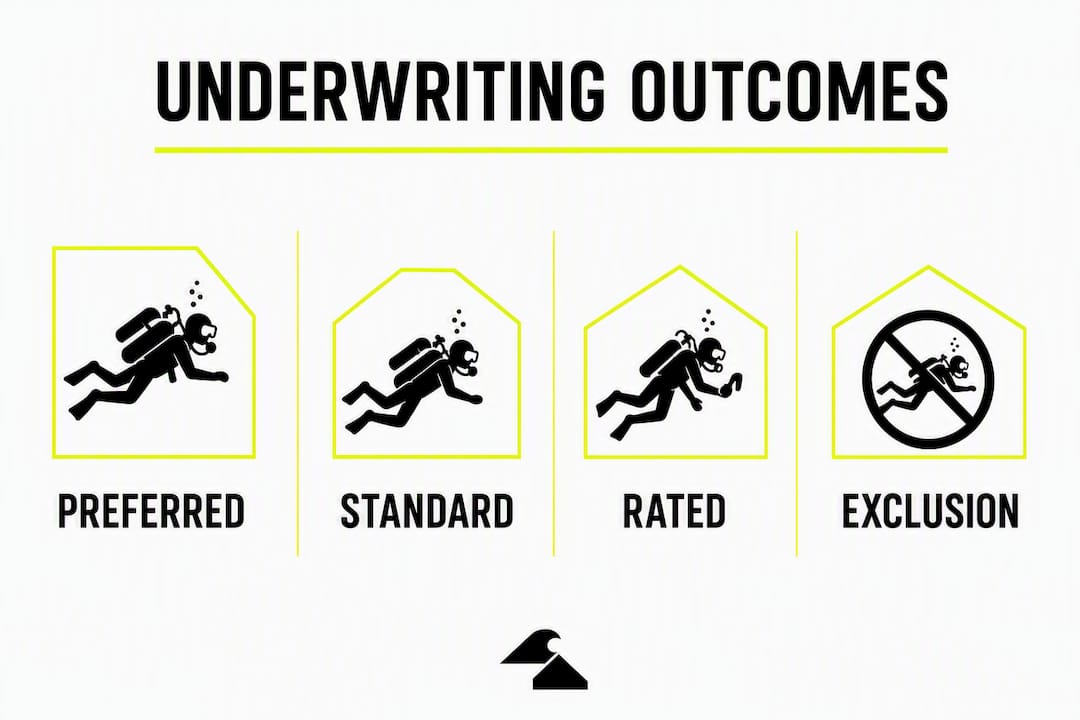
Preferred/Preferred Plus (best class): Available to recreational divers who meet the standard thresholds. No avocational surcharge, no exclusion. Your premium reflects your age, health, and term length only.
Standard: Still no flat extra in many cases, but you won’t qualify for the best pricing tier. Common when dive frequency is moderate or depth pushes toward the 100-foot boundary.
Rated (flat extra per $1,000 of coverage): The carrier accepts you but adds a per-$1,000 surcharge to your base premium. Flat extras typically start at $2.50 per $1,000 of coverage for mildly elevated risk profiles and can reach $10.00 or more per $1,000 for technical or high-frequency diving. For example, on a $500,000 policy, a $2.50 flat extra adds $1,250 per year to the base premium. These are illustrative figures. Your actual premium depends on age, health, carrier, and state.
Exclusion rider: Instead of charging more, the carrier excludes diving-related deaths from coverage. Your beneficiaries would receive the death benefit for any cause except a diving accident. This is common for profiles that exceed recreational norms but aren’t severe enough for a decline.
Decline: Some carriers won’t offer coverage at any price for certain profiles: commercial saturation divers, cave divers without substantial surface support, or applicants whose medical history compounds an already high-risk diving profile.
The trigger points for each outcome follow a rough pattern:
Open water, moderate depth, limited dives per year, current certification: preferred or standard, no extra
Increased depth or dive frequency: flat extra likely, with cost increasing by risk level
Technical diving, rebreather, overhead environments: higher flat extra or exclusion rider
Commercial, saturation, rescue-for-pay, or combined medical risk: individual consideration or decline
Pro Tip: A flat extra is not permanent. If you reduce your diving frequency, complete advanced safety training, or go through a long quiet period with no incidents, ask your broker to request reconsideration. Some carriers will remove or reduce the extra after 2–3 years of documented low-risk behavior.
What insurers will ask you on the application
The hazardous-activity question on a life insurance application is binary: yes or no. Answer yes to scuba diving, and the carrier will almost certainly send a Diving Supplement before making a decision.
Documents and information to prepare:
Current certification card (PADI, NAUI, SSI, or equivalent) and the date you were certified
Dive log showing dates, locations, depths, and buddy names for the past 2–3 years
Total number of dives per year (average and maximum)
Maximum depth reached, ever and in the past 12 months
Description of any technical, wreck, cave, or ice dives
Equipment used (open-circuit vs. rebreather)
Any history of decompression sickness, barotrauma, or hyperbaric treatment
Medical history relevant to diving: cardiac conditions, pulmonary disease, diabetes, seizures
Carriers commonly request a Diving Supplement (such as form 96200) that covers site type, equipment, certification status, and annual dive count. Supporting documents that help your case include copies of your certification cards, a signed statement from a dive instructor or operator, and any dive-operator logs from organized trips.
Mini-FAQ on disclosure:
Do I have to list scuba diving if I only dive once a year? Yes. The application asks about hazardous activities, and scuba diving is listed on virtually every carrier’s avocation questionnaire. Non-disclosure is material misrepresentation and can void a claim.
What if I haven’t dived in two years? Disclose it and note the gap. Many carriers treat a 2–3 year quiet period favorably, especially if you indicate no plans to resume.
How much detail do I provide on the supplement? Answer every question accurately and completely. Don’t volunteer information the form doesn’t ask for, but don’t omit anything it does. Accuracy protects you; omission creates claim risk.
How much scuba diving can actually change your premium
The flat-extra model is the most common mechanism carriers use to price avocational risk. Typical ranges of flat extras correspond to low, moderate, and higher-risk diving profiles. These illustrative examples help explain how additional costs may increase with risk but actual premiums vary by individual factors.
Carrier matrices confirm that Preferred Plus is available for divers at or below 100 feet with 10 or fewer annual dives. The jump to a flat extra happens when either the depth or frequency threshold is crossed, not both. Cross both, and the extra is almost certain.
The medical multiplier: Because cardiac events are the leading underlying cause of diving fatalities, a diver with a pre-existing heart condition faces stacked ratings. The avocational extra and the medical rating are added together, not averaged. A $2.50 flat extra combined with a Table 2 medical rating can push total cost well above what either factor alone would suggest.
One more variable worth flagging: policy type matters. A flat extra on a 20-year term policy at age 35 costs far less in total than the same flat extra on a whole life policy. Getting comparative quotes across policy types, not just carriers, is where the real savings surface.
When diving is treated differently by underwriters
Most of this article applies to recreational open-water diving. These profiles get handled differently.
Cave, wreck, and ice penetration diving: Overhead environments eliminate the direct-ascent escape route. Entrapment, disorientation, and limited rescue access push these profiles into higher flat-extra territory or exclusion riders. Gen Re’s underwriting guidance lists overhead penetration as a consistent trigger for elevated class ratings across carriers.
Rebreather diving: Rebreathers recycle exhaled gas, which eliminates the bubble trail that signals a diver’s position and status to a buddy. Oxygen toxicity and CO₂ scrubber failure are failure modes with very little warning. Most carriers treat rebreather use as a separate, higher-risk category regardless of depth.
Commercial and saturation diving: Saturation divers live under pressure for days or weeks at a time. The physiological stress, depth (often well beyond 300 feet), and occupational nature of the work place this category outside standard avocational underwriting entirely. Many carriers decline or require individual consideration with substantial documentation.
Rescue diving and diving for pay: Being paid to dive, or holding a rescue diver certification that implies active rescue operations, signals professional-level exposure. Carriers distinguish between a recreational diver who completed a rescue course and someone who actively performs underwater rescue work.
Solo diving: The 10x fatality rate differential for solo divers is the single most striking data point in diving underwriting. Carriers that learn an applicant dives alone regularly will treat that as a behavioral red flag, regardless of depth or frequency.
Pro Tip: If you fall into one of these higher-risk categories, a diving accident policy through an organization like DAN (Divers Alert Network) can provide supplemental accident and medical coverage. It does not replace life insurance, but it fills gaps that a life policy with a diving exclusion rider would leave open.
Which policy types and rider options make sense for divers
Not every policy form works equally well for a diver with a rated or excluded profile.
Diver Profile | Best Policy Type | Why |
Recreational, within thresholds | Term or whole life, standard/preferred | No avocational surcharge; full coverage including diving deaths |
Frequent diver, mild flat extra | Term life | Flat extra cost is contained; coverage period matches peak diving years |
Technical/overhead diver | Term with exclusion rider, or guaranteed issue | Exclusion limits cost; guaranteed issue avoids underwriting entirely |
Medically impaired diver | Guaranteed issue or final expense | Acceptance regardless of health or diving profile; lower face amounts |
Diver seeking permanent coverage | IUL or whole life, rated | Flat extra is permanent cost; compare total outlay vs. term carefully |
Term life is the most practical choice for most divers. The flat extra, if any, applies only during the term. A 20-year term policy bought at 40 covers the years when financial dependents are most exposed, and the total cost of a modest flat extra is manageable.
Whole life and IUL make sense when permanent coverage is the goal, but a flat extra on a whole life policy compounds over decades. Run the numbers before committing.
Guaranteed issue life insurance requires no medical exam and no avocation questions. The tradeoff is lower face amounts (typically $25,000–$50,000), higher cost per dollar of coverage, and a graded death benefit in the first two years. For a diver who has been declined elsewhere, it’s a floor, not a ceiling.
Accidental death and dismemberment (AD&D) policies are sometimes marketed to high-risk hobbyists, but they pay only on accidental death, not illness. A diver who dies from a cardiac event underwater may not qualify for an AD&D payout. Don’t rely on AD&D as a substitute for life insurance.
The most practical move for any diver navigating rated or excluded offers is working with an independent broker. Carrier-level matrices vary significantly, and a broker who can target carriers whose published thresholds align with your profile can often find a standard offer where a single-carrier approach would return a flat extra. East Two West runs quotes across multiple carriers from a single application, which is exactly the kind of comparison that surfaces those differences.
How to get the best life insurance as a scuba diver, step by step
1. Gather your medical records and medication list. Pull any records related to cardiac, pulmonary, neurological, or metabolic conditions. List current medications with dosages. Underwriters will ask, and having this ready prevents delays.
2. Assemble your diving documentation. Certification cards (all levels), your dive log for the past 2–3 years, and a written summary of your typical dive profile: average depth, max depth, annual frequency, environments, and equipment.

3. Flag any technical or commercial dives separately. If you’ve done cave, wreck, ice, or rebreather dives, note them with dates and context. Don’t bury them in the general log summary.
4. Request quotes from multiple carriers through a broker. Single-carrier applications leave money on the table. An independent broker like East Two West submits your profile across carriers simultaneously and returns the spread of offers, including which carriers offer standard rates for your specific profile.
5. If you receive a rated or excluded offer, ask about alternatives. A flat extra from one carrier may not exist at another. An exclusion rider at one carrier may be a flat extra at another. Ask your broker to identify the best available class across the pool before accepting any offer.
6. Appeal or re-underwrite after meaningful changes. Completed advanced safety training? Reduced annual dive count? Two years with no incidents? Request reconsideration. Some carriers will revisit a rating when the behavioral or medical picture has genuinely improved.
Pro Tip: If you’re planning corrective surgery for a cardiac or pulmonary condition, wait until you’re fully recovered and have a clean follow-up before applying. Applying mid-treatment almost always produces the worst possible underwriting class.
Key Takeaways
Most recreational scuba divers who stay within standard thresholds (certified, open water, ≤100 ft, ≤10 dives per year) qualify for standard or preferred life insurance rates with no avocational surcharge.
Point | Details |
Standard rates are achievable | Certified recreational divers within depth and frequency limits typically qualify with no flat extra. |
Flat extras start at $2.50 per $1,000 | Exceeding depth or frequency thresholds triggers per-$1,000 surcharges; a $2.50 extra adds $1,250 per year on a $500K policy. |
Medical history stacks with diving risk | Cardiac, pulmonary, or prior DCS history combines with avocational ratings, often preventing top-tier classes. |
Documentation changes outcomes | A logbook, current certification, and buddy-diving record are underwriting evidence, not just paperwork. |
East Two West compares multiple carriers | Running your diving profile across carriers via East Two West surfaces the best available class and avoids single-carrier limitations. |
What I see most often in diving underwriting
The pattern that shows up most consistently: divers who come in expecting the worst and leave with standard rates. The recreational diver who logs 6–8 dives a year in open water, stays above 80 feet, dives with a buddy, and carries a current PADI card is not a complicated underwriting case. Most carriers handle that profile without a second look.
The genuinely difficult cases are narrower than people assume. Technical divers, commercial divers, and anyone with a cardiac history who also dives regularly, those profiles require real carrier selection strategy. A flat extra that one carrier applies automatically may not exist at another carrier whose matrix draws the threshold differently.
What changes outcomes most reliably isn’t the diving profile itself. It’s the documentation. A diver who walks in with a complete logbook, current certification, and a clean medical history has a fundamentally different conversation with an underwriter than someone who says “I dive sometimes, maybe 10 times a year, I’m not sure how deep.” Specificity is protective. Vagueness reads as risk.
The other thing worth saying plainly: don’t let the fear of a rating stop you from applying. A rated policy with a $2.50 flat extra still pays your family. Waiting for a perfect underwriting outcome while uninsured is the worst possible risk management.
East Two West helps scuba divers compare life insurance quotes fast
Scuba divers shopping for life insurance face a specific problem: carriers vary widely in how they treat diving profiles, and a single-carrier application gives you one data point when you need several. East Two West solves that directly. You get quotes from multiple carriers in one place, with no sales pressure and no obligation to buy until you’ve seen the full picture.
[

Two paths are available. If your profile is straightforward (recreational, certified, within standard thresholds), the online self-service quote tool at East Two West gets you comparative pricing in minutes. If your situation is more complex (technical diving history, medical conditions, prior ratings), a licensed agent consultation walks through carrier selection and documentation strategy before anything is submitted. Before your call or quote, have your certification card, dive log summary, and a brief medical history ready. That’s the full prep list.
Compare carrier options at East Two West and see which carriers offer the best class for your specific diving profile.
Authoritative sources and further reading
The sources below are the primary references behind this article’s underwriting guidance. They are worth reading directly if you’re an agent, a diver with a complex profile, or anyone who wants to verify the thresholds and flat-extra ranges cited above.
“As many as nine million people worldwide are estimated to be currently certified to dive, which means it is likely a life insurance underwriter will come across an application from a diver at some point during his or her career.” — SCOR: Diving Deeper — Understanding Scuba in Underwriting
Gen Re: To Underwrite Scuba Diving, Understand the Perils of the Deep — mortality data, depth/frequency thresholds, and the medical footprint concept; the most cited reinsurer source on diving underwriting.
Gen Re: Underwriting Scuba Diving Risk — detailed treatment of overhead environments, rebreather risk, cardiac causation, and combined ratings.
Pinney Insurance: Underwriting Guidelines for Scuba Diving (Matrix) — carrier-level matrix showing preferred thresholds, flat-extra bands, and exclusion triggers by depth and activity type.
Pinney Insurance: Rx Scuba Diving — practical underwriting guidance including flat-extra ranges and typical acceptance patterns for recreational divers.
Pinney/AIG: Life Insurance Field Underwriting (Diving Supplement example) — sample Diving Supplement form showing exactly what carriers request when an applicant discloses scuba diving.
USC/Dornsife Hyperbaric Medicine: Diving Medicine for Scuba Divers — medical and fatality pattern data, including the solo vs. buddy fatality rate differential.
Crump Life Insurance: What You Need to Know About Avocations — wholesale underwriting perspective on scuba as a common avocation, including disclosure guidance.
CDC Yellow Book: Diving (Environmental Hazards) — public health reference on diving risks, DCS, and medical contraindications relevant to the underwriting medical footprint.
DAN: Membership and Insurance — Divers Alert Network’s supplemental accident and medical coverage options for divers, particularly relevant for those with exclusion riders on life policies.
Recommended
Comments