Executive Bonus Life Insurance: What Employers Need to Know
- Jib Hunt

- Aug 12
- 11 min read

An executive bonus life insurance plan is a straightforward arrangement: the employer pays a cash bonus to a key employee, that employee uses the bonus to pay premiums on a permanent life insurance policy they personally own, and the employer deducts the bonus as compensation. The executive reports the bonus as ordinary W-2 income. That is the whole engine.
Three facts matter before you go further:
Who owns the policy: The executive owns it outright, names their own beneficiaries, and takes it with them if they leave.
Basic tax treatment: The bonus is taxable income to the employee and generally deductible to the employer as reasonable compensation, per Section 162 mechanics.
Employer goal: Reward, retain, and selectively benefit key people without the complexity of a qualified retirement plan.
Three plan structures appear throughout this guide: the standard Section 162 executive bonus, the REBA (restricted executive bonus arrangement), and split-dollar. Each handles ownership, vesting, and tax differently.
Key Takeaways
An executive bonus life insurance plan is one of the simplest nonqualified executive benefits available: the employer pays a deductible bonus, the executive owns a permanent life policy, and both sides benefit when the plan is designed correctly.
Point | Details |
Core mechanics | Employer pays a taxable bonus; executive owns the permanent life policy and reports the bonus as W-2 income. |
Tax treatment | Bonus is generally deductible to the employer as compensation; employee pays income tax and FICA on the full bonus amount. |
Structure choice | Section 162 for simplicity and full portability; REBA when you need vesting/golden handcuffs; split-dollar when the company needs a share of the death benefit. |
Gross-up decision | Paying a grossed-up bonus covers the executive’s tax liability and significantly improves plan uptake, at a higher employer cost. |
East Two West | East Two West provides independent, multi-carrier quotes for executive bonus life policies with no sales pressure, online or by consultation. |
Table of Contents
How does an executive bonus life insurance plan actually work?
What are the differences between Section 162, REBA, and split-dollar?
What are the tax and payroll obligations for employers and employees?
What are the benefits and risks for employers and executives?
An independent broker’s perspective on when this plan earns its place
How East Two West can help you compare executive bonus options
How does an executive bonus life insurance plan actually work?
The mechanics are cleaner than most executive benefit strategies. The employer decides on a bonus amount, runs it through payroll, and the executive applies that money toward premiums on a permanent life policy. According to MassMutual’s breakdown, the employer treats premium payments as taxable bonuses and generally deducts them as compensation, while the employee owns the policy and controls it entirely.
A simple numeric illustration:
Suppose the employer wants to fund an annual premium for a senior VP.
Employer pays a $15,000 bonus (or a grossed-up amount, explained in Section 5).
Executive receives the bonus as W-2 income, pays income and payroll taxes on it.
Executive pays the $15,000 premium to the life insurance carrier.
If the executive is in a combined tax bracket, the bonus nets a reduced amount after taxes, leaving a gap between the net bonus and the full premium. That gap is why many employers choose to gross up the bonus, which is covered in the tax section.
Why permanent life insurance? Term policies have no cash value, so they offer nothing to the executive beyond a death benefit. Permanent policies, including indexed universal life (IUL), whole life, and variable universal life, accumulate cash value the executive can access through loans or withdrawals, often on a tax-advantaged basis. That cash value is what makes the plan attractive as a long-term compensation tool, not just a death benefit.
Portability is a real selling point for executives and a double-edged sword for employers. The policy belongs to the executive from day one. If they leave after two years, they take the policy with them. That portability is why REBA arrangements exist.
Who qualifies, and how do employers choose participants?
Section 162 bonus plans can be highly selective, with no minimum participation requirements like those that govern 401(k) or pension plans. An employer can cover one executive and no one else. That flexibility is the plan’s biggest structural advantage over qualified plans.
Typical participants include:
C-suite executives (CEO, CFO, COO) whose departure would materially disrupt operations
Senior vice presidents and division heads with high replacement costs
Key technical leaders or rainmakers whose client relationships or expertise are hard to replicate
Founding partners or equity-adjacent roles in pass-through entities where qualified-plan options are limited
Practical selection criteria matter as much as job title. Consider the executive’s retention risk: if they are being recruited aggressively, the plan adds a retention layer. Consider replacement cost: a $400,000-a-year executive who would take 12 months to replace has a measurable cost attached to their departure. And consider executive preference: some executives genuinely do not want life insurance as a benefit. A plan that the executive does not value will not retain them.
Pro Tip: Before finalizing the participant list, ask each candidate whether they already have substantial personal life insurance coverage. An executive who is already well-covered may prefer a different benefit, and a plan they do not value will not serve your retention goals.
What are the differences between Section 162, REBA, and split-dollar?
Each structure solves a different problem. The table below maps the key dimensions.
Feature | Section 162 (Executive Bonus) | REBA | Split-Dollar |
Policy owner | Executive | Executive (with restrictions) | Varies (employer or executive) |
When employee recognizes income | When bonus is paid | When bonus is paid | Depends on arrangement type (economic benefit or loan regime) |
Employer deduction | Yes, as compensation | Yes, as compensation | Depends on structure; often limited |
Employer rights to cash value or death benefit | None | Indirect (via restrictive endorsement) | Yes, typically split per agreement |
Vesting / forfeiture | None | Yes, via written agreement | Negotiated |
Typical use case | Immediate reward, full portability | Retention with golden handcuffs | Company needs a share of the death benefit or cash value |
Section 162 in practice: A profitable S-corp wants to reward its CFO with a meaningful benefit. The owner adds an annual bonus earmarked for a whole life policy. The CFO owns the policy immediately, and the company deducts the bonus. Simple, clean, and the CFO values it because the policy is entirely theirs.
REBA in practice: Same scenario, but the owner is worried the CFO will leave in three years. A REBA adds a written agreement and a carrier-filed restrictive endorsement that limits the CFO’s access to cash value for five years. The CFO still owns the policy, but cannot surrender it or take loans until the restriction lifts. REBA arrangements require written agreements and carrier direction forms, and they create a practical vesting schedule without triggering qualified-plan rules.
Split-dollar in practice: A company wants to fund a large death benefit for a key executive but also wants to recover its premium outlay from the death benefit proceeds. A split-dollar arrangement splits the policy’s economic benefits between employer and employee. The company gets reimbursed for premiums from the death benefit; the executive’s beneficiaries receive the remainder.
Consult tax and benefits counsel before implementing a split-dollar arrangement. Split-dollar plans are governed by IRS regulations that distinguish between the economic benefit regime and the loan regime, and the tax consequences differ significantly between them. Getting this wrong creates retroactive tax exposure.
What are the tax and payroll obligations for employers and employees?
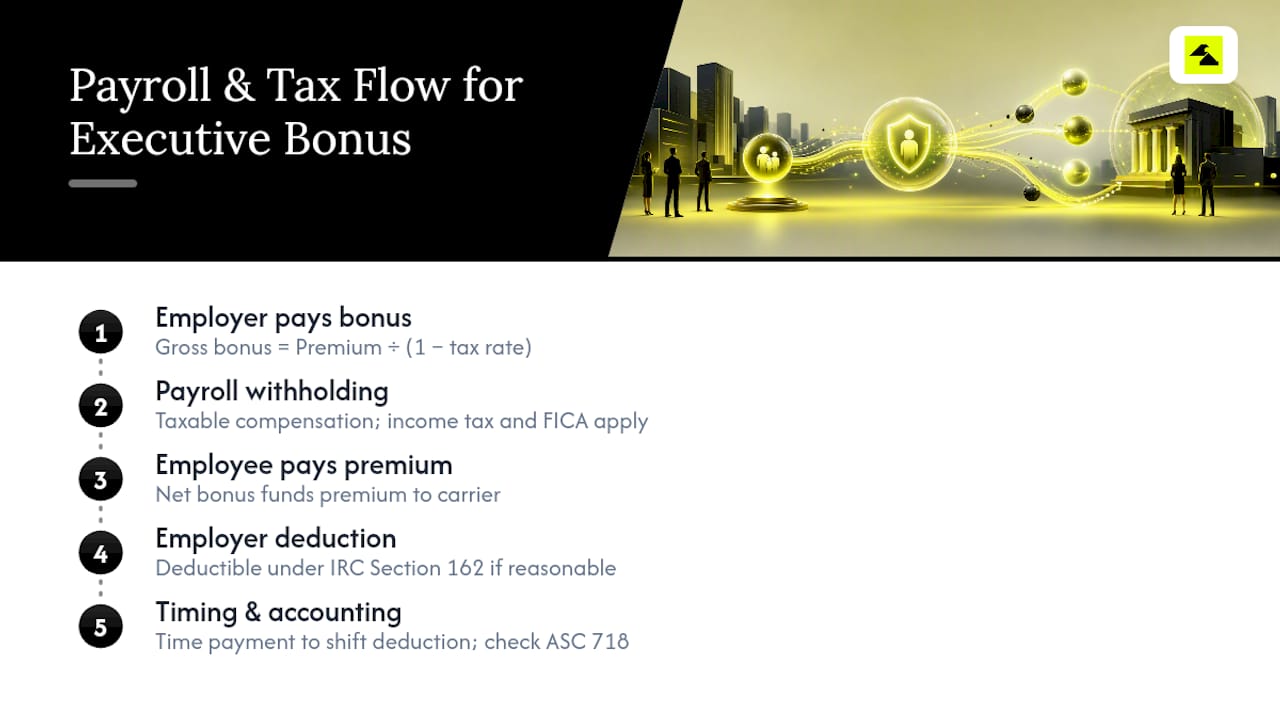
The tax treatment is not complicated, but the payroll mechanics require attention. The bonus is taxable compensation to the employee and generally deductible to the employer, provided it qualifies as reasonable compensation under IRC Section 162. The employee reports it on Form W-2, and both income tax and FICA (Social Security and Medicare) apply.
Payroll taxes and W-2 reporting obligations apply to these bonuses, and failure to withhold or report correctly creates employer tax risk. The premium payment does not go directly from employer to carrier; it flows through the executive’s payroll as a bonus. That distinction matters for payroll processing.
A gross-up solves this. The employer calculates a bonus large enough that after taxes, the executive receives exactly the premium amount.
The gross-up formula: Gross bonus = Premium ÷ (1 minus tax rate)
At a combined tax rate, the gross bonus equals the premium divided by one minus the tax rate. The executive pays taxes on the bonus and applies the premium amount. The employer deducts the grossed-up bonus as compensation. This “double-bonus” approach increases employer cost but significantly improves executive uptake because the executive receives the full benefit with no out-of-pocket tax hit.
Pro Tip: Time the bonus payment to align with your fiscal year-end tax planning. Because employer-paid premiums are treated as taxable compensation, payroll timing affects when the deduction is recognized. Paying the bonus in December rather than January can shift the deduction into the current tax year.
For book-tax purposes, employers should confirm with their CPA how the bonus interacts with ASC 718 or other compensation accounting standards if the executive is a named officer in a public company context.
This section is general information, not tax advice. Consult a CPA or tax attorney for guidance specific to your plan and jurisdiction.
What are the benefits and risks for employers and executives?
Employer benefits:
Selective participation with no nondiscrimination testing
Bonus is generally deductible as compensation
No plan document filing or ERISA compliance burden (for standard Section 162 arrangements)
Strengthens retention when paired with a REBA vesting schedule
Employee benefits:
Immediate policy ownership and full control
Cash value accumulates on a tax-deferred basis
Death benefit passes to named beneficiaries income-tax-free
Policy is portable if the executive changes employers
The risks are real and worth naming plainly.
Tax surprises: An executive who did not budget for the tax on a $20,000 bonus will be unhappy at tax time, especially if no gross-up was provided. This is the most common friction point in year one.
Portability cuts both ways: The employer pays significant premiums, the executive leaves after 18 months, and the policy goes with them. The employer recovers nothing. A REBA limits this exposure, but only if the written agreement is in place before the policy is issued.
Executive disinterest: Some executives, particularly younger ones, would rather have cash, equity, or a 401(k) match. A plan the executive does not value will not retain them, and the employer has spent real money for no retention benefit.
Underwriting risk: A key executive with health issues may not qualify for preferred rates, or may be declined entirely. Underwriting happens after the plan is designed, so build in a contingency.
Carrier and policy risk: Variable universal life policies carry investment risk. If the sub-accounts underperform, the cash value may not grow as illustrated, and the policy could lapse if premiums are not adjusted.
How do you set up an executive bonus plan?
Implementation typically runs four to eight weeks from design to policy issue, assuming clean underwriting. Here is the practical sequence:
Identify participants. Confirm which executives will be included, verify their interest, and document the business rationale for selection.
Choose the plan structure. Decide between a standard Section 162 bonus, a REBA, or a split-dollar arrangement based on retention goals and tax objectives.
Select the policy type and carrier. Whole life, IUL, or variable universal life each have different risk profiles and illustration assumptions. Get multiple carrier illustrations. Accelerated underwriting programs can shorten the timeline for executives who qualify.
Handle underwriting and medical requirements. The executive completes an application and may need a medical exam. Preferred health ratings significantly affect premium levels.
Set up payroll and gross-up decisions. Work with your payroll provider and CPA to code the bonus correctly, establish withholding, and decide whether to gross up.
Draft documentation. For a standard Section 162 plan, a written bonus agreement is advisable. For a REBA, a restrictive endorsement agreement and carrier REBA direction form are required before the policy is issued.
Issue the policy and begin premium payments. Confirm the policy is in force, the executive has received the policy documents, and payroll is processing the bonus on the agreed schedule.
Questions to ask your insurance broker: How does the policy illustration change if the executive is rated for health? What are the surrender charges in years one through ten? How do policy loans affect the death benefit and cash value?
Questions to ask your CPA: Is the bonus amount defensible as reasonable compensation? How should we code this in payroll? Does our state follow federal treatment, or are there state-level deduction differences?
When does another strategy make more sense?
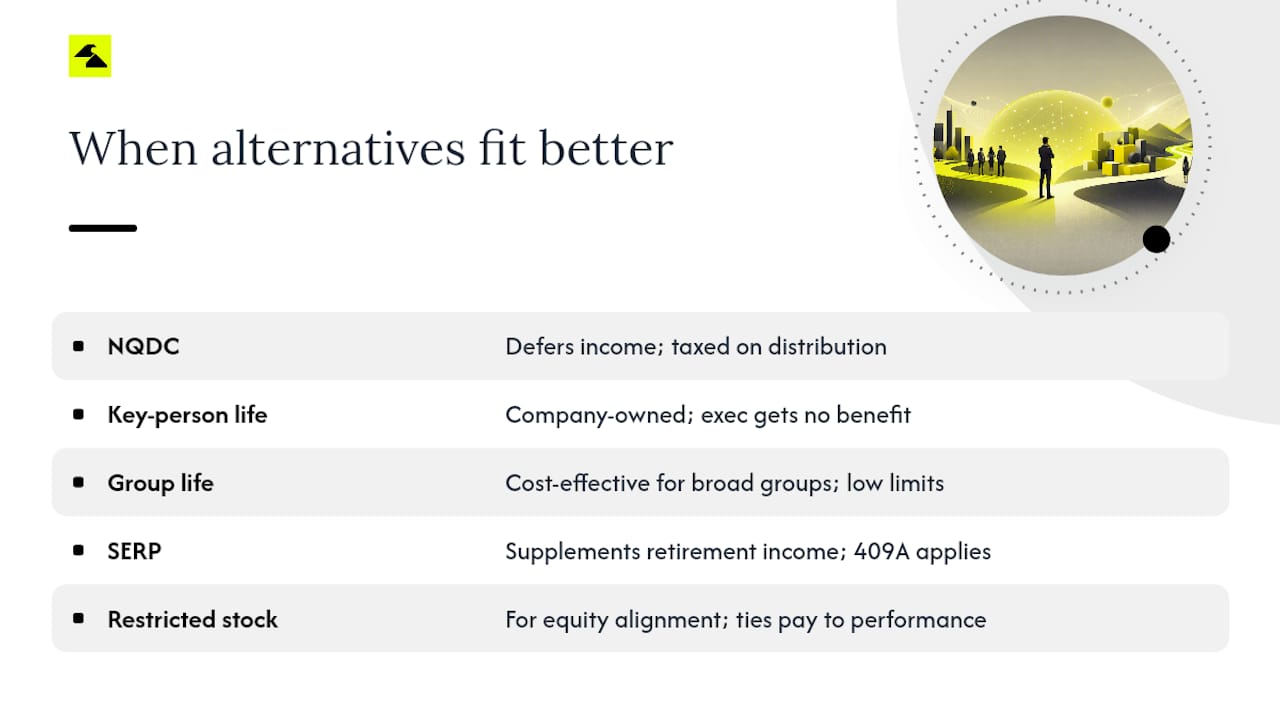
Executive bonus life insurance is not the right tool for every situation. Here is a quick map of alternatives and when they fit better.
Nonqualified deferred compensation (NQDC): When the executive wants to defer income to a lower-tax year in retirement, NQDC is the better vehicle. The executive does not pay tax until distribution. The trade-off is that the deferred amount is an unsecured employer obligation, subject to IRC Section 409A compliance, and the executive bears employer insolvency risk.
Key-person life insurance (company-owned): When the company needs financial protection against the loss of a key executive, not a benefit for the executive, a company-owned policy is the right structure. The company owns the policy, pays premiums, and receives the death benefit. The executive receives no direct benefit.
Group life insurance: Cost-effective for broad employee populations, but limited in face amount (typically capped at one to two times salary under group plans) and not selective. It does not serve the same retention function as an executive bonus plan.
SERPs (supplemental executive retirement plans): When the goal is to supplement retirement income for executives who have maxed out qualified plan contributions, a SERP provides a defined benefit-style promise. These carry 409A compliance requirements and are more complex to administer.
Restricted stock or RSUs: When equity alignment is the primary goal, stock-based compensation ties the executive’s wealth directly to company performance. Life insurance does not do that.
The practical trade-off across all alternatives comes down to three variables: who controls the asset, when the executive pays tax, and how much compliance burden the employer accepts. Executive bonus life insurance wins on simplicity and portability. NQDC and SERPs win on tax deferral. Key-person life wins when the company, not the executive, needs the protection.
An independent broker’s perspective on when this plan earns its place
The executives who benefit most from a bonus life insurance plan are not always the ones you would expect. Pass-through entity owners, S-corp shareholders, and partners in professional practices often find that qualified plan contributions are already maxed out and that their personal life insurance needs are substantial. An executive bonus plan funded with an IUL or whole life policy gives them a tax-deductible way to build cash value outside of a retirement account, with no contribution limits tied to plan testing.
The cases where I see this go sideways are predictable. An employer designs the plan without asking the executive whether they want life insurance. Or the gross-up is skipped to save cost, and the executive is blindsided by a tax bill in April. Or the REBA agreement is never drafted, the executive leaves in year two, and the employer has no recourse.
Underwriting surprises are also more common than employers expect. A 54-year-old CFO with a history of hypertension may be rated, which means the premium for the same death benefit is materially higher than the initial illustration assumed. Build that contingency into the design phase.
The plan works best when the employer has a clear retention goal, the executive genuinely values life insurance as a benefit, and both sides understand the tax mechanics before the policy is issued. When those three conditions are met, it is one of the cleanest executive benefit tools available.
How East Two West can help you compare executive bonus options
East Two West is an independent life insurance practice that pulls quotes from multiple carriers, so you see real premium comparisons without a captive agent steering you toward one company’s product. For executive bonus arrangements, that independence matters: premium differences between carriers for the same face amount and policy type can be significant, and the policy illustration assumptions vary enough to affect long-term cash value projections.
[

To request quotes for an executive bonus plan, East Two West needs basic information: the executive’s age, health profile, target face amount, preferred policy type (whole life, IUL, or variable universal life), and whether you are considering a gross-up or REBA structure. From there, you can compare illustrations side by side, online at your own pace or through a consultation call.
East Two West is commission-compensated by the issuing carrier, not by you. That structure is disclosed upfront, and the goal is to help you compare options clearly so you purchase only what fits your plan design. E2wusa to start comparing executive life insurance options across carriers.
Sources
These resources provide regulatory and industry-level guidance on executive bonus arrangements. They are starting points for background research; consult a CPA or tax attorney before implementing any plan.
This article is general information, not a substitute for advice from a qualified financial advisor. Consult a qualified financial professional about your own circumstances before acting on anything here.
Recommended
Comments