U.S. Seniors: Skip Final Expense Insurance If You Have $8,000–$10,000
- Jib Hunt

- 4 days ago
- 11 min read

Final expense life insurance pays a small, fixed death benefit, usually between $5,000 and $25,000, to cover funeral and burial costs so your family isn’t stuck footing an $8,300 bill on short notice. It’s the right move mainly if you don’t have that amount saved or can’t qualify for a standard term or whole life policy due to age or health. If you already have the savings, skip it and self-insure instead.
TL;DR:
Final expense insurance typically costs between $5,000 and $25,000 and is most suitable if you lack sufficient funeral savings or cannot qualify for standard policies.
Simplified issue policies ask few health questions and usually approve applicants quickly, while guaranteed issue policies require no questions but often have graded benefits and delayed payouts.
The average funeral cost is around $8,300 for burial with a casket, with cremation averaging about $6,280; premiums should be calculated based on these figures plus additional expenses.
Comparing multiple quotes and understanding key policy details such as waiting periods, exclusions, and beneficiary rules is essential to avoid overpaying and ensure proper coverage.
Final expense insurance is tax-free to beneficiaries, but caps on benefit amounts and waiting periods can limit its usefulness for large debts or income replacement needs.
Table of Contents
What Does Final Expense Insurance Cover?
Final expense insurance, sometimes called burial insurance for seniors, is a small whole life policy built for one job: covering the costs that pile up in the days after someone dies. That includes the funeral home bill, a casket or cremation, a headstone, and often leftover medical bills or credit card debt. Benefit amounts run smaller than a typical whole life policy, usually landing in the $5,000 to $25,000 range, versus the six or seven figures you’d see on a traditional life insurance for seniors policy meant to replace income.
The buyer profile is fairly specific. These policies attract:
People in their 50s, 60s, and 70s who never bought life insurance when they were younger and healthier
Seniors with diabetes, heart disease, or other conditions that get them declined for standard coverage
Retirees living on Social Security or a fixed pension who want a manageable, predictable premium
Anyone who simply wants funeral costs handled without dipping into a spouse’s savings or a child’s bank account
Where final expense diverges from term life is duration and purpose. Term life expires and is sized to replace decades of income. Final expense is permanent, smaller, and exists purely to prevent a funeral bill from becoming a family emergency.
How Much Does Final Expense Insurance Cost?
The math starts with what a funeral actually costs. The National Funeral Directors Association’s most recent General Price List study puts the median cost of an adult casketed funeral with burial at $8,300, and a casketed funeral with cremation at $6,280. Direct cremation alone runs closer to $2,645. None of those figures include the cemetery plot, a headstone, or perpetual care fees, which can add several thousand dollars more.
Premiums scale with age and health, not just benefit size. Here’s a rough sense of what carriers commonly charge for simplified-issue coverage:
Pro Tip: Run the break-even math before you buy. If you’re paying $126 a month for a $10,000 policy at age 70, as some market reporting on final expense premiums shows, you’ll pay in more than the policy pays out after roughly six and a half years. That’s fine if you’re worried about dying sooner. It’s a bad deal if you’re likely to live another 15 or 20.
Market data also shows cancellation rates run high on these policies, often because buyers realize later they’re overpaying relative to what a health-qualified term policy would have cost. If you can pass underwriting for a standard policy, that route is usually cheaper per dollar of coverage.
Simplified Issue vs. Guaranteed Issue: Which Fits You?
Underwriting is where final expense policies split into two camps, and the difference determines both your price and how fast you’re covered.
Simplified issue policies ask a short list of health questions (no needles, no medical exam) and approve most applicants within days. Guaranteed issue policies skip the questions entirely; anyone in the eligible age range gets accepted, no matter their health history.
That “no questions asked” convenience comes at a cost: guaranteed-issue policies almost always carry a graded or modified death benefit. If you die from natural causes within the first two to three years, your beneficiary typically receives only the premiums paid back, plus a small amount of interest, not the full face value. Accidental death is usually covered in full from day one.
Before signing anything, confirm these four items in writing:
Whether your policy is simplified issue or guaranteed issue
The exact length of the graded/waiting period and what triggers full payout
The contestability period (usually two years) during which the insurer can investigate and deny a claim for misrepresentation
Whether the premium is locked for life or can be adjusted by class
If you have a manageable health condition, a policy for pre-existing conditions through simplified issue is almost always cheaper than jumping straight to guaranteed issue.
Is Final Expense Insurance Worth It? Weighing the Trade-Offs
The appeal is real, but so is the price tag. Final expense insurance approves fast, requires no medical exam for most applicants, and locks in a premium that won’t rise as you age. The downside: you pay significantly more per $1,000 of coverage than you would with term or whole life, benefit amounts are capped low, and graded policies delay full payout for years.
Three alternatives are worth ruling out first:
Earmarked savings, such as a high-yield savings account, work well if you already have $8,000 to $10,000 you can set aside without touching it.
Prepaid funeral plans lock in today’s prices with a funeral home directly, which protects against inflation but ties you to one provider.
A small term life policy is often cheaper if you’re under 65 and in reasonably good health.
Ask yourself three questions: Can I qualify medically for standard coverage? Do I have the cash to self-insure? Would a graded benefit period leave my family exposed if I died in the next two years? Your answers point straight to the right option.
How to Compare Final Expense Quotes the Right Way
Shopping final expense insurance well takes maybe twenty minutes and can save you hundreds of dollars a year. Here’s the sequence that actually works:
Decide your target benefit based on real numbers, not a round figure. Use the NFDA’s median funeral costs above as your floor, then add a cushion for outstanding debts.
Get quotes from at least three carriers. Rates for identical coverage can vary by 30% or more between insurers for the same applicant.
Compare waiting periods and grading side by side. A policy that’s $5 cheaper a month but graded for three years isn’t automatically the better deal.
Ask directly about claim turnaround. Most insurers process valid claims within 24 to 48 hours of approval, according to funeral cost reporting from CNBC, but missing paperwork or contestability reviews can stretch that out.
Check the free-look period, typically 10 to 30 days, during which you can cancel for a full refund if the policy doesn’t match what you were told.
When you’re on the phone with an agent, ask point blank: Is there a graded death benefit, and for how long? Are there any exclusions for cause of death? Does the premium ever increase? How is a claim actually filed?
Pro Tip: Before locking in a monthly premium, run it against your actual budget for three months, not just the quote sheet. A payment that looks affordable on paper can feel very different sitting next to a fixed Social Security check.
Where Final Expense Fits Into a Bigger Financial Picture
A $10,000 to $15,000 final expense policy rarely stands alone in a solid plan. It’s often paired with a properly designed whole life policy, sized larger and structured for cash value growth, or layered alongside term coverage if other dependents still need protection. Final expense fills the narrow gap: guaranteed liquidity for immediate costs, without draining accumulation-focused policies. Because every situation, income, health, and existing coverage looks different, talk with a licensed agent before assuming one policy type covers everything you need.
Applying for Final Expense Insurance: What to Expect
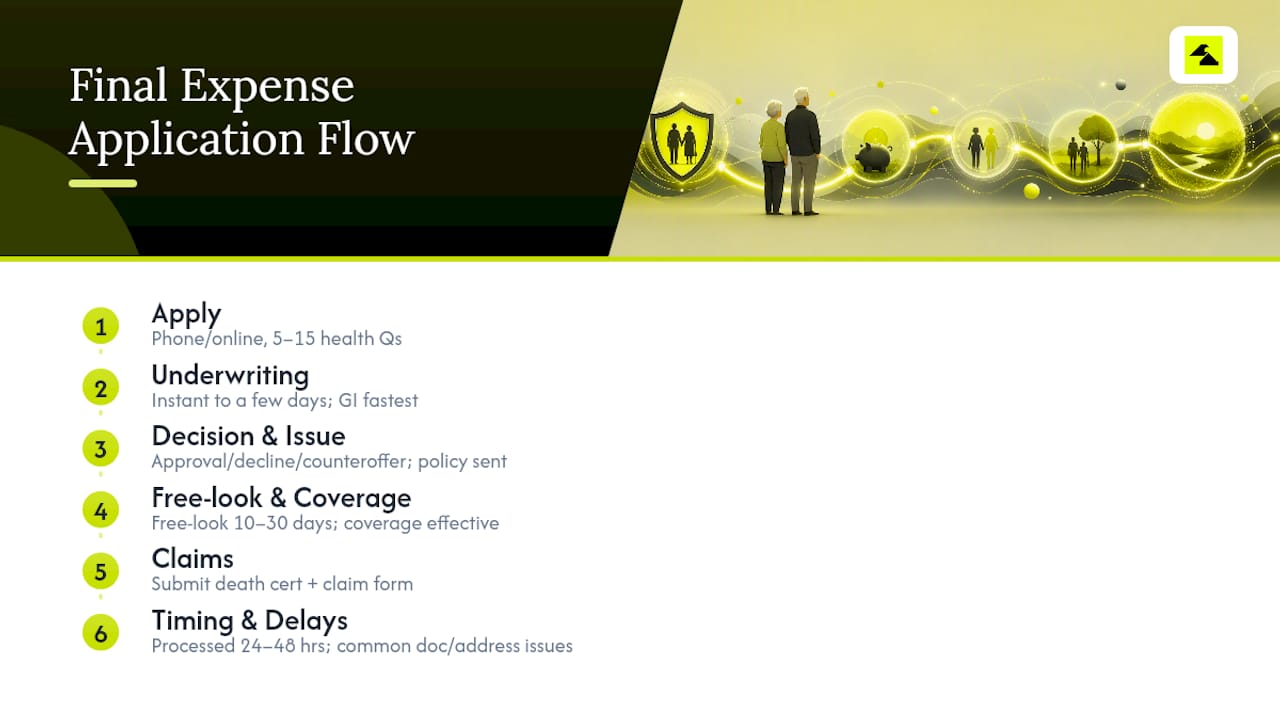
Applying for a simplified-issue final expense policy is faster than most people expect. You start with a phone or online application where you answer a handful of health questions (usually 5 to 15 yes/no items about major conditions like cancer, heart disease, or recent hospitalizations). There’s no blood draw, no paramedical exam, and no waiting weeks for lab results.
Once submitted, underwriting typically takes anywhere from a few minutes (for instant-decision products) to a few business days. Guaranteed-issue applications move even faster since there’s nothing to underwrite beyond age and state of residence. You’ll get an approval, a decline, or occasionally a counteroffer at a different rate class.
After approval, the policy is issued and mailed or emailed to you, along with your free-look window, generally 10 to 30 days depending on the carrier and state. Coverage is active from the policy’s effective date, though remember that graded-benefit policies still carry their waiting period regardless of how fast the paperwork moved.
On the payout side, the family or beneficiary files a claim by submitting a certified death certificate and a claim form. Insurers process valid, complete claims quickly, often within 24 to 48 hours of receiving everything, based on the same funeral-cost analysis from CNBC Select referenced earlier. The most common source of delay isn’t the insurer dragging its feet. It’s missing documents, an outdated beneficiary address, or a death that falls inside the contestability period, which can trigger a closer review of the original application.
Are Final Expense Insurance Payouts Taxable?
No. The death benefit from a final expense life insurance policy is not taxable income to your beneficiary under federal law. This is true whether the payout is $5,000 or $50,000, and it applies the same way it would to a term or whole life policy. Your beneficiary receives the full face amount without reporting it as income on their federal tax return.
There are two narrow exceptions worth knowing. First, if the policy was transferred to a new owner for something of value (a rare situation with final expense policies, but possible), the “transfer for value” rule can make part of the payout taxable. Second, if the death benefit sits in an interest-bearing account after payout rather than being taken as a lump sum, the interest earned on that balance is taxable, even though the original benefit isn’t.
Estate taxes are a separate issue from income taxes and rarely apply here. Federal estate tax only kicks in on estates worth several million dollars, which puts the vast majority of final expense buyers well outside its reach. A handful of states levy their own estate or inheritance taxes at lower thresholds, so it’s worth a quick check with a tax professional if your total estate, not just the policy, is unusually large.
Because the payout is federal-income-tax-free, that fixed premium you’re paying every month buys a benefit your family gets to keep in full.
Naming and Updating Your Beneficiary
Your beneficiary designation is the single most important piece of paperwork in a final expense policy, because it determines who gets paid and how fast. Most policies let you name a primary beneficiary and one or more contingent (backup) beneficiaries in case the primary dies before you do.
Two designation types matter here. A revocable beneficiary can be changed anytime without their permission, which is what most people choose. An irrevocable beneficiary requires their sign-off before you can make any change, and it’s rare on final expense policies unless tied to a divorce decree or specific legal arrangement.
Changing a beneficiary is usually simple: contact your carrier, request a beneficiary change form, and submit it. Most insurers process the update within a few business days, and there’s typically no fee. Do this any time your situation shifts, marriage, divorce, a death in the family, or a falling out with whoever you originally named.
One detail people miss: naming a minor as a direct beneficiary can create legal complications, since minors generally can’t receive insurance proceeds directly. If your intended beneficiary is under 18, consider naming a trust or a custodian under your state’s Uniform Transfers to Minors Act instead, and confirm the setup with your agent before finalizing the policy.
What Final Expense Policies Typically Don’t Cover
Final expense insurance is straightforward, but it isn’t unlimited. A handful of exclusions and limitations show up across most policies in this category, and knowing them upfront avoids an unpleasant surprise for your family later.
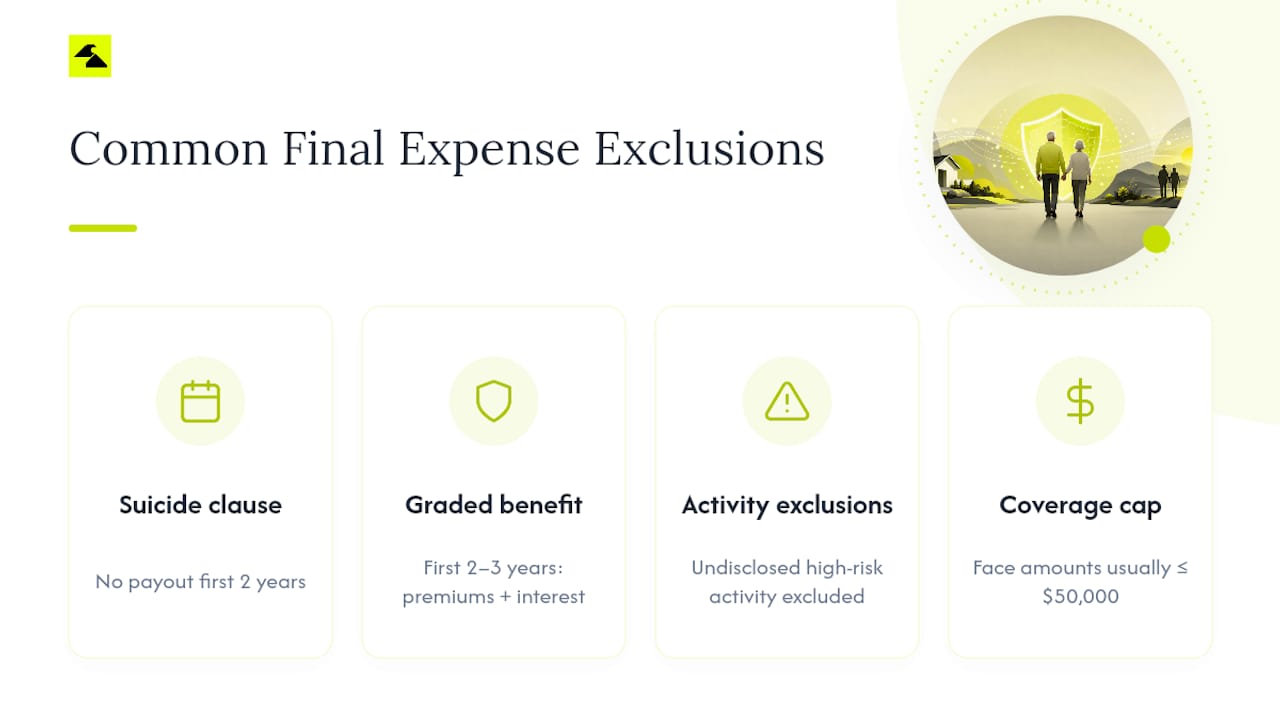
Suicide clauses are standard: most policies exclude payout for death by suicide within the first two years, mirroring the standard contestability period. Graded death benefits, as covered earlier, mean natural-cause deaths in the first two to three years of a guaranteed-issue policy return only premiums paid plus interest, not the full face amount. This is the single most common source of beneficiary disappointment, because families often don’t realize the waiting period applied until a claim gets filed.
Some policies also exclude or limit payout for death resulting from certain high-risk activities disclosed inaccurately at application, or for pre-existing conditions specifically excluded in the contract language (common with certain guaranteed-issue products). And because face amounts top out around $50,000 on most final expense products, the policy simply isn’t designed to cover large debts, mortgage payoff, or income replacement, even though nothing technically excludes those uses of the money.
Read the actual policy language, not the brochure, before you buy. The waiting period, the exclusion list, and the contestability clause are usually spelled out in plain terms on page two or three of the contract itself.
Bottom Line on Final Expense Insurance
Buy final expense insurance if you lack $8,000 to $10,000 in dedicated savings or can’t qualify medically for cheaper coverage. Otherwise, savings or a term policy usually wins. Either way, use your free-look period and compare at least three quotes before committing.
— Jib Hunt
Get a Final Expense Quote Without the Runaround
Shopping final expense coverage alone means calling carrier after carrier, repeating your health history each time, and hoping you’re not missing a graded-benefit clause buried on page three. East Two West compares multiple carriers at once, simplified issue and guaranteed issue alike, so you see real premium differences side by side instead of guessing.
[

Because East Two West works independently rather than for a single insurer, the recommendation you get is based on your health, age, and budget, not a sales quota. If you’re weighing final expense against a small term policy or a properly structured whole life plan, a licensed agent conversation clears that up in minutes. Start with a free online quote to see real premium ranges for your age and desired coverage, or call for a short phone consultation if you’d rather talk it through with someone directly. Every policy comes with a free-look period, so there’s no risk in comparing before you decide.
This article is general information, not a substitute for advice from a qualified financial advisor. Consult a qualified financial professional about your own circumstances before acting on anything here.
Sources
FAQ
What Are the Best Final Expense Insurance Companies?
There’s no single best carrier for everyone. The right choice depends on your age, health class, and state, which is why comparing quotes from multiple carriers through an independent agency like East Two West typically beats picking one insurer at random.
How Much Does a $500,000 Life Insurance Policy Cost Per Month?
That depends heavily on age, health, and policy type, but coverage amounts far beyond typical final expense benefit amounts, which usually max out between $5,000 and $25,000 as noted. A policy that size usually means term or whole life underwriting, not final expense.
At What Age Should You Buy Final Expense Insurance?
Most buyers purchase final expense coverage in their 50s through 70s, but there’s no fixed rule. The better trigger is circumstance: buy once you lack sufficient savings to cover a funeral or once health issues rule out cheaper term coverage.
What Does Dave Ramsey Say About Final Expense Insurance?
Dave Ramsey generally advises against final expense insurance for people who can build savings instead, arguing that self-insuring through a dedicated fund is usually cheaper over time than paying premiums for a small, capped benefit.
Is Final Expense Insurance the Same as Burial Insurance?
Yes. “Final expense insurance” and “burial insurance” describe the same product: a small, permanent life insurance policy designed to cover funeral and end-of-life costs.
Recommended
Comments