Paying 5x More? Universal vs. Term Life and When Permanent Makes Sense
- Jib Hunt

- 2 days ago
- 11 min read

Most people should buy term life insurance, not universal life. Term is cheaper, simpler, and covers the years your family actually depends on your income. The exception is anyone with a lifetime need, like estate taxes, a special-needs dependent, or a business succession plan, where permanent coverage and cash value genuinely earn their higher cost. Many buyers land somewhere in between: term now, with the option to convert later.
TL;DR:
Term life insurance is significantly cheaper, often more than five times less expensive than universal life for the same coverage, especially for those under 50.
Universal life may be appropriate only for long-term needs like estate taxes or business succession, but it requires careful funding and monitoring to prevent policy lapses.
The cost difference is driven by universal life premiums covering lifetime risk, fees, and cash value components, which translate into higher monthly payments.
Policy illustrations can be overly optimistic; buyers should stress-test guaranteed figures and understand how interest rates and market performance affect cash value growth.
If your primary need ends within a few decades, term policies generally offer the best value; permanent coverage makes sense only for specific long-term financial planning goals.
Table of Contents
Universal vs Term Life: A Side-by-Side Comparison
The two products solve different problems, which is why comparing them on price alone misses the point. Term life insurance locks in a death benefit for a fixed window, typically 10 to 30 years, at a level premium. There’s no cash value, no investment component, and no decision-making required once you sign. Universal life is permanent coverage with a savings-like account attached, and it comes with real flexibility, but that flexibility has to be managed.
Here’s how the core features stack up:
Coverage length: Term expires on a set date; universal life is designed to last your entire life, as long as it’s funded properly.
Premium structure: Term premiums are fixed and predictable. Universal life premiums are flexible, meaning you can sometimes pay more or less within limits, but underfunding creates long-term risk.
Cash value: Term builds none. Universal life accumulates cash value you can borrow against or withdraw, though loans and withdrawals reduce the death benefit and can trigger tax consequences if the policy lapses.
Variants: Indexed universal life, guaranteed universal life, and variable universal life each handle risk differently. Indexed UL ties growth to a market index but caps it with participation rates and ceilings. Variable UL exposes cash value directly to investment subaccounts, which means real market risk. Guaranteed UL trades cash value growth for a locked-in death benefit, closer to term in spirit but permanent in structure.
Maintenance: Term requires none. Universal life needs monitoring, because rising cost-of-insurance charges can quietly drain an underfunded policy toward lapse.
That last point is the one most buyers underestimate. A universal life policy isn’t “set it and forget it” the way term is.
What Term and Universal Life Actually Cost
The price gap between these two products is large enough to reshape a household budget, and the numbers make the tradeoff concrete. MoneyGeek’s illustrative example shows a notable cost difference where a 40-year-old nonsmoker might pay substantially less for a term policy compared to a universal life policy with the same death benefit.
That’s over five times the monthly cost for the same coverage amount.
Why the gap exists:
Universal life premiums fund a cash value account on top of the pure insurance cost.
Insurers price in lifetime mortality risk instead of a fixed 20 or 30-year window.
Fees, administrative charges, and cost-of-insurance increases (which climb as you age) get built into the premium structure.
Actual quotes vary widely by age, health class, carrier, and how the policy is designed, so treat these figures as a starting point, not a promise. Comparing term costs against a personalized universal life illustration is the only way to know your real breakeven point.
Weighing the Tradeoffs: Term vs. Universal Life
Neither product wins on every category, which is exactly why this decision comes down to your situation, not a generic ranking.
Term life advantages:
Lowest cost per dollar of coverage, especially for buyers under 50
Simple to understand and easy to compare across carriers
Often includes a conversion option to switch to permanent coverage without a new medical exam
Term life drawbacks:
Coverage ends when the term ends, with no residual value
Renewing after the term expires gets expensive, since pricing resets based on your current age
Universal life advantages:
Lifetime coverage as long as the policy stays funded
Cash value you can borrow against for tax-deferred growth
Premium flexibility that can absorb income changes, within limits
Universal life risks:
Rising cost-of-insurance charges can outpace an underfunded cash value balance
Surrender charges apply if you cancel in the early years
Indexed and variable versions carry market and index risk that can shrink projected growth
Pro Tip: Ask for the “guaranteed” column on any universal life illustration, not just the projected one. The guaranteed numbers show what happens if credited rates run at the policy’s contractual minimum, which is the scenario that actually matters if you’re planning to keep the policy for decades.
How to Decide Between Term and Universal Life
Work through this before you compare quotes, not after:
Define the timeline. Do you need coverage for 20 years until the mortgage is paid and kids are grown, or for life, to cover estate taxes or a business buyout?
Check the budget math. Can you sustain a universal life premium for 30 to 50 years without stretching your monthly cash flow?
Identify liquidity needs. Would your family need access to cash beyond the death benefit, and is a policy loan a realistic source for that?
Ask the hard questions on any illustration. What’s the guaranteed cash value versus the projected value? What assumptions drive the cost-of-insurance schedule? What’s the surrender charge schedule, and when does it end?
Consider layering. Buy term for the years you need low-cost protection, and keep the conversion privilege open in case your health or needs change later. Most conversion windows run through the first 10 to 15 years of the policy, or up to a specified age, so timing matters.
Before signing with any agent, verify their license and disciplinary history through FINRA BrokerCheck.
When Permanent Coverage Actually Makes Sense
Universal life isn’t a fallback for people who “want more than term.” It’s a tool for specific jobs. Estate liquidity is one: a permanent death benefit can cover estate taxes without forcing heirs to liquidate a business or property. Buy-sell funding for business partners is another, since the coverage has to last as long as the business relationship does, which term can’t guarantee. Special-needs planning and Infinite Banking style overfunding strategies also depend on coverage that doesn’t expire on a calendar date.
Designing these policies well means being honest about assumptions from day one.
The biggest mistake we see isn’t buying universal life, it’s buying it and assuming the projected column on the illustration is a promise. We model conservative credited rates, stress-test what happens if cost-of-insurance charges rise, and build a funding schedule disciplined enough that the policy still works if the market underperforms for a decade. That’s the difference between a policy that supports your goals and one that quietly lapses at 75.
What Term and Universal Life Insurance Actually Are
Term life insurance is coverage for a fixed period, typically 10, 20, or 30 years, that pays a death benefit if you die during that window and pays nothing if you outlive it. There’s no savings component, which is exactly why it’s the cheapest way to buy a large amount of coverage.
Universal life insurance is permanent coverage designed to last your entire life, built around two components: the death benefit and a cash value account that grows over time. Part of every premium payment covers the actual cost of insurance and administrative fees; the rest goes into the cash value, which grows tax-deferred and can be accessed through withdrawals or policy loans.
The “universal” in the name refers to premium flexibility. Within limits set by the policy, you can increase or decrease payments, and even skip payments in some years, as long as the cash value covers the ongoing insurance costs. That flexibility is the appeal and the risk in the same breath: it adapts to a changing budget, but it also means an underfunded policy can quietly erode until it lapses.
Both products pay a death benefit income tax free to beneficiaries. Where they diverge is what happens while you’re alive, and that difference drives almost every other tradeoff in this comparison.
Tax Treatment: Where Term and Universal Life Diverge
Both policies share the same core tax advantage: the death benefit passes to your beneficiaries income tax free, regardless of which type you choose. That part is identical.
The divergence happens with cash value. Universal life’s cash value grows tax-deferred, meaning you don’t owe taxes on the growth year to year the way you might on a taxable brokerage account. Policy loans against that cash value are generally not taxed as income, since a loan isn’t a taxable event, as long as the policy stays in force. Withdrawals up to your basis, the total premiums you’ve paid in, also typically come out tax free.
The catch: if the policy lapses or is surrendered with an outstanding loan balance, the portion of the gain above your basis can become taxable in that year, sometimes creating a tax bill at the worst possible moment. Term life has no cash value, so this entire category of tax complexity simply doesn’t exist. You pay premiums, the policy either pays a death benefit or expires, and there’s nothing to manage on the tax side while you’re alive.
For buyers weighing the two, this is often the deciding factor for estate and business planning purposes, since tax-deferred accumulation and tax-free loan access are exactly the mechanics that make permanent coverage useful for those specific goals.
Surrendering a Universal Life Policy: Options and Penalties
Canceling a universal life policy isn’t as simple as walking away from term coverage, because there’s cash value on the table and often a penalty attached to accessing it early.
If you surrender the policy, you receive the cash surrender value, which is the accumulated cash value minus any outstanding loans and minus a surrender charge if you’re still within the surrender period. That period commonly runs 10 to 15 years from issue, with the charge starting high and declining to zero over time. Surrender in year two or three can mean forfeiting a meaningful chunk of the account’s value.
You generally have three options short of a full surrender: take a partial withdrawal, take a policy loan against the cash value, or reduce the death benefit to lower ongoing costs and stretch the cash value further. Each comes with tradeoffs. Withdrawals permanently reduce cash value and future death benefit. Loans accrue interest and, if unpaid, eat into the death benefit or trigger tax exposure on lapse.
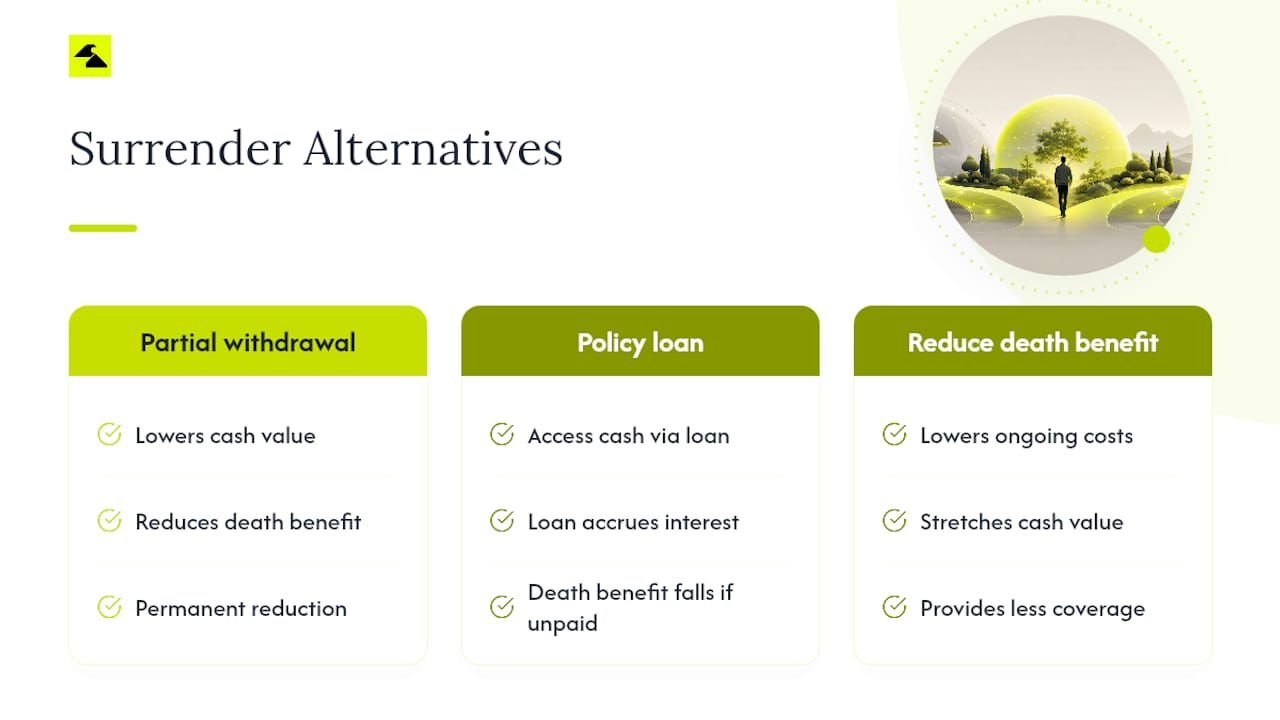
Before surrendering, it’s worth comparing the real cost of keeping the policy against replacing it, especially since replacing a policy outright often resets underwriting and cost-of-insurance pricing at your current age, which may cost more than staying put.
How Interest Rates Shape Universal Life Cash Value
Cash value growth in a universal life policy isn’t a fixed number, it moves with the credited interest rate the insurer applies, and that rate is where illustrations can quietly mislead buyers.
A basic universal life policy credits interest based on the insurer’s general account performance, subject to a guaranteed minimum, often around 2%. If the insurer’s actual investment returns are strong, the credited rate can run higher; if returns are weak, cash value growth slows to that guaranteed floor. Indexed universal life adds a twist: growth is linked to an index like the S&P 500, but capped by a participation rate and a ceiling, meaning you get a slice of the upside without full market exposure, and typically without downside loss below a stated floor.
Here’s why this matters over decades: a policy illustrated at a 6% projected credited rate can look dramatically different from one modeled at the guaranteed 2% minimum. Run the same policy for 30 years at each rate, and the gap in accumulated cash value can be the difference between a policy that self-sustains and one that requires additional premium to avoid lapsing. This is exactly why comparing the guaranteed column against the projected column on any illustration matters more than the sales pitch built around the optimistic scenario.
Changing Health or Life Circumstances: How Each Policy Responds
Life doesn’t stay static for 20 or 30 years, and how each policy type handles change is worth understanding before you buy.
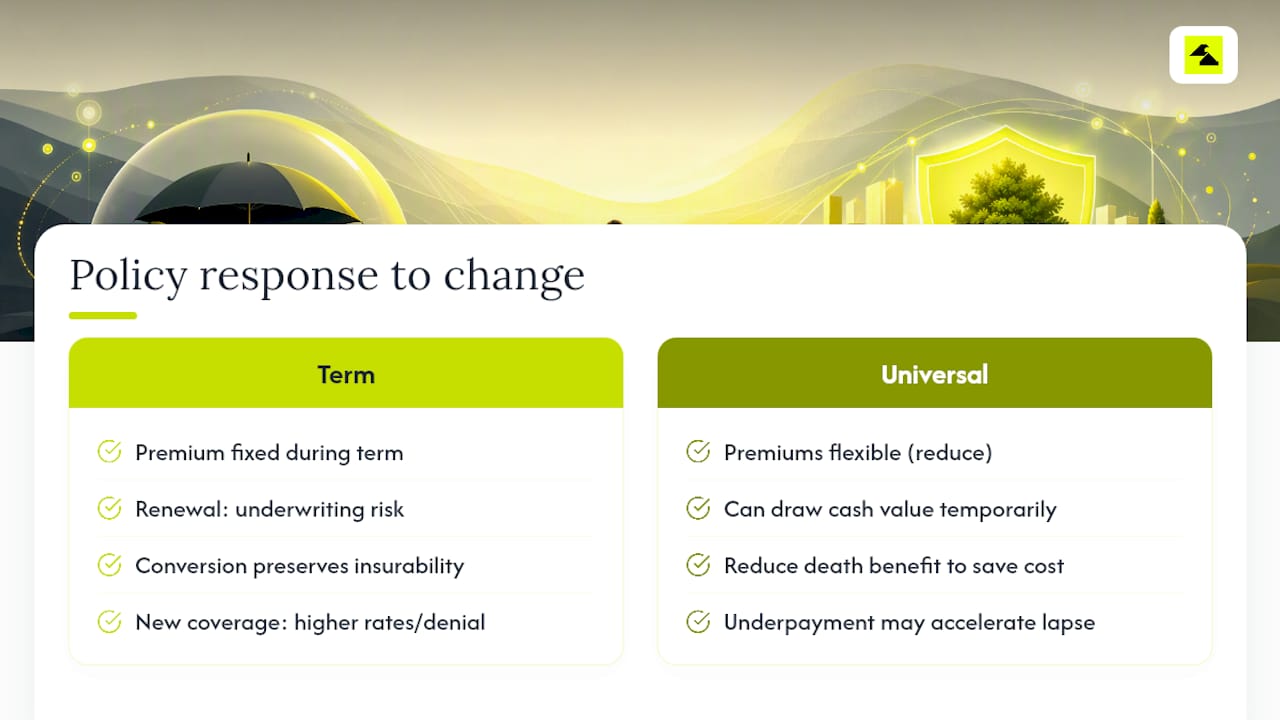
With term life, a health decline after you’ve locked in your rate doesn’t affect your existing premium. The risk shows up at renewal or when the term ends: if you need new coverage after developing a health condition, you’ll underwrite at your current health status, which can mean sharply higher rates or, in some cases, denial. This is exactly why the conversion privilege matters. Converting an existing term policy to permanent coverage during the conversion window locks in insurability regardless of what’s changed with your health, since no new medical exam is required.
Universal life responds differently to life changes because of its flexibility. If income drops, some policies allow reduced premium payments, drawing down cash value to cover the gap temporarily. If you need less coverage, you can often reduce the death benefit to lower ongoing costs. But flexibility cuts both ways: a period of underpayment during a rough financial stretch can accelerate lapse risk years later if the cash value never recovers. Major life events, like a new dependent, a business sale, or an inheritance, are the right moments to revisit whether your existing coverage still matches your actual needs, on either policy type.
Our Take: The Real Decision Isn’t Term vs. Universal
The conventional advice, “buy term and invest the difference,” is right for most households, and the math in this article backs that up. Where that advice falls short is treating permanent coverage as always inferior, when the real question is whether you have a lifetime obligation, not a temporary one.
If your need ends when the mortgage is paid off or the kids finish college, term wins on cost every time. If your need is estate taxes, a business partner buyout, or a legacy that has to outlast you, a properly designed permanent policy isn’t a worse version of term, it’s solving a different problem entirely. The mistake isn’t choosing universal life. It’s choosing it without stress-testing the illustration, or choosing term when the obligation you’re protecting against will still exist in 40 years. Start with the timeline, not the product.
— Jib Hunt
Get an Independent Comparison From East Two West
You don’t have to guess which policy fits your situation, and you shouldn’t rely on a single carrier’s pitch to figure it out. East Two West compares term, universal, indexed universal life, and whole life across multiple carriers, then designs the policy around your actual timeline, budget, and goals instead of a one-size-fits-all illustration.
[

If your need is 20 years of income protection, we’ll show you the most competitive term options available. If you’re weighing permanent coverage for estate planning, a business, or a long-term capital strategy, we’ll walk you through realistic guaranteed and projected numbers, not just the optimistic scenario. For an independent look at how other agencies approach this, Geneva Insurance Group is a solid resource on shopping the broader market. When you’re ready to see real numbers for your situation, get a quote from East Two West or schedule a consultation to compare your options side by side.
Sources
Investopedia covers core product definitions, MoneyGeek provides cost illustrations, NerdWallet explains UL variants, and FINRA verifies agent credentials.
This article is general information, not a substitute for advice from a qualified financial advisor. Consult a qualified financial professional about your own circumstances before acting on anything here.
FAQ
What does Dave Ramsey say about universal life insurance?
Dave Ramsey is a vocal critic of universal life insurance, arguing that its fees and cost-of-insurance charges make it a poor investment vehicle, and he generally recommends buying term life and investing the premium difference instead.
What is the downside to universal life insurance?
The main downsides are cost, complexity, and lapse risk: premiums run far higher than term for the same death benefit, rising cost-of-insurance charges can erode underfunded cash value, and surrender charges apply if you cancel early.
What are the downsides of term life insurance?
Term life builds no cash value and coverage ends when the term expires, so renewing or replacing coverage later in life typically means paying much higher premiums based on your age and health at that time.
At what age should you stop paying term life insurance?
There’s no universal age; the right time to stop is when the obligation the policy protects against ends, such as after your mortgage is paid off, your children are financially independent, or you’ve built enough assets to self-insure.
Recommended
Comments