Avoid 3–4x Premiums: Life Insurance for U.S. Vapers With a Broker
- Jib Hunt

- 3 days ago
- 14 min read

Yes, if you vape, expect most insurers to rate you as a smoker and charge accordingly, often significantly higher than a non-smoker’s premium. That gap shrinks or disappears only after documented nicotine abstinence, typically 12 months at minimum. Your immediate moves: disclose vaping honestly on every application, compare quotes across carriers before committing, and consider locking a policy now with a plan to reclassify once you’ve quit.
TL;DR:
Most insurers classify vaping as tobacco use, resulting in three to four times higher premiums compared to non-smokers, especially for a $500,000 policy.
Verification tests for cotinine can detect nicotine use up to two weeks after vaping, making quick switch-to-zero nicotine strategies generally ineffective before underwriting.
Reclassification to lower rates generally requires 12 months nicotine-free documentation, with 24 to 36 months needed for better classes and five years for the best pricing.
Disclosing vaping honestly is crucial, as non-disclosure or misreporting can lead to policy rescission during the contestability period.
Carriers’ vaping classification policies vary significantly, so obtaining written rules before applying can prevent unexpected rate hikes.
Table of Contents
Life Insurance for Vapers: Why Most Carriers Say No to Non-Smoker Rates
Insurers have decades of mortality data on cigarette smokers. They have almost none on vaping, which only became widespread in the last 10 to 15 years. That data gap explains nearly everything about how underwriters treat you.
Faced with an unknown, actuaries default to the conservative assumption: nicotine delivery carries risk, regardless of the device. Nearly every major life insurer in the United States classifies vaping as tobacco use for underwriting purposes, and that classification often applies even to nicotine-free e-liquids. Underwriters aren’t necessarily convinced vaping is as dangerous as smoking a pack a day. They’re pricing for uncertainty, and uncertainty gets the expensive rate class until proven otherwise.
A handful of carriers have started experimenting with more nuanced approaches, and some insurers do differentiate between vaping and traditional cigarette use in their underwriting guides. But these are exceptions, not the market standard, and they change without much public notice. If a carrier tells you they treat vapers differently, get that in writing before you apply. A verbal assurance from a call center rep means nothing once you’re in underwriting.
Here’s what typically happens when you disclose vaping on an application:
The insurer classifies you as a tobacco user, sometimes labeled “nicotine user” on the paperwork.
Your rate class shifts to the smoker tier for that carrier’s pricing table.
Coverage amount and term length stay the same, but your quoted premium jumps.
Some carriers ask follow-up questions about frequency, nicotine strength, and how long you’ve vaped.
Quick fact: Vapers frequently pay three to four times what non-smokers pay for identical coverage. On a $500,000 term policy, premiums can vary greatly, influencing affordability and coverage decisions.
One nuance worth flagging: labeling on vape products isn’t always reliable. Some products marketed as nicotine-free contain trace amounts of nicotine, which means underwriters can’t fully trust the packaging even when you can’t either. That inconsistency is part of why carriers lean conservative across the board rather than carving out exceptions for low-nicotine products.
How Insurers Verify Vaping: Exams, Tests, and Records
Most policies above a certain coverage threshold, often $100,000 to $250,000 depending on the carrier, still require a paramedical exam. A nurse or technician visits your home or office, takes your height, weight, and blood pressure, and collects blood and urine samples.

Those samples get tested for cotinine, the byproduct your body produces when it processes nicotine. Cotinine shows up whether the nicotine came from a cigarette, a vape pod, or a patch, and detection windows run anywhere from several days to about two weeks, depending on the sample type and how often you vape. Urine tests generally catch cotinine longer than blood tests. Heavy, daily use extends the window further than occasional use.
This is where the “just switch to 0 mg e-liquid before my exam” strategy tends to fall apart. If you’ve vaped regularly in the past two weeks, cotinine is likely still in your system. Insurers know this, which is why a sudden switch right before underwriting rarely fools anyone and can actually raise suspicion if your application says “non-smoker” but your test says otherwise.
Beyond the exam itself, underwriters pull from other sources:
MIB Group records. Nearly all major carriers report and check this database, which flags prior insurance applications, disclosed conditions, and past rate classifications.
Attending physician statements. If your medical records mention vaping, nicotine replacement, or a related respiratory complaint, the underwriter sees it.
Prescription history. Nicotine gum or patches prescribed by a doctor can show up in pharmacy records pulled during underwriting.
The combination of a cotinine test, an MIB check, and your medical history makes it very difficult to hide vaping from a carrier that requires an exam. Pro Tip: If you’re between vaping and quitting, don’t guess at your timeline. Ask the carrier directly how long they need clean cotinine results before they’ll consider you for non-smoker rates, and get the answer in writing.
What Vapers Actually Pay: Real Rate Examples
Numbers make this concrete faster than any explanation of underwriting philosophy. For a healthy 40-year-old buying a $500,000, 20-year term policy, non-smoker premiums run around $55 a month, while the same coverage as a smoker runs closer to $170 a month. That’s roughly three times the cost for identical coverage, on the same term, from the same underwriting tier.
Stretch that gap across a policy term and the numbers get harder to ignore:
Annual cost: roughly $660 as a non-smoker versus $2,040 as a smoker rate.
20-year total: around $13,200 versus $40,800, a difference of $27,600 for coverage that pays out identically.
Whole life comparison: the smoker penalty compounds further, since whole life premiums are already higher than term and carry that multiplier over decades instead of 20 years.
The gap isn’t fixed. It moves with coverage amount, policy type, and age. A $1 million policy widens the dollar gap even if the percentage difference stays similar, because you’re multiplying a bigger base premium by the same smoker penalty. Term life tends to show the starkest percentage gap because base rates are low to begin with, so a smoker multiplier stands out more starkly than it does on a whole life policy where mortality charges, cash value growth, and dividend participation are already baked into a higher starting cost.
Age matters too. A 30-year-old vaper pays less in raw dollars than a 50-year-old vaper, but the percentage penalty for tobacco classification tends to hold steady across age bands. In other words, quitting early saves you money for longer, since the smoker penalty compounds every year you carry it.
One more wrinkle: guaranteed-level term and whole life policies lock in your rate class at issue. If you buy as a smoker and later start vaping more, your premium won’t increase. But if you apply for additional coverage later, that triggers new underwriting, and your current habits get evaluated fresh.
Quitting and Reclassification: How Long Until Rates Improve
Insurers don’t take your word for it the day you quit. They want documented, verifiable abstinence, and the clock varies significantly by carrier and by how good a rate class you’re chasing.
12 months nicotine-free is the common minimum before most carriers will even consider reclassifying you out of the smoker tier.
24 to 36 months is typically required for the better “preferred” non-smoker classes, the ones with meaningfully lower premiums than standard non-smoker rates.
Five years abstinent is where most carriers reliably grant full preferred-plus status, the best pricing tier available.
You generally have two paths to actually capture those lower rates. The first is rate reconsideration on your existing policy: you submit physician documentation and a clean cotinine test, and the insurer re-underwrites your existing coverage at the new class. The second is applying for a brand-new policy once you’ve hit the abstinence window, which lets you shop other carriers but starts underwriting from scratch, including a new exam.
Neither path is automatic, and neither is risk-free if you rush it.
Pro Tip: Never cancel an old policy before a new one is fully approved and issued. If underwriting turns up something unexpected, an old health issue, an inconsistent cotinine result, you don’t want a gap in coverage while you sort it out.
Disclosure, Contestability, and Rescission: What’s at Stake if You Misreport
Every life insurance policy carries a contestability period, usually the first two years after issue. During that window, if you die and the insurer finds you misrepresented something material on your application, they can investigate the claim before paying out.
Vaping is exactly the kind of thing that surfaces in a contestability review. If your application says “non-smoker” and the insurer’s investigation turns up a vaping habit, whether through medical records, a life insurance database entry, or witness statements from family, the insurer can rescind the policy. That typically means your beneficiaries get your premiums refunded and nothing else. No death benefit, at the exact moment your family needs it most.
This is why honest disclosure isn’t just a compliance box to check, it’s the thing that actually protects your coverage. A few practical rules:
Disclose vaping even if you think it’s minor, occasional, or “basically quitting anyway.”
If your habits change after your policy is issued, most guaranteed policies won’t touch your existing rate, so there’s little upside to hiding it.
If you realize after the fact that you underreported, or the insurer asks a clarifying question during underwriting, answer completely and promptly rather than letting it sit.
You can read more about how the contestability period works and what it means for your beneficiaries if you’re worried about an existing policy.
What Vaping Actually Does to Your Health, and Why Underwriters Care
Underwriters aren’t pricing based on anecdote. Vaping delivers nicotine, which raises heart rate and blood pressure and has been linked to cardiovascular strain over time. Beyond nicotine itself, the aerosol from e-cigarettes contains chemicals that irritate lung tissue, and researchers are still tracking longer-term respiratory effects since vaping is too recent a habit to have full lifetime data behind it.
That’s the actual root of the pricing problem: insurers can quote confidently on a habit with 60 years of mortality tables (cigarettes) far more easily than one with 15. So they price vaping as if it carries similar risk to smoking, even in cases where the long-term picture may eventually look different.
For underwriting purposes, what matters most is nicotine dependency itself, not just the vaping mechanism. Nicotine affects clotting, blood pressure, and cardiovascular load regardless of delivery method. An applicant who vapes heavily and also shows early signs of hypertension or elevated resting heart rate on a paramedical exam is going to get flagged twice, once for the tobacco classification and once for the underlying vitals.
If you’re managing other health factors alongside vaping, say, borderline blood pressure or a family history of heart disease, it’s worth understanding how pre-existing conditions interact with your rate class before you apply, since the two issues can compound rather than exist independently in an underwriter’s assessment.
Does Frequency or Nicotine Strength Change Your Rate?
Mostly, no, and that surprises a lot of applicants. Underwriting questionnaires often ask about frequency and nicotine concentration, but the honest answer is that most carriers still sort you into a binary: tobacco user or non-user. Someone who vapes twice a month often lands in the same rate class as someone who vapes a pod a day.
That said, frequency and strength can matter at the margins. A handful of carriers use more granular questionnaires that ask how many days per week you vape and whether you use nicotine salts versus freebase nicotine at lower concentrations. Occasional, low-strength use might edge you toward a slightly better tier with those specific carriers, but you shouldn’t count on it. The safer assumption going in is that any regular use gets you the standard smoker rate, full stop.
Where frequency clearly matters is in cotinine testing. Someone who vapes daily will show detectable cotinine for longer after quitting than someone who vapes occasionally, which affects how quickly they can pass a clean test for reclassification. If you’re planning to quit and reapply, a lighter historical usage pattern generally means a shorter runway to a clean result, though the 12 month minimum documentation window still applies regardless.
Exclusions and Limitations Vapers Should Watch For
Vaping rarely triggers an outright denial, but it can shape the fine print of the policy you’re offered. A few things to check before you sign:
Rate class notes on the policy schedule. Confirm in writing whether you were rated as “smoker,” “tobacco user,” or a specific nicotine tier, since that label affects any future reclassification request.
Contestability language. Standard across nearly all policies, but worth rereading given how directly it applies to nondisclosed vaping.
Rider restrictions. Some accelerated death benefit or critical illness riders carry separate underwriting, and a tobacco classification can affect rider pricing even if your base policy is approved.
Reapplication clauses. A few carriers limit how soon you can request rate reconsideration after initial issue, sometimes requiring a minimum policy duration before they’ll revisit your class.
Guaranteed issue and simplified issue policies, often marketed to people who want to skip the exam, deserve a specific caution here. They tend to charge flat, higher premiums regardless of tobacco use, which can actually work against a light or occasional vaper who’d qualify for better fully underwritten rates. If you’re considering skipping the exam entirely, it’s worth understanding what no-exam life insurance actually limits before assuming it’s the cheaper route.
Comparing Policy Types When You Vape
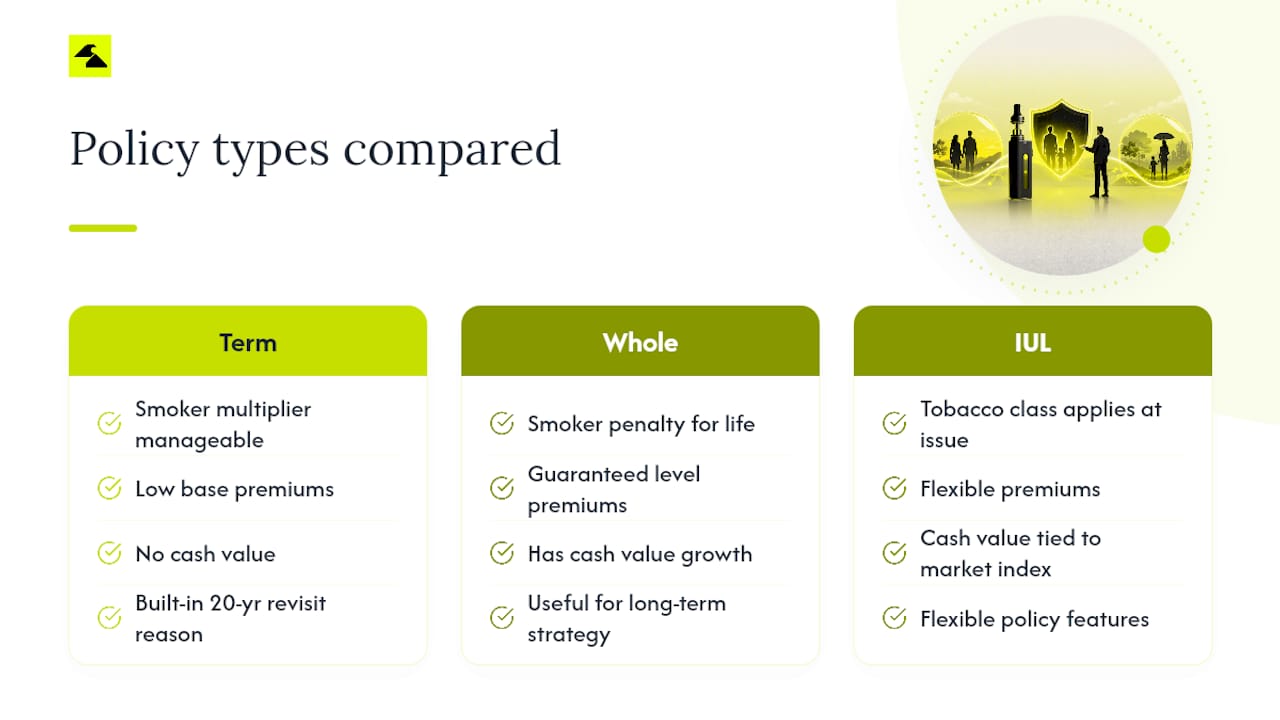
Term life insurance tends to be the most forgiving starting point for vapers, mainly because the base premiums are low enough that even a smoker multiplier lands at a manageable dollar amount. A 20-year term policy also gives you a built-in reason to revisit your rate class down the road, since you can shop a new policy once you’ve quit rather than being locked into permanent pricing.
Whole life insurance carries the smoker penalty for the life of the policy, which makes the math heavier, but it also comes with guaranteed level premiums and cash value growth that a term policy doesn’t offer. If you’re using whole life as part of a longer-term strategy, such as an Infinite Banking approach where the policy itself becomes a source of liquidity, paying the smoker rate now and pursuing reclassification later can still make sense, since the policy’s value compounds regardless of your rate class.
Indexed universal life (IUL) sits in between: flexible premiums and potential for cash value growth tied to a market index, but the tobacco classification still applies at issue and affects your cost of insurance charges throughout the policy.
Guaranteed issue and final expense policies skip underwriting entirely, which sounds appealing if you want to avoid a cotinine test, but they come with smaller coverage caps and higher per-dollar costs. They’re a reasonable fallback for older applicants or those with serious health complications, less so for a healthy vaper who’d likely qualify for much better term rates with a standard exam. If cost matters most, it’s worth comparing what term life actually costs across a few different coverage amounts before assuming permanent or guaranteed-issue coverage is your only option.
Beyond Quitting: Other Ways to Improve Your Rate
Quitting nicotine is the single biggest lever, but it’s not the only one. Underwriters look at your whole health picture, and a few adjustments can meaningfully offset the vaping penalty even before you hit a clean cotinine test.
Blood pressure and cholesterol control matter more than most applicants realize. If vaping has pushed your resting heart rate or blood pressure into a borderline range, addressing that through diet, exercise, or medication can improve your overall rating even while you’re still classified as a nicotine user. Insurers rate the whole applicant, not just the tobacco question.
Weight and BMI are the other lever underwriters weigh heavily. Dropping into a healthier BMI band before your exam can shift you into a better overall health class, which partially offsets the smoker multiplier even if it doesn’t eliminate it.
Timing your application matters too. If you know you’re going to quit within the next few months, it’s often smarter to wait for that clean window rather than applying now and paying the smoker rate for years before pursuing reclassification. But if you need coverage urgently, buying a term policy now and re-shopping once you’ve quit protects your family in the meantime without locking you into smoker rates forever.
Finally, be consistent across every application and medical record. Underwriters cross-reference, and an inconsistency between what you told your doctor and what you told the insurer is a bigger red flag than the vaping itself.
Why the “Just Quit First” Advice Misses the Real Decision
Most articles on this topic tell vapers to quit before applying, then treat the conversation as finished. That advice isn’t wrong, but it skips the actual decision most readers are facing: what to do with the years between now and a clean cotinine test.
Waiting has a cost too. Age-based premium increases and the risk of a new health issue showing up during those 12 to 36 months are real trade-offs against the smoker penalty you’re trying to avoid. A healthy 35-year-old vaper who buys coverage now, even at smoker rates, and re-shops in three years after documented abstinence usually comes out ahead of someone who delays buying entirely while trying to time a perfect non-smoker application.
The other gap in typical advice is treating all carriers as identical. They aren’t. Underwriting guides for vaping vary enough between carriers that the same applicant can get meaningfully different offers depending on where the application lands. That’s not a reason to shop blindly. It’s a reason to have someone check carrier-specific rules before you apply, rather than after you’ve already been rated.
If there’s one thing worth prioritizing first, it’s getting a carrier’s vaping classification rules in writing before underwriting starts, not after you’re already locked into a rate class you didn’t expect.
— Jib Hunt
Get a Vaping-Aware Quote From East Two West
You don’t have to guess which carriers will treat your vaping habit fairly. East Two West is an independent broker, which means access to multiple carriers’ underwriting guides instead of just one company’s rate sheet, so you’re not stuck with whichever insurer happens to have the harshest vaping policy.
[

A consult typically covers three things: checking which carriers currently offer better smoker-rate ladders for vapers, requesting each carrier’s written classification rules before you apply so there are no surprises at underwriting, and mapping out a realistic reclassification timeline if you’re planning to quit. East Two West works across term, whole life, and IUL, so the recommendation is based on your actual coverage needs and cash flow, not a one-size-fits-all product pitch.
Disclosure will always work in your favor here. Honest answers up front let a broker find the carrier best positioned to work with your specific habits, rather than discovering a mismatch after the exam. Get a quote to see what coverage looks like with your current vaping status, and start the conversation about a plan to improve your rate down the road.
This article is general information, not a substitute for advice from a qualified financial advisor. Consult a qualified financial professional about your own circumstances before acting on anything here.
Sources
FAQ
Does Vaping Affect Life Insurance Rates?
Yes. Nearly all major insurers classify vaping as tobacco use, which moves applicants into the smoker rate class and often triples or quadruples premiums for identical coverage.
How Much Does a $1,000,000 Life Insurance Policy Cost per Month?
It depends heavily on age, health, and tobacco classification, but a healthy 40-year-old non-smoker might pay somewhere in the low hundreds of dollars monthly for a term policy, while the same applicant rated as a smoker or vaper could pay roughly three times that amount for identical coverage.
What Disqualifies You From Life Insurance?
Outright denial is rare for vapers specifically, but serious undisclosed health conditions, dishonest answers on your application, or certain high-risk activities can lead to a decline; vaping itself typically results in higher pricing rather than disqualification.
How Much Do Smokers Pay for Life Insurance?
Smokers commonly pay three to four times what non-smokers pay for the same coverage amount, and vapers are usually priced using that same smoker rate table.
Can You Get Non-Smoker Rates After Quitting Vaping?
Yes, though it takes time. Most carriers require at least 12 months of documented abstinence before considering reclassification, with better rate tiers requiring 24 to 36 months or longer.
Recommended
Comments