Stop RMDs: How U.S. Tax Rules Treat Qualified vs Nonqualified Annuities
- Jib Hunt

- 12 minutes ago
- 8 min read

Qualified annuities are funded with pre-tax retirement dollars, so every dollar withdrawn counts as ordinary income. Nonqualified annuities are funded with money you’ve already paid tax on, so only the earnings get taxed when you take a distribution. That single difference in funding source drives almost every other rule that follows, from required minimum distributions to how the IRS calculates your taxable portion.
TL;DR:
Qualified annuities are funded with pre-tax dollars from retirement accounts, so all withdrawals are taxed as ordinary income, including principal and earnings.
Nonqualified annuities are funded with after-tax money, and only the earnings are taxed upon withdrawal, with taxation depending on whether you take lump sums or convert to stream payments.
The IRS uses different calculation methods, such as the Simplified Method for qualified plans and the exclusion ratio for nonqualified annuities, which influence taxable amounts during withdrawals.
Nonqualified annuities offer greater flexibility with no contribution limits and allow tax-free exchanges under IRC Section 1035, unlike qualified annuities subject to RMDs and plan limits.
Choosing between the two depends on account source, estate goals, expected tax brackets in retirement, and whether you favor avoiding RMDs or maximizing tax deferral.
Table of Contents
Qualified vs Nonqualified Annuity: What Actually Sets Them Apart
The label “qualified” has nothing to do with quality. It refers to where the money came from. A qualified annuity sits inside a retirement structure the IRS already recognizes: an IRA, a 401(k), or another employer-sponsored plan. Because you never paid income tax on those contributions, the IRS wants its share when the money finally comes out, and it wants all of it taxed as ordinary income.
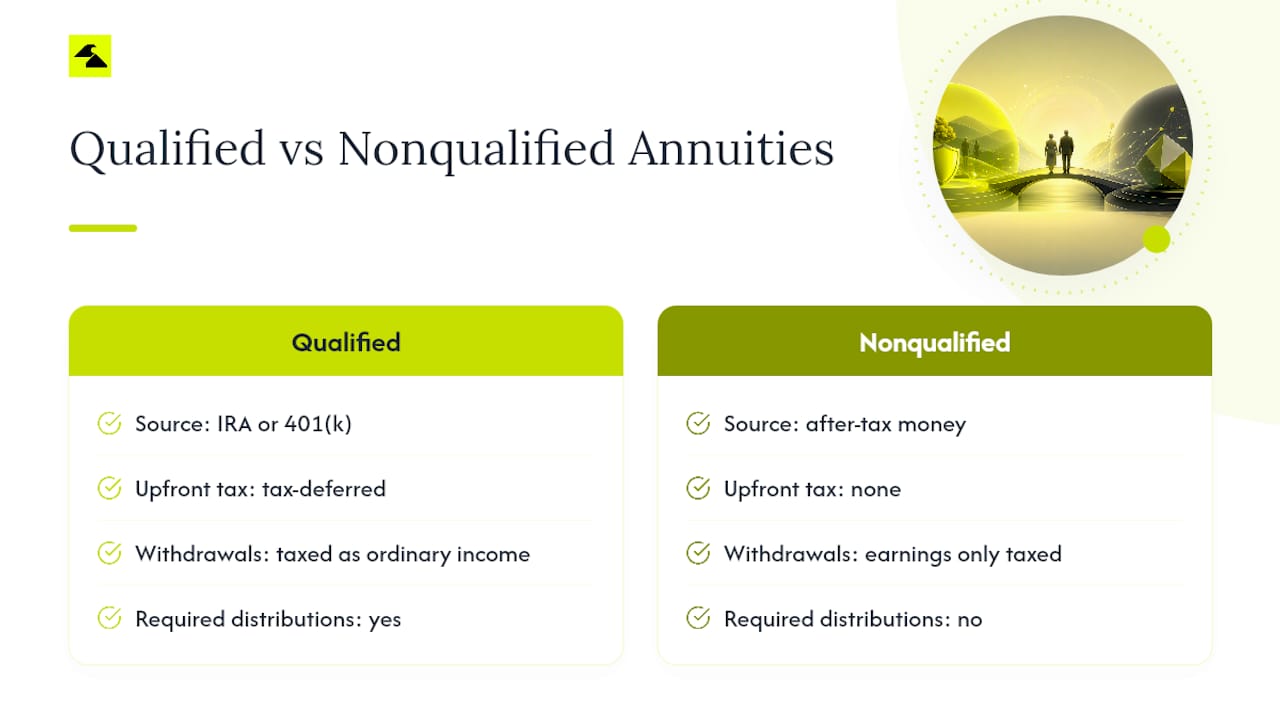
Nonqualified annuities work in reverse. You buy one with money that’s already been taxed, whether that’s a savings account, a brokerage account, or an inheritance. There’s no upfront tax break on the way in, which means the IRS only taxes the growth on the way out.
This distinction matters most at tax time and at required distribution time. Qualified money must eventually come out on the government’s schedule. Nonqualified money is yours to leave alone indefinitely. Understanding how annuities function inside an IRA helps clarify why the two paths diverge so sharply once withdrawals start.
What Is a Qualified Annuity? Funding, Rollovers, and Tax Rules
A qualified annuity is purchased with pre-tax dollars from a qualified retirement plan, most commonly an IRA or a 401(k). Employer pension plans and some 403(b) accounts also qualify. When someone rolls over an old 401(k) into an IRA annuity, that transfer preserves tax deferral as long as it’s handled as a direct rollover rather than a cash-out.
Because none of that money has been taxed yet, withdrawals are taxed as ordinary income in their entirety, principal and growth alike. There’s no tax-free basis to recover, unlike a nonqualified contract.
Contribution limits depend entirely on the underlying plan type, not the annuity itself. An IRA annuity follows IRA contribution rules; a 401(k) annuity follows plan limits set by the employer. Required minimum distributions also apply once you reach the age set by current law, just as they would with any other IRA or 401(k) asset.
Picture a 63-year-old who rolls $200,000 from an old employer 401(k) into a fixed annuity inside a rollover IRA. The transfer itself triggers no tax. But every dollar that annuity eventually pays out, whether as a lump sum or a stream of income payments, gets taxed as ordinary income the year it’s received. That’s the trade a qualified annuity always makes: tax deferral now, full taxation later.
What Is a Nonqualified Annuity? Taxation and Flexibility
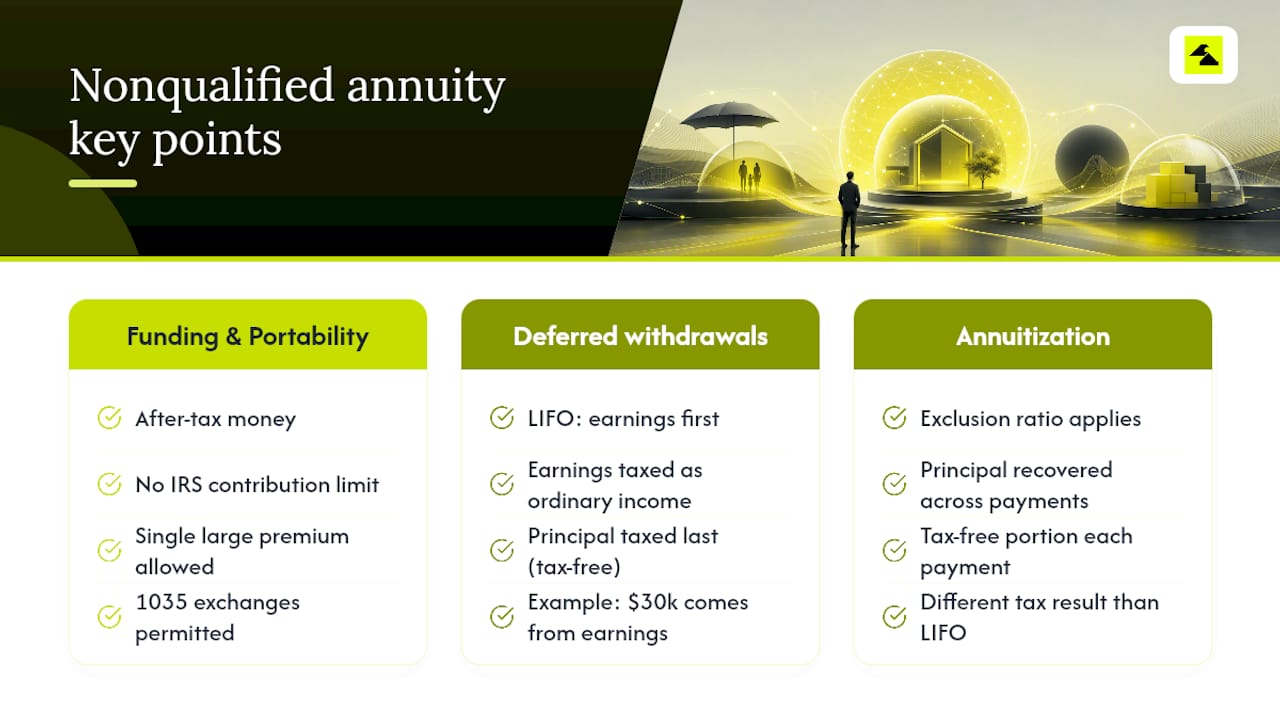
A nonqualified annuity is funded with after-tax money, so there’s no IRS contribution ceiling tied to the annuity itself. You can put in $50,000 or $500,000 in a single premium if the carrier allows it. That flexibility is one of the biggest reasons high earners who’ve maxed out their 401(k) and IRA use nonqualified annuities as a second layer of tax-deferred growth.
Taxation on withdrawal depends on how you take the money out. For a deferred nonqualified contract taking withdrawals before annuitizing, the IRS applies LIFO treatment, meaning earnings come out first and get taxed as ordinary income, and only after all the growth is withdrawn does your tax-free principal start coming out. If instead you annuitize the contract into a stream of payments, the calculation switches to an exclusion ratio, which spreads your tax-free principal recovery evenly across the expected payment period.
Nonqualified annuities also carry a real portability advantage. Under IRC Section 1035, you can exchange one nonqualified annuity for another, or for certain life insurance and long-term care products, without triggering a taxable event. Owners frequently use 1035 exchanges to move from an underperforming contract into one with better terms.
Say someone puts $100,000 after-tax into a nonqualified deferred annuity that grows to $140,000. A withdrawal of $30,000 is taxed entirely as ordinary income under LIFO, since it comes entirely from the $40,000 of earnings. Only after that $40,000 is exhausted does the original $100,000 come out tax-free.
Simplified Method, General Rule, and the Rules That Decide Your Tax Bill
Two IRS computation methods decide how much of an annuity payment is taxable, and picking the right one matters. The Simplified Method generally applies to qualified plan annuities and calculates the tax-free recovery of any after-tax contributions using a worksheet based on your age and expected number of payments. The General Rule, covered in IRS Publication 939, typically applies to nonqualified annuities and certain plans that don’t qualify for the simplified version, using an exclusion ratio derived from your investment in the contract divided by expected total return.
The exclusion ratio itself is straightforward in concept: divide your after-tax investment in the contract by the total expected payout over your life expectancy. That ratio becomes the tax-free percentage of every payment you receive, for life, once annuitized. For deferred nonqualified contracts still in the accumulation phase, LIFO governs instead, taxing earnings before principal on any withdrawal.
A few additional rules shape the full tax picture:
Distributions from nonqualified annuities can count toward net investment income for NIIT purposes, potentially adding the 3.8% surtax on top of ordinary income tax for higher earners.
Withdrawals taken before age 59½ generally trigger a 10% early-withdrawal penalty on the taxable portion, for both qualified and nonqualified contracts.
Annuitizing a nonqualified contract shifts its tax treatment from LIFO to the exclusion ratio, which can meaningfully change how much taxable income you recognize each year going forward.
Inherited qualified annuities are now largely subject to SECURE Act distribution timelines, which compressed the old “stretch” window for most non-spouse beneficiaries into a shorter payout period.
Pro Tip: Run the numbers before you annuitize a nonqualified contract. Switching from LIFO to an exclusion ratio can lower your taxable income in early retirement years, but it locks in a payment stream you can’t easily undo.
Qualified vs Nonqualified Annuity Comparison at a Glance
Feature | Qualified Annuity | Nonqualified Annuity |
Funding source | Pre-tax IRA, 401(k), or employer plan | After-tax personal funds |
Tax at withdrawal | Fully taxed as ordinary income | Only earnings taxed (LIFO or exclusion ratio) |
RMDs | Required starting at the IRS-mandated age | Not required |
Contribution limits | Set by the underlying plan (IRA/401k rules) | No IRS limit on the annuity itself |
Portability | Rollover between qualified accounts | 1035 exchange between nonqualified contracts |
Early withdrawal penalty | 10% before age 59½ on taxable amount | 10% before age 59½ on taxable amount |
The table confirms what the funding source implies: qualified money stays on the government’s distribution clock, nonqualified money doesn’t.
Choosing Between Qualified and Nonqualified: A Practical Checklist
Deciding which structure fits your situation comes down to a handful of concrete questions, not gut instinct.
Where is the money now? Retirement plan dollars point toward a qualified annuity by default; taxable savings point toward nonqualified.
Do you want to avoid RMDs? Nonqualified annuities carry no required distribution age, which matters if you don’t need the income.
What tax bracket will you be in at withdrawal? Bracket timing drives much of this decision, especially for people expecting a lower bracket in retirement.
Do you have estate or beneficiary goals? Qualified annuities inherited by non-spouses now face SECURE Act payout deadlines; nonqualified annuities pass tax basis differently to heirs.
Are you already maxing out IRA/401(k) contributions? If so, a nonqualified annuity offers extra tax-deferred growth room a qualified one can’t provide.
Before signing anything, ask the carrier or agent about the surrender schedule, annuitization guarantees, tax reporting support (1099-R forms), and whether the contract allows a 1035 exchange later. Watch for high surrender charges lasting beyond ten years and vague language around guaranteed income riders. Comparing an annuity against a 401(k) directly can also clarify whether either structure fits your bigger retirement picture.
How East Two West Approaches Annuity Decisions
Annuity structure decisions rarely happen in isolation. Some firms look at cash flow, liquidity needs, and risk tolerance first, then consider how an annuity fits alongside strategies like Infinite Banking, where control and access to capital often matter as much as tax deferral. The firm’s founder, Jib Hunt, built that framework after years in the action sports industry, where practical decisions beat theoretical ones every time. That same bias toward what actually works, not just what sounds good on paper, shapes how the firm evaluates whether a qualified or nonqualified structure serves a client’s real goals.
— Jib Hunt
Get Help Choosing the Right Annuity Structure
Figuring out whether a qualified or nonqualified annuity fits your retirement plan often comes down to numbers specific to your tax bracket, timeline, and existing accounts, not a generic rule of thumb. Independent brokers often compare fixed annuities, MYGAs, and income annuities side by side so clients aren’t limited to a single company’s product lineup.
[

Some practices earn compensation from the carrier rather than charging clients directly, meaning there may be no added cost to getting a second opinion on a contract you already own or one you’re considering. If you want to see how a qualified or nonqualified annuity would fit your specific numbers, request a quote or schedule a consultation and walk through the options with someone who isn’t selling just one carrier’s product.
Where to Verify These Rules Yourself
For the underlying computations, IRS Publication 575 covers the Simplified Method and qualified plan rules, while IRS Publication 939 details the General Rule for nonqualified contracts. The NJCPA’s taxation guide offers a clean professional summary of both, and Annuity walks through LIFO and exclusion ratio examples in plain language.
This article is general information, not a substitute for advice from a qualified financial advisor. Consult a qualified financial professional about your own circumstances before acting on anything here.
Sources
FAQ
How do I determine if my annuity is qualified or nonqualified?
Check the funding source: if you bought it inside an IRA, 401(k), or other employer plan with pre-tax dollars, it’s qualified. If you paid for it with after-tax savings outside a retirement account, it’s nonqualified. Your annual statement or 1099-R should also indicate the account type.
Is it better to buy an annuity with qualified or nonqualified money?
Neither is universally better. Qualified money makes sense when you’re consolidating existing retirement accounts, while nonqualified money often fits people who’ve maxed out retirement contributions and want additional tax-deferred growth without RMDs.
What are the four main types of annuities?
The four common types are fixed annuities, fixed indexed annuities, variable annuities, and income annuities (including SPIAs and MYGAs), and each can be structured as either qualified or nonqualified depending on the funding source. Learn more about how SPIAs compare to MYGAs if you’re weighing income versus growth.
Do I pay taxes on a nonqualified annuity?
Yes, but only on the earnings, not the principal you contributed. Withdrawals from a deferred nonqualified contract are taxed under LIFO rules, so earnings come out first and get taxed as ordinary income before your tax-free principal is touched.
Recommended
Comments