Life Insurance for Military: SGLI, VGLI, and VALife Explained


If you’re active duty, separating, or a veteran with a service-connected disability, three programs cover most of your life insurance needs: SGLI, VGLI, and VALife. Your single most important action right now is to log into your Leave and Earnings Statement (LES) or contact your unit personnel office, confirm your SGLI coverage amount, and verify your beneficiary designations are current.
Immediate priorities by reader type:
Active duty: Confirm SGLI enrollment and coverage amount on your LES; update beneficiaries after any major life event (marriage, divorce, birth of a child).
Separating or retiring: Apply for VGLI within 240 days of discharge to skip the health evidence requirement, or get private quotes before you leave while your health rating is strongest.
Veterans with service-connected disabilities: Check eligibility for VALife (guaranteed-issue whole life up to $40,000) through the VA.
Military spouses and children: If your marriage occurred on or after January 2, 2013, your spouse is NOT automatically enrolled in Family SGLI. The service member must complete enrollment through the SGLI Online Enrollment System (SOES).
Table of Contents
How SGLI, VGLI, and VALife compare at a glance
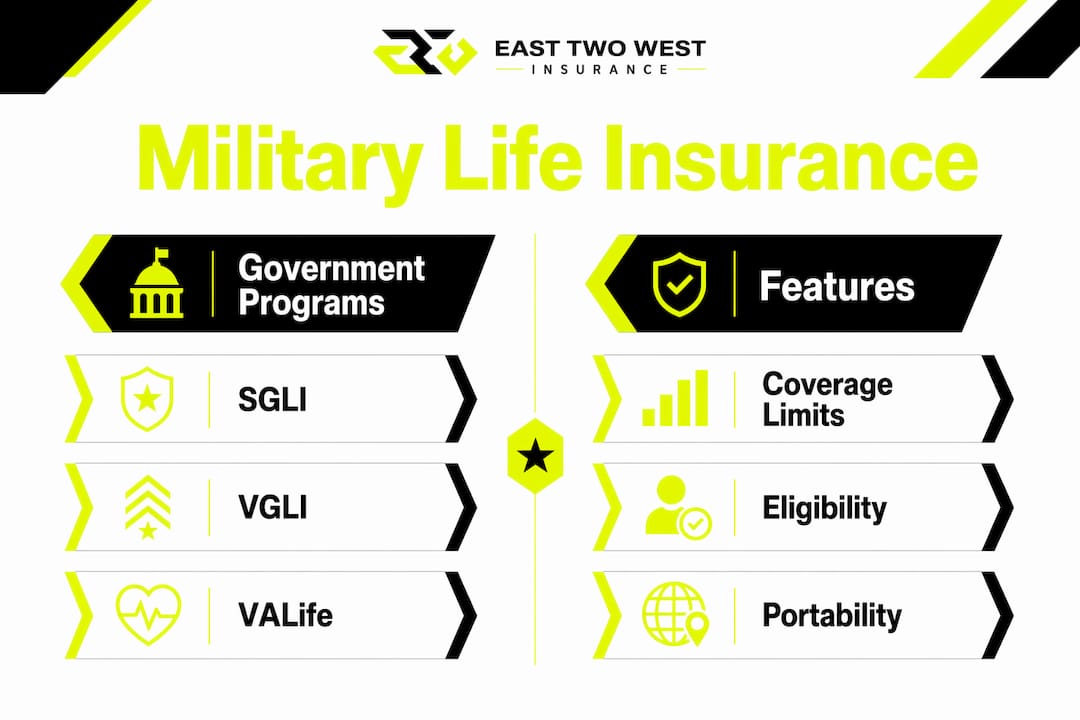
Three programs form the backbone of life insurance for military members and veterans. SGLI covers you while you serve. VGLI picks up after separation. VALife fills a specific gap for veterans whose service left them with a disability rating.
SGLI is automatic term life insurance for most active-duty members, with coverage up to $500,000 in $50,000 increments. Premiums are payroll-deducted and appear on your LES.
VGLI is a group term policy available after separation, matching whatever SGLI amount you carried, with options to increase coverage over time.
VALife is a guaranteed-issue whole life policy for veterans with service-connected disabilities, capped at $40,000.
Program | Who it’s for | Max coverage | Policy type | Portability |
SGLI | Active duty, Reserve, Guard, cadets | $500,000 | Term | Ends at separation (120-day free window) |
VGLI | Veterans within 1 year and 120 days of separation | $500,000 (can be increased in $25,000 increments after one year and every five years, up to $500,000 until age 60) | Term | Portable; age-banded premiums |
VALife | Veterans with service-connected disabilities (up to age 80) | $40,000 | Whole life (guaranteed issue) | Permanent |
SGLI premiums are automatically deducted from base pay and show up on your Leave and Earnings Statement, so many service members never think about them until separation. That’s exactly when the decisions get consequential.
What active-duty service members need to know about SGLI
SGLI is the foundation of life insurance for service members, and it covers more people than most realize.
Who qualifies:
Active-duty members of the Army, Navy, Air Force, Marines, Coast Guard, and Space Force
Ready Reserve and National Guard members scheduled for at least 12 periods of inactive duty training per year
Commissioned officers of NOAA and the U.S. Public Health Service
Cadets and midshipmen at the four service academies
Members on active duty for 30 days or more
Coverage goes up to $500,000 in increments, and the basic premium rate is $0.05 per $1,000 of coverage, plus $1 per month for Traumatic Injury Protection (TSGLI). At full coverage, the monthly cost includes a basic premium plus a TSGLI charge, resulting in a relatively low total premium that represents good value compared to private options for a healthy young service member.
Family coverage under FSGLI:
Family Servicemembers’ Group Life Insurance extends protection to spouses and dependent children. Spouse coverage goes up to $100,000 (but cannot exceed the service member’s own SGLI amount), and dependent children are automatically covered for $10,000 each at no cost.

Here’s the enrollment catch most families miss: if your marriage took place on or after January 2, 2013, your spouse is not automatically enrolled. The service member must actively complete enrollment for the spouse through SOES. Skipping this step means your spouse has no FSGLI coverage, even if you assume they do.
What happens at separation:
SGLI coverage continues for a period after discharge without cost. After that, the coverage ends unless you convert to VGLI or obtain a private policy. If you’re totally disabled at separation, the SGLI Disability Extension (SGLI-DE) can extend coverage for up to two years.
Pro Tip: After every major life event, log into SOES or contact your unit’s personnel office to update beneficiary designations. A policy paid to an ex-spouse because you never updated the form is a real and avoidable tragedy.
How VGLI works after you leave the military
VGLI is the most direct path to keeping life insurance coverage after separation, but the timing rules matter more than most veterans realize.
Eligibility and application windows:
Apply within the VA’s specified timeframes after separation to qualify: there is an initial period during which no health evidence is required, followed by a later period where evidence of insurability is necessary, all within the application eligibility window.
That 240-day no-health-evidence window is the most important deadline in the transition process. Miss it while healthy, and you’ll pay for it in underwriting.
Coverage amounts and increases:
Your initial VGLI amount matches whatever SGLI coverage you carried at separation. From there, you can increase coverage by $25,000 after one year of holding VGLI, and then every five years after that, up to $500,000 total, until age 60. No health evidence is required for those scheduled increases.
How premiums work:
VGLI uses age-banded pricing, meaning your premium increases as you move into the next age bracket. A 30-year-old veteran pays considerably less than a 50-year-old carrying the same coverage amount. Applications go through OSGLI (administered by Prudential) online, by mail, or by fax.
The practical implication: if you’re healthy at separation, private medically underwritten policies can lock in a level premium for 20 or 30 years at a rate that may be lower than what VGLI will cost you at 45 or 55. VGLI is a reliable safety net, but it’s not always the cheapest long-term option for healthy veterans.
VALife and VA options for veterans with service-connected disabilities
VALife is the VA’s answer to a specific problem: veterans with service-connected disabilities who can’t easily qualify for private life insurance at standard rates.
What VALife offers:
Guaranteed-issue whole life insurance up to $40,000 for eligible veterans with service-connected disabilities
Available to veterans up to age 80
No medical exam or health questions required for acceptance
Builds cash value over time, but the cash value accumulation doesn’t begin until after a waiting period in the first two years
Who qualifies:
Any veteran with a VA-rated service-connected disability is eligible to apply. The guaranteed-acceptance feature is the key distinction from private policies, which can decline applicants or charge significantly higher premiums based on health history.

The $40,000 cap is the honest limitation here. For a veteran with a mortgage, dependents, or significant financial obligations, $40,000 replaces very little income. VALife works best as a foundation, not a complete solution. Veterans who can qualify for private coverage, even at a higher premium, should strongly consider supplementing VALife with a private term or permanent policy to close that gap.
How VA and DoD programs compare with private life insurance
Government programs give you a reliable baseline. Private policies fill the gaps that baseline leaves open.
Feature | SGLI | VGLI | VALife | Private policy |
Eligibility | Active duty / qualifying Reserve | Veterans within application window | Veterans with service-connected disability | Anyone who qualifies medically |
Max coverage | $500,000 | $500,000 (can be increased in $25,000 increments after one year and every five years, up to $500,000, until age 60) | $40,000 | $1M+ (varies by carrier) |
Family coverage | FSGLI (spouse up to $100K, children $10K) | None | None | Separate policy required |
Underwriting | None (automatic) | None within 240 days; required after | None (guaranteed issue) | Full medical underwriting |
Cash value | No | No | Yes (after waiting period) | Depends on policy type |
Portability | Ends at separation | Portable; premiums rise with age | Permanent | Permanent (term or permanent) |
Policy type | Term | Term | Whole life | Term or permanent |
Three scenarios where private coverage makes sense:
Young family with a mortgage: SGLI covers $500,000 while you serve, but that coverage disappears at separation. A 28-year-old separating with a spouse, two kids, and a $350,000 mortgage needs coverage that lasts 20–30 years. A private 20-year term policy locked in while healthy can do that at a predictable cost.
Single service member with student loans and car debt: VGLI covers the debt if you die, but SGLI and VGLI are term policies with no cash value. A private indexed universal life (IUL) or whole life policy builds an asset alongside the death benefit.
Disabled veteran with VALife: The $40,000 VALife benefit is guaranteed, but it won’t replace a year of income for most families. Supplementing with a private guaranteed-issue or simplified-issue policy, even at a higher premium, closes a meaningful gap.
Pro Tip: Get private quotes while you’re still in uniform. Your health class at 26 on active duty is almost certainly better than it will be at 36 after a decade of civilian life. Locking in a level-premium term or permanent policy before separation is one of the most cost-effective moves a service member can make.
A practical checklist for choosing the right coverage
Picking the right mix of coverage isn’t complicated, but it does require answering a few honest questions first.
Step 1: List your financial obligations. Add up your mortgage or rent, car loans, student loans, credit card balances, and any other debt your family would need to cover if you died tomorrow.
Step 2: Estimate income replacement. A common rule of thumb is 10–12 times your annual income. A service member earning $60,000 per year would target $600,000–$720,000 in total coverage. Factor in childcare costs, education funding, and how long your dependents need support.
Step 3: Check your current coverage. Confirm your SGLI amount on your LES. If you’re below $500,000 and have dependents, consider increasing to the maximum. The cost difference is small.
Step 4: Assess your timeline. Separating within the next 12–24 months? That changes the math significantly. Private quotes obtained now, while you’re still healthy and employed, will reflect your best possible health class.
Step 5: Evaluate your health. Healthy veterans who can qualify for standard or preferred rates on private policies will almost always find better long-term value than relying solely on age-banded VGLI premiums.
Illustrative premium examples (for reference only; actual rates vary by carrier, health class, and state):
A 30-year-old non-smoker in good health might pay roughly $25–$35/month for a $500,000 20-year term policy from a private carrier.
VGLI for the same $500,000 at age 30 runs in a similar range, but that premium increases as you age into the next bracket.
At age 50, VGLI premiums for $500,000 coverage are substantially higher than a level-premium term policy locked in at 30.
Pro Tip: When comparing quotes, ask specifically about conversion rights. Some private term policies let you convert to permanent coverage without new underwriting, which matters if your health changes later.
How to apply, key deadlines, and what beneficiaries need at claim time
Active duty
Log into SOES or contact your unit’s S1/personnel office to confirm SGLI enrollment and coverage amount.
Verify FSGLI enrollment for your spouse (mandatory via SOES if married on or after January 2, 2013).
Confirm dependent children are listed (automatic, but worth verifying).
Update beneficiary designations after any life event.
Separating or retiring service members
Note your separation date. Your 240-day no-health-evidence VGLI window starts that day.
Apply for VGLI through OSGLI online, by mail, or by fax before that window closes.
Simultaneously, get private quotes while your health class is strongest.
If totally disabled at separation, ask your personnel office about the SGLI Disability Extension (SGLI-DE).
The full VGLI application window is 1 year and 120 days from separation. After 240 days, health evidence is required.
Veterans
If you have a service-connected disability, apply for VALife through the VA Benefits Administration.
Review your total coverage need and compare against the $40,000 VALife cap.
Consider private supplemental coverage to close any gap.
Documents to keep accessible:
DD-214 (discharge papers): required for most VA benefit applications and VGLI
Beneficiary designation forms (SGLV 8286 for SGLI)
Policy numbers and carrier contact information
Death certificate (beneficiaries will need certified copies at claim time)
What beneficiaries should expect:
SGLI and VGLI claims are processed through OSGLI. Beneficiaries should contact OSGLI directly, submit a certified death certificate and the policy number, and expect processing within a few weeks for straightforward claims. VALife claims go through the VA Benefits Administration.
Pro Tip: Store digital copies of your DD-214 and beneficiary forms in a secure cloud folder (encrypted) and tell your primary beneficiary exactly where to find them. A beneficiary who can’t locate the policy number or DD-214 faces weeks of unnecessary delay during an already difficult time.
How E2wusa helps military families close coverage gaps
Government programs give you a floor. E2wusa helps you figure out what’s above it.
E2wusa is an independent life insurance practice that pulls quotes from multiple carriers, covering term, whole life, indexed universal life (IUL), guaranteed issue, final expense, return of premium, and annuity products. There’s no single-carrier bias and no pressure to buy a specific product.
Where E2wusa is most useful for military readers:
Before separation: Comparing private term or permanent quotes while you’re still healthy and can qualify for preferred rates, before VGLI age-banding becomes your only realistic option.
Evaluating VGLI vs. private: Running a side-by-side cost comparison across your expected coverage years, not just the first year’s premium.
Filling family gaps: SGLI covers your spouse up to $100,000 and children at $10,000. If your family needs more, private policies for spouses and children are available and often affordable.
Permanent coverage planning: SGLI and VGLI are term products. If long-term wealth transfer, cash accumulation, or final expense coverage matters to you, E2wusa can compare private life insurance options across carriers to find what fits.
E2wusa operates on a commission-based model, meaning you pay nothing for the quote comparison. Compensation comes from the issuing carrier after a policy is placed. You can use the online self-service tool or schedule a phone consultation for more complex situations.
Key Takeaways
SGLI, VGLI, and VALife form a reliable government-backed foundation for military life insurance, but private coverage is often needed to close gaps in amount, portability, and long-term value.
Point | Details |
SGLI is automatic and affordable | Active-duty members get up to $500,000 in term coverage at $0.05 per $1,000 per month, deducted from base pay. |
VGLI application timing is critical | Apply within 240 days of separation to skip health evidence; the full window is 1 year and 120 days. You can increase VGLI coverage by $25,000 after one year and every five years, up to $500,000, until age 60. |
VALife is guaranteed-issue but limited | Veterans with service-connected disabilities can get up to $40,000 in whole life coverage with no medical exam. |
Private policies close real gaps | SGLI and VGLI are term-only with no cash value; private policies can provide higher amounts and permanent coverage. |
E2wusa compares private options | E2wusa pulls quotes from multiple carriers to help military families supplement VA coverage with private policies. |
The coverage gap most service members don’t see coming
There’s a pattern that shows up repeatedly in military financial planning: service members who carry $500,000 in SGLI for 10 years, separate, and then spend the next two years assuming VGLI is “basically the same thing.” It isn’t, and the difference compounds over time.
VGLI is a solid fallback, especially for veterans who can’t qualify for private coverage. But for a healthy 30-year-old separating after a first enlistment, relying on VGLI as a permanent solution means accepting premiums that will increase every five years for the rest of your life, with no cash value building in the background. The math on a 20-year level-premium term policy, locked in at 30 while you’re healthy, almost always looks better by age 50.
The other thing worth saying plainly: the 240-day VGLI window and the FSGLI SOES enrollment requirement are the two most consequential deadlines in military life insurance, and they’re also the two most commonly missed. Neither the VA nor the DoD will chase you down. The responsibility sits with the service member, and the cost of missing them is real.
If you’re within two years of separation, the single most valuable thing you can do is get private quotes now, while your health class is at its peak. Compare them against projected VGLI costs at 40, 50, and 60. The answer won’t always be “go private,” but you should make that decision with the actual numbers in front of you.
Get personalized quotes that work alongside your VA coverage
SGLI and VGLI give you a starting point. Whether that starting point is enough depends on your income, your family’s obligations, and how long you need coverage to last.

E2wusa pulls quotes from multiple carriers in minutes, with no sales pressure and no obligation to buy. You choose between a self-service online tool or a phone consultation if your situation is more complex. The process is transparent: E2wusa is compensated by the carrier after a policy is placed, not by charging you a fee. Whether you’re comparing a 20-year term policy against projected VGLI costs, looking for permanent coverage for a spouse, or evaluating an IUL for long-term accumulation, E2wusa gives you the comparison without the runaround.
Get a personalized quote and see what private coverage costs alongside your VA benefits.
Official resources and where to apply
Use these official government pages for enrollment, conversion, and claims. Never submit applications through third-party sites that aren’t .gov or the official OSGLI portal.
Resource | What it covers | Link |
VA SGLI page | Enrollment, coverage amounts, TSGLI, beneficiary forms | va.gov/life-insurance/options-eligibility/sgli |
VA VGLI page | Application, deadlines, coverage increases, OSGLI contact | va.gov/life-insurance/options-eligibility/vgli |
VA Benefits Administration (VALife) | VALife application and all VA insurance programs | benefits.va.gov/insurance |
FSGLI enrollment | Spouse/child coverage and SOES enrollment | va.gov/life-insurance/options-eligibility/fsgli |
DoD Military Pay (SGLI premiums) | LES deduction verification and SGLI basics | militarypay.defense.gov |
Additional contacts:
Your unit’s S1 or personnel office handles SGLI enrollment and beneficiary updates while you’re on active duty.
VA regional offices assist with VALife applications and service-connected disability ratings.
OSGLI (administered by Prudential) handles VGLI applications and claims; contact information is on the VA VGLI page above.
Keep these documents accessible at all times: DD-214, SGLV 8286 (beneficiary designation), policy numbers for any private coverage, and a list of carrier contact information. Review and update beneficiary designations after every major life event.
This article is general information, not professional legal, tax, or financial advice. Verify current program rules, deadlines, and eligibility requirements directly with the VA, DoD, or a licensed insurance professional before making coverage decisions.
Recommended
Comments