Long Term Care Insurance: A Complete U.S. Buyer's Guide


Long term care insurance makes the most sense for Americans with significant assets to protect, a desire to preserve their independence, and the budget to sustain premiums over decades. If that describes you, keep reading. If you’re already on Medicaid or have very limited savings, insurance may not be your best path.
Quick signals that point toward buying:
You have substantial non-home assets and want to protect them from care costs
You want to preserve an inheritance or avoid burdening family members with caregiving
You can comfortably absorb premiums without straining your monthly budget
Signals that point away from buying:
Your income and assets are low enough that Medicaid would cover you after a spend-down
You have enough liquid assets to self-fund several years of care without financial hardship
Significant health issues may make you uninsurable or push premiums to unaffordable levels
TL;DR: Get at least three quotes now, compare a traditional standalone policy against a hybrid life-with-LTC product, and check whether your employer or association offers a group plan with simplified underwriting.
According to the Center for Retirement Research at Boston College, most older adults significantly underestimate their likelihood of needing extended care, which means the decision to buy often gets delayed until it’s too late to qualify at a reasonable premium.
Table of Contents
What does long term care insurance actually cover?
Long-term care insurance is designed to cover long-term services and supports, not medical treatment. The distinction matters. A hospital stay after a stroke is a medical event covered by health insurance or Medicare. The months of help you need afterward to bathe, dress, and move around safely — that’s long-term care, and most health plans don’t touch it.
The ACL (Administration for Community Living) defines LTC insurance as coverage that reimburses policyholders a daily amount, up to a pre-selected limit, for services that assist with activities of daily living (ADLs) such as bathing, dressing, or eating. Policies can also cover cognitive impairment supervision, which is increasingly relevant as dementia rates rise.
Common services covered under most LTC policies:
Personal/custodial care: Help with ADLs at home or in a facility
Home health aides: Skilled or unskilled aides who come to your residence
Adult day services: Supervised daytime programs outside the home
Assisted living facilities: Residential communities with on-site support staff
Nursing home care: Full-time skilled or custodial care in a licensed facility
Respite care: Temporary relief for family caregivers
Most policies pay benefits in one of two ways. A reimbursement policy pays you back for documented expenses up to your daily limit. An indemnity (or cash benefit) policy pays the full daily benefit regardless of what you actually spent, giving you more flexibility. Indemnity policies tend to carry higher premiums, but the flexibility can be worth it if you plan to use family caregivers or informal help.
The NAIC Shopper’s Guide recommends evaluating your personal assets and budget before buying, and it’s the document your agent is required to give you in most states before you sign anything.
Who is likely to need care, and when should you buy?
Statistic: As of January 1, 2020, about 7.5 million Americans had some form of LTC coverage from either traditional or linked-benefit products — a fraction of the population that will eventually need extended care.
The gap between coverage rates and actual need is striking. Most financial planners cite a lifetime probability of needing some form of long-term care that is substantial for people who reach their mid-60s, yet ownership of LTC coverage remains low. The Center for Retirement Research at Boston College has documented that older adults consistently underestimate these risks.
Risk factors that increase your likelihood of needing care:
Age (the primary driver; risk rises sharply after 75)
Family history of Alzheimer’s disease or other dementias
Chronic conditions such as diabetes, heart disease, or arthritis
Limited mobility or a history of falls
Living alone, which increases reliance on paid care rather than family support
The buying window matters more than most people realize. The conventional planning guidance is to apply between your late 40s and early 60s. Premiums at 55 are meaningfully lower than at 65, and your health is more likely to qualify you for standard underwriting rates. Waiting until 65 or later doesn’t just raise your premium; it increases the chance that a new diagnosis disqualifies you entirely or bumps you into a rated (higher-cost) underwriting class.
Pro Tip: If you’re in your late 50s and on the fence, run the numbers on a hybrid policy now. A single-pay hybrid can lock in coverage with no future premium risk, and the underwriting window closes faster than most people expect.
What types of LTC policies are available to you?
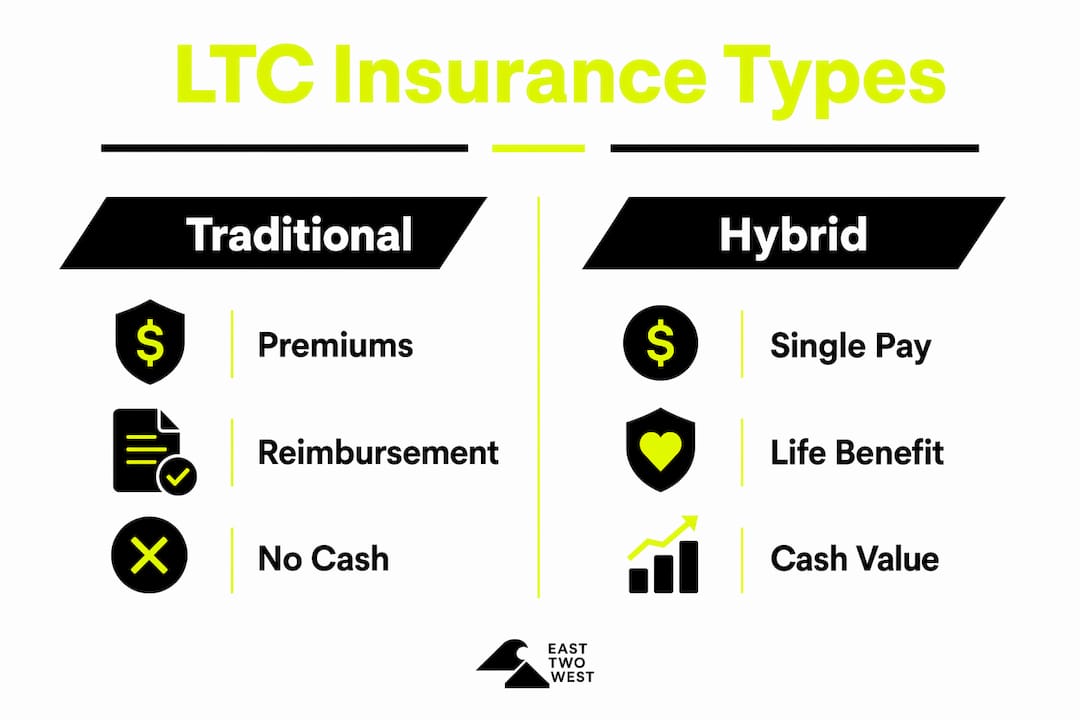
The market has changed significantly over the past 15 years. Traditional standalone policies still exist, but hybrid linked-benefit products have become the dominant choice for new buyers since around 2010. Here’s how each type works.

Traditional standalone LTC policies
You pay an annual (or monthly) premium, and the policy pays benefits if you meet the benefit triggers. Premiums are not guaranteed to stay level; carriers have historically requested rate increases, sometimes substantial ones. The upside is that standalone policies typically offer the most benefit per premium dollar at the time of purchase. The downside is the “use-it-or-lose-it” reality: if you never need care, you receive nothing back.
Hybrid life-with-LTC and annuity-with-LTC policies
A hybrid policy combines a life insurance or annuity contract with a long-term care benefit. If you need care, the policy pays LTC benefits. If you don’t, your heirs receive a death benefit. Since 2010, many LTC policies sold have been hybrids, and they can be structured as single-pay (one lump sum) or limited-pay (premiums over 5, 10, or 20 years). The premium is typically fixed, which eliminates the rate-increase risk that has plagued traditional policies.
LTC riders on life insurance
An LTC rider attached to a permanent life insurance policy accelerates the death benefit to pay for care. It’s not the same as a standalone or linked-benefit policy because the benefit pool is limited to the death benefit amount, but it can be a cost-effective way to add LTC protection to coverage you already own.
Group and employer/association plans
Group plans may not require full medical underwriting, making them a strategic path for people who might be declined in the individual market. The federal government’s FLTCIP program is the largest employer-sponsored group LTC plan in the country. Premiums in group plans can be lower due to the larger risk pool, though benefit designs may be less customizable.
Pros and cons at a glance:
Policy type | Premium predictability | Use-it-or-lose-it risk | Underwriting flexibility |
Traditional standalone | Low (rate increases possible) | Yes | Standard medical underwriting |
Hybrid life/annuity + LTC | High (fixed premium) | No (death benefit remains) | Standard medical underwriting |
LTC rider on life policy | High | Partial (reduces death benefit) | Tied to life policy underwriting |
Group/employer plan | Moderate | Varies | Simplified or guaranteed issue |
Pro Tip: If the idea of paying premiums for decades and getting nothing back bothers you, a hybrid is almost always the better fit. The fixed premium also makes long-range budgeting far easier.
How do LTC insurance benefits actually work?
Understanding the mechanics before you buy prevents unpleasant surprises when you file a claim. Four features drive most of the value in any policy.

Benefit triggers
To receive benefits, you must meet the policy’s trigger. Under federal tax-qualified rules, that means being certified by a licensed health care practitioner as a chronically ill individual — either unable to perform at least two of six ADLs for at least 90 days, or requiring substantial supervision due to severe cognitive impairment. The FLTCIP guidelines confirm that eligibility requires this certification and a prescribed plan of care.
Elimination period
The elimination period is the number of days you must pay for care out of pocket before the policy starts paying. Common options are 30, 60, or 90 days. A 90-day elimination period functions like a large deductible: it lowers your premium but requires you to cover the first three months of care costs yourself. Most financial planners recommend the 90-day option for buyers who have adequate liquid savings to bridge the gap.
Benefit period and lifetime maximum
Your daily benefit multiplied by your benefit period equals your lifetime maximum. A policy paying $200 per day for three years has a lifetime maximum of $219,000. Policies typically offer benefit periods of two to five years. Some offer unlimited (lifetime) benefits, though those are rare and expensive.
Example benefit scenarios:
Daily benefit | Benefit period | Lifetime maximum |
$200/day | 2 years | $219,000 |
$200/day | 3 years | $219,000 |
— | 5 years | — |
— | Lifetime | Unlimited |
Inflation protection
This is the feature most buyers underestimate. A $200 daily benefit that looks adequate today may cover less than half the cost of a nursing home in 20 years. Compound inflation riders grow your benefit on the increased balance each year, preserving purchasing power far more effectively than simple inflation options, which add only a fixed dollar amount annually. If you’re buying in your 50s, compound inflation protection is worth the higher premium.
How much does LTC insurance cost?
Premiums vary widely based on your age, health, and the benefit design you choose. There’s no single “average” that applies to everyone, but a few benchmarks help frame the decision.
Cost context: The Genworth Cost of Care Survey is the most widely cited annual benchmark for long-term care costs across the U.S. It consistently shows that nursing home and assisted living costs vary significantly by state, with median annual costs for a private nursing home room running well above $90,000 in many markets. Your daily benefit should be calibrated to your local cost of care, not a national average.
Major premium drivers:
Age at purchase: The single biggest factor. Buying at 55 versus 65 can cut your annual premium significantly.
Benefit amount: Higher daily benefits cost more; calibrate to your local care costs.
Benefit period: Longer coverage periods raise premiums substantially.
Elimination period: A longer waiting period lowers premiums.
Inflation rider: Compound inflation protection adds meaningfully to annual cost.
Health and underwriting class: Preferred health ratings earn lower premiums; rated policies cost more.
Gender: Women often pay higher premiums than men because they statistically live longer and file more claims.
Cost-reduction strategies worth considering:
Couples discounts (typically 5–15% per person when both spouses apply)
Limited-pay options (pay premiums over 10 years rather than for life)
Choosing a 90-day elimination period instead of 30 or 60 days
Selecting a shorter benefit period (3 years instead of 5) with a higher daily benefit
Single-pay hybrid policies that eliminate ongoing premium exposure entirely
The rate-increase risk is real. NAIC model laws and state DOI oversight require disclosure of policy terms, and in many states insurers must provide premium rate history upon request. Policies issued before the mid-2000s saw significant rate increases because carriers mispriced early products. Always ask a carrier for its complete rate increase history before you buy.
How does underwriting work, and what if your health is a concern?
Most individual LTC policies require full medical underwriting. That means the carrier reviews your health history, current medications, and sometimes your medical records before deciding whether to offer coverage and at what price. Conditions like recent cancer treatment, significant cognitive decline, or certain neurological diagnoses can result in a denial.
What underwriting typically examines:
Current diagnoses and chronic conditions
Prescription drug history
Cognitive screening results (some carriers require this for applicants over 70)
Height, weight, and blood pressure
Family history of dementia or hereditary conditions
If standard underwriting is a concern, you have options. Group or association plans sometimes offer simplified or guaranteed-issue underwriting, bypassing the full medical review. The federal FLTCIP program, available to federal employees and their families, is one of the most accessible group options in the country.
Life-to-LTC exchanges are another avenue. Some carriers allow you to exchange an existing life insurance policy for a linked-benefit LTC product, sometimes with simplified underwriting. This can be a practical path if you hold a permanent life policy you no longer need for death benefit protection.
Pro Tip: Before applying, request a copy of your medical records from your primary care physician and review them for accuracy. Errors in your records, like a misrecorded diagnosis, can trigger an unnecessary denial. Correcting them before you apply is far easier than appealing a denial afterward.
What are the alternatives to LTC insurance?
Insurance isn’t the only way to fund long-term care. For many people, the right answer is a combination of approaches rather than a single product.
Medicare’s limits
Medicare usually does not pay for long-term custodial care. It may cover a short skilled nursing facility stay following a qualifying hospital admission (up to 100 days under specific conditions), but it stops well short of covering the months or years of personal care most people eventually need. Counting on Medicare for long-term care is one of the most common and costly planning mistakes.
Medicaid
Medicaid covers long-term care for people who qualify financially, but it requires spending down most of your assets first. The rules vary by state, but the basic structure is means-tested: you must exhaust most of your savings before Medicaid pays. Medicaid partnership policies, available in most states, allow you to protect assets equal to the benefits your LTC policy paid before Medicaid eligibility kicks in. That’s a meaningful planning tool for middle-income households.
Other funding approaches
Annuities with LTC riders: Similar to hybrid life policies but built on an annuity chassis; can be funded with existing retirement assets
Reverse mortgages: Convert home equity to income, which can fund care costs, though this reduces the estate
Self-funding: Works if you have substantial liquid assets and are comfortable with the uncertainty of care costs
Family caregiving: Reduces paid care costs but places significant burden on family members, often adult children
Comparison of funding approaches:
Approach | Eligibility | Cost predictability | Estate impact |
LTC insurance (traditional) | Medical underwriting required | Moderate (rate increase risk) | Preserves assets if benefits used |
Hybrid life/annuity + LTC | Medical underwriting required | High (fixed premium) | Death benefit paid if unused |
Medicaid | Means-tested (spend-down required) | High (government-funded) | Significant asset depletion |
Self-funding | No eligibility barrier | Low (open-ended costs) | Depends on portfolio performance |
How do you choose the right policy?
The checklist below covers the five features that matter most. Work through each before you compare quotes.
Buyer checklist:
Coverage amount: Is the daily benefit calibrated to your local cost of care? Check the Genworth Cost of Care Survey for your state.
Inflation protection: Does the policy include compound inflation indexing? If you’re under 65, this is close to non-negotiable.
Benefit period: Does the coverage period align with your risk tolerance? Three to five years covers the majority of care episodes.
Elimination period: Can you self-fund the waiting period (typically 90 days) from liquid savings?
Nonforfeiture options: Does the policy include a nonforfeiture benefit so you retain some coverage if you stop paying premiums?
Questions to ask every agent or carrier:
What is the carrier’s complete premium rate increase history for this product line?
Is the policy guaranteed renewable, and under what conditions can the carrier raise premiums?
What are the exact benefit triggers, and how is “chronically ill” defined in this contract?
Does the policy include a nonforfeiture provision, and what does it protect?
Are there any exclusions for pre-existing conditions or specific diagnoses?
What inflation protection options are available, and what is the cost difference between simple and compound?
Red flags that should make you pause:
Benefit triggers that are vague or defined more narrowly than the federal ADL standard
No nonforfeiture language in the policy document
A carrier that refuses to provide its premium rate increase history
Policies that are not guaranteed renewable
Steps for comparing quotes:
Request quotes from at least three carriers for the same benefit design (same daily benefit, benefit period, elimination period, and inflation option).
Document each quote in a spreadsheet: carrier name, annual premium, daily benefit, benefit period, elimination period, inflation rider type, and nonforfeiture provision.
Ask each carrier for its rate increase history and note any past increases.
Compare the lifetime maximum under each policy and the cost per dollar of lifetime benefit.
Consumer protections, regulation, and tax treatment
State insurance departments have primary jurisdiction over LTC insurance carriers. The NAIC develops model laws and regulations that states adopt to set minimum standards for disclosure, nonforfeiture, and consumer protections. In most states, your agent is legally required to give you the NAIC Shopper’s Guide before you sign an application.
What “tax-qualified” means and why it matters:
Under the Health Insurance Portability and Accountability Act (HIPAA), codified at 26 USC §7702B, a tax-qualified LTC policy must meet specific benefit trigger requirements, be guaranteed renewable, and comply with NAIC model regulations. The tax advantages are meaningful:
Benefits received from a qualified policy are generally excluded from your gross income
Premiums may be deductible as medical expenses to the extent they and other unreimbursed medical costs exceed 7.5% of your adjusted gross income
Age-adjusted annual deduction limits apply; in 2023 these ranged from $480 for those aged 40 and younger to $5,960 for those aged 71 and older
Most traditional policies sold after HIPAA’s enactment are tax-qualified. Hybrid policies with a separately identifiable LTC premium component can also qualify.
Consumer protection checklist:
Verify your carrier’s license and complaint history through your state insurance department (the California Department of Insurance page is one example of state-level guidance)
Request the carrier’s premium rate history in writing before signing
Confirm the policy includes a nonforfeiture provision
Ask whether your state participates in the Medicaid partnership program
What to expect when you apply: timeline and documents
The process from first quote to active coverage typically takes 4–12 weeks, depending on the carrier and how quickly underwriting moves.
Typical timeline:
Week 1: Request quotes from multiple carriers; review benefit designs and premium ranges
Weeks 1–2: Submit applications to your top two or three carriers
Weeks 2–6: Underwriting review; carrier may request medical records or schedule a phone health interview
Weeks 4–10: Underwriting decision; carrier issues an offer, a rated offer, or a denial
Weeks 8–12: Policy delivery; review the policy document carefully before the free-look period expires (typically 30 days)
Documents and information to gather before applying:
A complete list of current medications (name, dosage, prescribing physician)
Names and contact information for all treating physicians in the past 3–5 years
A summary of significant diagnoses and hospitalizations
Recent lab results if you have chronic conditions being monitored
Your Social Security number and financial information for premium payment setup
Pro Tip: Apply to two or three carriers simultaneously rather than sequentially. If one carrier declines you, having a second application already in underwriting saves weeks and avoids the gap in coverage that can occur if your health changes between applications.
When comparing quote outputs, use the same benefit design across all carriers and focus on three numbers: the annual premium, the lifetime maximum, and the carrier’s rate increase history. A policy with a slightly higher premium but a clean rate history may cost less over 20 years than a cheaper policy from a carrier that has raised rates repeatedly.
For complex situations, a fee-only fiduciary financial advisor who specializes in long-term care planning is worth the consultation fee. An independent insurance agent who represents multiple carriers is the right resource for quote comparisons and application support.
Key Takeaways
Long term care insurance works best when you buy early, choose inflation protection carefully, and compare at least three carriers on identical benefit designs before committing.
Point | Details |
Buy in your 50s if possible | Premiums rise sharply with age; waiting past 65 risks denial due to new health conditions. |
Hybrid policies eliminate rate-increase risk | Fixed-premium hybrids pay a death benefit if LTC benefits go unused, solving the use-it-or-lose-it problem. |
Compound inflation protection matters | Simple inflation riders lose purchasing power over decades; compound indexing preserves your daily benefit’s real value. |
Always request rate increase history | Carriers must provide premium rate history in most states; a clean history is a meaningful quality signal. |
East Two West simplifies the comparison | East Two West provides independent quotes from multiple carriers with no sales pressure, online or by phone. |
The part of this decision most guides skip
There’s a version of the LTC insurance conversation that focuses almost entirely on probability statistics and premium math, and it misses the most important variable: what you actually want your life to look like if you need care.
The financial case for buying is straightforward enough. The harder question is whether you’ve thought through the non-financial side. Most people who end up in a nursing home didn’t plan to be there. They planned to stay home, or move in with family, or figure it out later. A well-structured LTC policy doesn’t just protect your assets; it gives you the ability to choose your care setting rather than defaulting to whatever Medicaid will fund.
The conventional wisdom says to buy between 55 and 65 and focus on the premium. That’s correct but incomplete. What the premium math doesn’t capture is the underwriting window. I’ve seen people in their early 60s who were in excellent health assume they had five more years to decide, then get diagnosed with something that made them uninsurable. The window closes without warning.
Hybrid policies get dismissed by some advisors as expensive compared to standalone coverage on a pure benefit-per-dollar basis. That’s true at the time of purchase. But standalone policies carry rate-increase risk that has materialized repeatedly in this market, and the psychological cost of paying premiums for 20 years and receiving nothing is real for many people. The “right” policy is the one you’ll actually keep paying for.
One more thing: don’t skip the nonforfeiture provision. If you buy a traditional standalone policy and can no longer afford the premiums at 78, a nonforfeiture benefit means you retain some coverage rather than losing everything you paid in. It’s not glamorous, but it’s the feature that protects you from the worst-case scenario within the policy itself.
How East Two West helps you compare LTC options without the pressure
Sorting through traditional policies, hybrids, and group options across multiple carriers is genuinely time-consuming, and most people don’t want to repeat that process with three different agents who each represent one carrier. East Two West is built around a different model: independent quotes from multiple carriers, with no obligation and no sales pressure.
[

You can compare LTC and life insurance options across carriers in one place, or request a personalized consultation if your situation involves hybrid products, existing life policies you want to exchange, or health concerns that make underwriting strategy important. Before you reach out, have your current medications, a rough list of your physicians, and a sense of your daily benefit target ready. The process is faster when that information is at hand.
East Two West is commission-based, meaning the practice is compensated by the carrier when a policy is placed, not by you directly. That structure is standard in the insurance industry, and it’s disclosed upfront. The goal is to match you with coverage that fits your situation, not to push a product that pays the highest commission.
Ready to see what coverage actually costs for your age and health profile? Get a personalized quote and compare your options without sitting through a sales pitch.
Authoritative sources and where to verify what you’ve read
The facts in this guide draw from government agencies, federal regulators, and industry bodies. Before you buy, verify current rules and carrier details through these primary sources.
Key sources to bookmark:
ACL Administration for Community Living: Federal overview of LTC insurance, what it covers, and how it’s priced
NAIC Shopper’s Guide to Long-Term Care Insurance: The consumer guide your agent is required to provide in most states; includes checklists and state-specific contacts
FLTCIP / LTCFEDS: Federal employees’ group LTC program; also a useful reference for benefit trigger and underwriting standards
AARP Long-Term Care Insurance Guide: Consumer-friendly overview of policy types, hybrid products, and coverage options
Medicare.gov Long-Term Care Coverage: Official explanation of what Medicare does and does not cover for long-term care
California Department of Insurance LTC page: Example of state-level consumer guidance; find your state’s equivalent through NAIC’s state directory
Congress.gov CRS Overview of LTC Insurance: Congressional Research Service background on market structure, tax treatment, and regulation
26 USC §7702B: The federal statute governing tax-qualified LTC insurance contracts
What to request from any carrier before you buy:
Complete premium rate increase history for the specific product line
A policy outline or summary of benefits
The nonforfeiture provision in writing
Confirmation of the policy’s tax-qualified status
Verify carrier licensing and complaint history through your state’s department of insurance. NAIC’s Consumer Information Source tool lets you look up complaint ratios for any licensed carrier, which is one of the most useful pre-purchase checks most buyers never make.
This article is general information, not professional financial, legal, or tax advice. Confirm current rules, rates, and eligibility requirements with your state insurance department, a licensed insurance professional, or a qualified financial advisor before purchasing a policy.
Recommended
Comments