Getting Life Insurance With Pre-Existing Health Conditions


Yes. Most people with pre-existing conditions can still buy life insurance for pre-existing conditions, though the path there depends on how well the condition is managed and how you shop for it. You’ll land in one of three lanes: standard underwriting if your condition is stable and well controlled, a rated policy with a premium surcharge if it’s more complicated, or a simplified/guaranteed-issue policy if you can’t qualify any other way.
The first move costs nothing and takes an afternoon:
Pull your recent medical records, especially labs and specialist notes from the last 6 to 12 months
Get quotes from at least three carriers before assuming you’re stuck with one option
Ask an independent broker to run your health profile against multiple underwriting models at once
Key Takeaways
Approval odds and pricing for pre-existing conditions depend far more on documentation and timing than on the diagnosis itself.
Point | Details |
Three approval paths exist | Standard underwriting, rated policies with surcharges, and simplified/guaranteed issue cover nearly every health profile. |
Documentation drives rate class | Six to 12 months of stable labs and a physician letter often beat a lower A1C alone. |
Table ratings compound fast | Each table step adds roughly 25% to premiums, so Table 4 can double your cost versus standard. |
Carriers rate the same condition differently | Comparing at least three insurers can reveal a two or three table gap for identical health profiles. |
East Two West compares carriers for you | Its independent, multi-carrier model matches applicants to insurers with underwriting appetites suited to their specific condition. |
This article is general information, not a substitute for advice from a qualified financial advisor. Consult a qualified financial professional about your own circumstances before acting on anything here.
Table of Contents
What Counts as a Pre-Existing Condition?
A pre-existing condition is any health issue diagnosed or treated before you apply for coverage, according to Healthcare. That covers a lot of ground: a hospitalization from 15 years ago counts on paper, even if it hasn’t affected your health since.
Not every condition carries the same weight with underwriters. Diabetes, heart disease, cancer history, mental health diagnoses, and obesity are the ones that show up most often in applications, and each gets evaluated differently:
Type 2 diabetes with an A1C under 7.0 can sometimes land near standard rates
Heart disease depends heavily on how recent the event was and whether there’s been a repeat incident
Cancer history hinges on time since remission and cancer type
Mental health conditions rarely disqualify you outright but do get scrutinized for medication and treatment consistency
Obesity and sleep apnea are usually rated based on BMI thresholds and whether the sleep apnea is treated with CPAP compliance
Recency and complications matter more than the diagnosis itself. A heart attack six months ago reads very differently to an underwriter than one from a decade back with no follow-up issues.
How Underwriting Evaluates Pre-Existing Conditions
Underwriters don’t take your word for it. They verify.
For fully underwritten policies, the process typically runs through four checkpoints:
Paramedical exam — a nurse visits or you go to a clinic for bloodwork, blood pressure, height, and weight
Attending Physician Statement (APS) — your doctor sends over records confirming diagnosis, treatment, and current status
MIB and prescription database checks — insurers cross-reference the Medical Information Bureau and prescription histories to catch undisclosed conditions or prior declined applications
Final review and rate class assignment — the underwriter combines everything into a rate class or declines the case
Some carriers now offer accelerated underwriting, which skips the exam using predictive data models built from your prescription history, MIB records, and motor vehicle report. It’s faster, but it’s conditional. If the algorithm flags something it can’t resolve or lacks enough data on your specific condition, it routes you back to full underwriting with the exam requirement reinstated.
Timelines vary sharply by path. Accelerated underwriting can produce a decision in hours to a few days. Full underwriting with an APS request typically takes two to six weeks, longer if your doctor’s office is slow to send records.
Which Policy Type Fits Your Health History?
Your options break into five categories, and picking the wrong one wastes money or leaves you underinsured.
Fully underwritten term or permanent life insurance gets you the best rates, but only if your condition is well documented and stable. This is where the real savings live if you qualify.
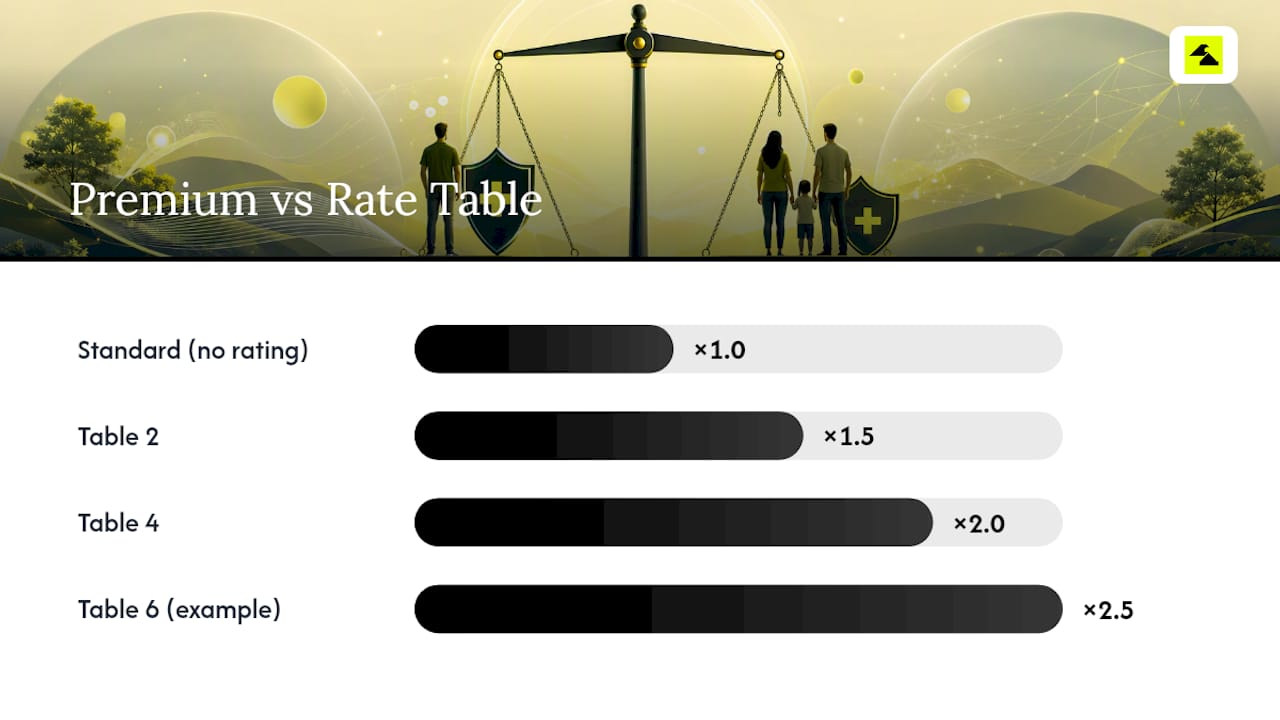
Rated policies use a table-rating system. “Table 4” means a 100% premium increase over standard rates; each table typically adds another 25% on top of that. A Table 2 policy costs roughly 50% more than standard; a Table 4 might double your premium.
Simplified issue skips the exam entirely and relies on a health questionnaire. Approval is faster, but coverage usually caps between $100,000 and $500,000, and the price per dollar of coverage runs higher than a fully underwritten policy.
Guaranteed issue approves almost anyone regardless of health, but it comes with a graded death benefit (usually 2 to 3 years) where beneficiaries only get premiums back plus interest if you die of natural causes during that window. Coverage caps are low, often around $25,000 or less.
Employer or group life insurance is frequently the fastest coverage you can get right now, since most group plans don’t require individual underwriting up to a guaranteed issue amount.
What Will Pre-Existing Conditions Add to Your Premium?
Rate tables are where the math either stays manageable or gets ugly fast.
A Table 2 rating adds roughly half again to standard premiums. Table 4 typically doubles them. Each table step above that generally adds another quarter, so a higher rating can mean paying several times what a healthy applicant of the same age would pay for identical coverage. On a $500,000 policy, that difference can mean hundreds of extra dollars a month, not a rounding error.
The gap between fully underwritten and no-exam products is just as real. Simplified and guaranteed-issue policies charge more per dollar of coverage because insurers are pricing in uncertainty. They haven’t seen your labs, so they assume worse-case scenarios across the whole risk pool.
Here’s the part most people miss: carriers don’t rate the same condition the same way.
One insurer might rate a controlled autoimmune condition at Table 2 while another rates it Table 6 for the identical profile
Diabetes underwriting guidelines differ significantly between carriers, with some far more generous toward well-managed A1C levels than others
Shopping at least three carriers is standard advice for exactly this reason. Underwriting models genuinely diverge, and the only way to find the generous one is to apply, or have a broker apply, in more than one place.
How to Improve Your Approval Odds Before You Apply
Underwriters reward evidence, not intentions. Here’s what actually moves the needle:
Gather your medical file first. Pull recent labs, A1C results, lipid panels, vitals, and specialist notes going back at least a year.
Build a track record of stability. Insurers generally want to see 6 to 12 months of consistent readings for chronic conditions like diabetes or hypertension, not just one good checkup.
Request a physician letter. A short letter from your treating doctor summarizing your condition, current control, and prognosis often carries more weight than anything you write yourself on the application.
Apply through at least three carriers, or work with an independent broker who already knows which companies underwrite your specific condition more favorably.
Match the underwriting path to your situation. If your condition is well documented and controlled, push for full underwriting. If you’re short on time or documentation, accelerated or simplified issue may serve you better, even at a slightly higher cost.
Pro Tip: Order your own copy of your MIB report and prescription history before you apply. If there’s an error or an outdated entry from years ago, you can dispute it before it drags down your rate class instead of finding out after a decline.
Medical evidence beats lifestyle statements every time. A lab result showing your A1C dropped from 8.2 to 6.9 over a year tells an underwriter something a paragraph about “eating better” never will.

What to Do If You’re Denied or Priced Out
A decline isn’t the end of the road. It just means you need a different door.
Guaranteed-issue and simplified-issue policies remain available even after a decline, though you’ll pay more per dollar of coverage and, with guaranteed issue, wait through a graded benefit period before full payout applies.
Timing matters after major health events. Insurers typically want to see 6 months to 2 years post-recovery for cardiac events, and often a full year or more of clean scans after cancer treatment before reconsidering standard rates.
Employer group coverage fills the gap in the meantime. Most group plans require no individual underwriting up to the guaranteed issue amount, giving you real protection while you build the evidence needed to reapply.
How East Two West Helps You Navigate This
Comparing quotes across carriers is the single highest-leverage move available to someone with a complicated health history, and it’s exactly what East Two West does.
Multi-carrier quoting means your profile gets checked against different underwriting appetites at once, not just one company’s rate tables.
Two service paths: run comparisons yourself through online self-service quoting, or talk through your situation with a licensed advisor if your case involves multiple conditions or prior declines.
No sales pressure. East Two West’s independent model means the goal is matching you to a policy that fits, not pushing whichever product pays the highest commission.
Readers researching adjacent situations, like coverage questions for non-citizens or how accelerated underwriting actually works, find the same independent-comparison approach applied there too.
Where the Conventional Advice Falls Short
Most articles on this topic tell you to “shop around” and stop there. That advice is technically correct and almost useless in practice, because it skips the part that actually changes your outcome: documentation timing.
The applicants who get the best rate classes aren’t the healthiest ones. They’re the ones who waited until they had a clean 6 to 12 month track record and a physician letter in hand before applying, instead of applying the week after a diagnosis when the underwriter has nothing to judge stability by. Apply too early with a chronic condition and you’ll likely get rated worse than you would have three months later with two more clean labs on file.
The other underrated move is treating a decline as data, not a verdict. A Table 6 rating from one carrier and a Table 2 from another for the identical health profile isn’t rare. It’s the whole reason independent comparison exists. If your first quote feels punishing, that’s usually a sign you asked the wrong carrier, not that you’re uninsurable.
Prioritize the paperwork before the phone calls. The stability evidence is what underwriters actually price against.
— Jib Hunt
Get a Quote That Actually Reflects Your Health Profile
East Two West runs your situation against multiple carriers at once instead of asking you to guess which insurer treats your condition fairly. That matters here specifically: two carriers can rate the same diagnosis two or three tables apart, and you have no way to know which one until someone checks. East Two West does that checking for you, whether you want to run the comparison yourself or talk it through with someone who reads rate tables for a living.
[

If your condition is well controlled and documented, you may qualify for far better terms than a single online quote tool would ever show you. If it’s more complicated, an advisor can walk you toward a rated, simplified, or guaranteed-issue policy that still gets you covered without wasting months on the wrong application. Start by requesting a quote comparison and see what your actual options look like before committing to any one carrier’s number.
Sources
Recommended
Comments