Should You Replace Your Life Insurance Policy?


Replacing a life insurance policy makes sense when your needs have genuinely changed, your health has improved enough to qualify for better pricing, or a 1035 exchange lets you upgrade without a tax hit. It usually backfires when you’re leaving behind a policy with strong guarantees, low grandfathered pricing, or a locked-in health rating you couldn’t get again today.
Three situations justify a serious look at replacement:
Your coverage goals shifted (you now need permanent protection, long-term care riders, or a bigger death benefit).
You’re eligible for a tax-free 1035 exchange into a product that better fits your goals.
Your health has improved enough to move into a materially better underwriting class.
Before you do anything else, request an in-force illustration from your current carrier and ask for the cost-to-surrender figure alongside current cash value. That one document tells you more than any sales pitch will.
Key Takeaways
Replacing a life insurance policy only pays off when the new contract’s benefits clearly outweigh the surrender costs, reset contestability period, and any lost guarantees on the old one.
Point | Details |
Get the illustration first | Request an in-force illustration and cost-to-surrender figures before comparing any new proposal. |
Match the reason to the risk | Legitimate replacement fits changed goals, improved health, or a valid 1035 exchange, not sales pressure. |
Never leave a coverage gap | Keep your old policy active until the new one is fully issued and past its free-look period. |
Loop in a trust attorney | If an ILIT owns your policy, get legal sign-off before applying for a replacement. |
Compare before you commit | East Two West provides independent multi-carrier quotes and in-force reviews so you can weigh options before replacing anything. |
This article is general information, not a substitute for advice from a qualified financial advisor. Consult a qualified financial professional about your own circumstances before acting on anything here.
Table of Contents
What Does It Mean to Replace a Life Insurance Policy?
“Replacement,” in insurance regulatory terms, isn’t just canceling one policy and buying another. The NAIC’s model regulation defines it as any transaction where you buy a new policy or annuity and, in connection with that sale, the old contract is lapsed, surrendered, forfeited, assigned, terminated, or used in a financed purchase.
That last phrase matters. A “financed purchase” happens when you use existing cash value, through a loan or partial withdrawal, to help fund premiums on a new policy, even if you technically keep the old one active for a while.
Several everyday actions count as replacement under this definition:
Surrendering your policy for cash and buying a new one.
Letting an old policy lapse shortly after a new one is issued.
Borrowing against cash value to pay premiums on a different contract.
Because these actions all trigger replacement, they also trigger consumer protections: a signed replacement notice, disclosure duties for the producer, and anti-churning safeguards designed to stop agents from repeatedly rewriting the same client’s coverage for commission.
Why Do People Legitimately Switch Life Insurance Companies?
Not every reason to switch life insurance companies is a good one, but plenty are. Here’s what separates a sound decision from an impulsive one.
Your objectives changed. A term policy bought at 30 to cover a mortgage looks very different from what a 55-year-old with aging parents and estate concerns actually needs. If you now want permanent coverage, or a policy with a long-term care rider, your original contract may simply not do the job anymore.
You got healthier. Quit smoking five years ago? Lost 40 pounds and got your blood pressure under control? Insurers reclassify risk constantly, and a former “Standard” rating can become “Preferred Plus” once you requalify, sometimes cutting premiums substantially.
New features exist that didn’t when you bought. Indexed universal life products, in particular, have evolved fast, with better cap rates, participation structures, and living benefits than what carriers offered a decade ago. Our guide to indexed universal life breaks down what’s changed.
You’re juggling too many small policies. Consolidating three old term or whole life policies into one right-sized contract often reduces fees and simplifies beneficiary management.
What Are the Hidden Costs of Replacing Whole Life Insurance?
Replacing whole life insurance is where people get burned most often, because the costs aren’t always obvious on day one.
Age works against you first. Every year you wait, premiums for the same death benefit climb, and if you locked in pricing at 35, walking away from that at 55 usually means paying substantially more for equivalent coverage.
Contestability resets, too. Most new policies come with a fresh two-year contestability period and suicide clause, meaning the insurer can investigate and deny a claim on the new contract in ways it no longer could on your seasoned policy.
Watch for these additional traps:
Loss of embedded guarantees. Older whole life and universal life contracts sometimes carry guaranteed interest rates or loan provisions no longer available on new products.
Surrender charges. Permanent policies often carry a multi-year surrender charge schedule, and replacing the policy typically restarts that clock on the new contract, trapping your cash value again just as it was becoming accessible.
Improper tax treatment. Surrendering a policy and separately buying a new one, instead of using a direct exchange, can turn built-up gains into a taxable event.
Pro Tip: Ask your current insurer, in writing, exactly what riders or guarantees disappear if you surrender. Agents proposing the new policy often can’t answer that question accurately because they don’t have your old contract in front of them.
How Do State Replacement Rules and 1035 Exchanges Work?
Two separate safeguards apply to anyone considering replacing a policy: state insurance regulation and federal tax law.
Every state bases its replacement rules on the NAIC model, which requires the producer selling you a new policy to give you a signed replacement notice and, in many cases, make in-force illustrations and side-by-side comparisons available so you can compare old and new before signing anything. Producers who skip this step, or who don’t keep records of the disclosure, can face real penalties.
On the tax side, an IRC Section 1035 exchange lets you move funds directly from one life insurance or annuity contract into another, tax-free, as long as the owner and insured stay the same and the transfer goes directly between carriers rather than passing through your hands first.
A few practical limits matter here:
A 1035 exchange preserves tax deferral, but it does not waive surrender charges or sales commissions on either the old or new contract.
Not every swap qualifies. Exchanging a life insurance policy for an annuity works; exchanging an annuity for life insurance generally does not.
You still need medical underwriting on the new policy even when the exchange itself is tax-free.
Checklist: How to Decide Whether to Keep, Modify, or Replace Your Policy
Before you sign anything, pull together the paperwork and run the comparison properly.
Request your documents. Get an in-force illustration, your current policy summary, rider descriptions, any outstanding loan balances, and a cost-to-surrender worksheet from your existing carrier.
Compare premiums to maturity, not just today’s quote. A new policy might look cheaper in year one and cost more over 20 years once you account for how each contract’s cost structure changes with age.
Check cash-value projections and the surrender schedule side by side. A policy that looks strong on paper can still trap your money for another decade if the new surrender period is long.
Vet the new carrier’s financial strength, and ask directly whether the agent recommending replacement earns a new commission on the sale. That’s not a rude question. It’s a fair one, and any honest producer will answer it.
Land on one of three outcomes: modify your existing policy (add a rider, adjust the death benefit), execute a 1035 transfer to preserve tax deferral, or replace outright and accept the trade-offs with eyes open.
Pro Tip: If the illustration for your proposed policy assumes non-guaranteed dividend or interest rates higher than what your current policy has actually earned in recent years, treat that as a red flag, not a selling point.
How East Two West Approaches In-Force Policy Reviews
East Two West runs this evaluation the same way for every client: pull real numbers before recommending a direction. Our quote comparison tool gives you fast, multi-carrier pricing if you’re shopping fresh coverage, and a personal consultation is available when your situation involves an existing policy that needs a real in-force illustration review rather than a quick quote.
We typically point clients toward a review, not an automatic replacement, when:
Their current policy still has years left on a favorable rate lock.
They’re unsure whether their health class has genuinely improved enough to matter.
Multiple older policies need consolidating rather than replacing one-for-one.
To get the most from a consult, have your current policy’s declarations page, any loan statements, and a recent premium notice on hand. Most reviews take less than 30 minutes and end with a clear recommendation, not a pitch.
Point | Details |
Start with documents | Bring your in-force illustration and declarations page to any review. |
Reviews aren’t sales calls | East Two West separates the illustration review from any replacement recommendation. |
What Happens to Beneficiaries and Death Benefit Timing When You Replace?
Your beneficiaries don’t see a seamless handoff when you replace a policy. There’s a gap, and it matters.
The moment your old policy lapses or is surrendered, its death benefit disappears immediately, even if the new policy hasn’t been formally issued yet. If you die during underwriting on the replacement contract, before the new policy is in force, your beneficiaries could be left with nothing from either contract. This is why every credible replacement process insists you keep the old policy active until the new one is fully approved and delivered.

Beneficiary designations also don’t carry over automatically. A new policy starts with a blank slate, and if you forget to name a contingent beneficiary you had on the old contract, or misspell a name, that oversight only surfaces after a death, when it’s far too late to fix cleanly.
There’s a timing wrinkle with cause-of-death exclusions, too. Suicide clauses and contestability periods reset on the new policy regardless of how long the old one had been in force. A death that would have been fully covered under a ten-year-old policy could face a contestability review under a brand-new one issued six months earlier. Related benefit structures, like accidental death riders, can also differ meaningfully between old and new contracts; our breakdown of accidental death versus life insurance explains how those payouts diverge from standard death benefits.
Never let the old policy lapse until the new one’s first premium has been paid and the policy is confirmed in force.
What Underwriting Risks Come With a New Policy?
Every replacement runs through new medical underwriting, and that’s the single biggest wildcard in the entire process.
Your current policy’s rating was locked in when you bought it. Moving to a new contract means a fresh application, a new medical exam in most cases, and a new review of your prescription history, driving record, and sometimes financial background. If your health has changed for the worse since your original policy, even in ways that feel minor to you, a new insurer will price for that risk or decline coverage outright.
This creates a sequencing problem people underestimate: don’t apply for coverage assuming approval, and don’t cancel anything until the new policy is actually issued and the free-look period has passed. Insurability isn’t guaranteed just because you were healthy enough to qualify once before.
A few underwriting risks deserve specific attention:
New diagnoses since your original policy, even well-controlled ones like early-stage diabetes or sleep apnea, can move you into a worse rate class or trigger a decline.
Build changes matter more than people expect. Weight gain alone can shift your rate class even when every other health marker looks fine.
Foreign travel, hazardous hobbies, or a new occupation picked up since your last application can all affect pricing on the new contract in ways your existing policy never accounted for.
Get a firm, underwritten offer in hand, not just a preliminary quote, before you take any action on your existing coverage.
Does Replacing a Policy Affect Estate Planning or Trust Ownership?
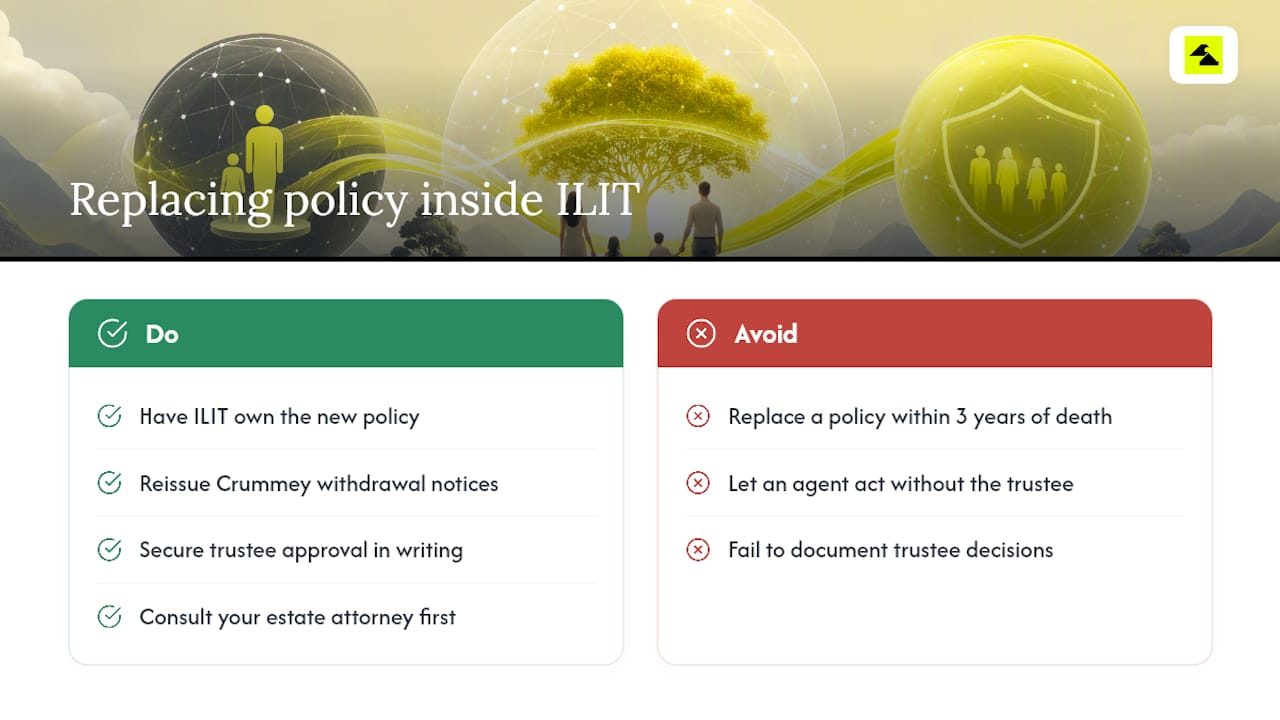
If your policy sits inside an irrevocable life insurance trust, or ILIT, replacing it isn’t a simple swap. It’s a legal event with its own set of rules.
An ILIT typically owns the policy directly, which means the trust, not you personally, has to be the one applying for and owning the new contract. Miss that step and you risk pulling the death benefit back into your taxable estate, undermining the entire reason the trust existed in the first place.
Crummey withdrawal notices, the annual gift-tax mechanism many ILITs use to fund premiums, need to be reissued correctly for a new policy, and trustees have fiduciary duties around approving any replacement that a policyholder acting alone doesn’t have to think about.
There’s also a three-year lookback rule to consider. If a policy is transferred into a trust, or a new one is issued inside a trust, within three years of the insured’s death, it can be pulled back into the taxable estate under IRS rules governing transfers of life insurance. Replacing a trust-owned policy resets that clock, which matters enormously for anyone doing estate planning near larger estate tax thresholds.
If a trust owns your existing policy, loop in your estate attorney before you sign anything with a new carrier. This isn’t a decision to make through an insurance agent alone.
How East Two West Can Help You Evaluate a Replacement
You don’t have to figure out surrender schedules, contestability periods, and 1035 mechanics on your own. East Two West offers independent, multi-carrier quotes alongside a consultative in-force illustration review, so you can see exactly what you’d be trading away before committing to anything.
[

Start by requesting a free quote comparison, where you’ll see real pricing across multiple carriers rather than a single company’s proposal. If your situation involves an existing policy, upload your current declarations page and most recent statement, and a licensed advisor will walk through whether a 1035 exchange, a policy modification, or a full replacement actually serves your goals best. Because East Two West works across carriers instead of for one, there’s no incentive to push replacement when keeping your current policy is the smarter move. You can also browse the full range of life insurance and annuity options if you’re still narrowing down what you actually need. Either way, the next step is the same: get real numbers before you decide anything.
A Note on Getting This Right
The biggest mistake I see isn’t replacing a policy. It’s replacing one without ever pulling the in-force illustration first. Run the checklist in this article before you sign anything, and if a proposal can’t survive that scrutiny, that tells you something. Reach out for a no-pressure review anytime.
— Jib Hunt
Sources
Recommended
Comments