Simplified Issue Life Insurance: Fast No-Exam Coverage Explained
- Jib Hunt

- Aug 10
- 16 min read

Simplified issue life insurance lets you get covered without a paramedical exam. You answer a short health questionnaire, the insurer runs a few electronic checks, and you can have a decision in minutes. It’s the right move if you need coverage fast, have minor health issues that might slow down full underwriting, or simply don’t want a nurse drawing blood in your living room. The trade-off: premiums run higher and coverage limits are lower than fully underwritten policies.
Quick look:
Pros: Fast approval (sometimes same-day), no physical exam, accessible to applicants with stable health conditions
Cons: Higher premiums than fully underwritten policies, lower maximum death benefits, some policies carry waiting periods
Next step: East Two West compares simplified-issue quotes from multiple carriers so you can see real numbers without a sales pitch. Start at E2wusa.
Key Takeaways
Simplified issue life insurance is the fastest path to real coverage for applicants who need speed or have minor health conditions, but the premium cost is higher than fully underwritten policies and coverage limits are lower.
Point | Details |
No exam, but not blind | Insurers check prescription history, MIB records, and motor-vehicle reports automatically. |
Higher premiums, lower limits | Simplified-issue rates run higher than fully underwritten policies for the same coverage amount. |
Graded vs. level benefit | Always confirm whether a policy pays full benefits from day one or uses a two-year graded period. |
Honesty protects your beneficiary | Misrepresentation found during the contestability period can result in claim denial. |
East Two West | Compare simplified-issue quotes from multiple carriers online or by phone, with no sales pressure. |
Table of Contents
Pros and cons: when simplified issue helps and when it doesn’t
Simplified issue vs. guaranteed issue: which one do you need?
What to expect after you apply: waiting periods, contestability, and claims
How insurers actually check your risk without a medical exam
Common riders and policy features on simplified-issue products
How to choose a simplified-issue policy and what to ask an agent
Why “no exam” still means insurers know your medical history
Common exclusions and limitations beyond underwriting criteria
How to read your policy documents and understand the fine print
How pre-existing conditions affect eligibility and premium rates
What simplified issue life insurance actually covers
Simplified issue life insurance is a category of coverage where the insurer skips the paramedical exam but still evaluates your health through a questionnaire and automated data checks. You can be approved or declined. That’s the key distinction from guaranteed issue, where no one gets turned away.
Forbes Advisor notes that these policies come in term and whole-life variants and generally carry lower maximum death benefits than fully underwritten policies.
Policy types available as simplified issue:
Simplified issue term life: Typically covers 10, 15, 20, or 30 years. Coverage limits often reach $500,000 or more with some carriers, though many cap lower than fully underwritten term.
Simplified issue whole life: Permanent coverage with a cash value component. Limits tend to be lower than term, often in the $25,000–$100,000 range.
Final expense insurance: A form of simplified whole life marketed to older buyers, usually ages 50–85, with death benefits commonly between $5,000 and $25,000. ChoiceMutual describes these as permanent, simplified options aimed squarely at covering burial and end-of-life costs.
Limited permanent coverage: Some carriers offer simplified-issue permanent policies with modest face amounts as a middle ground between final expense and full whole life.
Coverage ranges vary widely by carrier and your age. Final-expense products typically have lower limits, while simplified term policies can reach higher limits for those who qualify.
How the application and approval process works
The application is genuinely fast. Here’s what the process looks like from start to coverage:
Choose your application channel. You can apply online, over the phone, or through a licensed agent. East Two West offers both self-service quoting and agent-assisted consultations.
Answer the health questionnaire. Expect 5–15 yes/no questions covering major conditions: cancer, heart disease, HIV/AIDS, recent hospitalizations, and similar. No blood draw, no urine sample.
Electronic data checks run automatically. The insurer pulls your prescription history, Medical Information Bureau (MIB) records, and motor-vehicle reports in the background. You won’t feel this step, but it matters.
Receive a decision. Progressive reports that decisions can come within minutes, and coverage may take effect the same day once you pay your first premium. Some applications trigger manual review and take a few days.
Sign and pay. Once approved, you sign the policy documents and submit your first premium to activate coverage.
Have this information ready before you start:
Government-issued photo ID
Social Security number
Beneficiary names, dates of birth, and relationships
Names of any prescription medications you currently take
Basic medical history (dates of diagnoses, if any)
Pros and cons: when simplified issue helps and when it doesn’t
Simplified underwriting life insurance solves a specific problem: getting covered quickly without the friction of a full medical exam. But it’s not the right product for everyone.
Pros:
No paramedical exam required
Approval decisions in minutes to a few days
Accessible to applicants with minor, stable health conditions
Coverage can start the same day in many cases
Straightforward application process
Cons:
Premiums are meaningfully higher than fully underwritten policies for the same coverage amount
Lower maximum death benefits across most product types
Some policies include a two-year graded benefit period, meaning early death from illness may pay only a return of premiums plus interest rather than the full face amount
Fewer rider options compared to fully underwritten policies
Applicants with serious health conditions may still be declined
When simplified issue is the right call:
You need coverage immediately for a legal or financial obligation. You’ve been declined for full underwriting but have stable, minor health issues. You’re a senior looking for final-expense coverage and don’t want the hassle of a full exam. You want a policy in force while you wait to qualify for something better.
When to skip it:
If you’re under 40, healthy, and have time, full underwriting will almost certainly get you a lower premium for the same or higher coverage. Simplified issue as a permanent solution for a young, healthy person is paying a premium for convenience you don’t need.
Pro Tip: Use simplified issue as a bridge policy. Get covered now, then apply for fully underwritten coverage once you have time. If you qualify, replace the simplified policy. You’ll pay more for a few months but won’t have a gap in coverage.
Typical costs and coverage amounts
Insurance that simplified-issue premiums are generally higher than fully underwritten policies, with meaningful variability by age and coverage amount. The table below shows illustrative monthly premium ranges for a 10-year, $100,000 simplified issue term policy. These are directional figures to set expectations, not quotes.
Age | Approximate Monthly Premium (Male) | Approximate Monthly Premium (Female) |
35 | $15–$30 | $15–$25 |
45 | $30–$50 | $25–$45 |
50 | $60–$110 | $50–$85 |
60 | $130–$175 | $100–$150 |

Source: Illustrative ranges based on Insurance.com sample data. Actual rates depend on carrier, health answers, and state.
Final-expense whole life premiums for a $10,000 policy typically run $30–$80 per month for buyers in their 60s and 70s, again depending on age, sex, and carrier.
Common riders and their cost impact:
Accelerated death benefit: Available on most simplified-issue policies, often at no extra cost. Allows early access to a portion of the death benefit if diagnosed with a terminal illness.
Accidental death benefit rider: Adds a payout if death results from an accident. Relatively affordable but adds to the monthly premium. See how accidental death coverage compares to standard life insurance before adding it.
Child rider: Less commonly available on simplified-issue products; some carriers exclude it entirely.
Waiver of premium: Occasionally available; suspends premium payments if you become totally disabled. Not universal on simplified-issue products.
Simplified issue vs. guaranteed issue: which one do you need?
These two products are frequently confused, and the difference matters when you’re deciding which to apply for.
NerdWallet explains that guaranteed issue accepts anyone with no health questions, while simplified issue requires a questionnaire and can decline applicants. Guaranteed issue is the last resort, not the first choice.
Feature | Simplified Issue | Guaranteed Issue |
Health questions required | Yes (5–15 questions) | No |
Can be declined | Yes | No |
Typical maximum death benefit | Up to $500,000+ (term); $25,000–$100,000 (whole) | Usually $5,000–$25,000 |
Premium cost | Higher than fully underwritten | Highest of all policy types |
Waiting/graded period | Sometimes (varies by carrier) | Almost always (typically 2 years) |
Best for | Applicants who can answer health questions and want faster coverage | Applicants who cannot qualify for any other coverage |
How to decide:
If you can answer health questions honestly and don’t have a serious recent diagnosis, start with simplified issue. You’ll get better limits and likely lower premiums than guaranteed issue.
If you’ve been declined for simplified issue or have a condition that would trigger a decline (recent cancer treatment, for example), guaranteed issue may be your only option.
Never choose guaranteed issue just to avoid answering questions. The premiums are higher and the limits are lower.
Who benefits most from simplified-issue policies
Simplified issue isn’t a universal product. It fits a specific set of situations well.
Good candidates:
Seniors seeking final-expense coverage. Older buyers who want a permanent policy to cover burial costs and don’t want a full medical exam. The simplified whole-life products designed for this purpose are widely available and straightforward to apply for.
People with minor, stable health conditions. Controlled hypertension, well-managed type 2 diabetes, or a past health event that’s now resolved. These applicants may face delays or surcharges in full underwriting but can often qualify under simplified rules.
Anyone needing immediate coverage. Court-ordered life insurance, a business buy-sell agreement, or a mortgage requirement with a tight deadline. Simplified issue can put a policy in force the same day.
New parents who want fast term coverage. A new parent who wants $250,000 in coverage in place before the end of the week, not the end of the month.
Who should avoid it:
Young, healthy applicants in their 20s and 30s who have time to complete full underwriting. The premium difference between simplified and fully underwritten coverage at age 30 can be substantial over a 20-year term. Paying more for speed you don’t need is a poor trade.
What to expect after you apply: waiting periods, contestability, and claims
Getting approved is step one. Understanding what happens next prevents surprises.
Waiting and graded benefit periods:
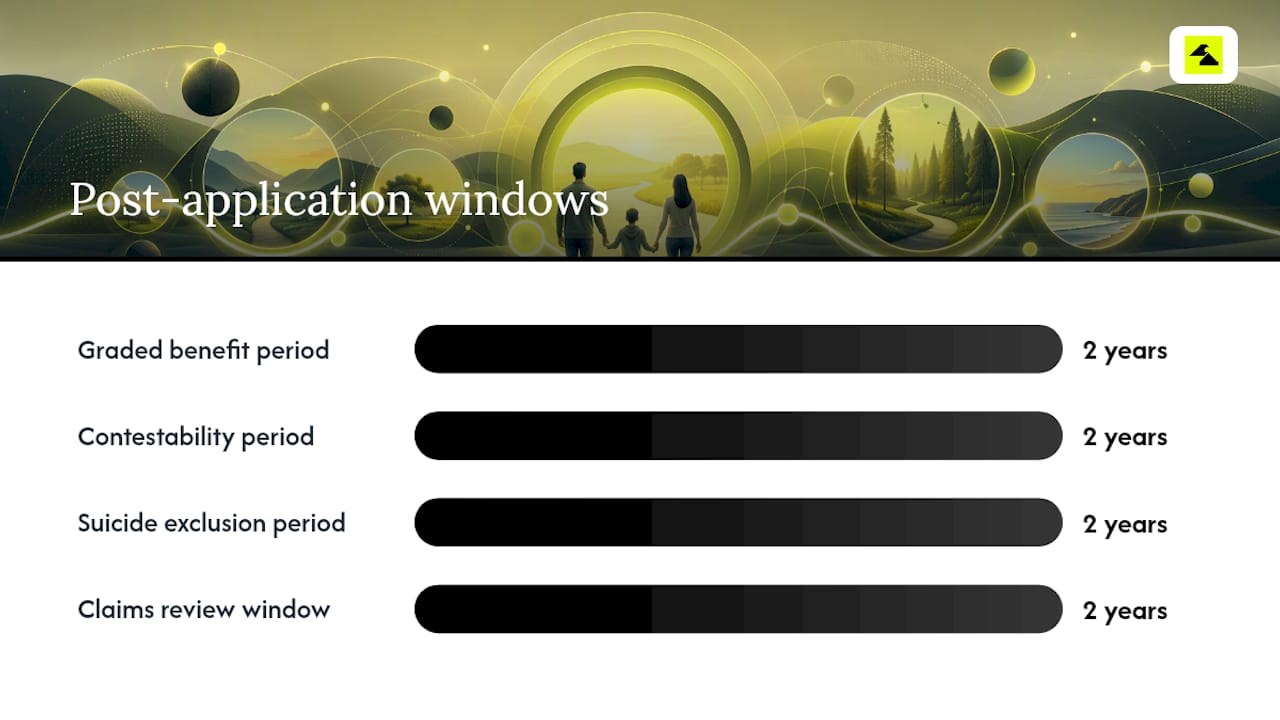
Some simplified-issue policies, particularly final-expense whole life products, include a two-year graded benefit period. If you die from illness within those two years, the insurer typically pays a return of premiums plus interest rather than the full face amount. Death from an accident usually pays the full benefit immediately. Always check whether a policy is “level benefit” (full payout from day one) or “graded benefit” before you buy.
Contestability period:
Nearly every life insurance policy includes a two-year contestability window. During this period, the insurer can investigate a claim and deny payout if they find material misrepresentation on the application. Business Insider warns that misrepresenting health information on a simplified-issue application can lead to claim denial. After two years, the policy becomes incontestable except in cases of outright fraud.
Suicide clause:
Most policies exclude suicide as a covered cause of death for the first two years. After that window, suicide is typically covered.
Common claim outcomes:
Claims filed after the contestability period with accurate application information are almost always paid promptly.
Claims filed within the first two years trigger a review. If the application was honest, the claim pays. If the insurer finds discrepancies, they may deny the claim or reduce the payout to what the premium would have purchased had the correct information been disclosed.
How insurers actually check your risk without a medical exam
“No exam” doesn’t mean “no medical information.” Insurers pull data from several electronic sources the moment you submit your application.
Data sources commonly used:
Prescription history databases: Your medication history is often the single most influential data point. Prescriptions for certain conditions signal health risks even if you don’t disclose the underlying diagnosis.
Medical Information Bureau (MIB): A shared database where insurers report coded health information from prior applications. If you applied for life insurance before and disclosed a condition, that record exists.
Motor-vehicle reports: Driving history, DUIs, and reckless driving citations affect life insurance rates because they correlate with mortality risk.
Prior application data: Answers you gave on previous insurance applications are often accessible to underwriters.
Common red flags that trigger manual review or decline:
Prescription medications for serious conditions (certain cancer treatments, HIV antiretrovirals, medications for advanced heart disease)
Conflicting information between your questionnaire answers and database records
Recent hospitalizations or surgeries
High-risk occupations (commercial fishing, logging, certain aviation roles)
Extreme sports participation (skydiving, BASE jumping)
Pro Tip: Before you apply, make a list of every prescription you currently take and any you’ve taken in the past two years. Match your questionnaire answers to that list exactly. Inconsistencies between your answers and your prescription history are the most common trigger for manual review or decline.
The NerdWallet analysis of simplified-issue underwriting confirms that prescription history and MIB records drive most automated underwriting decisions. Carriers often make an initial automated call but will route flagged applications to a human underwriter, per Forbes Advisor’s overview.
Prescription drug history is frequently the most influential data point in automated simplified underwriting. Skipping the exam doesn’t mean the insurer is working blind.
Common riders and policy features on simplified-issue products
Riders add flexibility, but simplified-issue products carry fewer options than fully underwritten policies.
Commonly available:
Accelerated death benefit (ADB): Included on most simplified-issue policies, often at no added cost. Lets you access part of the death benefit early if you’re diagnosed with a terminal illness.
Accidental death benefit (ADB rider): Doubles or increases the payout if death results from a covered accident. Available on many simplified-issue term products.
Return of premium (ROP): Less common on simplified issue but available from select carriers. Returns premiums paid if you outlive the term. Adds significantly to the monthly cost.
Less commonly available or restricted:
Child rider: Many simplified-issue carriers exclude this or require separate underwriting for it.
Waiver of premium: Available from some carriers but not standard. Suspends your premium if you become disabled.
Long-term care rider: Rarely available on simplified-issue products. If this is a priority, you’ll likely need full underwriting. East Two West also offers indexed universal life and other permanent options that may accommodate these riders.
Cost note: Riders increase your monthly premium. On a small final-expense policy with a $10,000 face amount, an accidental death rider might add $5–$15 per month, which is proportionally significant. Evaluate whether the added protection justifies the cost relative to the base policy’s face amount.
How to choose a simplified-issue policy and what to ask an agent
Shopping simplified-issue coverage without a checklist is how people end up overpaying or buying the wrong product.
Step-by-step evaluation:
Decide your coverage amount first. What specific financial obligation are you covering? Final expenses, income replacement, a mortgage? The answer determines whether you need $15,000 or $500,000.
Compare quotes from multiple carriers. Premiums for the same coverage can vary by 30–50% across carriers for the same applicant profile. Use a multi-carrier tool like East Two West’s quote page to see options side by side.
Check whether the policy has a graded benefit or level benefit. This is non-negotiable information before you buy.
Verify the contestability period and suicide clause terms. Standard is two years for both, but confirm.
Ask about available riders and their costs. Get the premium with and without each rider so you can make an informed decision.
Confirm the carrier’s financial strength rating. AM Best ratings of A or better indicate financial stability.
Questions to ask your agent:
What’s the maximum coverage amount I can get under simplified underwriting?
Does this policy have a graded benefit period, and if so, what does it pay in year one vs. year two?
Which prescription medications would disqualify me?
Does the carrier use MIB and prescription history checks?
What’s the claims approval rate for this carrier?
Can I convert this policy to permanent coverage later?
Trust signals to look for: Licensed agents (verify at NMLS Consumer Access), transparent quote sources showing multiple carriers, and clear disclosure of waiting periods. East Two West operates as an independent practice, which means no single-carrier pressure and no hidden incentive to push one product over another.
For a deeper look at how fast-issue underwriting compares to simplified issue, the accelerated underwriting guide covers the differences in detail.
Why “no exam” still means insurers know your medical history
The phrase “no medical exam” is accurate but incomplete. Insurers have built a parallel system of electronic data checks that gives them substantial medical insight without a nurse ever visiting your home.
Prescription history databases, MIB records, and motor-vehicle reports combine to create a detailed risk profile. An applicant who answers “no” to questions about heart disease but has been filling prescriptions for a beta-blocker and a statin will likely trigger a flag. The automated system catches the inconsistency before a human underwriter ever reads the file.
What this means for you as an applicant:
Honesty on the questionnaire isn’t just ethical; it’s strategic. Misrepresentation that surfaces during a claim investigation can void the policy entirely.
Your prescription history is more transparent to insurers than most people realize. Disclose conditions accurately even if you think they’re minor.
If you have a complex health history, a licensed agent can help you identify which carriers are most likely to approve your profile before you formally apply, preserving your MIB record.
Business Insider’s analysis stresses that simplified issue works best for applicants with legitimate reasons for speed or those with minor, stable conditions, not as a workaround for full disclosure.
Simplified issue is best used legitimately — for speed, convenience, or applicants with minor stable health issues. Misrepresenting health on the application can lead to claim denial.
Steps to follow if a claim is denied or delayed
A denied or delayed claim is stressful, but there’s a clear path forward.
If a claim is denied:
Request the denial in writing. Insurers are required to provide a written explanation. Get the specific reason before taking any other step.
Review the application against the denial reason. If the denial cites misrepresentation, compare the original application answers to the insurer’s evidence. Sometimes the insurer’s data is wrong.
File a formal appeal. Every insurer has an internal appeals process. Submit the appeal with supporting documentation: medical records, prescription records, and any evidence that contradicts the denial reason.
Contact your state’s insurance commissioner. If the internal appeal fails and you believe the denial is improper, file a complaint with your state’s Department of Insurance. They have authority to investigate and mediate.
Consult an insurance attorney. For large claims, an attorney who specializes in insurance bad faith can evaluate whether the denial is legally defensible.
If a claim is delayed:
Follow up in writing, not just by phone. Create a paper trail.
Ask for a specific timeline and the reason for the delay.
State insurance laws typically require insurers to acknowledge a claim within a set number of days (often 10–15) and pay or deny within 30–45 days of receiving complete documentation. If those windows are missed, escalate to the state commissioner.
Common exclusions and limitations beyond underwriting criteria
Passing the health questionnaire doesn’t mean every cause of death is covered from day one.
Standard exclusions in simplified-issue policies:
Suicide: Excluded for the first two years in virtually all policies.
Contestability-period misrepresentation: If the insurer finds material inaccuracies during the two-year contestability window, they can deny or reduce the claim.
Graded benefit for illness-related death: In graded-benefit policies, death from illness in the first two years typically pays only a return of premiums plus interest, not the full face amount.
War and military service: Some policies exclude death resulting from active military combat, particularly for term products.
Aviation exclusions: Death while piloting a non-commercial aircraft is excluded in many policies.
Criminal activity: Death occurring during the commission of a felony is commonly excluded.
Hazardous activity exclusions: Some carriers add specific exclusions for extreme sports if disclosed during the application.
Limitations specific to simplified issue:
Lower maximum face amounts compared to fully underwritten policies
Fewer available riders
Some carriers restrict policy loans or cash value access in the early years of whole-life products
Conversion options (term to permanent) may be limited or unavailable
How to read your policy documents and understand the fine print
Your policy document is the contract. What the agent said matters less than what the document says.
Key sections to read carefully:
Declarations page: Lists the insured, beneficiary, face amount, premium, and policy effective date. Verify every field is accurate before the free-look period expires.
Definitions section: Insurers define terms like “total disability,” “terminal illness,” and “accidental death” precisely. The definition determines whether a claim qualifies.
Exclusions and limitations: Read this section completely. This is where graded benefit terms, suicide clauses, and activity exclusions live.
Contestability clause: Confirms the two-year window and what constitutes a material misrepresentation.
Beneficiary designation: Confirm the named beneficiary matches your intent. A policy paid to the wrong person because of an outdated beneficiary designation is a common and avoidable problem.
Free-look period: Most states require a 10–30 day free-look period during which you can return the policy for a full refund. Use this time to read the document thoroughly.
Practical steps:
Compare what the agent told you verbally against the written policy. If there’s a discrepancy, contact the insurer in writing before the free-look period ends. Keep a copy of your application alongside the policy, because the application becomes part of the contract.
How pre-existing conditions affect eligibility and premium rates
Pre-existing conditions don’t automatically disqualify you from simplified-issue coverage, but they do affect both eligibility and cost.
How insurers categorize conditions:
Minor, stable conditions: Controlled hypertension, well-managed type 2 diabetes, mild asthma, or a past health event fully resolved. These often qualify under simplified underwriting, sometimes at standard rates, sometimes with a surcharge.
Moderate conditions: Conditions that are managed but carry meaningful mortality risk. These may qualify with some carriers and be declined by others. Rates will typically be higher.
Serious or recent conditions: Active cancer treatment, recent heart attack or stroke, advanced kidney disease, HIV/AIDS. Most simplified-issue carriers will decline these applications. Guaranteed issue may be the only option.
Premium impact:
Applicants with health conditions that don’t trigger a decline but do raise risk will typically pay more than a healthy applicant of the same age. The premium increase varies by carrier and condition severity. Shopping multiple carriers matters here because underwriting guidelines differ significantly.
What to disclose:
Disclose every condition and every prescription accurately. The risk of non-disclosure isn’t just ethical; it’s financial. A claim denied during the contestability period because of an undisclosed condition means your beneficiary receives nothing, or only a return of premiums on a graded-benefit policy.
An honest take on simplified issue from East Two West
Most people shopping simplified-issue coverage are doing so because they’ve heard it’s fast and easy. That’s true. What they don’t always hear is that “easy” doesn’t mean “cheap” or “unlimited.” The premium you pay for skipping the exam is real, and for a healthy 35-year-old, it can add up to thousands of dollars over a 20-year term compared to fully underwritten coverage.
The clients who get the most value from simplified issue are the ones who genuinely need speed or who have a health history that makes full underwriting uncertain. For them, the higher premium is the cost of certainty, and that’s a reasonable trade.
What I’d push back on is the idea that simplified issue is always the path of least resistance. If you have time and you’re reasonably healthy, spend two to four weeks on a fully underwritten policy. The savings are worth it. If you don’t have that time, or if your health history is complicated enough that you’re not sure what a full exam would find, simplified issue is a legitimate, well-structured product that puts real coverage in force quickly.
East Two West’s approach is to show you both options side by side so you can make that call with real numbers in front of you, not a sales pitch.
Compare simplified-issue quotes without the pressure
Shopping for life insurance without a medical exam shouldn’t mean settling for the first quote you see. Premiums for the same coverage can vary significantly across carriers, and the only way to know you’re getting a fair rate is to compare.
[

East Two West is an independent life insurance practice that pulls quotes from multiple carriers at once, covering simplified issue term, final expense, whole life, and other no-exam options. There’s no single-carrier bias and no pressure to buy. You choose your path: run quotes yourself online or talk through your situation with a licensed agent who can identify which carriers are most likely to approve your health profile before you formally apply.
Get your simplified-issue quotes at East Two West and see real rates from multiple carriers in one place.
Sources
This article is general information, not a substitute for advice from a qualified financial advisor. Consult a qualified financial professional about your own circumstances before acting on anything here.
Recommended
Comments